
TL;DR:
- Choosing the right air conditioning system in California depends on home layout, ductwork availability, and energy efficiency goals. Mini-splits are ideal for ductless homes, while central AC suits homes with existing ducts, and window units are best for renters and small spaces. Proper sizing, contractor quotes, and rebate options are essential to ensure cost-effective, comfortable cooling tailored to your situation.
Picking the right air conditioner in California is more consequential than most people realize. The wrong system wastes money every month for years. This air conditioning types guide walks you through what actually matters: your home layout, whether you have ductwork, your rental situation, and California's energy standards. By the time you finish reading, you'll know which HVAC system fits your specific situation, what it should cost, and what questions to ask before signing anything.
Table of Contents
- Key takeaways
- Your air conditioning types guide starts with these criteria
- 1. Central air conditioning
- 2. Ductless mini-split systems
- 3. Window air conditioners
- 4. Portable air conditioners
- 5. Heat pump systems
- 6. Packaged HVAC systems
- Head-to-head comparison of common AC systems
- Choosing the right system for your situation
- My honest take after years of HVAC installs
- Let E320air help you find the right fit
- FAQ
Key takeaways
| Point | Details |
|---|---|
| Match system to home layout | Ductwork availability is the single biggest factor in which AC type makes practical sense for you. |
| Size matters more than brand | Oversized units short-cycle and fail to dehumidify, making your home feel uncomfortable even when the thermostat is satisfied. |
| Renters have real options | Window and portable units offer legitimate cooling without triggering lease violations or requiring permits. |
| Mini-splits win without ducts | Ductless systems eliminate duct losses that can reach 30% of energy consumed, making them highly efficient for older California homes. |
| Get multiple quotes | Contractor quotes verify sizing and feasibility, preventing costly equipment mismatches before installation. |
Your air conditioning types guide starts with these criteria
Before comparing systems, you need a clear picture of your home. Skipping this step is how people end up buying the wrong equipment.
Here are the factors that matter most:
- Square footage and BTU sizing. The correct baseline is 20 BTU per square foot, adjusted for ceiling height, sun exposure, and occupancy. More is not better. Bigger units cool too fast, shut off before pulling humidity out of the air, and leave rooms feeling clammy.
- Ductwork presence. If your home already has ducts in good condition, central AC becomes a realistic option. Without ducts, you're looking at ductless mini-splits, window units, or portables.
- Renter vs. homeowner status. Renters typically cannot modify walls or install permanent systems. That limits choices to window ACs and portable units unless a landlord agrees to a mini-split installation.
- Electrical capacity. Small window units under 7.5 amps can run on standard household circuits. Larger systems, including central AC and most mini-splits, may require dedicated circuits and panel upgrades.
- Energy efficiency goals. Look for ENERGY STAR labels and pay attention to EER2 ratings. A higher EER2 means lower monthly electricity bills, which adds up significantly in California's hot inland regions.
- California rebate eligibility. Southern California Edison, PG&E, and other utilities offer rebates on qualifying high-efficiency systems. Check current program availability before you purchase, since incentives change annually.
Pro Tip: Before committing to any system, get at least three quotes from licensed HVAC contractors. Quotes validate sizing, reveal permit requirements, and help you compare installation approaches. A contractor who skips a load calculation before quoting is a red flag.
Choosing the right size and efficiency features outweighs brand loyalty or initial price in every meaningful way.
1. Central air conditioning
Central AC is the standard for whole-home cooling in California homes built with ductwork. A single outdoor condenser unit connects to an air handler indoors, and conditioned air travels through ducts to every room.
The benefits are real: quiet operation, consistent temperatures throughout the house, and compatibility with smart thermostats. The drawbacks are equally real. Installation costs range from $5,000 to $12,000 depending on home size and duct condition. You also cool every room whether you're using it or not, which raises operating costs.
Central AC makes the most sense when your ducts are already in good shape and you need to cool more than 1,200 square feet. If the ductwork is old or leaky, factor in duct sealing costs before assuming this is the cheapest long-term path.
2. Ductless mini-split systems
Mini-splits are the fastest-growing category in California residential cooling, and for good reason. One outdoor compressor connects to one or more indoor air handlers mounted on walls or ceilings. No ducts required.
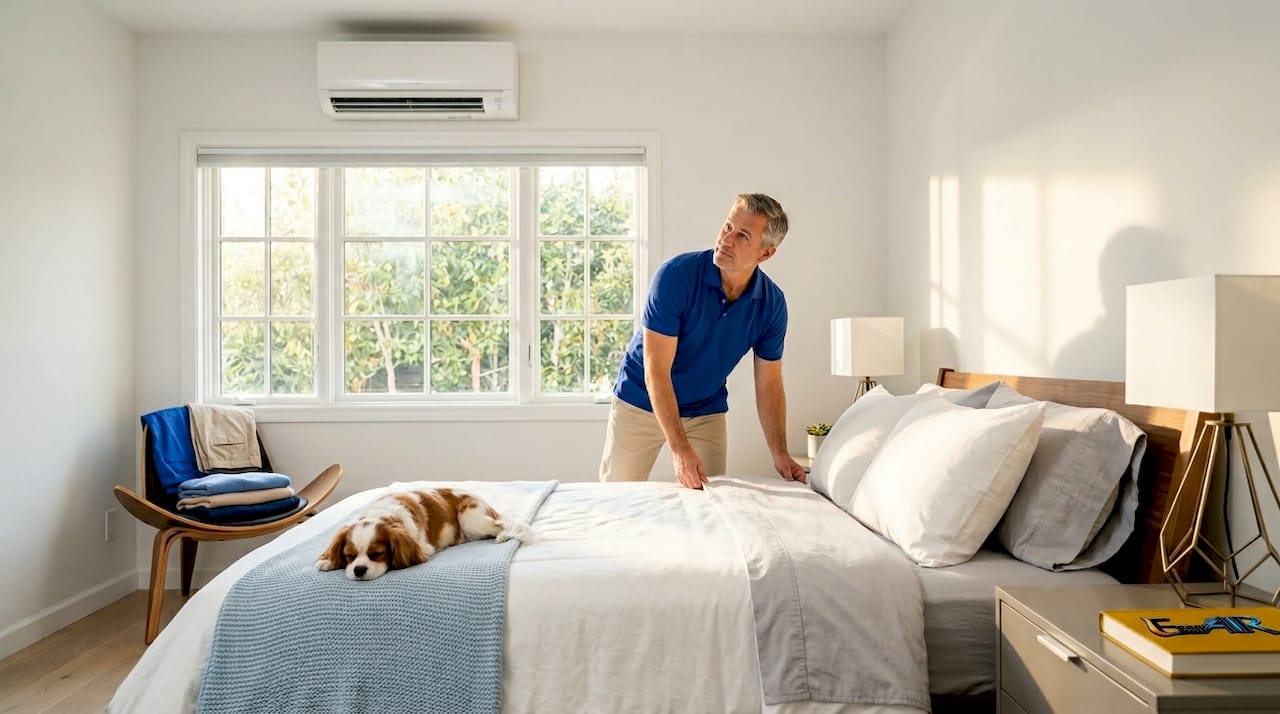
The key advantages include zoned control (each room or zone gets its own thermostat), whisper-quiet operation, and high efficiency ratings. Duct losses account for up to 30% of energy consumption in ducted systems. Mini-splits bypass that problem entirely.
Installation runs $3,000 to $8,000 per zone depending on brand and complexity. The indoor units are visible on the wall, which some homeowners dislike aesthetically. For older California bungalows, condos, or home additions without ducts, mini-splits are often the best long-term value.
Many modern mini-splits also include inverter technology, which adjusts compressor speed to match cooling demand rather than cycling fully on and off. That translates to more consistent temperatures and lower electricity bills over time.
Pro Tip: A mini-split with a SEER2 rating of 18 or higher qualifies for many California utility rebates. Always confirm rebate eligibility before selecting your specific model.
Learn more about how mini-splits work before your first contractor meeting so you can ask informed questions.
3. Window air conditioners
Window units are self-contained systems that mount in a standard window opening. They handle one room at a time, cost $150 to $800, and require no professional installation for most models.
For renters in California, this is often the only realistic option. They're easy to install, easy to remove at move-out, and widely available. The trade-offs are noise (the compressor and fan are right in the room) and efficiency. Window units have lower EER ratings than mini-splits and central systems.
Modern ENERGY STAR certified window AC models have improved significantly in efficiency, so don't assume all window units are power hogs. Look for EER2 ratings above 10 for better performance.
4. Portable air conditioners
Portables are the most flexible option on paper. They sit on the floor, vent through a window kit, and move from room to room. No installation required beyond running the exhaust hose.
The reality is less impressive. Portable units are the least efficient type of room AC available. They also pull warm air from inside the room to cool the condenser, partially undermining the cooling effect. Expect higher electricity costs per BTU compared to any other option.
They work best as a supplemental solution: cooling a garage workshop, a room that gets extreme afternoon sun, or a space where no other installation is feasible.
5. Heat pump systems
Heat pumps function as both heating and cooling systems using the same refrigerant-based technology as conventional AC. In cooling mode, they work exactly like a standard air conditioner. In heating mode, they extract heat from outside air and bring it inside.
California's mild winters make heat pumps particularly attractive. You get year-round climate control from one system without a separate furnace. Modern cold-climate heat pumps maintain efficiency even below freezing, though that's less of a concern in most California climates.
Installation costs are similar to central AC ($5,000 to $14,000), but you eliminate the cost of a separate heating system. California's climate incentive programs, including the state's Building Decarbonization initiative, often include heat pump rebates that reduce net cost substantially.
6. Packaged HVAC systems
Packaged units house all components (compressor, condenser, and air handler) in a single cabinet installed outside the home, typically on the roof or a concrete pad at ground level.
These systems are most common in commercial buildings but do appear in California residential settings, particularly in manufactured homes, homes with crawl spaces, and properties with limited indoor mechanical room space. They're not the first recommendation for most homeowners, but they solve specific installation challenges cleanly when the situation calls for them.
Head-to-head comparison of common AC systems
This table gives you a quick reference across the factors that matter most for California homeowners and renters.
| System type | Typical installed cost | SEER2 range | Best for | Ductwork needed |
|---|---|---|---|---|
| Central AC | $5,000–$12,000 | 14–22 | Whole-home, existing ducts | Yes |
| Ductless mini-split | $3,000–$8,000/zone | 18–30+ | No ducts, zoned control | No |
| Window AC | $150–$800 | EER 10–12 | Renters, single rooms | No |
| Portable AC | $300–$700 | EER 8–10 | Temporary, flexible use | No |
| Heat pump | $5,000–$14,000 | 15–24 | Heating and cooling combined | Yes/No (split type) |
| Packaged system | $4,000–$10,000 | 14–18 | Manufactured homes, no indoor space | Yes |
Longevity ranges from 10 to 12 years for window units up to 15 to 20 years for well-maintained central AC and mini-split systems.
Choosing the right system for your situation
Now that you have the options laid out, here's how to work through the decision systematically.
-
Are you renting? Start with a window unit or portable AC. They're affordable, require no landlord permission in most cases, and travel with you when you move. If your landlord is open to it, a ductless mini-split installation may be negotiable and benefits the property long term.
-
Do you own your home without ductwork? A ductless mini-split is almost always the right call. The efficiency gains over portable and window units pay back the higher upfront cost within a few years in California's hotter inland climates. Homes without ducts are also where California installation constraints most directly shape your choices.
-
Do you own your home with existing ductwork? Get the ducts inspected first. If they're in good condition, central AC or a heat pump with a ducted air handler are strong choices. If the ducts are leaking or poorly routed, weigh duct repair costs against going ductless.
-
Is heating also a concern? A heat pump covers both needs. California's mild climate means you'll recoup the cost faster than homeowners in colder states.
-
What's your budget threshold? Window units cost the least upfront. Central AC and heat pumps cost the most. Mini-splits land in the middle with strong long-term returns. Don't let upfront cost alone drive the decision. A window unit running 24/7 in a Redlands summer costs more annually than a properly sized mini-split would.
-
Have you explored rebates? California utility rebates can reduce mini-split and heat pump installation costs by $1,000 or more. Check your utility's current programs before finalizing your choice.
Pro Tip: A professional load calculation costs little or nothing when bundled with a contractor quote, and it protects you from the most common and expensive AC mistake: buying an oversized system that underperforms on humidity control.
My honest take after years of HVAC installs
I've been doing HVAC work across California for a long time, and the mistake I see most often is not choosing the wrong system type. It's buying too much system for the space.
Oversized AC units short-cycle constantly. They hit the set temperature fast, shut off, and never run long enough to pull moisture from the air. The room feels cool but sticky. Homeowners often blame the unit when the real problem is sizing done wrong from the start.
My honest opinion on mini-splits: they've gone from a niche product to the smart default for California homes without ducts. The efficiency numbers are real, the comfort improvement is real, and the utility rebates make the math work for most homeowners I talk to.
What I push back on is the idea that the cheapest upfront option saves money. I've seen plenty of households run a $400 window unit through brutal Inland Empire summers and pay more in electricity over three years than a mini-split would have cost installed. The math is straightforward when you run it honestly.
My advice: work with a licensed HVAC contractor who does a proper load calculation before recommending anything. If a contractor quotes you a system without asking about your square footage, insulation, or sun exposure, walk away.
— Edward
Let E320air help you find the right fit
At E320air, we handle HVAC installations across California, from single-zone ductless mini-splits in older bungalows to full central AC replacements in newer tract homes. We work with homeowners and renters alike, and we start every project with a proper load calculation, not a guess.
Our team installs systems from leading manufacturers, handles permits, and helps you identify California rebate programs that apply to your project. We're licensed and insured, and we give you a written quote before any work begins. If you want to see the kinds of problems we've solved for homeowners just like you, browse our project problem-solving gallery to get a realistic sense of what we do and how we work. Ready to talk through your options? E320air is a call or click away.
FAQ
What is the most efficient AC type for California homes?
Ductless mini-split systems typically offer the highest efficiency ratings (SEER2 up to 30+) and eliminate duct energy losses, making them the top choice for California homes without existing ductwork.
How do I choose between a split system vs window AC?
If you own your home and want long-term savings, a mini-split delivers better efficiency and comfort. If you're renting or need temporary cooling, a window AC is the practical, affordable choice.
What size AC do I need for my California home?
Start with 20 BTU per square foot as a baseline, then adjust for ceiling height, insulation quality, and sun exposure. A licensed contractor should confirm sizing with a full load calculation.
Can renters in California install a mini-split?
Generally, mini-split installation requires wall penetrations and a dedicated electrical circuit, so landlord approval is needed. Most renters are better served by window or portable units unless the landlord agrees to a permanent installation.
Do California utility rebates apply to all AC types?
Rebates vary by utility and program year, but heat pumps and high-efficiency ENERGY STAR mini-splits most commonly qualify. Check with your specific utility before purchasing to confirm current incentive availability.