

TL;DR:
- Choosing the right HVAC system in California requires proper sizing, efficiency ratings, and contractor expertise to ensure long-term comfort and savings. Selecting high-efficiency, appropriately sized equipment and working with licensed, experienced installers minimizes common mistakes like oversizing and poor installation. Proper maintenance, warranty registration, and leveraging rebates can significantly extend system life and reduce overall costs over 15 to 20 years.
Choosing the right HVAC equipment isn't as simple as picking a brand you recognize. This hvac equipment buying guide exists because California homeowners face a unique combination of factors: strict energy regulations, diverse climate zones from the coast to the Central Valley, and more system options than ever before. Get the decision right and you'll stay comfortable for 15 to 20 years while keeping energy bills manageable. Get it wrong and you're looking at short-cycling systems, mold problems, or a warranty that won't cover anything when you need it most.
Table of Contents
- Key takeaways
- 1. Understanding the HVAC equipment buying guide criteria
- 2. Types of HVAC systems worth considering
- 3. Brand comparison for California homeowners
- 4. Common mistakes buyers make when purchasing HVAC units
- 5. Budgeting, rebates, and the repair vs replacement decision
- 6. How to choose the right HVAC contractor
- My honest take after years of HVAC work in California
- Ready to find the right system for your home? E320air can help
- FAQ
Key takeaways
| Point | Details |
|---|---|
| Sizing beats brand loyalty | A correctly sized system from any reputable brand outperforms an oversized premium unit every time. |
| Efficiency ratings affect your bills | High-efficiency SEER2 models can cut cooling costs by up to 50% versus older units. |
| Warranty requires action from you | Over 70% of warranty claims are denied for missed maintenance or late registration. |
| Rebates reduce upfront cost | Federal tax credits and utility rebates in California make high-efficiency systems far more affordable than their sticker price suggests. |
| Contractor quality matters as much as equipment | A great system installed poorly will underperform. Verify licenses, certifications, and sizing methods before signing anything. |
1. Understanding the HVAC equipment buying guide criteria
Before you compare brands or request quotes, you need a clear framework for evaluating any system. Most homeowners skip straight to price. That's where the problems start.
Sizing comes first. An HVAC contractor should perform a Manual J load calculation before recommending any equipment. This room-by-room analysis accounts for your home's insulation, window placement, square footage, and local climate data. Contractors skipping this step risk causing humidity problems, short-cycling, and premature equipment failure. Don't accept a quote based purely on square footage rules of thumb.
Efficiency ratings to know:
- SEER2 (Seasonal Energy Efficiency Ratio 2): measures cooling efficiency for air conditioners and heat pumps. Higher is better. California's minimum is now 15.2 SEER2 for most residential systems.
- HSPF2 (Heating Seasonal Performance Factor 2): measures heat pump heating efficiency.
- AFUE (Annual Fuel Utilization Efficiency): applies to gas furnaces. A 96% AFUE furnace loses only 4 cents of every fuel dollar.
Top models reach 28 SEER2, which represents a massive leap from the old minimum of 13 SEER. The difference shows up clearly on your utility bill.
Refrigerant type matters now. Systems using R-410A refrigerant are being phased out under EPA regulations. Look for equipment using R-454B or R-32, both of which have significantly lower global warming potential and will remain serviceable long-term.
Pro Tip: Adding a smart thermostat to any new system is one of the cheapest efficiency upgrades available. Programmable thermostat use can reduce your cooling costs by around 10% on its own.
2. Types of HVAC systems worth considering
California's mild but varied climate makes it one of the best states for heat pump adoption, but other system types still have their place depending on your home's setup and your heating needs.
Central air conditioners work with existing ductwork to cool the whole home. They're the most common setup in California and pair with a gas furnace for heating in colder inland regions.
Heat pumps handle both heating and cooling from a single outdoor unit. In mild climates, they're more efficient than running separate systems. Federal incentives under the Inflation Reduction Act have made heat pumps significantly more affordable through 2026. Heat pumps are increasingly favored in California for exactly this reason.
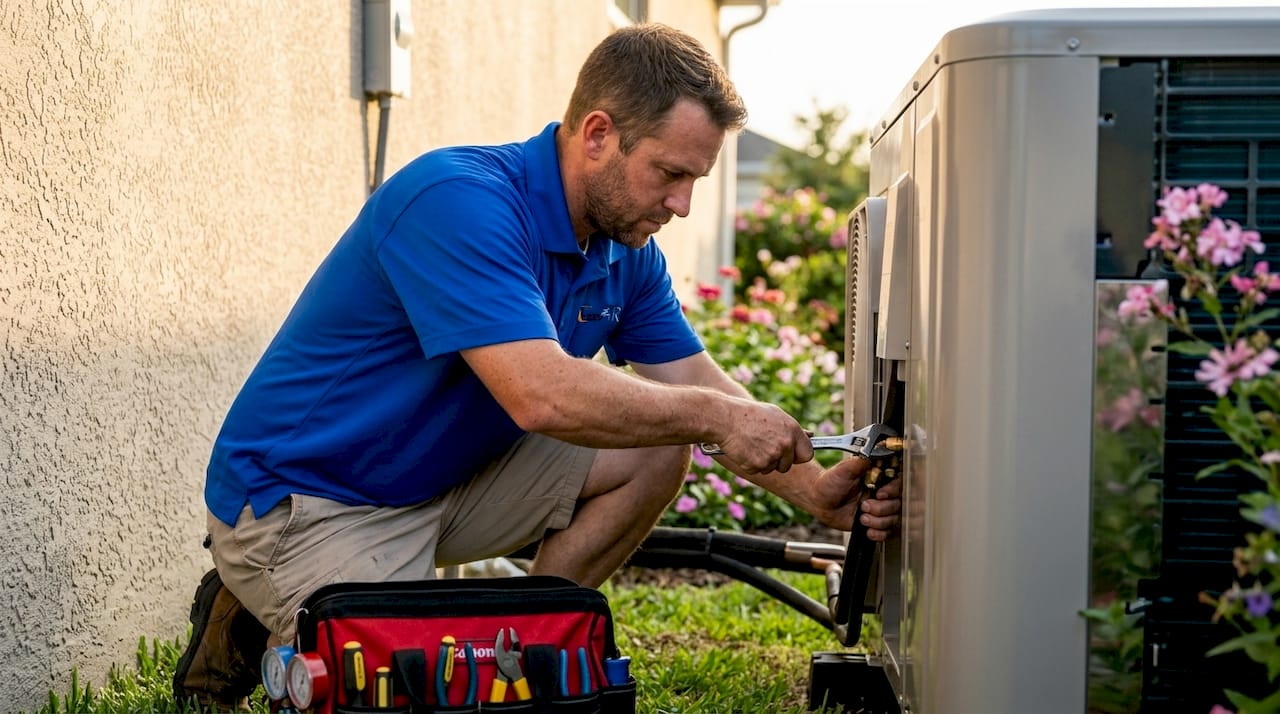
Ductless mini-splits work without ductwork and are ideal for room additions, older homes without ducts, or homes where zoning flexibility matters. They cost more per ton of cooling but eliminate duct losses, which can account for 20 to 30 percent of a central system's efficiency.
Gas furnaces still make sense for colder California climates like the Sierra Nevada foothills or high desert areas. A high-efficiency condensing furnace with 96% AFUE provides reliable and affordable heat where temperatures drop significantly.
3. Brand comparison for California homeowners
Here's a direct comparison of the most commonly installed residential HVAC brands in California. This isn't a definitive ranking. Each brand has strong and weak product lines. Use this as a starting point, not a final answer.
| Brand | Efficiency range | Price tier | Reliability notes |
|---|---|---|---|
| Trane | Up to 22 SEER2 | Premium | Known for durability, strong dealer network |
| Carrier | Up to 24 SEER2 | Premium | Excellent variable-speed options |
| Lennox | Up to 28 SEER2 | Premium | Highest efficiency available, higher parts cost |
| Rheem | Up to 20 SEER2 | Mid-range | Good value, widely serviced |
| Goodman | Up to 18 SEER2 | Budget | Lower upfront cost, adequate reliability |
| Daikin | Up to 22 SEER2 | Mid-premium | Strong mini-split lineup, growing U.S. presence |
Key features that separate system performance in real-world use:
- Variable-speed compressors adjust output to match demand, reducing short-cycling and improving dehumidification.
- Two-stage systems run at low capacity most of the time and high capacity only when needed. Better humidity control than single-stage.
- Single-stage systems are either fully on or fully off. Lower cost but less comfort precision in shoulder seasons.
Pro Tip: For California coastal climates, variable-speed or two-stage systems are worth the price premium. The humidity control they provide in mild weather is noticeably better than single-stage. Visit best HVAC systems for homes for a deeper breakdown by system type.
4. Common mistakes buyers make when purchasing HVAC units
This is where most HVAC purchases go sideways. Knowing what to avoid is just as useful as knowing what to look for.
Buying oversized equipment is the most common and costly mistake. A unit that's too large cools the space quickly but shuts off before completing a full humidity-removal cycle. The result is a cold, clammy home and a system that wears out faster from constant on-off cycling. Oversized units fail to dehumidify properly and cause persistent comfort issues even when the temperature reads correctly.
Common pitfalls to watch for:
- Accepting quotes that don't include a Manual J calculation printout
- Buying equipment online and arranging separate installation. As of 2025, 14% of customers always requested installation-only services, creating real problems with warranty coverage and liability
- Skipping equipment registration after installation. Most manufacturers require registration within 60 to 90 days to activate extended warranties
- Choosing the cheapest bid without verifying that the contractor pulled permits
- Ignoring ductwork condition when replacing just the air handler or outdoor unit
Warranty denials are more common than most homeowners realize. Over 70% of warranty claims are rejected because the equipment wasn't registered, or annual maintenance wasn't documented. Read the warranty terms before you buy, not after.
The long-term cost of a poor installation frequently exceeds the money saved by choosing the cheapest contractor. Read more about avoiding these issues in this homeowner's HVAC repair guide.
5. Budgeting, rebates, and the repair vs replacement decision
California homeowners shopping for HVAC equipment face a wide cost range depending on system type, efficiency level, and home complexity.
-
Understand total installation cost. Replacing a home HVAC system typically costs between $5,000 and $15,000, with premium variable-speed systems and complex ductwork jobs on the higher end. This includes equipment, labor, permits, and startup.
-
Apply the 50% Rule and the $5,000 Rule. If your repair quote exceeds 50% of a new system's price, or if your system's age multiplied by the repair cost exceeds $5,000, replacement is almost always the smarter financial move.
-
Factor in energy savings over time. Upgrading from a 10-year-old unit to a high-efficiency SEER2 system can cut your cooling costs by up to 50%. That savings compounds over a 15 to 20 year system lifespan.
-
Claim federal tax credits. The Inflation Reduction Act offers up to $2,000 in tax credits for qualifying heat pumps installed in 2026. Check the ENERGY STAR website for the current qualifying equipment list.
-
Check your utility provider. PG&E, SCE, and SDG&E all offer rebates for qualifying high-efficiency equipment. These rebates range from $100 to over $1,000 depending on the system and program availability.
-
Ask about financing. Many HVAC contractors offer 12 to 18 month deferred interest financing, which can make a more efficient system accessible without a large upfront payment. A higher-efficiency system often pays for itself through energy savings before the financing period ends.
Pro Tip: If your system is between 10 and 15 years old and facing a repair quote over $1,500, get a full system replacement quote at the same time. The comparison often makes the replacement decision obvious. Check the HVAC replacement stages guide to understand what the process looks like.
6. How to choose the right HVAC contractor
Equipment is only half the equation. Who installs it determines how long it lasts, whether your warranty stays valid, and how well the system actually performs.
When vetting contractors for your HVAC installation, confirm these basics:
- Valid California contractor's license (C-20 HVAC classification from the CSLB)
- NATE certification (North American Technician Excellence): the most recognized field certification in the industry
- Proof of insurance covering both liability and workers' compensation
- Written Manual J load calculation included in the quote
- Permit pulling: a licensed contractor should pull permits for any full system replacement
Questions worth asking before signing a contract:
- Will you perform a Manual J calculation before sizing the system?
- Who registers the equipment warranty, and how will I receive confirmation?
- Do you offer a maintenance plan, and does it satisfy the warranty's annual service requirement?
- What happens if there's an issue with the installation after the job is done?
A reputable contractor doesn't just sell you equipment. Their real value lies in system design, installation quality, warranty handling, and ongoing service. Read more about what HVAC contractors actually do before your first conversation with one.
Pro Tip: Ask for references from customers in your city or neighborhood. Local experience matters in California because climate conditions, permit requirements, and utility rebate programs vary significantly by county.
My honest take after years of HVAC work in California
I've helped hundreds of California homeowners work through HVAC decisions, and the pattern I see most often is this: people spend three weeks researching equipment and about 20 minutes vetting their contractor. It should be the other way around.
The equipment brands I listed above are all capable of delivering 20 years of reliable performance if they're installed correctly and maintained properly. I've seen budget-tier Goodman systems outlast premium Lennox units simply because one had a meticulous installation and the other didn't.
What I tell every homeowner I work with: treat your HVAC system like you treat your roof. You wouldn't hire the cheapest roofer you could find and expect it to hold up for two decades. The same logic applies here. The upfront cost difference between a mediocre installation and a professional one is usually less than $500. The long-term difference in system life, comfort, and warranty coverage is enormous.
One more thing most guides won't say directly. Warranty registration is your responsibility. I've seen homeowners lose $3,000 in coverage because they assumed their contractor handled it. Confirm it in writing before the installer leaves your property.
— Edward
Ready to find the right system for your home? E320air can help

E320air works with California homeowners throughout the entire HVAC buying process, from system selection to professional installation and ongoing maintenance. The team performs proper Manual J load calculations on every job, handles warranty registration, and offers maintenance plans designed to keep your equipment covered and running efficiently.
If you're comparing systems, weighing repair versus replacement, or simply want a second opinion on a quote you've already received, E320air provides free consultations for homeowners in their service areas. Financing options and rebate assistance are available to help manage upfront costs on qualifying equipment.
Visit E320air's HVAC installation services to request a quote, or go to E320air's homepage to learn more about the full range of services available to California homeowners.
FAQ
What size HVAC system does my California home need?
Proper sizing requires a Manual J load calculation performed by a licensed contractor. Square footage alone is not sufficient, and generic sizing rules lead to humidity problems and short-cycling.
Are heat pumps a good choice for California homes?
Yes. Heat pumps are increasingly favored in California's mild climate because they handle heating and cooling efficiently from one unit, and federal rebates make them more affordable in 2026.
How much does HVAC replacement cost in California?
Most homeowners pay between $5,000 and $15,000 for a full system replacement, depending on system type, efficiency level, and installation complexity. Utility rebates and federal tax credits can reduce that total significantly.
What SEER2 rating should I look for?
California's current minimum is 15.2 SEER2, but higher-efficiency models in the 18 to 22 range offer meaningfully lower operating costs over time. Top-tier models reach 28 SEER2, though the cost-to-savings ratio depends on how much you run your system.
Can I buy HVAC equipment online and hire a local installer?
You can, but it comes with real risks. Equipment purchased independently may not qualify for manufacturer warranties when installed by an unaffiliated contractor. As of 2025, 70% of HVAC contractors reported dealing with customers who bought equipment online, and warranty complications were common. Buying through your installer protects both the equipment and your coverage.