

TL;DR:
- HVAC systems also play a crucial role in filtering pollutants and improving indoor air quality.
- Upgrading to MERV 13 filters can significantly reduce harmful particles like PM2.5 in homes.
- Proper ventilation, source control, and monitoring are essential for maintaining healthy indoor air.
Your home's air conditioner does more than cool the air. Most Southern California homeowners assume their existing HVAC system is handling air quality just fine, but the numbers tell a different story. Research on LAUSD classrooms found that adding HEPA to MERV13 HVAC cut PM2.5 concentrations by nearly 40%. That gap between "good enough" and genuinely clean air is exactly what this guide covers. We'll walk through how your HVAC system manages pollutants, which filters actually work, how to meet ventilation standards, and what practical upgrades make the biggest difference for your family.
Table of Contents
- How residential HVAC systems impact indoor air quality
- Understanding filtration: MERV ratings, HEPA, and their real-world impact
- Ventilation: Meeting standards, practical upgrades, and source control
- Addressing edge cases: Airflow, short-cycling, and supplemental solutions
- The uncomfortable truth about HVAC and indoor air quality
- Improve your home's air quality with expert HVAC solutions
- Frequently asked questions
Key Takeaways
| Point | Details |
|---|---|
| Upgrade filters wisely | MERV 13 and HEPA filters substantially improve particle removal compared to standard filters. |
| Ventilation standards matter | Meeting ASHRAE ventilation guidelines ensures effective pollutant dilution in your home. |
| Avoid airflow issues | High-MERV upgrades demand proper system sizing and static pressure checks to prevent short-cycling. |
| Supplemental solutions help | Portable HEPA units and air quality monitors are strong additions to HVAC for best results. |
How residential HVAC systems impact indoor air quality
Your HVAC system is doing three jobs at once: heating or cooling the air, circulating it through the home, and filtering out particles along the way. Most homeowners focus on the first two and ignore the third. That's a mistake, especially in Southern California where wildfire smoke, dust, and high pollen counts are a regular part of life.
The pollutants your system deals with daily include:
- PM2.5 (fine particles smaller than 2.5 microns, linked to respiratory and cardiovascular issues)
- PM10 (larger dust, pollen, and mold spores)
- VOCs (volatile organic compounds from cleaning products, furniture, and paint)
- Smoke particles from wildfires and outdoor combustion
- Biological contaminants like pet dander, dust mites, and bacteria
Your HVAC handles these through two main mechanisms: filtration and dilution. Filtration physically traps particles as air passes through the filter media. Dilution brings in fresh outdoor air to reduce the concentration of indoor pollutants. Both matter, and neither works well if your system is improperly sized.
Ventilation standards exist for a reason. ASHRAE 62.2-2022 sets the residential minimum at 0.01 CFM per square foot of floor area plus 7.5 CFM per person living in the home. A 2,000 square foot house with four occupants needs at least 50 CFM of mechanical ventilation. Many older California homes fall short of this without their owners realizing it.
Stat to know: A properly ventilated and filtered HVAC system can reduce indoor PM2.5 levels by 30 to 50% compared to a system running with a basic fiberglass filter.
Proper HVAC sizing for comfort also directly affects air quality. An oversized unit short-cycles, meaning it turns on and off too quickly to complete a full air circulation pass. That means less air gets filtered per hour, and humidity control suffers too. Moisture buildup creates a breeding ground for mold. Undersized systems run constantly but may never achieve adequate air exchange. Getting sizing right is foundational to everything else. Understanding residential HVAC pollutants and how your system responds to them is the first step toward real improvement.
The EPA's indoor air quality guidance confirms that indoor air can be two to five times more polluted than outdoor air, even in urban areas. That stat surprises most people. Your HVAC system is the primary tool you have to close that gap.
Understanding filtration: MERV ratings, HEPA, and their real-world impact
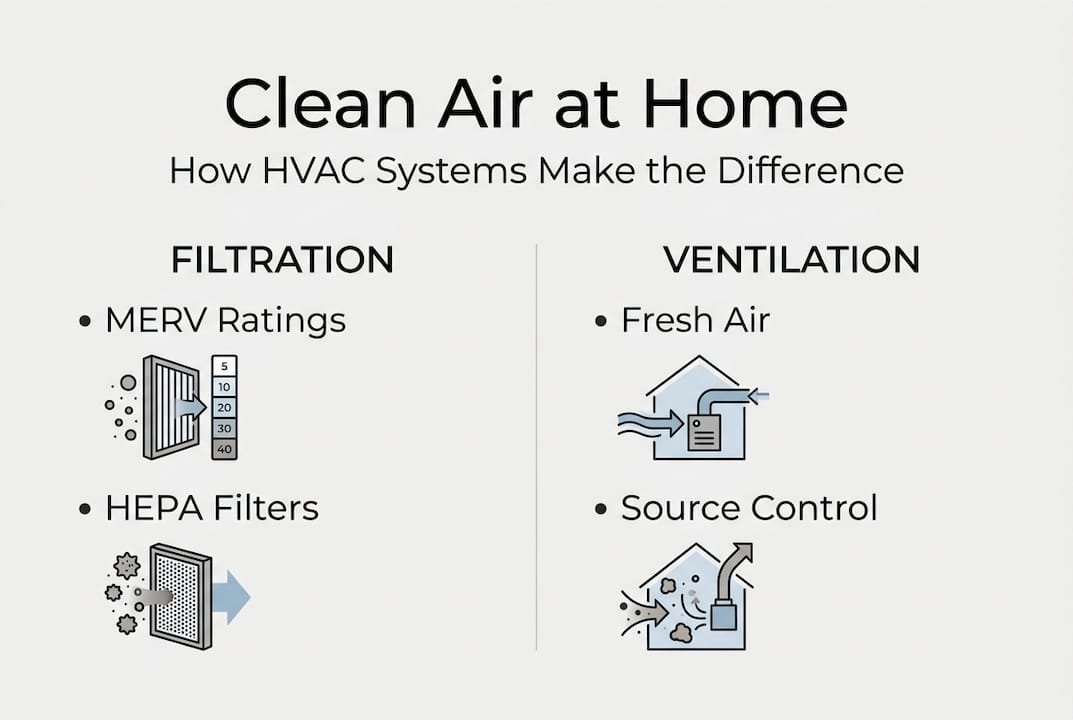
Not all filters are equal, and the difference between a MERV 8 and a MERV 13 isn't just marketing. MERV stands for Minimum Efficiency Reporting Value. The higher the number, the smaller the particles the filter captures.
Here's how the most common options compare:
| Filter type | MERV rating | Captures PM2.5? | Best for |
|---|---|---|---|
| Basic fiberglass | 1 to 4 | No | Equipment protection only |
| Standard pleated | MERV 8 | Partially | General dust, pollen |
| Mid-range pleated | MERV 13 | Yes (85%+) | Smoke, allergens, fine particles |
| HEPA (standalone) | 17+ equivalent | Yes (99.97%) | Supplemental room-level filtration |
For Southern California homeowners, MERV 13 is recommended by both the EPA and ASHRAE as the minimum for capturing PM2.5, wildfire smoke, and fine allergens. During fire season, this isn't optional. It's the difference between filtering out smoke particles and just moving them around your home.
Key things to know about upgrading your filter:
- MERV 8 captures particles 3 microns and larger. It misses most of what makes Southern California air dangerous.
- MERV 13 captures particles as small as 0.3 microns with high efficiency. It's the sweet spot for most residential systems.
- HEPA filters are extremely effective but are typically used in standalone air purifiers, not central HVAC systems, because they restrict airflow too much for most residential ductwork.
Pro Tip: Before upgrading to MERV 13, have a technician check your system's static pressure rating. Some older systems aren't designed for the added resistance, and forcing a high-MERV filter into an incompatible system can reduce airflow and damage your equipment.
The tradeoff is real. Higher MERV ratings affect airflow by increasing resistance in the filter media. If your system can handle it, MERV 13 is the right call. If it can't, a MERV 11 is still a significant upgrade over MERV 8. You can also explore upgrading your home HVAC to a newer system designed to handle higher filtration without airflow penalties. Newer variable-speed systems handle MERV 13 much better than older single-stage units. Check HVAC replacement choices if your system is more than 10 years old.
Ventilation: Meeting standards, practical upgrades, and source control
Filtration captures what's already in your air. Ventilation replaces stale indoor air with fresh outdoor air. Both are necessary, and they work best together.
To calculate your home's minimum ventilation need using the ASHRAE formula:
- Multiply your home's square footage by 0.01 to get the area-based CFM requirement
- Multiply the number of occupants by 7.5 to get the occupancy-based CFM requirement
- Add both numbers together for your total minimum ventilation rate
For a 1,800 square foot home with three people: (1,800 x 0.01) + (3 x 7.5) = 18 + 22.5 = 40.5 CFM minimum.
Most homes in Los Angeles and surrounding areas were built before these standards existed. That means many are under-ventilated by design.
| Home size | Occupants | Minimum ventilation (CFM) |
|---|---|---|
| 1,200 sq ft | 2 | 27 CFM |
| 1,800 sq ft | 3 | 40.5 CFM |
| 2,500 sq ft | 4 | 55 CFM |
| 3,500 sq ft | 5 | 72.5 CFM |
Source control is the most underrated strategy in home air quality. Instead of diluting pollutants after they're already in the air, source control eliminates them at the origin. Examples include using exhaust fans while cooking, sealing off attached garages, and choosing low-VOC materials when renovating.
Pro Tip: Install a CO2 monitor in your main living area. CO2 levels above 1,000 ppm are a reliable signal that your ventilation is insufficient. It's a cheap, real-time indicator that your HVAC isn't exchanging air fast enough.
ASHRAE 62.2 Appendix D allows reduced mechanical ventilation if you can demonstrate low contaminant levels through monitoring and high-efficiency filtration. This is useful for homes with excellent air sealing that want to balance energy efficiency with air quality. But it requires actual monitoring, not guesswork.
During the 2025 LA wildfires, homes with balanced ventilation systems and MERV 13 filters maintained indoor PM2.5 levels well below outdoor levels. Homes relying on natural ventilation saw indoor levels spike to match outdoor readings within hours. If you're unsure how your system performs under stress, reviewing HVAC troubleshooting tips is a good starting point.
Addressing edge cases: Airflow, short-cycling, and supplemental solutions
Even a well-chosen filter in a properly sized system can create problems if the installation details aren't right. Here's where most homeowners run into trouble.

Airflow and static pressure are the hidden variables. Every filter adds resistance to airflow, measured as static pressure in inches of water column (in. w.c.). Most residential systems are designed for static pressure around 0.5 in. w.c. total. A dirty or high-MERV filter can push that number up significantly. MERV 13 filters can reduce airflow by up to 22% in compact filter configurations. That's enough to cause problems.
Signs your HVAC is struggling with a high-MERV filter:
- Rooms that used to cool quickly now take much longer
- The system runs longer cycles than before
- You notice the filter collapsing or bowing inward
- Energy bills increase without a change in usage patterns
Short-cycling is when your system turns on and off too frequently, usually in cycles under 10 minutes. It's bad for air quality because the system never completes a full air exchange. It's also hard on the compressor. If upgrading to a high-MERV filter triggers short-cycling, the system likely can't handle the added resistance and needs either a larger filter surface area or a system upgrade.
"Portable HEPA units are not just a workaround. Randomized trials show they reduce PM2.5 by nearly 40% in occupied rooms, making them a legitimate supplement to central HVAC in high-risk situations."
Supplemental solutions worth considering include portable HEPA air purifiers for bedrooms and main living areas, whole-house air monitors that track PM2.5 and VOCs in real time, and ERV (energy recovery ventilator) units that bring in fresh air without losing conditioned air. Browse HVAC upgrade pitfalls to see what goes wrong when these decisions are made without a proper assessment. For persistent issues, reviewing common residential HVAC issues can help you identify whether the problem is the filter, the system, or the ductwork.
The uncomfortable truth about HVAC and indoor air quality
Here's what most filter marketing won't tell you: buying the most expensive filter on the shelf is not a strategy. We've seen homeowners install MERV 16 filters in 20-year-old systems and wonder why their energy bills jumped and their system broke down six months later. The filter wasn't the problem. The mismatch was.
Conventional wisdom says "upgrade your filter and breathe easier." That's incomplete advice. The biggest air quality wins come from source control first, proper HVAC sizing second, and filtration upgrades third. Southern California homes face a specific combination of wildfire smoke, dry air, high occupancy, and aging infrastructure that makes a one-size-fits-all approach genuinely risky.
Monitoring is the piece most people skip entirely. You can't manage what you don't measure. A $50 air quality monitor will tell you more about your home's real air quality than any filter brand's claims. Pair that data with a system that's properly sized and maintained, and you'll have something that actually works.
Improve your home's air quality with expert HVAC solutions
Understanding the science is one thing. Getting it right in your actual home is another. Southern California's unique air quality challenges, from wildfire smoke to year-round allergens, require HVAC solutions that are matched to your specific home size, occupancy, and existing equipment.
At E320 Air, we help homeowners assess their current systems, recommend the right filtration and ventilation upgrades, and handle professional HVAC installation from start to finish. Whether you need a filter upgrade, a full system replacement, or just a second opinion, our team has the experience to get it right. See real examples of how we've solved complex air quality problems in our problem-solving solutions gallery. Visit E320 Air to schedule a consultation and start breathing better air at home.
Frequently asked questions
What is the minimum ventilation required for my home?
ASHRAE 62.2-2022 requires 0.01 CFM per square foot of floor area plus 7.5 CFM per person living in the home. Add both numbers together to find your home's minimum mechanical ventilation rate.
Is MERV 8 sufficient for air quality in Southern California?
No. MERV 8 filters miss most fine particles like PM2.5 and wildfire smoke. EPA and ASHRAE recommend MERV 13 or higher for effective protection against the pollutants common in Southern California.
What are the risks of upgrading to high-MERV filters?
High-MERV filters increase airflow resistance and can cause short-cycling or reduced system performance if your HVAC isn't designed for them. Always check static pressure before upgrading to MERV 13 or higher.
Can portable HEPA units really supplement my HVAC system?
Yes. Randomized trials show portable HEPA units reduce PM2.5 by nearly 40% in occupied rooms, making them a proven and practical supplement to central HVAC, especially during wildfire events.