
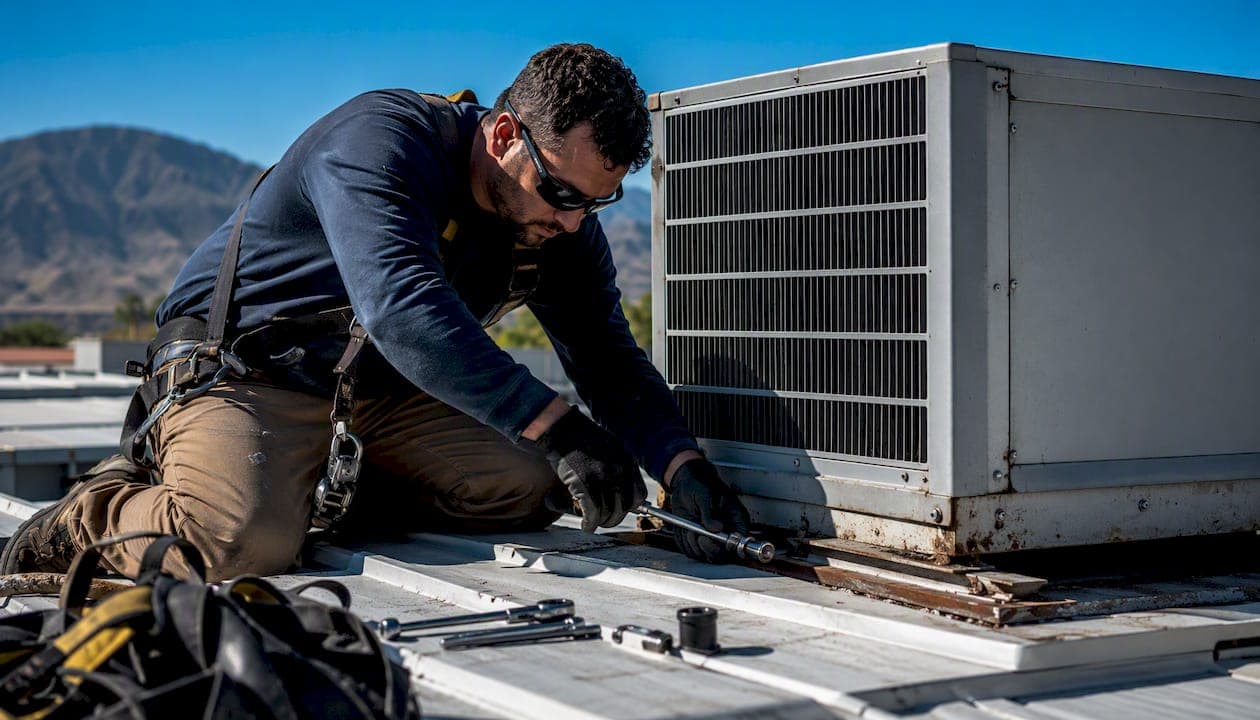
Replacing a rooftop unit (RTU) in the U.S. typically runs $8,000 on the low end for a small packaged unit up to $38,000 or more for larger commercial systems, with most standard 5-ton installed jobs landing between $5,000 and $18,000 depending on efficiency spec, curb condition, and roof access. At roughly $1,800–$2,900 per ton installed for mid-range units, tonnage is the first number that moves your budget. The three factors that most often push a quote toward the high end: crane or rigging requirements, a mismatched curb that needs an adapter or full replacement, and an efficiency upgrade to 16+ SEER2.
Pro Tip: Before you call a single contractor, pull the nameplate off your existing unit and note the tonnage, model number, refrigerant type, and curb dimensions. That 10-minute step cuts quoting time in half and surfaces refrigerant-phase-out costs early.
Key Takeaways
Replacing a rooftop unit in the U.S. costs $8,000–$62,000 installed depending on tonnage, with a typical 5-ton job running $5,000–$18,000 and crane access, curb condition, and efficiency spec driving most of the variation.
| Point | Details |
|---|---|
| Installed cost range | 5-ton RTU: $5,000–$18,000 installed; full range $8,000–$62,000 by tonnage. |
| Biggest cost drivers | Crane/rigging, curb compatibility, and efficiency spec move the number most. |
| Hidden costs to budget | Curb adapters, electrical upgrades, refrigerant disposal: add 10%–15% contingency. |
| First action to take | Pull nameplate data, measure the curb, photograph roof access, then get 3 bids. |
| E320air next step | Request an on-site assessment for a site-specific quote covering crane, permits, and full install. |
Table of Contents
- What does rooftop unit replacement cost by tonnage?
- What does an itemized RTU replacement quote include?
- Which factors raise or lower your replacement price the most?
- Realistic installed scenarios using a 5-ton RTU example
- How do you get an accurate, site-specific quote?
- How can you reduce the net cost of an RTU replacement?
- When should you replace rather than repair an RTU?
- What should you expect on installation day?
- What the numbers miss: a contractor's perspective on budgeting RTU replacements
- Get an on-site RTU replacement quote from E320air
- Where to check rebates, efficiency standards, and local permits
- Sources
What does rooftop unit replacement cost by tonnage?
Installed RTU costs scale predictably with tonnage, though crane access and controls complexity can push any size into the next price band. Use the table below as a first-pass budget check.
| Tonnage | Typical Installed Range | Common Application |
|---|---|---|
| 2–3 ton | starting in low thousands | Small retail, offices under 1,200 sq ft |
| 4–5 ton | varying mid-range sums | Mid-size offices, 1,200–2,500 sq ft |
| 7.5–10 ton | generally higher costs | Light commercial, 2,500–5,000 sq ft |
| 15–20 ton | significantly higher prices | Large retail, multi-zone commercial |
| 25–30 ton | substantial investment required | Big-box, warehouse, campus buildings |
A few things worth knowing about each band:
- 2–3 ton: Often accessible by forklift or manual lift on low-slope roofs, which keeps rigging costs minimal.
- 4–5 ton: The most common replacement size for small commercial and light industrial. Crane is sometimes needed but not always.
- 7.5–10 ton: Crane mobilization becomes standard here. Budget a crane day-rate on top of the unit cost.
- 15–20 ton: Controls integration and ductwork modifications frequently add cost at this size.
- 25+ ton: Complex lifts, dedicated electrical circuits, and BMS tie-ins make these the most variable projects in the range.
What does an itemized RTU replacement quote include?
Materials, labor, rigging, permits, and disposal are the five main cost buckets contractors price separately. Here is what each line typically looks like on a quote.
| Line Item | Typical Range |
|---|---|
| Equipment (unit + controls) | materials cost can vary widely depending on unit and controls |
| Labor (2–4 techs, 8–24 hrs) | typical labor requirements vary by project complexity |
| Rigging / crane | crane fees depend on building height and site access |
| Ductwork / electrical | duct and electrical modification costs depend on existing conditions |
| Permits & inspections | permit and inspection fees vary by jurisdiction |
| Delivery & disposal | disposal and delivery fees depend on local logistics |
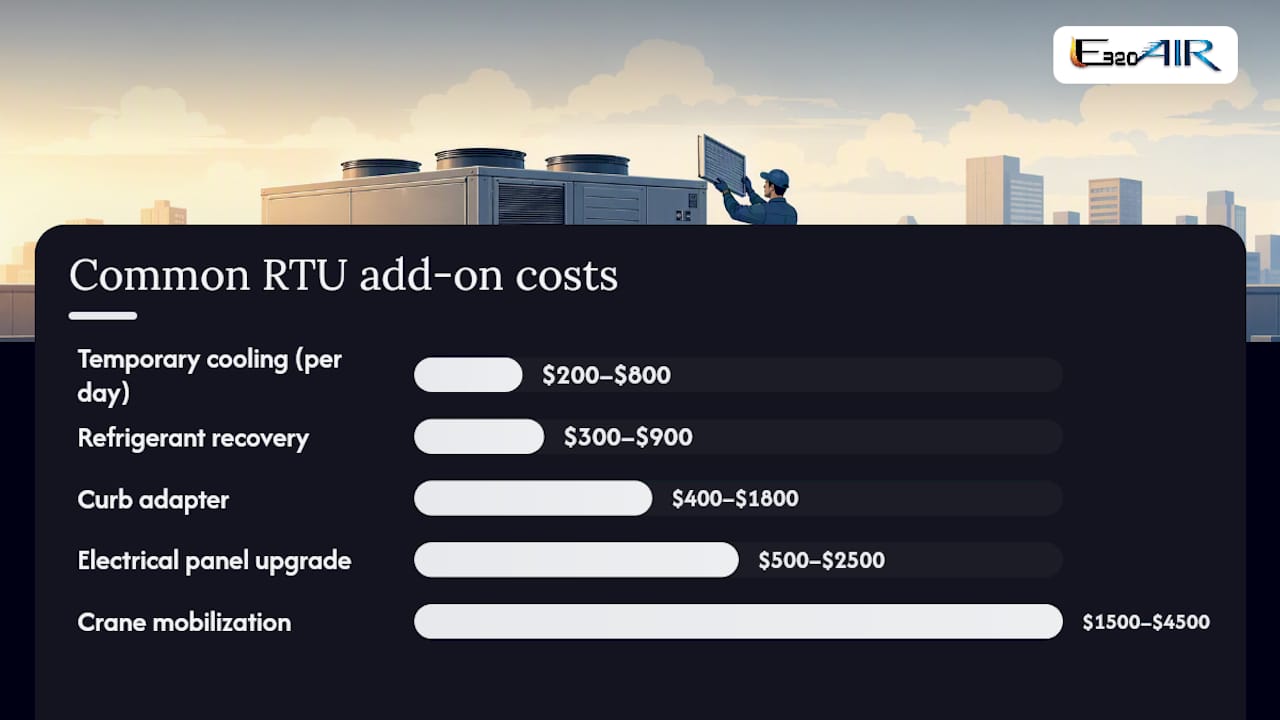
Labor rates typically run $75–$125 per tech per hour, and a standard job uses a 2–4 person crew over 8–24 site hours. Crane fees for units above roughly 10 tons commonly add $1,500–$4,500 for mobilization alone; complex multi-crane or high-roof scenarios can reach $6,000.
Items owners frequently miss on first review:
- Curb adapter: When the new unit footprint doesn't match the existing roof curb, an adapter costs $400–$1,800 and adds installation time.
- Electrical panel upgrade: Older buildings sometimes need a dedicated circuit or breaker upgrade, which can add $500–$2,500.
- Refrigerant recovery and disposal: Units running R-22 or other legacy refrigerants require certified recovery, typically adding $300–$900 to the project.
- Temporary cooling: On occupied buildings, a portable unit rental during the swap can run $200–$800 per day.
- Roof patching: Penetrations from the old unit often need sealing; roofing labor and materials for this step vary by roof type but are rarely zero.
A typical installed quote covers equipment, standard labor, basic rigging, and one permit pull. Everything else is usually a line-item add.
Which factors raise or lower your replacement price the most?
Knowing which variables apply to your building lets you self-sort before quotes arrive. Here is how each driver moves the number.
- Tonnage (large impact): The single biggest lever. Each tonnage step up adds roughly $1,500–$4,000 to the installed total.
- SEER2/IEER efficiency band (moderate impact): Stepping from a standard 14 SEER2 unit to a 16+ SEER2 model typically adds $1,000–$3,500 to equipment cost. High-efficiency RTUs can reduce energy consumption 20%–40% and often qualify for utility rebates that partially offset that premium.
- Roof access and crane requirements (large impact): A ground-level crane setup on a flat single-story roof is straightforward. A multi-story building with limited staging area or overhead obstructions can double rigging costs.
- Curb compatibility (moderate impact): If your existing curb matches the new unit's footprint, you save $400–$1,800 and a half-day of labor. Mismatched curbs require an adapter or full curb replacement.
- Ductwork condition (variable): Leaky or undersized duct adds cost but is often discovered only after the unit is off. Budget a contingency here.
- Controls and BMS integration (moderate to large): Connecting a new RTU to a building management system adds programming time and hardware, commonly $500–$3,000 depending on protocol.
- Refrigerant type (small to moderate): R-410A units are still common, but R-22 recovery and disposal adds $300–$900. Newer R-454B or R-32 units may require updated line sets.
- Local permit fees and labor market (small to moderate): Dense urban markets charge more for permits ($150–$1,200 range) and carry higher prevailing wage rates. Inland Empire projects generally sit in the mid-range of California's labor market.
Pro Tip: Walk your roof before calling contractors. Note whether there is a clear staging area for a crane truck, measure the curb opening (length × width × height), and photograph the electrical disconnect. Contractors who receive this upfront give faster, more accurate bids.
Realistic installed scenarios using a 5-ton RTU example
A 5-ton packaged RTU is the most common replacement size in small commercial and light industrial buildings. Three scenarios show how the same tonnage can land at very different price points.
Scenario assumptions:
- Basic: Existing curb fits the new unit, ground-level forklift access, standard 14 SEER2 unit, no ductwork changes, single permit pull, R-410A system with straightforward refrigerant handling.
- Standard: Crane required for second-story roof, minor duct sealing and thermostat upgrade, 15–16 SEER2 unit, permit plus inspection, refrigerant recovery included.
- Premium: New curb fabricated, high-efficiency 17+ SEER2 unit with economizer, BMS integration, complex crane lift, full duct modification on two zones, refrigerant disposal for legacy system.
To move a standard job toward the basic end, the clearest levers are: confirm curb compatibility before ordering the unit, schedule during a slow season when crane day-rates are negotiable, and skip the economizer if your climate doesn't justify it.
How do you get an accurate, site-specific quote?
The gap between a ballpark number and a real bid usually comes down to how much site information you hand the contractor upfront. Total project costs can range from $8,000 to over $60,000 depending on size and complexity, so a quote built on assumptions is nearly useless for CapEx planning.
Before you request bids, gather:
- Nameplate data from the existing unit (model, serial, tonnage, refrigerant type, voltage).
- Curb measurements: outside length, width, and height above the roof deck.
- Roof photos showing the unit location, staging area, and any overhead obstructions.
- Electrical panel access: breaker size and distance from the unit.
- Tenant or occupancy schedule: when the building can tolerate a cooling outage.
Questions to ask every contractor:
- Is a crane required, and is the crane cost included in your quote or billed separately?
- Who pulls and manages the permit, and what is the typical inspection timeline in this jurisdiction?
- Does your quote include refrigerant recovery and disposal?
- What warranty do you provide on labor, and what does the equipment manufacturer warrant?
- What is your plan if the curb doesn't match once the old unit is removed?
- Do you provide temporary cooling for occupied spaces during the swap?
Get at least three bids. Quotes that omit line items for rigging, permits, or disposal are not cheaper — they are incomplete.
Pro Tip: Send the same photo package and curb measurements to every contractor. Identical inputs produce comparable quotes. Without them, you are comparing different scopes, not different prices.
How can you reduce the net cost of an RTU replacement?
There are real levers here, and a few that sound good but rarely move the number much.
Spec and timing choices that actually save money:
- Choose a mid-range efficiency unit (15–16 SEER2) rather than the highest available. The rebate math often favors this band over a 17+ SEER2 unit once you factor in the premium.
- Keep the existing curb when it is structurally sound and dimensionally compatible. Curb replacement adds cost and time with no efficiency benefit.
- Schedule during shoulder seasons (October–November or February–March). Crane operators and HVAC crews are less booked, and day-rates are often negotiable.
- Bundle multiple unit replacements in one mobilization. A second unit on the same crane day costs far less than a separate crane call.
Rebates and incentives worth checking:
Utility commercial rebate portals (Southern California Edison, Pacific Gas & Electric, and others) often pay $50–$200 per ton for qualifying high-efficiency RTU replacements. The federal Section 179D deduction may apply to commercial building owners who upgrade to qualifying efficient systems. State energy programs vary; the ENERGY STAR product lookup confirms which units qualify. High-efficiency upgrades can reduce energy use 20%–40% and rebates can cover 10%–30% of the efficiency premium, which meaningfully changes the payback period. Understanding your SEER rating options before you spec the unit helps you target the rebate sweet spot.
Financing options:
- Equipment financing: Most HVAC distributors and contractors offer 12–60 month terms. Interest rates vary, but this keeps capital reserves intact.
- Operating lease: Some commercial programs treat the RTU as a leased asset, keeping it off the balance sheet.
- Utility on-bill financing: A handful of utilities allow repayment through monthly energy bills, sometimes at 0% interest for qualifying efficiency upgrades.
- Capital budget and Section 179: Purchasing outright and expensing under Section 179 can accelerate the tax benefit in year one for qualifying commercial property owners.
When should you replace rather than repair an RTU?
Most packaged RTUs last 12–20 years with consistent maintenance. Units on the shorter end of that range typically ran without regular filter changes or coil cleaning; well-maintained units in moderate climates can push past 18 years. Age alone is not the trigger. The repair-versus-replace decision usually comes down to a simple calculation.
The $5,000 rule: If the cost of a repair exceeds $5,000 AND the unit is more than 10 years old, replacement almost always wins on a lifecycle basis. Here is why the math works: a $3,500 compressor replacement on a 14-year-old unit buys you perhaps 2–4 more years before the next major failure. A new unit at $10,500 installed gives you 15+ years and lower energy bills from day one.
A quick example: a 12-year-old 5-ton RTU needs a $4,200 compressor. The unit runs R-22, so refrigerant costs are elevated. Repair cost: $4,200 plus ongoing refrigerant exposure. The replacement pays back the cost difference in roughly 3–5 years through energy savings alone, before counting avoided future repairs.
For a deeper look at how repair decisions stack up, the HVAC repair guide covers the evaluation framework in detail.
Pro Tip: Factor projected energy savings into the replacement side of the calculation. That number belongs in your payback math, not just the capital cost comparison.
What should you expect on installation day?
A standard RTU swap on a commercial building runs 1–2 days for most 5–10 ton units. Here is the typical sequence.
- Pre-site prep (day before or morning of): Permits confirmed, staging area cleared, crane truck access route verified, tenant notification sent.
- Delivery and staging: Unit arrives on a flatbed. Crew inspects it against the order before the crane is rigged.
- Crane lift window: Most crane lifts for standard commercial RTUs take 1–3 hours. The crane is typically on-site for a half-day minimum regardless of lift time, so that cost is largely fixed.
- Disconnect and removal: Old unit is de-energized, refrigerant recovered, disconnected from duct and electrical, and lifted off. Curb condition is assessed at this point — surprises here can add same-day cost.
- Set and connect: New unit is set on the curb, duct connections made, electrical reconnected, refrigerant charged.
- Testing and balancing: System is started, airflow balanced, controls programmed, and operation verified across all zones.
- Inspection and sign-off: Inspector visit is scheduled at permit pull; timing varies by jurisdiction from same-day to several days out.
Crew size is typically 2–4 technicians. Labor rates run $75–$125 per tech per hour. Crane time is usually billed as a half-day or full-day rate, not hourly, so scheduling the lift early in the day maximizes what you get from that cost.
Facility managers should plan for 4–8 hours of cooling downtime on a single-unit building. Multi-unit buildings can often sequence the swap to keep at least partial cooling running.
What the numbers miss: a contractor's perspective on budgeting RTU replacements
The cost tables in this article are accurate starting points, but the jobs that blow budgets almost always share one trait: the owner didn't budget for what they couldn't see before the crane arrived.
The most common surprise on a rooftop job is curb condition. A curb that looks fine in photos can be rusted through at the base, requiring same-day fabrication or a return trip. That adds $800–$2,500 and a scheduling delay. The second most common surprise is the electrical disconnect: a 30-amp disconnect feeding a unit that the new model requires at 40 amps means a panel trip and a licensed electrician on the same day.
On a $10,500 job, that is $1,050–$1,575 held in reserve. Most jobs don't need it. The ones that do need it badly. For multi-unit replacements, stage the work: replace one unit, document what you found, then adjust the budget for the remaining units based on actual conditions rather than assumptions.
Permit timelines also catch facility managers off guard. In some Inland Empire jurisdictions, mechanical permits are issued over the counter in a day. In others, plan review adds 1–2 weeks. Verify the timeline before you schedule the crane.
Pro Tip: Call the local building department before you finalize the contractor schedule. Ask specifically about mechanical permit turnaround for a packaged RTU replacement. A two-week permit delay on a crane-dependent job is an expensive surprise.
Get an on-site RTU replacement quote from E320air
When the budget numbers point toward replacement, the next step is a quote built on your actual roof, not industry averages. E320air handles the full scope of commercial and residential RTU replacements in the Inland Empire: on-site assessment, crane coordination, permit pulling, full installation, and warranty coverage on both equipment and labor.

You can request an on-site estimate directly at E320air or review completed crane lifts, curb work, and packaged unit replacements in the project gallery. For multi-unit commercial properties, the commercial HVAC service page outlines scope options for facility managers coordinating larger replacement programs. E320air typically schedules initial site assessments within a few business days. Bring your nameplate data and curb measurements and the quote turnaround is faster.
Where to check rebates, efficiency standards, and local permits
Before you finalize a spec or sign a contract, these sources help you confirm rebate eligibility, equipment standards, and permit requirements.
- ENERGY STAR product finder: Confirms which RTU models qualify for rebates and meet current efficiency standards. Use the commercial HVAC category.
- AHRI Directory (ahridirectory.org): Verifies certified efficiency ratings for specific unit models before you accept a contractor's spec sheet.
- Utility rebate portals: Southern California Edison (sce.com/rebates), Pacific Gas & Electric (pge.com/rebates), and other utilities publish commercial equipment rebate schedules. Rebate amounts and qualifying SEER2/IEER thresholds change annually.
- California Energy Commission (energy.ca.gov): Lists state-level efficiency requirements and any active commercial equipment incentive programs.
- Local building department: Search "[your city] building department mechanical permit" to find the permit application, fee schedule, and plan review timeline. In the Inland Empire, cities like Riverside, San Bernardino, and Ontario each have separate permit offices.
- EPA Section 608 and refrigerant rules: If your existing unit uses R-22 or another regulated refrigerant, the EPA's Section 608 requirements govern recovery and disposal. Confirm your contractor holds a valid Section 608 certification before work begins. Refrigerant recovery typically adds $300–$900 to project cost.
- High-efficiency AC guide for California: Covers SEER2/IEER tradeoffs and how California's Title 24 standards interact with equipment selection and rebate eligibility.
Sources
- 5 Ton RTU Cost: Typical Prices, Breakdowns, and Savings Tips 2026 - Pick Comfort
- Rooftop unit replacement cost for commercial buildings
- Commercial HVAC Replacement Cost in 2026: Pricing by Equipment Type & Building Size
- Rooftop HVAC Unit Cost Guide 2026 | Official Site