
TL;DR:
- HVAC service prices in California vary based on location, season, and system details, making fixed quotes unreliable. Most repairs cost between $150 and $3,000+, with labor rates averaging $125–$175 per hour, and seasonal surcharges increase costs during peak demand periods. Homeowners are advised to consider maintenance plans, follow the $5,000 and 50% repair rules, and always seek detailed written estimates to ensure fair pricing.
You call an HVAC company, ask what it costs to service your system, and get a quote that feels like it came out of thin air. That frustration is common, and it happens because hvac service prices are anything but fixed. In California, what you pay depends on your city, the season, your system's age, the parts involved, and whether you're calling at 2 p.m. or 2 a.m. This guide breaks down every major cost factor so you can budget with confidence, ask the right questions, and avoid overpaying.
Table of Contents
- Key Takeaways
- HVAC service prices for common repairs in California
- How contractors set their hvac service pricing
- Repair vs. replace: applying the right financial rules
- What HVAC maintenance plans actually cover
- My honest take on HVAC pricing in California
- Get straightforward HVAC pricing from E320air
- FAQ
Key Takeaways
| Point | Details |
|---|---|
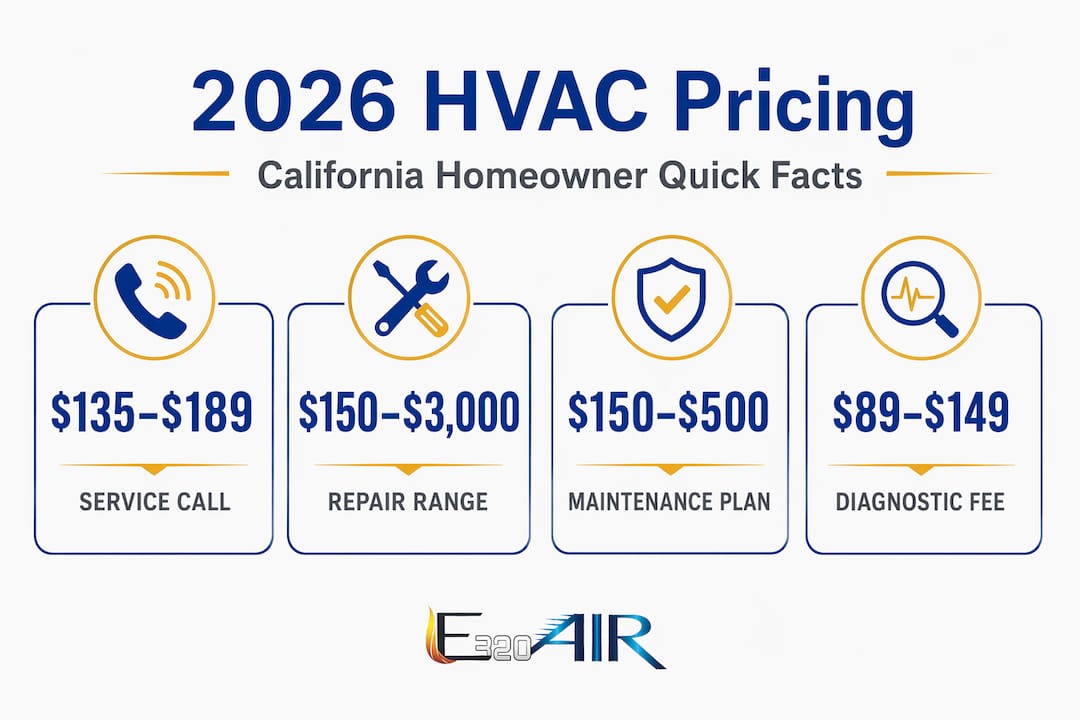
| Service calls vary by market | California homeowners pay $135–$189 for a diagnostic visit, more than the national average. |
| Repairs range widely by part | Common fixes run $150 for a capacitor up to $3,000+ for a compressor replacement. |
| The $5,000 Rule guides replacement | Multiply your system's age by the repair cost; above $5,000 means replacement usually wins. |
| Maintenance plans save money | Annual agreements running $150–$500 prevent costly breakdowns and protect manufacturer warranties. |
| Labor costs are rising fast | Hourly HVAC labor rates are climbing 8–12% annually, making preventive care more valuable than ever. |
HVAC service prices for common repairs in California
Most homeowners don't realize how much a zip code affects what they pay. California residential labor rates run $125–$175 per hour, and service call fees in Bay Area markets average $135–$189 compared to $99–$159 nationally. That gap reflects higher wages, fuel costs, and the operational overhead of running a business in a high-cost state.
Here's a realistic look at what typical repairs cost in 2026:
| Repair Type | Parts Cost | Labor Time | Total Estimated Cost |
|---|---|---|---|
| Capacitor replacement | $30–$80 | 0.5–1 hr | $150–$350 |
| Thermostat replacement | $50–$200 | 1–2 hrs | $200–$450 |
| Blower motor replacement | $150–$450 | 2–4 hrs | $400–$900 |
| Refrigerant recharge | $100–$400 | 1–2 hrs | $250–$700 |
| Compressor replacement | $800–$1,500 | 4–6 hrs | $1,500–$3,000+ |
These figures come from flat-rate pricing data compiled across residential HVAC markets in 2026. The labor column is where California consistently adds cost relative to other states.
Seasonal timing has a real effect on cost for hvac service. Peak demand in summer (June through September) and winter (December through February) brings surcharges from many contractors. Some charge 15–25% more for the same repair during peak weeks simply because demand outpaces technician availability. Emergency and after-hours calls stack additional fees of $50–$150 on top of the standard service call charge.
Pro Tip: Schedule your HVAC tune-up in spring or fall when demand is low. You'll get faster scheduling and often avoid seasonal surcharges entirely.

The smart move is treating your system like a car. You wouldn't wait for the engine warning light to get an oil change. The same logic applies to your HVAC.
How contractors set their hvac service pricing
Understanding how a contractor builds a quote helps you evaluate whether what you're being charged is fair. There are two dominant pricing models in the industry: flat-rate pricing and time and materials billing.
Flat-rate pricing bundles the job into a single price regardless of how long it takes. A technician who completes a blower motor swap in 90 minutes charges the same as one who takes three hours. This model rewards efficiency and gives you price certainty upfront.
Time and materials billing charges an hourly labor rate plus the actual cost of parts with a markup. If the job runs long, your bill grows. This model can favor homeowners when jobs are simple, but it creates risk when complications arise.
Most established contractors in California use flat-rate pricing because it simplifies customer conversations and ensures profitability. The loaded labor rate behind every flat-rate job typically runs $85–$150 per hour once you factor in technician wages, insurance, truck maintenance, and company overhead. A contractor charging $95 per hour is often operating at or below margin.
Parts markup follows a tiered structure:
- Low-cost parts (under $50): 3x to 4x markup
- Mid-range parts ($50–$300): 2x to 3x markup
- High-cost parts (over $300): 1.5x to 2.5x markup
This markup is not price gouging. It covers the cost of carrying inventory, making warranty replacements, and absorbing losses when parts are ordered but not used. Flat-rate pricing bundles all of this into a coherent job price rather than itemizing every overhead cost separately.
Diagnostic fees deserve a separate mention. Most California contractors charge $89–$149 for a service call, and diagnostic fees are commonly waived when you approve the repair. This is standard practice and worth confirming before you book. Always ask: "Is the diagnostic fee waived if I move forward with the repair?"
Geographic location within California also matters. A contractor based in the Inland Empire serving a call in coastal Los Angeles may add a trip charge of $50–$100. Geographic scheduling that clusters jobs by neighborhood keeps prices lower, but it can also mean longer wait times if you're outside a contractor's core service area.
Pro Tip: Ask for a written estimate that separates parts, labor, and the diagnostic fee before any work begins. A contractor who can't provide this is a red flag.
Repair vs. replace: applying the right financial rules
This is the question every California homeowner faces when a technician delivers bad news. Two rules of thumb cut through the emotion and help you decide with your wallet, not your gut.
-
The $5,000 Rule. Multiply your system's age in years by the cost of the repair. If the result exceeds $5,000, replacement is almost always the smarter financial move. Example: a 12-year-old system facing a $500 capacitor repair scores 6,000. That's above the threshold, but a capacitor is a minor fix. Pair this rule with context.
-
The 50% Rule. According to HVAC repair financial guidance, if a single repair costs more than 50% of what a new system would cost, replacement wins financially over time. A $1,800 compressor repair on a system where a new unit runs $3,200 is a classic replacement scenario.
-
The refrigerant factor. Older systems using R-22 refrigerant add serious cost complexity. The R-22 phase-out has driven recharge prices to levels that rival a down payment on new equipment. If your system runs R-22, any refrigerant leak repair tilts the math decisively toward replacement.
-
Efficiency savings. Modern systems run at 16–20 SEER2 ratings versus 10–12 SEER in older units. California homeowners running aging equipment often see energy bills drop 30–40% after replacing a 15-plus-year-old system. That monthly savings compounds over the life of the new unit.
-
Warranty coverage. If your system is under a parts or labor warranty, repair costs drop significantly. A compressor replacement covered by warranty may cost only $400 in labor versus $2,500 out of pocket. Check your paperwork before authorizing any major fix.
Pro Tip: Before you decide, ask your technician to pull your system's age from the data plate on the unit. That single number changes the entire repair vs. replace calculation.
For a deeper look at what today's California replacements actually cost and the equipment tiers available, the top HVAC replacement options guide walks through current market pricing in detail.
What HVAC maintenance plans actually cover
Maintenance agreements are the most underused money-saving tool in residential HVAC. Most California homeowners skip them until something breaks, which is the most expensive approach possible.
Annual maintenance agreements run $150–$500 per year and typically include:
- Two seasonal tune-up visits (one before cooling season, one before heating season)
- Coil cleaning and filter replacement
- Electrical connection checks and tightening
- Refrigerant level inspection
- Thermostat calibration
- Priority scheduling during peak demand periods
- Discounts of 10–20% on repair parts and labor
The cost for maintenance plans at the $150–$300 range covers the basics. Plans in the $300–$500 range typically add more included services and deeper repair discounts. For most California homeowners with newer systems, a mid-tier plan is the best value.
Beyond the direct service benefits, maintenance plans keep your manufacturer warranty valid. Most HVAC manufacturers require documented annual maintenance as a condition of their warranty. Skip a year and you could void coverage on a compressor that costs $2,000 to replace. That math should settle the question of whether $200 per year is worth it.
California's climate also rewards year-round maintenance discipline. Systems in the Inland Empire and Central Valley work harder than those in coastal areas due to extreme summer heat. A system running 3,000-plus hours per cooling season needs more frequent attention than one in a mild coastal city. Building a seasonal maintenance schedule around your local climate is the most cost-effective approach.
My honest take on HVAC pricing in California
I've worked in and around HVAC contracting long enough to watch pricing shift from something fairly predictable to something that genuinely confuses homeowners. The confusion isn't accidental. It's the result of a market where labor inflation is running 8–12% annually, equipment costs have climbed sharply since 2020 due to refrigerant transitions and efficiency standards, and the range between a honest quote and an inflated one can be $500 or more for the same job.
My biggest piece of advice: never accept a quote without a written line-item breakdown. I've seen homeowners pay $400 for a capacitor swap where the part costs $35. That's not just markup. That's a contractor betting you won't ask questions.
Unusually low bids deserve the same skepticism as unusually high ones. A contractor who quotes $59 for a service call in a California metro is either cutting corners on insurance, paying technicians below market wages, or planning to make it up in parts markup. The loaded labor rate structure of this industry makes genuinely low prices economically unsustainable for a legitimate business.
The homeowners I've seen navigate HVAC costs best are the ones who treat their system like an investment and their contractor like a long-term relationship. An annual maintenance plan with a contractor you trust costs less per year than one emergency call in August.
— Edward
Get straightforward HVAC pricing from E320air
Knowing what fair pricing looks like is only half the equation. The other half is finding a contractor who actually delivers it.

E320air serves California homeowners with transparent, written estimates before any work begins. Whether you need a routine tune-up, a same-day repair, or a full system replacement, the team at E320air provides clear pricing broken down by parts and labor so you know exactly what you're paying for. Installation options come in good-better-best tiers to match your budget and efficiency goals. Maintenance plans are available with priority scheduling and repair discounts built in. For homeowners who want to see real repair scenarios and outcomes before committing, the problem-solving gallery shows actual jobs completed across Southern California. If you're ready to stop guessing and start budgeting accurately, get a detailed estimate from E320air today.
FAQ
How much is an HVAC service call in California?
California homeowners typically pay $135–$189 for a diagnostic service call in metro areas like the Bay Area and Los Angeles, compared to the national average of $99–$159. The fee is often waived when you approve the repair.
What is the average cost for HVAC service and repair?
Repairs range from $150 for a simple capacitor replacement to $3,000 or more for a compressor. The total depends on the part, labor time, and whether you're in a high-cost California market.
How do I know when to replace instead of repair my HVAC?
Use the $5,000 Rule: multiply your system's age by the repair cost. If the result exceeds $5,000, replacement is typically the better financial move. The 50% Rule also applies: replace when a single repair exceeds half the cost of a new system.
Are HVAC maintenance plans worth the cost?
Yes. Annual plans running $150–$500 cover two seasonal tune-ups, priority service, and repair discounts. They also keep your manufacturer warranty valid, which can save thousands if a major component fails.
Why are HVAC labor costs so high in California?
California's HVAC labor rates of $125–$175 per hour reflect higher wages, business insurance costs, and fuel expenses. Industry-wide labor inflation of 8–12% annually has also pushed rates up significantly since 2020.