
TL;DR:
- Proper HVAC tonnage measurement ensures your system maintains comfort, controls humidity, and runs efficiently.
- Accurate load calculation with Manual J considers home-specific factors instead of relying on square footage rules.
HVAC tonnage is the measure of an air conditioner's cooling capacity, where one ton equals 12,000 BTUs of heat removal per hour. The term has nothing to do with how much the unit weighs. Getting the tonnage right for your home is the single most important factor in whether your system keeps you comfortable, controls humidity, and runs efficiently for years.
What does HVAC tonnage mean and how is it calculated?
The word "ton" in HVAC comes from a surprisingly practical origin. Before mechanical refrigeration, people used blocks of ice to cool buildings. Engineers calculated that melting one ton of ice over 24 hours absorbed a specific amount of heat. That figure became the industry standard: 12,000 BTUs per hour equals one ton of cooling capacity. Every air conditioner sold in the United States today is rated using this same unit.

Residential systems typically range from 1.5 to 5 tons. A small condo might need a 1.5-ton unit. A large two-story home in a hot climate could require a 4- or 5-ton system.
The basic tonnage formula
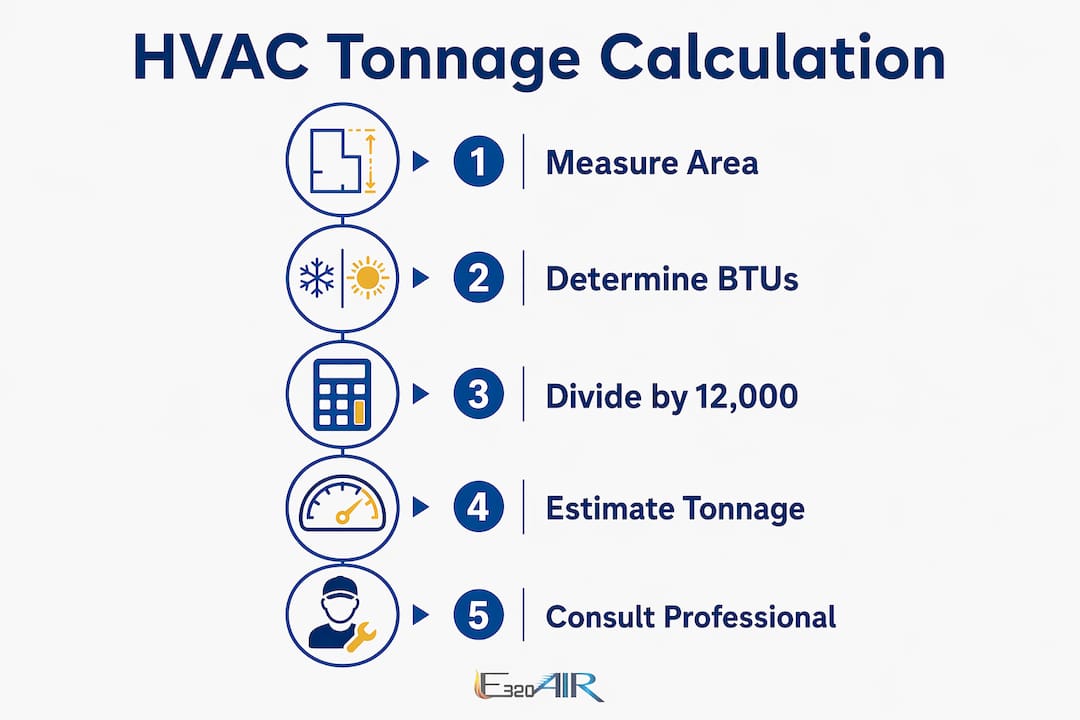
You can estimate your cooling needs with a straightforward calculation. Multiply your home's square footage by 20–25 BTUs per square foot, then divide by 12,000 to get tons. For example, a 1,500 square foot home at 20 BTUs per square foot needs 30,000 BTUs, which equals 2.5 tons.
- Measure your conditioned square footage (exclude garages and unconditioned attics).
- Multiply by 20 BTUs for a well-insulated home or 25 BTUs for an older, leakier home.
- Divide the result by 12,000 to get the tonnage estimate.
- Round to the nearest standard size (1.5, 2, 2.5, 3, 3.5, 4, or 5 tons).
Pro Tip: This formula gives you a starting estimate only. Treat it as a conversation starter with your HVAC contractor, not a final answer. Dozens of variables can shift the real number up or down.
One more clarification worth noting: tonnage applies only to cooling. Heating capacity is measured in BTU output per hour, not tons. Furnaces and heat pumps carry BTU ratings ranging from 40,000 to 150,000 BTU per hour for residential use.
Why square footage rules for HVAC tonnage are often wrong
The 400–600 square feet per ton rule is a rough starting point, not a reliable answer. Older homes with single-pane windows and minimal insulation may need one ton for every 400 square feet. A newer, well-insulated home in the same city might need only one ton for every 600–1,000 square feet. That is a massive difference in equipment size and cost.
Several factors push your actual tonnage requirement higher or lower than the square footage rule suggests:
- Insulation quality: Spray foam insulation can reduce HVAC load significantly, meaning a well-sealed home needs less cooling capacity.
- Window area and type: Large south-facing windows with single-pane glass add substantial heat gain. Double-pane, low-E glass cuts that load considerably.
- Ceiling height: A home with 10-foot ceilings has more air volume than the same footprint with 8-foot ceilings. More volume means more cooling demand.
- Local climate: A home in Phoenix, Arizona needs more tonnage than an identical home in San Francisco, California, even with the same square footage.
- Home age and air sealing: Drafty older homes lose conditioned air constantly, forcing the system to work harder.
| Home type | Square footage | Estimated tonnage |
|---|---|---|
| Older home, poor insulation, hot climate | 1,500 sq ft | 3.5–4 tons |
| Modern home, good insulation, hot climate | 1,500 sq ft | 2.5–3 tons |
| Modern home, excellent insulation, mild climate | 1,500 sq ft | 2–2.5 tons |
| Older home, poor insulation, mild climate | 1,500 sq ft | 2.5–3 tons |
Pro Tip: If your home has had major upgrades like new windows, added attic insulation, or air sealing work, your old system's tonnage may now be too large. A reassessment can save you money on your next replacement.
Trane, one of the largest HVAC manufacturers in the country, warns that relying on old square footage rules leads to oversized, inefficient, and uncomfortable systems. Modern construction has changed the math significantly.
How professional load calculations determine the right tonnage
The industry standard for sizing residential HVAC systems is Manual J, a calculation method developed by the Air Conditioning Contractors of America (ACCA). Manual J calculates the precise cooling load by accounting for climate zone, building envelope, window area and orientation, number of occupants, and internal heat sources like appliances and lighting. The result is a BTU per hour figure that reflects your specific home, not a generic rule.
Manual J is only the first step. Manual S uses those Manual J results to select the right equipment. ACCA's 2026 sizing standards require that single-stage systems be sized to no more than 115% of the calculated load. Variable-capacity systems can be sized up to 130% of the load because they modulate output rather than cycling on and off. These limits exist to prevent the comfort and efficiency problems that come with oversized equipment.
A true load calculation is a whole-home performance assessment. Professionals following ACCA standards work through three documents in sequence:
- Manual J: Calculates the actual heating and cooling load for the home.
- Manual S: Selects equipment whose capacity matches the Manual J result within allowed tolerances.
- Manual D: Designs the duct system to deliver conditioned air where it is needed.
Skipping any of these steps creates problems. Poor duct design undermines system performance even when the tonnage is correct. A properly sized unit connected to undersized ducts will still struggle to cool your home evenly.
"A true HVAC load calculation is an entire home performance assessment including ductwork, which is why tonnage alone is not sufficient for comfort." — ACCA load calculation guidance
How to find your existing HVAC unit's tonnage
Your current system's tonnage is usually encoded in the model number on the outdoor condenser unit. Many manufacturers embed a two-digit number representing BTUs in thousands. For example, a Bryant model with "30" in the model number indicates 30,000 BTUs, which equals 2.5 tons. This coding is not universal across all brands, so the same number in a different manufacturer's model may mean something else entirely.
Follow these steps to find your unit's tonnage:
- Locate the data plate on the outdoor condenser unit, usually on the side panel.
- Write down the full model number exactly as printed.
- Look for a two-digit number divisible by 6 or 12 (such as 18, 24, 30, 36, 42, 48, or 60). Divide by 12 to get tons.
- Cross-reference with the manufacturer's engineering manual or product specification sheet for confirmation.
- If the model number does not follow this pattern, contact the manufacturer directly or consult a licensed HVAC technician.
Guessing based on the physical size of the unit or its age is unreliable. Two units that look identical can have different tonnage ratings. Consulting manufacturer documentation or a qualified contractor gives you a definitive answer.
Why correct tonnage matters for comfort, efficiency, and equipment life
Getting the tonnage right affects far more than your monthly energy bill. A correctly sized system maintains balanced temperature and humidity throughout your home, runs in longer and more efficient cycles, and lasts significantly longer than an oversized or undersized unit.
Oversizing is the more common mistake, and its consequences are well documented:
- Short cycling: The unit cools the air quickly, shuts off, then restarts before completing a full cycle. This wastes energy and stresses the compressor.
- Poor dehumidification: Oversized AC systems fail to remove humidity properly because they do not run long enough to pull moisture from the air. The result is a home that feels clammy even when the thermostat reads the right temperature.
- Higher energy costs: Oversized systems can add roughly $200 per year in unnecessary energy waste.
- Premature failure: Constant short cycling accelerates compressor wear, shortening the system's lifespan.
Undersizing creates a different set of problems. The system runs constantly, struggles to reach the set temperature on hot days, and may void the manufacturer's warranty if it operates outside design parameters. Proper HVAC sizing protects both your comfort and your investment.
Pro Tip: If your home feels humid even when the AC is running, or if your system runs in very short bursts and shuts off quickly, those are classic signs of an oversized unit. Both problems are worth a professional evaluation.
Ductwork design completes the picture. Even a perfectly sized system delivers poor results if the ducts are leaky, undersized, or poorly routed. Manual D duct design ensures the air actually reaches every room at the right volume and velocity.
Key takeaways
Correct HVAC tonnage is the foundation of home comfort, energy efficiency, and equipment longevity. Sizing based on square footage alone consistently produces the wrong answer for modern homes.
| Point | Details |
|---|---|
| One ton equals 12,000 BTU/hr | This is the universal standard for measuring AC cooling capacity in the United States. |
| Square footage rules are estimates | Insulation, climate, windows, and ceiling height all shift the real tonnage requirement. |
| Manual J is the accurate method | Professional load calculations account for all home variables, not just floor area. |
| Oversizing causes real problems | Short cycling, poor humidity control, and premature failure are direct results of too much tonnage. |
| Ductwork completes the system | Correct tonnage paired with Manual D duct design delivers consistent comfort in every room. |
What I've learned from years of HVAC tonnage mistakes in the field
The most common mistake I see homeowners make is trusting the size of their old system as the right answer for the new one. If the previous contractor installed an oversized unit, replacing it with the same tonnage just repeats the problem. The old unit's size tells you what was installed, not what your home actually needs.
The square footage rule frustrates me because it sounds authoritative and is easy to repeat. A 2,000 square foot home does not automatically need a 3.5-ton system. I have seen well-insulated California homes of that size perform perfectly with a 2.5-ton variable-capacity unit. The difference in operating cost and comfort over ten years is significant.
Homeowners also frequently confuse tonnage with the physical size or weight of the equipment. A 5-ton condenser is larger than a 2-ton unit, but the relationship is not proportional in the way people expect. The capacity rating is what matters, not the cabinet dimensions.
My strongest advice: ask any contractor you hire whether they perform a Manual J calculation before recommending equipment. If they quote you a tonnage based only on your square footage and a quick look at your old unit, find someone else. The HVAC sizing process is not complicated when done correctly, but it does require actual measurements and calculations. Your comfort for the next 15 years depends on getting it right the first time.
— Edward
E320air's approach to HVAC sizing and installation
Choosing the right tonnage is a technical decision that affects every year of your system's life. E320air performs detailed load calculations before recommending any equipment, so you get a system matched to your actual home, not a generic estimate.
Whether you are replacing an aging unit or installing a new system in a remodel, E320air's HVAC installation services include full Manual J sizing, equipment selection, and duct evaluation. The goal is a system that keeps every room comfortable, controls humidity, and runs efficiently from day one. Visit E320air to schedule a consultation and get a sizing assessment based on your home's real numbers.
FAQ
What is one ton of HVAC cooling capacity?
One ton of cooling capacity equals 12,000 BTUs of heat removal per hour. The unit originates from the energy required to melt one ton of ice over 24 hours.
How do I calculate the tonnage I need for my home?
Multiply your conditioned square footage by 20–25 BTUs per square foot, then divide by 12,000. This gives an estimate; a Manual J calculation from a licensed contractor gives the accurate answer.
What happens if my AC unit is the wrong tonnage?
An oversized unit short cycles, wastes energy, and leaves indoor air feeling humid. An undersized unit runs constantly and cannot maintain comfortable temperatures on hot days.
How do I find the tonnage of my existing AC unit?
Check the model number on the outdoor condenser's data plate. Look for a two-digit number divisible by 6 or 12, then divide by 12 to get tons. Confirm with the manufacturer's documentation or a licensed technician.
Does HVAC tonnage apply to heating systems?
No. Tonnage is specific to air conditioning cooling capacity. Heating systems, including furnaces and heat pumps, are rated in BTUs per hour of heat output, not tons.