

TL;DR:
- Proper HVAC sizing requires a Manual J load calculation and Manual S equipment selection to avoid inefficiency and comfort issues. Oversizing based on square footage alone often leads to short-cycling, high humidity, and increased equipment wear. Regional climate factors in the Inland Empire necessitate higher BTU per square foot estimates to ensure accurate cooling capacity.
Central air conditioner sizing is the process of determining the exact cooling capacity your home needs to maintain comfort without wasting energy. Get it wrong in either direction and you pay for it every month. An undersized unit runs nonstop and never catches up on a 108°F Redlands afternoon. An oversized unit short-cycles, leaves your home humid, and wears out faster than it should. This central air conditioner sizing guide walks you through the methods that actually work, from quick estimates to the professional calculations required for any serious installation in the Inland Empire.
How to size a central air conditioner using BTUs and square footage
The most common starting point for central air unit sizing is the 20 BTU per square foot rule. A 2,000 sq ft home needs roughly 40,000 BTU, which converts to about 3.3 tons of cooling capacity. Since residential AC units come in half-ton increments from 1.5 to 5 tons, that home would land on a 3.5-ton unit as the nearest standard size. This conversion matters because contractors and equipment manufacturers both speak in tons, not BTUs.
Here is a quick air conditioning sizing chart to give you a reference point:
| Home size (sq ft) | Estimated BTU | Approximate tonnage |
|---|---|---|
| 1,000 | 20,000 | 1.5 tons |
| 1,500 | 30,000 | 2.5 tons |
| 2,000 | 40,000 | 3.5 tons |
| 2,500 | 50,000 | 4 tons |
| 3,000 | 60,000 | 5 tons |
This table is a rough guide, not a specification. The 20 BTU rule ignores several factors that dramatically change the real cooling load:
- Ceiling height above 8 feet adds volume that needs cooling
- Single-pane windows or west-facing glass increases solar heat gain
- Poor attic insulation lets heat pour in from above
- Open floor plans with high ceilings behave differently than compartmentalized layouts
Pro Tip: Use the square footage estimate only to ballpark a budget range. Never use it to specify equipment for a real installation.
What is Manual J and why is it the gold standard in 2026?
Manual J is the industry-standard residential load calculation method developed by ACCA (Air Conditioning Contractors of America). Manual J is the most accurate residential AC sizing method available, and as of 2026, it is required by the International Residential Code (IRC) and the International Energy Conservation Code (IECC) for new installations and replacements in most jurisdictions, including California.
Where the square footage rule uses one variable, Manual J uses dozens. A proper calculation accounts for:
- Insulation values in walls, attic, and floors
- Window area, orientation, and glazing type (single, double, or low-e)
- Local design temperatures based on your specific climate zone
- Ceiling height and conditioned volume of each room
- Air infiltration rate based on construction quality and age
- Internal heat gains from occupants, lighting, and appliances
- Duct location (in conditioned or unconditioned space like an attic)
Each of these inputs changes the final tonnage recommendation. A 2,000 sq ft home in Fontana with a dark tile roof, single-pane windows, and an attic duct system will need significantly more cooling capacity than an identical floor plan in a coastal city with a white roof and insulated ducts.
Manual J typically takes 2 to 4 hours and costs $200 to $500 when not included with the installation quote. That cost is trivial compared to 15 years of monthly utility bills on an oversized or undersized system. Contractors who skip it are guessing, and their guesses tend to favor oversizing because a unit that is too large rarely generates a callback complaint on day one.
Pro Tip: Ask any contractor for a printed Manual J report before approving equipment selection. If they cannot produce one, find a contractor who can.
How Manual S prevents oversizing after Manual J
Manual J tells you how much cooling your home needs. Manual S tells you which piece of equipment to buy. The distinction matters because equipment does not come in every possible size, and contractors sometimes use that gap as an excuse to install a larger unit than the load actually requires.
Manual S limits cooling capacity to no more than 115% of the Manual J calculated load. That ceiling exists specifically to prevent short-cycling, which is when the unit reaches setpoint so fast it shuts off before removing enough moisture from the air. The result is a home that feels cold but clammy. This is one of the most common comfort complaints in the Inland Empire, and it almost always traces back to an oversized unit.
"Bigger is not better in HVAC. A correctly sized system runs longer cycles, removes more humidity, and maintains steadier temperatures than an oversized unit that blasts on and off all day."
Here is how the Manual S selection process works in practice:
- Calculate the Manual J cooling load (for example, 38,400 BTU for a specific home)
- Multiply by 115% to find the maximum allowable capacity (44,160 BTU)
- Identify standard equipment sizes that fall at or below that ceiling (3 ton = 36,000 BTU or 3.5 ton = 42,000 BTU)
- Select the closest compliant size, which in this case is the 3.5-ton unit
Selecting the next equipment size within Manual S limits prevents contractors from adding unnecessary safety margins that degrade real-world performance. A system running within its designed range also lasts longer and maintains its rated SEER2 efficiency more consistently over time.
How Inland Empire climate changes your AC sizing calculation
The Inland Empire is not a mild coastal market. Cities like Riverside, San Bernardino, Ontario, and Rancho Cucamonga regularly see summer highs above 100°F, with design temperatures used in Manual J calculations that are far above the national average. That heat load changes everything about how you calculate HVAC system size.
The Inland Empire's hot-dry climate typically requires 22 to 26 BTU per square foot, compared to the general 20 BTU rule used in milder regions. Desert-adjacent areas in the eastern Inland Empire trend even higher, toward 26 to 28 BTU per square foot. That means a 2,000 sq ft home in Redlands could need a 4-ton unit where the same home in San Diego might need only 3 tons.
| Factor | Mild coastal California | Inland Empire |
|---|---|---|
| Design temperature | 83°F | 105°F+ |
| BTU per sq ft estimate | 18 to 20 | 22 to 28 |
| Typical 2,000 sq ft unit | 3 tons | 3.5 to 4 tons |
| Cooling season length | 3 to 4 months | 5 to 6 months |
Beyond raw temperature, Inland Empire homes face specific conditions that push load calculations higher. West-facing walls absorb intense afternoon sun. Tile roofs over poorly ventilated attics trap heat. Many homes built in the 1980s and 1990s have minimal wall insulation by modern standards. Ceiling heights in newer tract homes often reach 9 or 10 feet, adding conditioned volume that a square footage estimate misses entirely.
Pro Tip: When reviewing a Manual J report for an Inland Empire home, confirm the contractor used the correct design temperature for your specific city. Using a coastal design temperature in a Riverside calculation will undersize your system.
For regional equipment guidance, the best HVAC brands for California article covers which manufacturers build units rated for high-ambient conditions common in this region.
Common sizing mistakes that cost Inland Empire homeowners money
The most expensive sizing mistake is not undersizing. It is oversizing based on guesswork, which is far more common. Oversizing leads to short-cycling and high indoor humidity, which negates any efficiency advantage from a high SEER2 rating. A 20 SEER2 unit that short-cycles delivers far less real-world efficiency than a 16 SEER2 unit running proper cycles.
Ductwork is the second most overlooked factor. Poor ductwork with leaks or pressure imbalances reduces airflow and comfort even when the unit itself is correctly sized. In older Inland Empire homes, attic duct systems often leak 20 to 30 percent of conditioned air into unconditioned space. Installing a new unit without addressing those leaks is like buying a new engine for a car with a cracked radiator.
Additional pitfalls to avoid:
- Accepting a quote with no Manual J report attached
- Assuming a higher SEER2 rating compensates for wrong sizing
- Replacing a unit with the same tonnage as the old one without recalculating (the old unit may have been wrong from the start)
- Ignoring duct design (Manual D) when replacing equipment
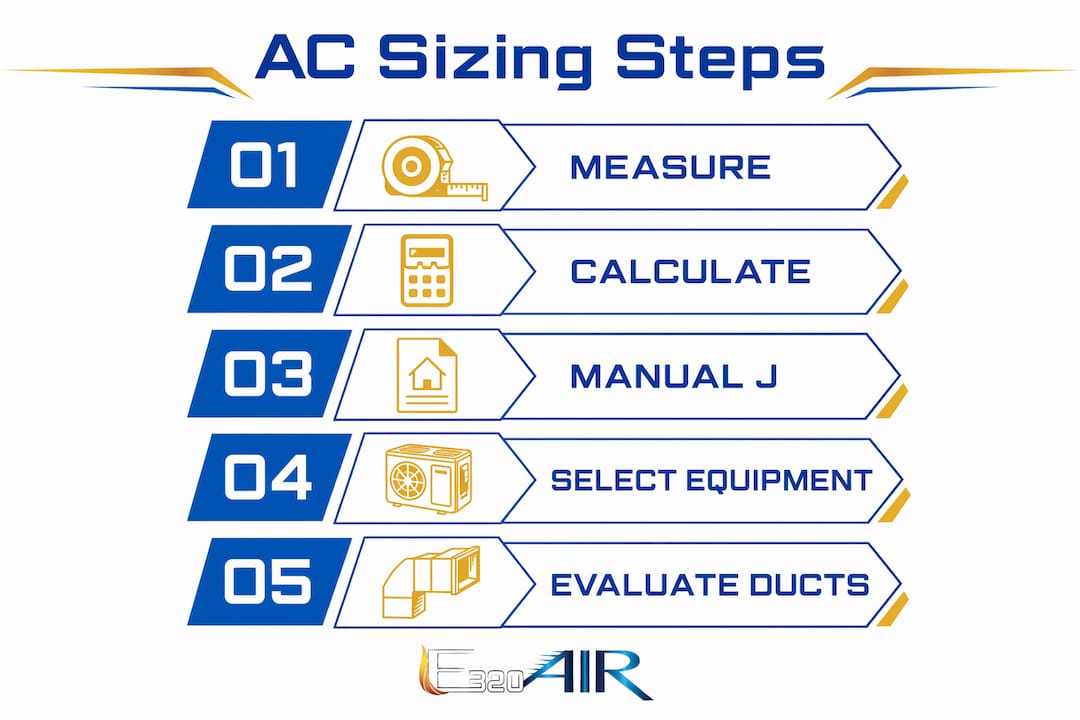
Pro Tip: Request the HVAC replacement stages checklist from your contractor before any installation begins. A professional process includes load calculation, equipment selection, and duct evaluation as separate documented steps.
Key takeaways
Proper central air conditioner sizing requires a Manual J load calculation, Manual S equipment selection, and duct evaluation. Skipping any one of these steps produces a system that underperforms regardless of its rated efficiency.
| Point | Details |
|---|---|
| Start with BTU estimates | Use 20 BTU per sq ft as a budget reference only, not an equipment specification. |
| Manual J is required | ACCA Manual J is the IRC and IECC standard for accurate residential load calculation. |
| Manual S prevents oversizing | Equipment capacity must not exceed 115% of the Manual J load to avoid short-cycling. |
| Inland Empire needs more BTU | Regional design temperatures push sizing to 22 to 28 BTU per sq ft, above national averages. |
| Ductwork affects performance | Leaky or undersized ducts reduce comfort even when the unit itself is correctly sized. |
Why I stop trusting any sizing quote without a Manual J report
I have reviewed hundreds of HVAC quotes for Inland Empire homeowners over the years, and the pattern is consistent. Contractors who skip Manual J almost always oversize. They do it because a larger unit rarely fails on day one, and most homeowners have no way to verify the math. The complaint comes 18 months later when the utility bill is high and the house never feels dry.
The uncomfortable truth about HVAC sizing is that the square footage shortcut survives because it is fast, not because it works. A 2,000 sq ft home in Moreno Valley with a dark roof, single-pane windows, and a leaky attic duct system needs a completely different unit than a 2,000 sq ft home in Upland with a cool roof and new insulation. Treating them the same is not a minor error. It is a 15-year financial mistake.
What I have found actually works is insisting on a documented Manual J report before any equipment discussion begins. The report forces the contractor to measure real inputs, not assume defaults. It also gives you a document you can compare across multiple bids. If two contractors produce Manual J reports and one recommends a 3-ton unit while the other recommends a 4-ton unit, you now have something specific to ask about rather than just comparing prices.
Investing in proper HVAC sizing upfront is the single highest-return decision you can make before buying new equipment. The unit itself is a commodity. The calculation behind it is where the real value lives.
— Edward
Get the right size AC for your Inland Empire home with E320air
Choosing the wrong size central AC unit is a mistake that compounds every summer for the life of the system. E320air performs full Manual J load calculations and Manual S equipment selection for every installation, using real building data from your specific home, not regional defaults or square footage guesses.

E320air serves homeowners across Riverside, San Bernardino, Ontario, Fontana, and the surrounding Inland Empire with professional HVAC installation backed by documented sizing calculations. Every project includes duct evaluation and a written equipment recommendation tied to your actual cooling load. Contact E320air today to schedule a sizing consultation and get a quote built on real numbers.
FAQ
What size AC do I need for a 2,000 sq ft home in the Inland Empire?
A 2,000 sq ft home in the Inland Empire typically needs 3.5 to 4 tons of cooling capacity, based on regional BTU requirements of 22 to 28 BTU per square foot. A Manual J calculation using your home's specific insulation, windows, and orientation will confirm the exact size.
How much does a Manual J load calculation cost?
A Manual J calculation costs roughly $200 to $500 when not included with the installation quote, and takes 2 to 4 hours to complete. Most reputable HVAC contractors include it as part of a full replacement proposal.
What happens if my central AC is oversized?
An oversized AC short-cycles, meaning it reaches the thermostat setpoint before completing a full dehumidification cycle, leaving the home feeling cold but humid. This also increases wear on the compressor and reduces the system's effective lifespan.
Is a higher SEER2 rating enough to offset wrong sizing?
No. Oversizing leads to short-cycling that negates SEER2 efficiency gains regardless of the unit's rated performance. Correct sizing paired with a properly designed duct system delivers more real-world efficiency than a high-rated unit installed at the wrong capacity.
Do I need a new Manual J if I'm just replacing my old AC unit?
Yes. The previous unit may have been incorrectly sized from the start, and your home's insulation, windows, or ductwork may have changed since the original installation. A fresh Manual J calculation confirms the right size for current conditions.