
TL;DR:
- Leaky ductwork is a major source of energy loss, causing homeowners to waste up to 40% of conditioned air. Proper sealing and insulation can significantly improve HVAC efficiency, extend system lifespan, and enhance indoor comfort. Professional testing and diagnostics are essential to identify hidden leaks and ensure effective duct repair and performance.
Your HVAC system could be brand new, high-efficiency, and properly sized, and you could still be paying hundreds of dollars extra every year on energy bills. The culprit hiding in your walls, attic, and crawlspace is your ductwork. Most Southern California homeowners spend their time comparing SEER ratings and thermostat brands, while the real energy drain quietly sits behind drywall. This article breaks down exactly how ducts affect your comfort and costs, what warning signs to watch for, and what proven fixes actually work.
Table of Contents
- How ductwork impacts HVAC energy efficiency
- Hidden duct problems: What's causing energy loss and poor comfort?
- Duct sealing and insulation: The proven efficiency upgrade
- Duct inspection, testing, and professional solutions
- What most homeowners miss about ductwork and HVAC upgrades
- Next steps: Expert ductwork solutions for your home
- Frequently asked questions
Key Takeaways
| Point | Details |
|---|---|
| Most energy loss is hidden | Leaky ductwork can cause 25%–40% energy loss, raising utility bills without homeowners noticing. |
| Comfort depends on ducts | Uneven room temperatures and poor air quality often trace back to duct leaks or lack of insulation. |
| Sealing boosts efficiency | Duct sealing and insulation are proven ways to increase HVAC performance and reduce costs. |
| Professional testing is key | Accurate leak detection and repairs require diagnostic airflow tests, not just visual checks. |
How ductwork impacts HVAC energy efficiency
Think of your duct system as the circulatory system of your home. Your HVAC unit produces conditioned air, but the ducts are responsible for delivering that air to every room. If there are holes, poor connections, or missing insulation along the way, a massive portion of what you paid to cool or heat simply disappears before it ever reaches you.
Ductwork is a major determinant of HVAC energy performance, and duct systems can lose a large share of conditioned heating and cooling energy due to leakage. In practical terms, that translates to 25% to 40% of the energy your system produces going straight to waste inside your attic or garage instead of cooling your living room. For a typical Southern California home running air conditioning six or more months a year, that loss adds up fast.
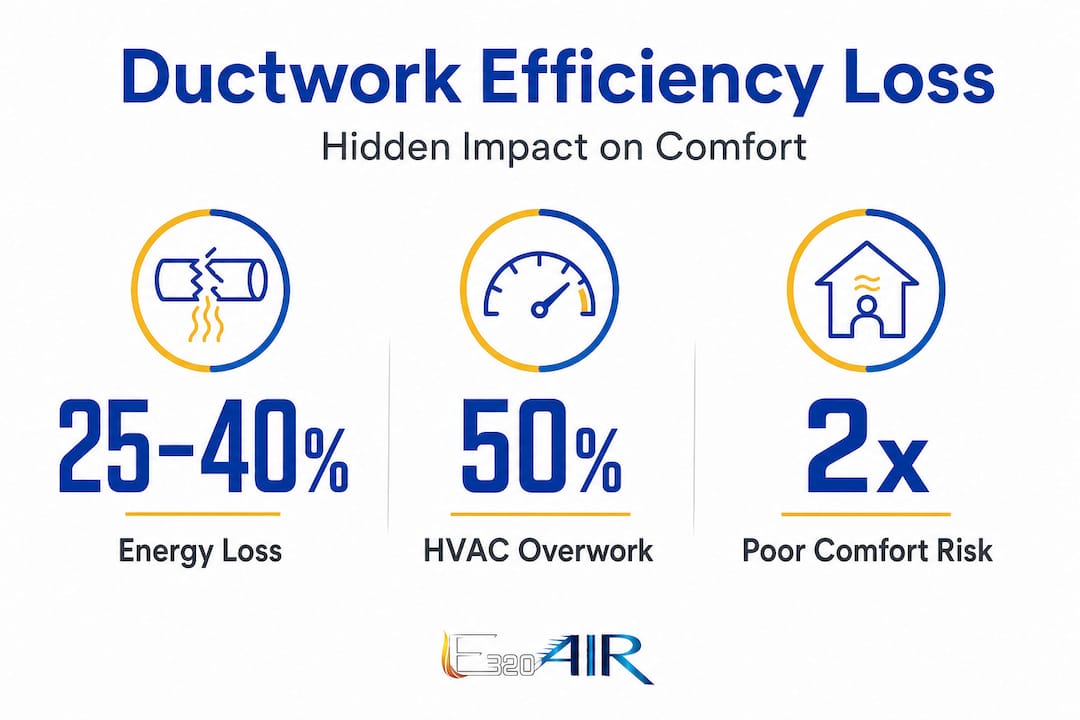
Leaking ducts don't just waste energy passively. They force your HVAC system to run longer and work up to 50% harder to compensate for the lost air. That means more wear on your compressor, more frequent breakdowns, and a shorter overall system lifespan. If you want to reduce HVAC energy waste, fixing the duct system often delivers a faster return than upgrading equipment.
Common energy losses from leaky ductwork
| Source of loss | Typical energy waste | Impact on system |
|---|---|---|
| Duct leaks at joints and connections | 15% to 25% | Compressor runs longer |
| Poor or missing duct insulation | 5% to 15% | Thermal gain in hot attics |
| Undersized or restrictive duct design | 5% to 10% | Reduced airflow, higher static pressure |
| Disconnected duct sections | Up to 100% loss in that run | Room gets no conditioned air |
The main sources of duct-related energy waste break down into a few categories:
- Leaks at joints, seams, and connections where flex duct meets a metal collar or where duct sections are improperly fastened
- Poor insulation on ducts running through unconditioned spaces like attics that regularly reach 140 degrees Fahrenheit in the Inland Empire summer
- Design flaws including ducts that are too small, too long, or have too many sharp bends that create airflow resistance
- Disconnected or collapsed sections of flex duct, which can occur over time as duct supports fail or pests damage the material
"Duct systems operating in unconditioned spaces, like hot attics, can experience dramatic efficiency losses that no HVAC equipment upgrade can fully overcome unless the duct system itself is fixed."
For homes interested in energy-efficient duct designs, understanding these loss points is the first step toward making meaningful improvements.
Hidden duct problems: What's causing energy loss and poor comfort?
Most duct problems are invisible. They happen inside walls, above ceilings, or in crawlspaces where you rarely look. Yet damaged or leaking ductwork wastes energy, raises bills, harms air quality, and creates a home that never feels quite right no matter how far you push the thermostat.

In Southern California, the location of leaky ducts is especially damaging. Attics in the Inland Empire and surrounding areas heat up to extreme temperatures in summer. When ducts run through those spaces with leaks or missing insulation, they pull in superheated air and lose their cooling charge before reaching the living space. Garages and unconditioned crawlspaces present the same problem. Even a small gap or a loose connection in those spaces becomes a very expensive problem over time.
Beyond the energy bills, effects of duct leaks on air quality are a serious concern for families. Leaky ducts in attics and crawlspaces can pull in dust, insulation fibers, rodent debris, and allergens, then push all of that directly into your breathing air. In extreme cases, moisture can enter through duct leaks and lead to mold issues from duct problems that become health hazards.
Leaky vs. well-sealed duct system comparison
| Factor | Leaky duct system | Well-sealed duct system |
|---|---|---|
| Monthly energy bills | 20% to 40% higher | Optimized and stable |
| Comfort | Uneven rooms, hot/cold spots | Consistent throughout home |
| Indoor air quality | Risk of dust, allergens, mold | Filtered, clean air delivery |
| System wear and tear | Compressor runs harder and longer | Normal runtime and load |
| Equipment lifespan | Shorter, more frequent repairs | Extended with proper load |
Here are five warning signs that your ducts may be costing you money and comfort right now:
- Uneven cooling or heating where some rooms are noticeably hotter or colder than others even with the system running
- Dust buildup near vents or on furniture that seems to return quickly no matter how often you clean
- Whistling or hissing sounds coming from vents, registers, or walls when the HVAC is running
- Unusually high energy bills that don't match the temperature outside or your usage habits
- Visible gaps, disconnected sections, or damaged flex duct in accessible areas like the garage or crawlspace
Staying current on routine maintenance tips can help catch some of these issues early before they become expensive repairs.
Pro Tip: Many homeowners schedule duct cleaning when they notice dust or air quality issues, and while cleaning can help with contamination, it does nothing to fix leaks or missing insulation. If energy efficiency and comfort are your goals, sealing and insulation repairs are where you need to focus.
Duct sealing and insulation: The proven efficiency upgrade
Once you know where your ducts are losing energy, sealing and insulating them is the most impactful single upgrade you can make to an HVAC system short of full replacement. Duct sealing can save money and energy because up to 30% of a home's conditioned air can be lost due to poor sealing alone.
Duct sealing can cut energy waste by as much as 20% in a typical home, which in Southern California's cooling-heavy climate translates to real dollar savings every single month.
Priority areas where sealing and insulating make the biggest difference include:
- Attics: The single most impactful location in most Southern California homes due to extreme heat gain
- Garages: Often contain duct runs that homeowners forget about, especially on return air side
- Crawlspaces: Prone to moisture, pest damage, and disconnected flex duct sections
- Utility closets and interior chases: Where ducts transition between floors or connect to the air handler
The benefits of professional duct sealing go well beyond lower utility bills. Here is what properly sealed and insulated ductwork does for your system:
- Reduces compressor runtime because the system reaches the thermostat setpoint faster and holds it more efficiently
- Extends system life by lowering the total hours the compressor and blower motor have to run each season
- Improves humidity control because conditioned air reaches rooms at the right temperature and moisture level instead of mixing with attic air
- Lowers the risk of premature equipment failure caused by the extra strain of compensating for lost air
Understanding improving duct insulation in hot climates is especially relevant here because standard duct insulation ratings may be insufficient for extreme attic temperatures common in the Inland Empire.
When combined with other must-have HVAC features, sealed and insulated ducts create a complete system that actually performs as advertised. Additional energy performance research confirms that duct-level improvements often deliver efficiency gains that rival or exceed switching to a higher-SEER unit.
Pro Tip: After any major duct sealing or insulation project, always ask your contractor to re-balance the system airflow. When leaks are sealed, the airflow distribution across all rooms changes, and some zones may need register adjustments or damper settings updated to keep comfort even throughout the home.
Duct inspection, testing, and professional solutions
Here is something most people don't realize: visible fixes only solve visible problems. The most damaging duct leaks are often buried in places you cannot reach or see without equipment. That is why professional inspection and testing are not optional extras but essential parts of any serious duct efficiency project.
Have a professional test and balance the system for maximum effectiveness, because duct sealing improvements may not deliver real savings without confirming leakage and system performance through proper testing. In other words, sealing a few accessible joints and calling it done is not the same as actually knowing where the leaks are.
A professional duct inspection and testing process typically follows these steps:
- Visual inspection of all accessible duct sections in the attic, garage, crawlspace, and near the air handler for obvious damage, disconnections, or poor connections
- Duct blaster or blower door test to pressurize the duct system and measure exactly how much air is leaking out under controlled conditions
- Static pressure measurement at the air handler to identify whether airflow restrictions exist in the supply or return duct system
- Thermal imaging or smoke testing in some cases to locate hidden leaks behind walls or in enclosed chases
- System re-commissioning after repairs to confirm leakage rates have improved and airflow is properly balanced to all rooms
"Airflow measurements are used to diagnose duct leakage or restrictions, and static pressure diagnostics are the gold standard for identifying exactly where a duct system is underperforming."
Static pressure testing reveals problems that no visual inspection can catch. A normal static pressure reading on the supply side tells a technician the system is moving air freely. An elevated reading points to a restriction or undersized ductwork. A low reading on the return side can indicate leaks pulling in unconditioned air. These numbers guide precise repairs instead of guesswork.
Reviewing HVAC installation and testing steps shows how this kind of commissioning process fits into a complete system setup. For older homes with ducts that have never been professionally tested, the results often reveal problems that have been slowly inflating energy bills for years. Additional context on the value of professional home inspection tips underscores why thorough diagnostics beat surface-level fixes every time.
What most homeowners miss about ductwork and HVAC upgrades
Here is the perspective that tends to surprise people: spending money on duct cleaning when you have real leaks is like polishing your car when the engine has a crack in it. It might feel productive, and it might even address a real need, but it does absolutely nothing for the underlying performance problem.
Efficiency comes from sealing and insulation, not just cleanliness. The primary driver of HVAC efficiency gains is duct leakage and thermal loss, and no amount of cleaning changes either of those factors. We see this mistake repeatedly in Southern California homes where families invest in annual duct cleanings but still wonder why their energy bills keep climbing.
The misconceptions that actually cost homeowners the most money include:
- Believing a new HVAC unit fixes everything when the duct system is still leaking, causing the new equipment to underperform from day one
- Skipping airflow testing after repairs because it seems like an unnecessary extra step, when it is actually the only way to confirm the work delivered results
- Ignoring attic and crawlspace ducts because they are out of sight, when those are precisely the runs with the most exposure to temperature extremes
- Assuming duct cleaning equals duct repair and not realizing the two serve completely different purposes
- Waiting for a visible breakdown instead of proactively sealing and insulating ducts that are slowly bleeding energy
The actionable takeaway is straightforward. If your goal is lower energy bills and consistent comfort in every room, start with a professional duct inspection. Fix the leaks and insulate the exposed runs. Then test the system to confirm the repairs worked. Upgrading your HVAC filters and maintaining your equipment regularly compounds the gains from duct improvements and keeps the whole system running at its best.
Next steps: Expert ductwork solutions for your home
If any of this sounds familiar, whether it's rooms that never cool down, bills that seem too high for the equipment you have, or a system that just runs and runs without ever feeling efficient, your ductwork is almost certainly part of the story.

We specialize in exactly this kind of work across Southern California, from duct inspections and static pressure testing to full sealing, insulation, and system re-commissioning. Our HVAC installation service includes proper duct evaluation as part of every project because we know a new system in a leaky duct network is money left on the table. Browse our real home ductwork fixes to see the kinds of problems we find and solve in homes just like yours. When you are ready to stop guessing and start saving, we are here to help.
Frequently asked questions
How much energy can leaky ductwork waste?
Typical air-duct systems lose about 25% to 40% of heating and cooling energy through leaks, meaning your HVAC system could be wasting nearly half its output before air reaches a single room.
What are the signs of leaking or damaged ductwork?
Common signs include uneven heating and cooling between rooms, higher than expected energy bills, excessive dust near vents, and whistling or hissing sounds when the system runs. Damaged or leaking ductwork also harms indoor air quality by pulling in outside air and contaminants.
Does duct cleaning improve HVAC efficiency?
Duct cleaning can improve air quality if there is contamination like dust, mold, or debris inside the ducts, but it does not fix leaks or add insulation. Efficiency comes from sealing and insulation, not from cleaning alone, so those repairs should be the priority for homeowners focused on lower bills.
How do professionals test for duct leaks?
Technicians use airflow and static pressure measurements to identify hidden leaks and airflow restrictions, which gives them precise data to guide targeted repairs rather than guesswork.