

TL;DR:
- Proper HVAC sizing and regular maintenance are crucial for comfort, efficiency, and air quality.
- Expert contractors perform comprehensive load calculations, installations, and quality checks to avoid costly mistakes.
- Well-maintained HVAC systems improve indoor air health and long-term system performance.
Most Southern California homeowners spend thousands on their HVAC systems yet never get the comfort or energy bills they expect. The reason isn't always the equipment. It's the decisions made around it: the sizing, the installation quality, the maintenance habits, and the expertise of the people doing the work. Oversized and undersized systems both lead to higher energy bills and humidity problems that no homeowner should have to live with. This guide cuts through the confusion and gives you a clear picture of what professional HVAC services actually deliver, and how to choose the right partner for lasting comfort and efficiency.
Table of Contents
- What HVAC services truly offer: Beyond installation
- Comfort and efficiency: The case for professional HVAC sizing
- Air quality and health: Why expertise matters
- Choosing the right HVAC partner: What to look for
- Why most HVAC issues trace back to the provider you choose
- How E320 Air can help with expert HVAC solutions
- Frequently asked questions
Key Takeaways
| Point | Details |
|---|---|
| Professional sizing matters | Proper HVAC system sizing prevents costly comfort and efficiency problems in Southern California homes. |
| Expert maintenance protects health | Regular HVAC service by professionals directly improves indoor air quality and reduces allergy risks. |
| Choose providers carefully | Selecting a skilled HVAC partner prevents long-term issues and ensures home comfort all year. |
| Avoid DIY mistakes | Attempting HVAC repairs or installation without expertise can lead to higher bills and system failures. |
What HVAC services truly offer: Beyond installation
When most homeowners hear "HVAC service," they picture a technician swapping out an old unit for a new one. That's the beginning of the story, not the whole thing. Modern HVAC services from a qualified contractor cover a much wider range of work, and each piece plays a direct role in how comfortable, healthy, and affordable your home feels to live in every single day.
A full-service HVAC company handles:
- System installation and replacement, including proper sizing, equipment selection, and code-compliant setup
- Preventive maintenance, which includes cleaning coils, checking refrigerant levels, inspecting electrical connections, and testing safety controls
- Repairs, from fixing a noisy blower motor to diagnosing refrigerant leaks or failed capacitors
- System optimization, which involves adjusting airflow, balancing registers, and programming thermostats to match your lifestyle
- Indoor air quality upgrades, such as whole-home air purifiers, UV lights, and upgraded filtration
Each of these services connects to the others. A system that's installed correctly but never maintained will lose efficiency within a few seasons. A well-maintained system in the wrong size will still make your home uncomfortable and drive up your utility bills. Professionals treat your HVAC as an integrated system, not a collection of separate parts.
Regular maintenance and correct system sizing are two of the most essential inputs for getting the most out of your equipment and avoiding preventable repair costs. Skipping annual tune-ups, for example, often shortens a system's lifespan by years and allows small problems to grow into expensive failures.
Air quality is one of the most underrated benefits of consistent HVAC service. When filters are dirty, ducts are contaminated, or airflow is unbalanced, your system circulates the same stale, polluted air over and over. Learning more about HVAC and air quality can help you understand just how directly your comfort system affects your family's health. Getting filter maintenance tips from a trusted source is a great first step toward taking control of what your family breathes.
A well-serviced HVAC system doesn't just heat and cool. It protects your home's value, keeps your family healthy, and saves you money every month on energy bills.
Pro Tip: Schedule your HVAC tune-up before the summer heat arrives in Southern California, ideally in early spring. This puts you ahead of the rush and ensures your system is ready before temperatures climb into the 90s and beyond.
One of the biggest mistakes homeowners make is waiting until something breaks before calling a technician. Reactive service is almost always more expensive than preventive care. A technician who finds a worn belt or a low refrigerant charge during a routine visit prevents the emergency call at 9 p.m. when your AC stops working on the hottest day of the year.
Comfort and efficiency: The case for professional HVAC sizing
Now that we've outlined what's included in HVAC service, it's time to confront one of the most overlooked factors in home comfort: system sizing. This single variable affects your energy bills, your indoor humidity, the consistency of temperatures room to room, and how long your equipment actually lasts.
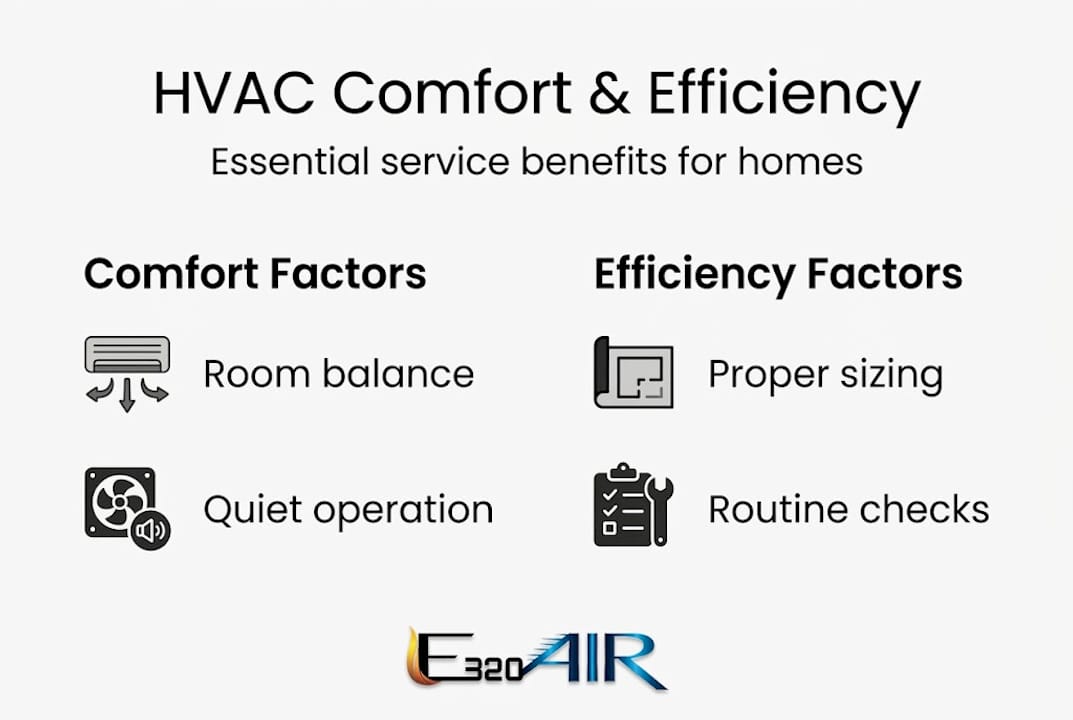
Here's the frustrating truth. Bigger is not better when it comes to HVAC equipment. An oversized air conditioner cools the air so quickly that it shuts off before it removes enough humidity from your home. You end up with a house that feels cold but clammy, and a system that cycles on and off constantly in what's called "short cycling." That rapid on-and-off pattern puts enormous stress on the compressor, which is the most expensive component in the system.
An undersized system has the opposite problem. It runs almost constantly trying to reach your target temperature, drives up your electricity bill, and still can't keep up when Southern California temperatures spike in August or September. Neither scenario gives you real comfort, and both cost you money.
Oversized and undersized systems are surprisingly common, precisely because sizing an HVAC system isn't as simple as matching square footage to a chart. Professionals use what's called a Manual J load calculation, which accounts for your home's insulation levels, window size and orientation, ceiling height, local climate data, and even how many people live in the home.
| Factor | DIY estimate | Professional load calculation |
|---|---|---|
| Square footage | Used as the only variable | One of many variables considered |
| Insulation quality | Ignored | Measured and factored in |
| Window exposure | Not accounted for | Direction and size evaluated |
| Duct condition | Not assessed | Inspected for leaks and balance |
| Humidity loads | Not considered | Built into the calculation |
| Result accuracy | Often 20-40% off | Engineered to match your home |
Learning more about HVAC sizing and efficiency gives you a deeper look at why this step is so critical. For homes with multiple floors or distinct zones, HVAC zoning benefits can make an even bigger difference by allowing different areas to be controlled independently.
Southern California's climate also creates seasonal demands that are different from most of the country. Understanding seasonal HVAC needs specific to Riverside County and nearby areas helps homeowners make smarter decisions about system capacity and scheduling.
Pro Tip: If you've ever had rooms that are noticeably hotter or colder than the rest of your house, don't assume it's a duct problem right away. Ask a technician to evaluate whether your system was properly sized to begin with. Many "mystery comfort issues" trace directly back to incorrect sizing at installation.
Air quality and health: Why expertise matters
You've seen how essential correct sizing is. But comfort is more than temperature. Let's look at the hidden health impacts of HVAC expertise, because this is the part most homeowners never think about until they or someone in the family starts experiencing symptoms.
Indoor air is typically two to five times more polluted than outdoor air. Your HVAC system is the primary tool for managing that air quality. When it's well-maintained, it filters out dust, pollen, pet dander, mold spores, and volatile organic compounds. When it's neglected, it becomes part of the problem, redistributing contaminants throughout every room in your home.
Here's what professional HVAC maintenance does for your air quality:
- Filter replacement and upgrades: A clogged filter doesn't just restrict airflow. It allows particles to bypass the filter and coat your coils and ducts. Technicians check filter condition and recommend the right MERV rating for your system.
- Coil cleaning: Dirty evaporator coils are a breeding ground for mold and bacteria. Professional cleaning removes these buildup layers and prevents biological contamination.
- Duct inspection and cleaning: Ducts that haven't been inspected in years may carry dust, mold, or even pest debris. A technician can identify issues and recommend the appropriate service.
- Airflow balancing: Poor airflow creates stagnant zones where humidity and contaminants accumulate. Balancing ensures every room receives proper circulation.
| Indoor air quality issue | Cause | Professional solution |
|---|---|---|
| Dust buildup | Clogged or wrong-rated filter | Filter replacement and MERV upgrade |
| Musty odor | Mold on coils or in ducts | Coil cleaning, UV light installation |
| High humidity | Oversized system or dirty coils | Sizing check, coil cleaning |
| Allergy flare-ups | Poor filtration | Whole-home air purifier installation |
| Dry indoor air | Undersized system running constantly | Sizing evaluation, humidifier option |
Proper HVAC maintenance and filter replacement are foundational to healthy indoor air and keeping your system running at full capacity. Homeowners with asthma, allergies, or young children in the home see some of the most noticeable improvements after professional maintenance visits.
Your HVAC system should be cleaning the air your family breathes, not adding to the problem. Expert service is what keeps it on the right side of that line.
For a detailed look at how your system affects what you breathe, see our guide on improving indoor air quality and get the full picture on understanding HVAC filters and how to choose the right one for your home.
Choosing the right HVAC partner: What to look for
Once you appreciate the health and comfort value of expert services, it's crucial to know how to pick a trustworthy provider. Southern California has no shortage of HVAC contractors, but the quality gap between them is enormous. Choosing the wrong one can result in exactly the problems you're trying to avoid: poor sizing, shortcuts during installation, and service that creates more issues than it solves.
Here's a step-by-step process for evaluating any HVAC contractor before you commit:
- Verify licensing and certification. In California, HVAC contractors must hold a valid C-20 license issued by the Contractors State License Board. Ask to see the license number and verify it on the CSLB website. Technicians should also hold EPA 608 certification for handling refrigerants.
- Ask about their load calculation process. Any contractor who quotes you a system without performing a Manual J load calculation is skipping a critical step. A good contractor will want to walk through your home before recommending equipment.
- Request a written, itemized estimate. Verbal quotes lead to disputes. A professional contractor provides a detailed written estimate that breaks down equipment costs, labor, materials, and any permits required.
- Check online reviews and ask for references. Look at Google and Yelp reviews, paying attention to how the company responds to negative feedback. Ask the contractor for two or three recent references you can actually call.
- Ask about warranties and service agreements. Equipment warranties mean little if the installation is poor. A reputable contractor backs their labor with a workmanship warranty and offers maintenance agreements to keep your system in top shape.
HVAC sizing, maintenance, and performance all require genuine technical expertise combined with honest homeowner education. Contractors who gloss over details or pressure you to decide immediately are showing you something important about how they operate.
Watch out for these red flags:
- Quotes that seem suspiciously low compared to other bids
- Pressure to sign on the same day without time to review
- No mention of permits or inspections for new installations
- Technicians who can't explain why they're recommending a specific size or brand
- No written warranty on labor
To understand more about what a qualified professional does on the job, the guide on HVAC contractor roles breaks it down clearly. When you're ready to move forward, seeing what a quality professional HVAC installation looks like in practice helps set the right expectations.
Pro Tip: Get at least three quotes before making a decision. This isn't just about price. It helps you understand the range of approaches different contractors take and spot outliers on either end. The lowest bid and the highest bid often tell you the most.
Why most HVAC issues trace back to the provider you choose
After years of working on HVAC systems across Southern California, we've noticed something consistent. When homeowners come to us frustrated with high bills, uneven temperatures, or air quality issues, the problem is almost never the brand of equipment they bought. It's the decisions made by whoever installed and maintained it.
California's climate makes this worse. The combination of intense summer heat, dry inland conditions, and wildfire smoke seasons puts more stress on HVAC systems here than in most parts of the country. A system installed with shortcuts anywhere else might muddle through for years. In Southern California, those shortcuts show up fast.
The homeowners who have the best long-term outcomes are the ones who prioritize credentials and transparency over price when choosing a contractor. They ask hard questions. They get things in writing. And they don't wait until something breaks to schedule service.
When a system is installed correctly from the start and maintained on schedule, it runs efficiently, lasts longer, and keeps the home comfortable through every season. That's not luck. It's the result of choosing a provider who treats every job as if their reputation depends on getting it right, because it does. For anyone considering an upgrade, this overview of California HVAC upgrade choices is worth reading before making any decisions.
How E320 Air can help with expert HVAC solutions
Ready to avoid costly mistakes and enjoy year-round comfort? The difference between a frustrating HVAC experience and one that genuinely improves your home comes down to who you trust with the work.
E320 Air brings local Southern California expertise to every project, from correctly sized system installations to thorough maintenance visits that protect your air quality and extend equipment life. Our team holds all required certifications, provides detailed written estimates, and stands behind every job with workmanship guarantees. Whether you're planning a new HVAC installation or want to see real examples of problems we've solved for homeowners just like you, our problem solving gallery shows what honest, skilled service actually looks like in practice.
Frequently asked questions
Why can't I install or repair my HVAC system myself?
Professional HVAC service ensures correct sizing through load calculations, code-compliant installation, and safe refrigerant handling. DIY attempts often result in oversized or undersized systems that drive up bills and create ongoing comfort and humidity problems.
How often should HVAC maintenance be performed in Southern California?
Twice-yearly maintenance, once in spring before cooling season and once in fall before heating season, keeps your system performing at its best. Proper maintenance and filter replacement are essential for healthy indoor air and long system life.
What are the signs my HVAC system was poorly sized?
High energy bills, rooms that never quite reach the right temperature, and excess humidity or dryness are all common signs. These are classic results of oversized or undersized systems that needed a proper load calculation before installation.
Does regular HVAC service really improve my home's air quality?
Yes, and the difference can be dramatic. Expert maintenance removes dust, mold, and allergens from filters, coils, and ducts, and proper filter replacement ensures your system circulates genuinely cleaner air rather than recycling pollutants through your home.