
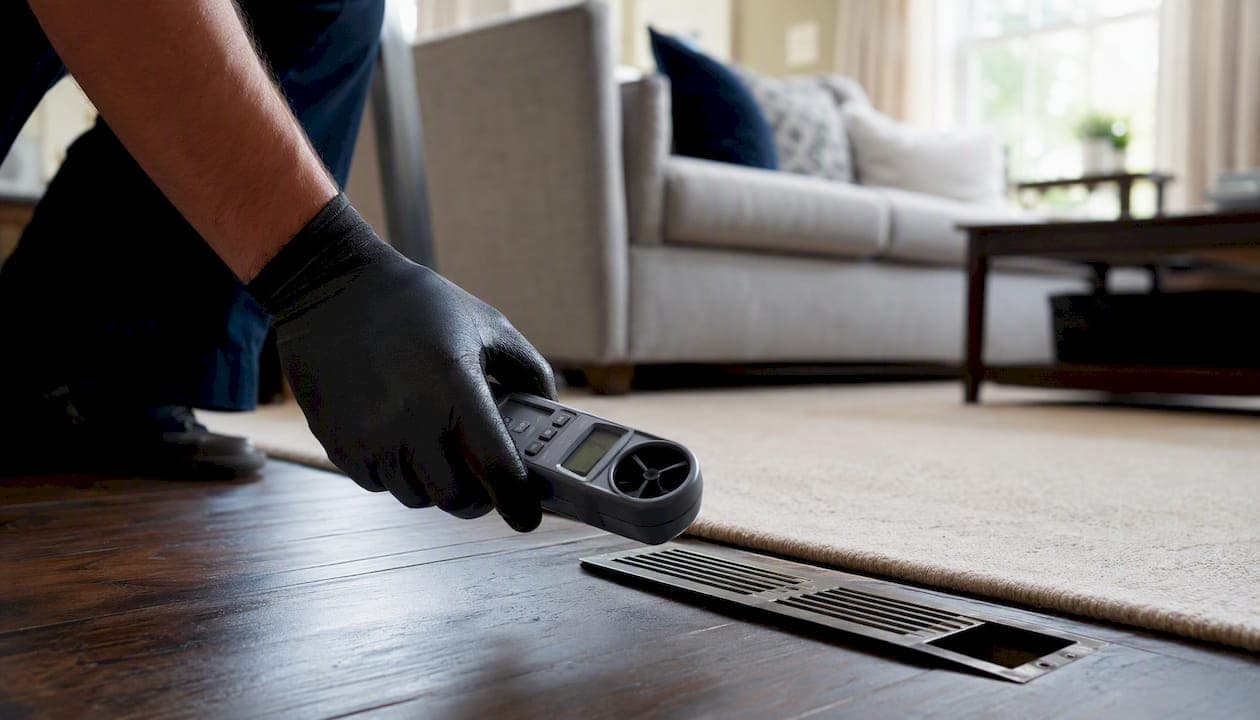
Weak airflow from vents usually comes down to one of five culprits: a clogged air filter, closed or blocked registers, leaky ductwork, a struggling blower motor, or a frozen evaporator coil. Most of the time, you can narrow it down in under ten minutes. Before you call anyone, try these three checks first.
Three fast checks to do right now:
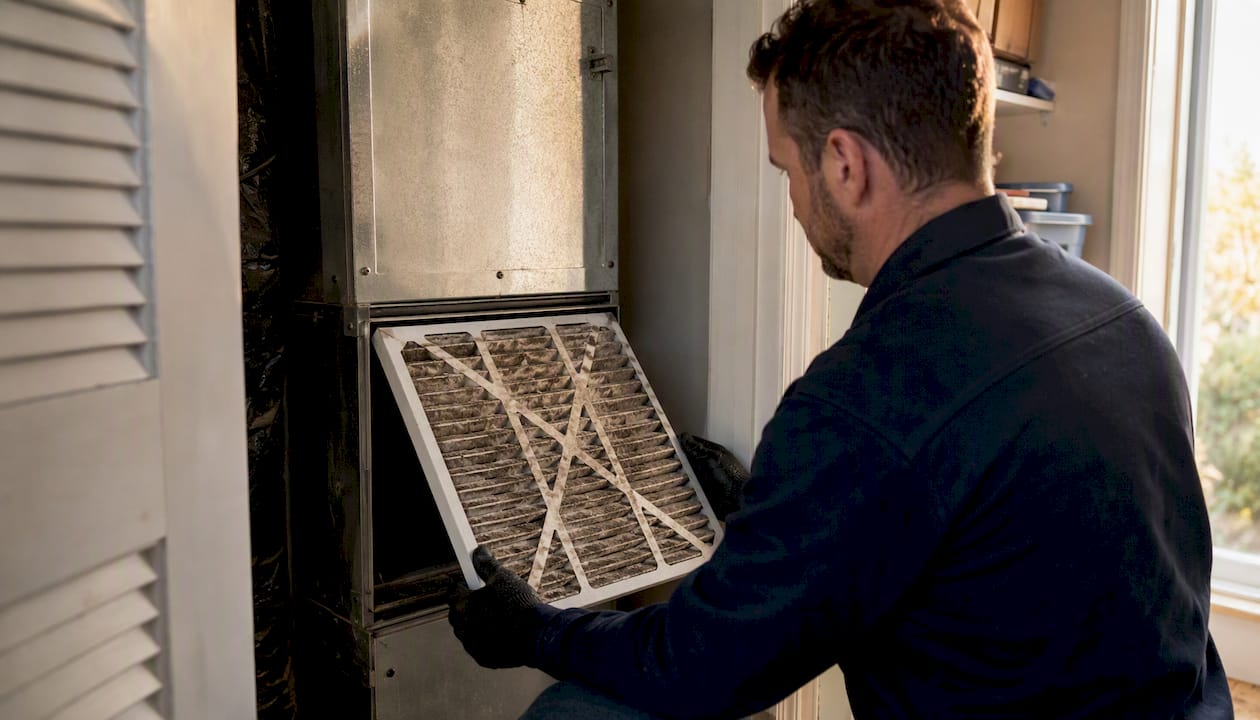
- Check your air filter. Pull it out and hold it up to a light. If you can't see light through it, replace it immediately. A choked filter is the single most common reason for low airflow from vents, and swapping it out costs a few dollars.
- Walk every supply and return vent. Make sure none are closed, covered by furniture, or blocked by rugs. A single blocked return can starve the entire system.
- Feel the airflow. Hold a thin tissue near a supply register. Weak flutter or no movement at all tells you the system is struggling to push air. Then check the return grille — if suction feels faint there too, the problem is upstream (filter, blower, or coil), not just a single duct run.
One safety note before you go further: never open the air handler cabinet or touch any wiring or refrigerant lines without first turning off power at the breaker. What's inside can injure you.
Temporary fixes that often restore noticeable airflow quickly:
- Replace a dirty filter with a fresh one (same MERV rating or lower if airflow was already weak)
- Open every supply and return register fully
- Move furniture, rugs, or curtains away from vents
- Set the thermostat fan to "ON" briefly to test whether airflow improves at all registers
Key Takeaways
A dirty air filter is the most common cause of weak airflow from vents, and replacing it — along with opening all registers and clearing returns — resolves the problem in most homes without a service call.
| Point | Details |
|---|---|
| Replace the filter first | A clogged filter raises static pressure and cuts airflow; it's the fastest, cheapest fix to try. |
| Open every register and return | Closed or blocked vents starve the blower and reduce airflow throughout the system. |
| One room vs. whole-house matters | Weak airflow in one room points to a duct problem; whole-house weakness points to the blower or coil. |
| Frozen coil means call a pro | Ice on the evaporator coil requires a technician — turn the system off and don't delay. |
| E320air for persistent issues | E320air provides static pressure testing, duct sealing, blower repair, and coil cleaning across the Inland Empire. |
Table of Contents
- What's actually causing weak airflow from your vents?
- Step-by-step troubleshooting checklist for homeowners
- When to call an HVAC professional for low vent pressure
- How to prevent weak airflow before it starts
- What the field actually teaches you about airflow problems
- E320air can diagnose and fix your airflow problem
- Sources
What's actually causing weak airflow from your vents?
Poor air circulation rarely has a single dramatic cause. More often it's a combination of small restrictions that add up. Homeowners often mistake temperature problems for airflow problems — the system runs and runs, yet certain rooms stay stuffy or warm. That's a circulation failure, not a thermostat failure.
Here's how to read the signs and match them to a cause.
| Symptom | DIY checks | Likely pro fix |
|---|---|---|
| Weak airflow at all vents | Replace filter, open all registers | Blower motor, capacitor, or coil cleaning |
| Weak airflow in one room only | Check that room's register and duct run | Disconnected or crushed flex duct |
| Airflow weak AND air is cold | Check for ice on the coil (visible at air handler) | Frozen coil defrost, refrigerant check |
| Whistling or hissing near vents | Inspect duct joints in attic/crawlspace | Duct sealing or reconnection |
| Uneven temps floor to floor | Check return vent locations and sizes | Air balancing, duct redesign |
| Dusty rooms despite recent cleaning | Check filter and return vent sizing | Duct leakage test, sealing |
The Daikin circulation guide lists fogging windows, lingering odors, and fast dust re-accumulation as reliable signs of poor circulation — useful for distinguishing a real airflow problem from a heating or cooling failure.
Clogged or dirty air filter
A dirty filter raises static pressure inside the duct system, forcing the blower to work harder while moving less air. It's the leading cause of HVAC airflow issues and the easiest fix. Replace it, then run the system for 15 minutes to see whether airflow improves.
Closed, blocked, or recessed registers
Closing vents to "redirect" airflow to other rooms actually increases system pressure and can damage the blower over time. Open every register fully. Check that supply registers aren't recessed into deep floor cavities where furniture sits directly over them.
Blocked or undersized return vents
Returns are the intake side of the system. Block them and the blower starves for air. A single large return in a central hallway often can't serve a multi-room home adequately — especially if interior doors stay closed. Try leaving bedroom doors open or cracking them an inch; it makes a measurable difference.
Duct leaks, disconnections, or crushed flex duct
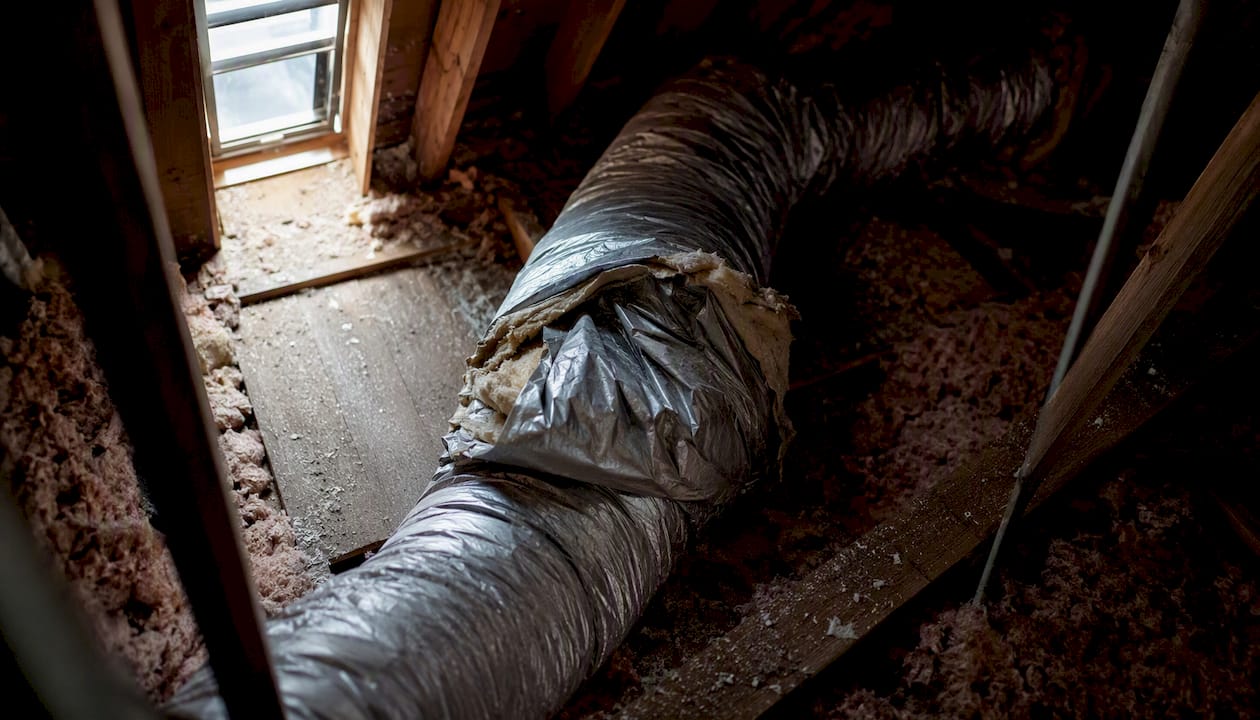
Leaky ductwork can lose up to about 30% of conditioned air before it reaches living spaces. In attics and crawlspaces, flex duct gets kinked, crushed, or simply falls off its collar. Inspecting accessible duct runs often finds a disconnected joint that's been blowing conditioned air into the attic for years. That's a high-payoff repair you can sometimes fix with foil tape and a clamp — but only if you can safely access it.
Undersized or poorly designed ductwork
Some homes were built with duct systems that were never adequate for the equipment installed. If every other cause checks out and airflow is still weak throughout the house, the duct design itself may be the problem. This requires a load calculation and professional redesign. Learn more about why ductwork matters for HVAC efficiency.
Blower motor, capacitor, or fan issues
A blower running at reduced speed — due to a failing capacitor or worn motor — produces noticeably less airflow at every vent simultaneously. You might hear the system running but feel almost nothing at the registers. This is a pro repair.
Frozen or very dirty evaporator coil
A frozen coil physically blocks airflow at the air handler. The system may still blow cold air, but weakly. Ice on the coil is a clear sign a trained technician is needed — turn the system off (fan only) to let it thaw, and call for service. A dirty coil has the same effect without the visible ice.
Clogged condensate drain or pan
A backed-up condensate drain can trigger a float switch that shuts the system down partially or causes moisture buildup around the coil. If you notice water near the air handler alongside weak airflow, the drain line likely needs flushing. Mold in the drain pan can compound the restriction and is worth addressing as part of any airflow diagnosis.
High-MERV filters that overload the blower
Pro Tip: A MERV 13 filter traps more particles, but if your blower wasn't sized for that resistance, it will move significantly less air. Many homeowners upgrade to a high-efficiency filter thinking it helps — and it does for air quality — but it can cut airflow noticeably on older or smaller systems. If you suspect this, drop to a MERV 8 temporarily and see whether airflow improves. If it does, your system needs either a blower upgrade or a lower-rated filter.
Seasonal pollen, smoke, and external factors
During high-pollen spring months or wildfire smoke events common in the Inland Empire, filters load up far faster than usual. A filter that normally lasts 90 days may need replacement after 30. Check it monthly during those periods.
Step-by-step troubleshooting checklist for homeowners
Work through these in order. Each step takes only a few minutes, and the sequence is designed to catch the most common problems first.
What you'll need: replacement filter (same size), flashlight, ladder, screwdriver, thin tissue or paper strip.
- Turn off the system at the thermostat before touching any panels or registers.
- Replace the air filter. Even if it looks okay, swap it. A filter that appears lightly gray can still be restricting airflow significantly. Check the HVAC filter essentials guide for the right MERV rating for your system.
- Open and clear every supply register. Walk the house. Open any that are closed, and move furniture or rugs blocking them.
- Check every return grille. Returns are usually larger, wall-mounted grilles with no louvers. Make sure none are blocked. Hold your hand near one with the system running — you should feel a strong pull.
- Check the thermostat fan setting. Set it to "FAN ON" (not AUTO) and feel airflow at several registers. If airflow is present but weak, the blower is running but underperforming. If there's no airflow at all, the blower may not be running.
- Run the tissue test. Hold a thin strip of tissue near a supply register. It should flutter noticeably. Near a return, it should pull toward the grille. Weak or no movement confirms restricted airflow.
- Inspect accessible duct runs in the attic or crawlspace with a flashlight. Look for disconnected joints, crushed flex duct, or sections that have fallen off their collar. Reconnecting a dropped duct joint is one of the highest-payoff DIY repairs possible.
- Check the air handler for ice. Open the panel (power off first) and look at the evaporator coil. Visible frost or ice means a frozen coil — stop here and call a technician.
- Note whether the problem is one room or whole-house. One weak room points to a duct problem on that branch. Whole-house weakness points to the filter, blower, or coil.
Safety reminder: Turn off power at the breaker before opening the air handler. Never touch refrigerant lines, electrical terminals, or the capacitor — capacitors store charge even after power is cut.
| What you found | What it likely means | Suggested next step |
|---|---|---|
| Airflow improved after filter change | Static pressure restriction | Continue regular filter maintenance |
| No change after filter change | Blower, coil, or duct issue | Continue checklist; call tech if no improvement |
| Whistling or hissing near ducts | Duct leak or disconnection | Inspect accessible duct runs; seal or call tech |
| Ice visible on coil | Frozen evaporator coil | Turn off system; call HVAC technician |
| One room weak, others normal | Branch duct problem | Inspect that room's duct run |
| Blower spins slowly or hums | Capacitor or motor failure | Call HVAC technician |
When to call an HVAC professional for low vent pressure
Some problems are genuinely beyond safe DIY. Knowing when to stop saves you time, money, and the risk of making things worse.
Call a pro if you see or experience any of these:
- Ice or frost on the evaporator coil or refrigerant lines
- Refrigerant smell (sweet or chemical odor near the air handler)
- Blower motor humming but not spinning, or spinning slowly
- Airflow still weak after replacing the filter and clearing all registers
- Visible duct damage in inaccessible areas (inside walls, sealed ceilings)
- Water pooling near the air handler or a tripped float switch
- Persistent ventilation system problems after completing the full checklist above
What a technician will actually do
A trained tech doesn't just guess. They measure. Static pressure testing tells them exactly where resistance is highest in the duct system. Blower amp draw shows whether the motor is working too hard or underperforming. A duct leakage test (blower door or duct blaster) quantifies how much conditioned air the system is losing. ENERGY STAR recommends sealing and insulating ducts as a priority step before any equipment replacement — because leaky ducts can make a new system perform just as poorly as the old one.
For a frozen coil, the tech will defrost it, check refrigerant charge, and inspect the metering device. For a blower issue, they'll test the capacitor first (a $10–$30 part that causes most blower failures) before recommending a motor replacement.
Cost ranges are ballpark estimates for U.S. residential service; actual pricing varies by region, system size, and access difficulty.
How to prevent weak airflow before it starts
Prevention is mostly about consistency. A few simple habits keep the system moving air freely year-round.
Filter replacement schedule:
- Basic fiberglass (MERV 1–4): every 30 days
- Pleated mid-range (MERV 8–10): every 60–90 days
- High-efficiency (MERV 11–13): every 60–90 days, or monthly during pollen season or wildfire events
- Homes with pets or allergy sufferers: check monthly regardless of filter type
The HVAC filter replacement guide covers filter selection and timing in more detail for California homes, where seasonal smoke and pollen load filters faster than the national average.
Annual and biannual maintenance tasks:
- Spring (before cooling season): coil inspection and cleaning, condensate drain flush, refrigerant charge check, blower inspection
- Fall (before heating season): heat exchanger inspection, filter replacement, duct visual inspection
- Every 2–3 years: professional duct leakage test and sealing if airflow has gradually declined
Seasonal factors to watch:
During high-pollen months (typically March through May in Southern California) and wildfire smoke events, outdoor air quality degrades fast. Filters load up quickly, and ventilation systems in Southern California homes face added strain. Check filters monthly during these windows, not quarterly.
Why returns and fresh air matter:
ASHRAE recommends a minimum of 15 CFM per person for residential make-up air in living areas. When returns are blocked or undersized, the system can't meet that threshold — and indoor air quality drops alongside airflow.
Proper ventilation and condensate management also reduces mold risk, which can compound airflow restrictions over time.
When to consider an upgrade:
If airflow has been chronically weak despite clean filters and open registers, the duct system or equipment may simply be undersized for the home. A Manual J load calculation and duct design review will tell you whether a new HVAC installation makes more sense than continued repairs. Learn more about how HVAC design affects home comfort and when a redesign pays off.
What the field actually teaches you about airflow problems
The pattern on most service calls is predictable: a filter that hasn't been changed in eight months, two or three supply registers closed "to save energy," and a return vent blocked by a bookcase. Fix those three things and airflow often doubles before a single tool comes out of the bag.
The second most common pattern is crushed flex duct in the attic — usually from someone stepping on it during a roof inspection or insulation job. One kinked section can cut airflow to an entire room by half. It's a 20-minute fix when you can reach it, and it goes unnoticed for years because the system still runs.
What I'd caution against is the DIY instinct to open the air handler and start poking around when the blower seems slow. Capacitors store a dangerous charge. Refrigerant lines are under pressure. If the basic checklist didn't fix it, the next step is a licensed technician with a static pressure gauge — not a screwdriver and a YouTube video.
E320air can diagnose and fix your airflow problem
When the checklist doesn't solve it, E320air handles the full diagnostic workup: static pressure testing, blower inspection, duct leakage assessment, coil cleaning, and targeted repairs — all in a single visit for most residential systems. No guesswork, no upselling parts you don't need.

E320air serves homeowners across the Inland Empire with transparent pricing on diagnostics and repairs. A diagnostic visit includes a full system inspection and a written summary of findings before any repair work begins — so you know exactly what's wrong and what it will cost to fix it. For homeowners dealing with persistent low airflow after DIY attempts, that clarity alone is worth the call.
Browse real before-and-after repair examples in the E320air problem-solving gallery, or schedule a diagnostic visit today.
Sources
- Duct sealing — ENERGY STAR
- Why is My HVAC System Blowing Weak Air? 5 Easy Fixes
- Poor HVAC Airflow? Fix Weak Air Coming From Vents
- Signs your home has bad airflow — Real Simple
- Signs your home has poor air circulation | Daikin