
HVAC airflow CFM, or cubic feet per minute, measures the volume of air your system moves through your home every minute. Think of it as the heartbeat of your HVAC system: too slow and rooms stay stuffy or unevenly heated; too fast and you lose humidity control. A 3-ton central air system generally moves around 1,200 CFM at peak operation based on the rule of thumb of 400 CFM per ton used in residential HVAC design.
CFM is the standard measurement for airflow in heating, ventilation, and air conditioning across the United States. It tells you how much conditioned air actually reaches your living spaces, not just what the equipment is rated to produce. A few quick reference points:
- A 1-ton cooling system targets 400 CFM
- A 2-ton system targets 800 CFM
- A 3-ton system targets 1,200 CFM
- Ventilation airflow is calculated separately using air changes per hour (ACH), which measures how many times per hour the total room air volume is replaced
ACH and CFM are closely linked. A bedroom with 800 cubic feet of volume needing 4 ACH requires a corresponding ventilation airflow. The distinction between ventilation CFM and cooling CFM matters because they serve different purposes and use different formulas.
Table of Contents
- Why proper CFM levels matter for your home's comfort and efficiency
- How to calculate CFM for your HVAC system
- Common problems that disrupt your HVAC airflow
- How duct design and sizing shape your actual CFM delivery
- Professional insights on getting HVAC airflow right
- Key Takeaways
Why proper CFM levels matter for your home's comfort and efficiency
Getting CFM right is not just about comfort. It directly affects how long your equipment lasts and how much you pay to run it.
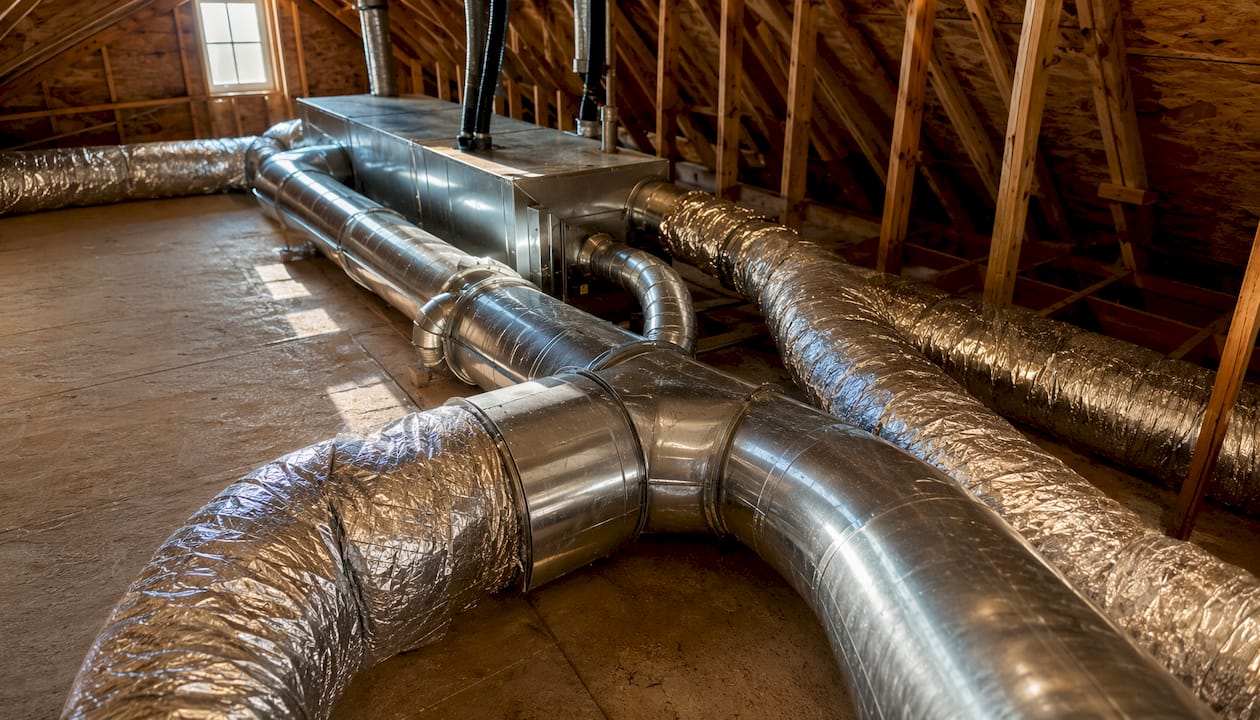
Proper CFM prevents the blower motor and compressor from working harder than they need to. When airflow is too low, the evaporator coil can freeze, the heat exchanger overheats, and components wear out years ahead of schedule. When airflow is too high, the system blows air through too quickly to condition it properly, and in humid climates like the American South, you end up with that cold and clammy feeling that no thermostat setting seems to fix.
Key ways proper CFM affects your home:
- Even temperature distribution: Balanced airflow means every room reaches the set temperature, not just the ones closest to the air handler
- Indoor air quality: Adequate CFM keeps air circulating through filters, reducing dust, allergens, and pollutants; learn more about HVAC and indoor air quality
- Energy bills: A system fighting poor airflow runs longer cycles and consumes more electricity
- Humidity control: Correct CFM gives the coil enough contact time with the air to pull out moisture effectively
- System lifespan: Consistent, correct airflow is one of the strongest predictors of how long your equipment lasts; see E320air's guide on extending HVAC lifespan
Pro Tip: If certain rooms in your home always feel warmer or cooler than the thermostat setting, unbalanced CFM is usually the first thing to check, not the thermostat itself. A simple vent adjustment or duct inspection often resolves what homeowners assume is a refrigerant problem.
How to calculate CFM for your HVAC system
There are two main approaches, and which one you use depends on what you are trying to figure out.
Method 1: Ventilation CFM from room volume and ACH
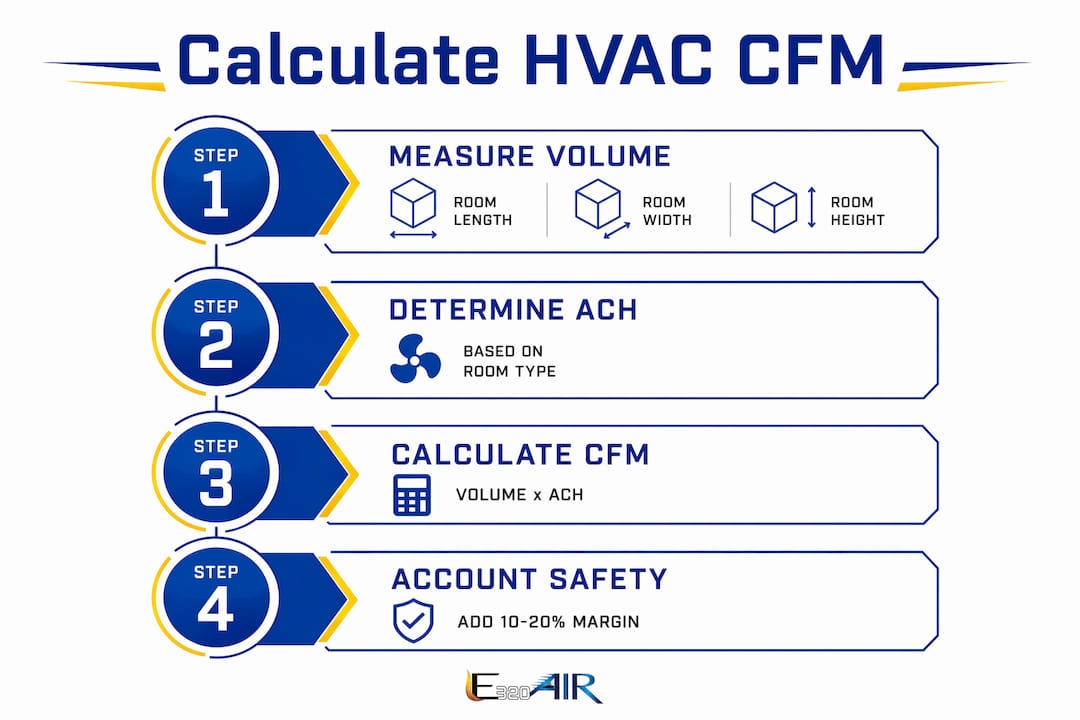
This formula tells you how much airflow a room needs to meet ventilation standards:
Room volume is simply length × width × height in feet. ACH varies by room type: bedrooms typically need 1–2 ACH, kitchens 7–8 ACH, and bathrooms 6–7 ACH. A 10 × 12 × 9-foot bedroom (1,080 cubic feet) at 2 ACH needs 36 CFM.
Method 2: Cooling CFM from sensible heat load
For sizing cooling airflow, the industry-standard thermal load formula is:
Where ΔT is the difference between room temperature and supply air temperature. A typical supply air temperature is 55°F against a 75°F room setpoint, giving a ΔT of 20°F. Using the sensible heat formula, you can calculate the needed CFM based on BTU/h sensible heat gain divided by (1.08 × ΔT).
Method 3: Tonnage rule of thumb
For a quick whole-system estimate, 400 CFM per ton of cooling capacity is the standard starting point, though climate and coil specs can shift that number.
Calculation steps in brief:
- Measure room dimensions and calculate volume (L × W × H)
- Determine required ACH for the space type
- Apply the ventilation formula for fresh air needs
- Use the sensible heat formula for cooling load sizing
- Cross-check against tonnage: multiply system tons by 400 for a ballpark total CFM
Common problems that disrupt your HVAC airflow
Most airflow complaints trace back to a handful of causes, and the fix is rarely the fan itself.
Weak airflow often comes from high static pressure caused by dirty filters, blocked vents, or leaking ducts, not from the fan being undersized. The fan may be rated for 1,200 CFM, but if the duct system is fighting it with resistance, actual delivery to rooms can drop significantly.
Common airflow problems to inspect:
- Dirty air filters: A clogged filter is the single most common cause of reduced CFM; replacing it every 1–3 months is the cheapest maintenance you can do
- Blocked or closed vents: Closing vents in unused rooms increases static pressure system-wide and reduces total airflow
- Leaking ductwork: The U.S. Department of Energy estimates that duct leakage in typical homes can account for significant conditioned air loss before it reaches living spaces
- Undersized or oversized ducts: Ducts that are too small create velocity pressure that restricts flow; ducts that are too large slow air down and reduce delivery pressure
- Dirty evaporator coils: Coil buildup restricts airflow across the heat exchange surface, reducing both CFM and cooling efficiency
Too little CFM causes hot and cold spots, frozen coils, and humidity buildup. Too much CFM, as noted, rushes air through before the coil can dehumidify it properly. Neither extreme is harmless, and both cost money over time.
How duct design and sizing shape your actual CFM delivery
Your HVAC unit's rated CFM means nothing if the duct system cannot deliver it. Duct design is where most residential airflow problems originate.

The cross-sectional area of a duct directly limits how much air can pass through it at a given velocity. A standard rule in residential design is to keep duct velocity below 700–900 feet per minute (FPM) in main trunks to control noise and pressure drop. Undersized ducts push velocity higher, which increases friction loss and drops the CFM reaching each register.
Duct length and the number of bends also matter. Each 90-degree elbow adds friction equivalent to several feet of straight duct. A long duct run with multiple elbows to a far bedroom can deliver noticeably less CFM than a short, straight run to a room near the air handler, even when both registers are the same size. This is why air balancing across a duct system requires dampers and careful design, not just the right fan size.
Duct material matters too. Flex duct, common in residential construction, has higher friction resistance than sheet metal when it is compressed or kinked during installation. A flex duct run that sags or bends sharply can lose a meaningful portion of its rated airflow before the air ever reaches the register.
Professional insights on getting HVAC airflow right
Knowing the formula is one thing. Getting the right CFM out of a real-world system takes a few additional steps that most homeowners never hear about.
Most HVAC systems need a 10–20% safety margin added to calculated CFM to account for duct resistance, filter loading, and system effects that are hard to model precisely. If your calculation says you need 1,000 CFM, size the fan or system for 1,100–1,200 CFM. That buffer keeps performance consistent as filters load up between changes.
Humidity and climate also shift the target. In high-humidity regions, slightly lower CFM gives the evaporator coil more contact time with the air, improving moisture removal. In dry climates, higher CFM is less of a concern. Adjusting airflow seasonally, or at least accounting for climate in the original design, pays off in comfort.
For measuring actual airflow, professionals use:
- Anemometers: Measure air velocity at registers; combined with register area, they calculate CFM directly
- Flow hoods: Placed over a register to capture and measure total airflow at that point, giving the most accurate per-register reading
- Pressure drop measurement: Measuring pressure drop across filters and coils reveals actual airflow quality beyond what the fan nameplate states
Maintenance steps that protect CFM over time:
- Replace filters on schedule (every 1–3 months for standard 1-inch filters)
- Seal duct leaks with mastic sealant or metal tape, not standard duct tape
- Keep all supply and return vents open and unobstructed
- Schedule annual professional airflow testing, especially after any duct modification or equipment change
Pro Tip: Ask your HVAC technician to measure static pressure during your next service visit. A reading above 0.5 inches of water column (in. w.c.) on a residential system usually signals a restriction worth investigating, whether that is a dirty filter, a kinked flex duct, or an undersized return.
Key Takeaways
Correct HVAC airflow CFM, calculated from sensible heat load or room volume and ACH, is the single most important factor in keeping your system efficient, your air clean, and your equipment running long.
| Point | Details |
|---|---|
| CFM baseline rule | Residential cooling systems target roughly 400 CFM per ton of cooling capacity; for example, a 3-ton system typically targets 1,200 CFM. |
| Two calculation methods | Use the ACH formula for ventilation needs; use the sensible heat formula (CFM = BTU/h ÷ (1.08 × ΔT)) for cooling load sizing. |
| Safety margin matters | Add a 10–20% buffer to calculated CFM to account for real-world duct resistance and filter loading. |
| Most airflow problems start in ducts | Dirty filters, leaking ducts, and blocked vents reduce effective CFM far more often than fan capacity does. |
| Measure, don't guess | Anemometers, flow hoods, and pressure drop readings give you actual CFM delivery, not just nameplate ratings. |
If your home has rooms that never quite reach the right temperature, or your energy bills seem high for the system size you have, airflow CFM is almost always part of the story. E320air's team diagnoses and corrects airflow issues across residential and commercial systems, from HVAC installation to full duct balancing. If you want a professional assessment of your system's actual airflow performance, E320air is ready to help.