
Most California homeowners land between $2,500 and $9,000 out-of-pocket for a heat pump installation after stacking state and federal incentives, with a typical 3-ton ducted system netting around $6,000 to $12,000 and a single-zone ductless starter unit often falls under $4,000. The final number depends heavily on whether your ductwork needs work and whether your electrical panel can handle the new load.
TL;DR:
- The net cost of a heat pump in California can be reduced by $3,000 to $8,000 through state and federal rebates, depending on income qualification.
- Costs vary widely based on system type, home size, ductwork condition, and electrical upgrades, with ductless systems starting under $4,000 and ducted setups exceeding $12,000.
- Most of the price difference stems from ductwork repairs, electrical panel upgrades, and accurate sizing, which contractors should verify with a Manual J calculation.
- Rebate processing at the point of sale by licensed contractors ensures savings are applied directly, but only if the contractor accurately documents rebate eligibility and invoicing.
- A typical installation takes one to two days for simple swaps and up to five days when duct or electrical upgrades are necessary.
Table of Contents
- What Does Heat Pump Installation Cost in California?
- How Much Does a Heat Pump Cost by System Type?
- What Actually Drives Your Final Price?
- What Rebates and Tax Credits Apply in California?
- How Long Does Permitting and Installation Actually Take?
- How Do You Get an Accurate Contractor Quote?
- Field Notes: What Real California Installs Actually Cost
- What Most Cost Guides Get Wrong About Heat Pumps
- Get a Rebate-Ready Quote From E320air
- Sources
What Does Heat Pump Installation Cost in California?
The gross installed price before any rebates typically varies by system type, with single-zone ductless systems generally being less expensive than whole-home ducted heat pumps, and larger multi-zone or geothermal setups costing more. Those numbers reflect equipment, standard labor, and permit fees for a straightforward swap, not a job with major ductwork or panel work.
Once you stack the state's point-of-sale rebate program with the federal Residential Clean Energy Credit, the net price for most households drops by $3,000 to $8,000, more for income-qualified equity-tier households. A quoted "installed" price should include:
- The heat pump unit and any indoor air handler or coils
- Labor for removal of old equipment and installation of new
- Permit fees and required inspections
- Basic refrigerant line connections and startup testing
It usually does not include electrical panel upgrades, extensive duct repair, or asbestos abatement in older attics. Those get quoted separately, and they're where budgets blow past estimates.
How Much Does a Heat Pump Cost by System Type?
Home size and existing infrastructure determine which system type makes sense, and each comes with its own cost band. Installed-cost benchmarks by home footprint show a rough doubling in price from a single zone to a full ducted retrofit.
-
Single-zone ductless (mini-split). Installed cost runs $4,000 to $9,000. This fits smaller homes, additions, or a single problem room, roughly 1,000 square feet or less. Coastal Southern California homes with mild year-round temperatures often get away with just one or two zones.
-
Multi-zone ductless. Installed cost for multi-zone ductless systems covers three to five indoor units tied to one or two outdoor condensers, suitable for mid-size homes without existing ductwork. This suits mid-size homes without existing ductwork, around 1,800 to 2,200 square feet, especially older bungalows in the Inland Empire where adding ducts would mean tearing into walls.
-
Ducted central heat pump. Installed cost for ducted central heat pumps applies to homes with existing ductwork in reasonable condition and is typical for larger homes. This is the most common path for larger homes, 2,500 square feet and up, particularly in hot inland valleys like Riverside and San Bernardino where a heat pump also replaces central air conditioning.
-
Geothermal (ground-source). Installed cost for geothermal (ground-source) heat pumps tends to be substantially higher due to excavation and loop-field installation requirements. Rare in most California residential markets, but it delivers the most stable efficiency in extreme heat.
Across all four types, equipment typically accounts for 55% to 65% of the gross price, with labor and incidental materials making up 25% to 35%, according to cost-split data from California installs. If ductwork or a panel upgrade enters the picture, that's an add-on cost layered on top, not something baked into these base ranges.
What Actually Drives Your Final Price?
Two identical homes on the same street can get bids $6,000 apart, and it almost always comes down to four things.
- Ductwork. Sealing and minor duct repairs can add to the cost, and full duct replacements, often needed in older homes, substantially increase the total expense.
- Electrical upgrades. A simple subpanel addition might cost $1,200 to $2,500. A full panel upgrade to 200-amp service, often required for larger heat pumps with backup heat strips, runs $1,200 to $4,000, based on typical California electrical upgrade pricing.
- Sizing and refrigerant type. A proper Manual J load calculation might reveal you need a bigger (or smaller) unit than your old system, and newer refrigerants like R454B can carry a modest equipment premium over older R410A units.
- Permits and inspections. Permit and inspection fees depend on local jurisdiction and may add to both cost and processing time.
Pro Tip: Ask your contractor for a Manual J calculation before you sign anything. An oversized heat pump costs more upfront, short-cycles constantly, and won't qualify for some efficiency-based rebate tiers.
What Rebates and Tax Credits Apply in California?
This is where the real savings happen, and it's also where quotes get confusing if a contractor isn't transparent about how the numbers stack.
TECH Clean California offers point-of-sale rebates, meaning the discount gets applied directly on your invoice rather than as a rebate check you chase down months later. Standard-tier households get one rebate amount; income-qualified equity-tier households get a substantially larger one. That gap can swing net cost by thousands of dollars, so check your household's eligibility before assuming the "average" rebate applies to you.
- TECH Clean rebate is applied at point of sale with amounts that vary depending on system size and income tier.
- Utility-specific adders: some territories layer on additional incentives for income-qualified customers
- Federal Residential Clean Energy Credit: a percentage-based tax credit calculated on your cost after the point-of-sale rebate is applied, not before
- ENERGY STAR certification is often the eligibility threshold for the higher rebate tiers
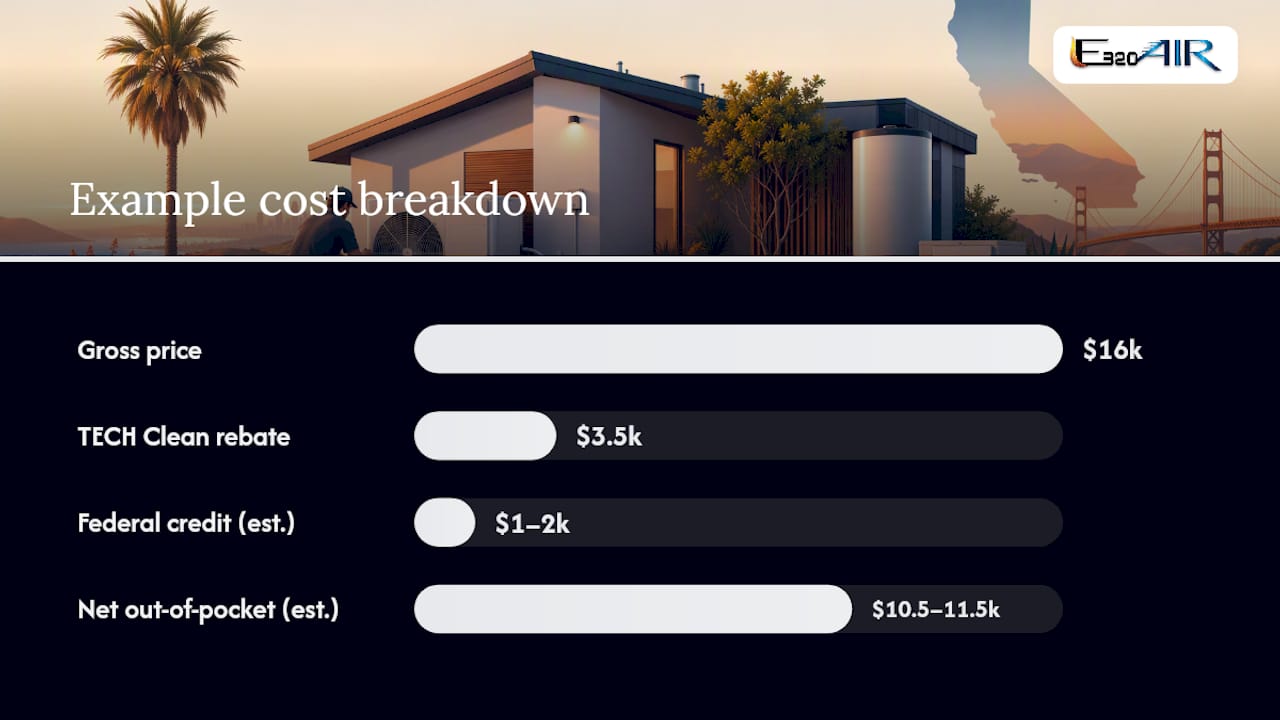
Worked example: A ducted 3-ton system quotes at $16,000 gross. TECH Clean applies a $3,500 point-of-sale rebate, bringing the contract price to $12,500. The federal credit then applies to that post-rebate amount, shaving off roughly $1,000 to $2,000 depending on the current credit percentage and cap. Net out-of-pocket: somewhere around $10,500 to $11,500. Income-qualified households under the equity tier can receive significantly larger TECH Clean rebates, substantially lowering net costs.
How Long Does Permitting and Installation Actually Take?
California's updated Title 24 energy code now requires HERS field verification for many heat pump replacements, and that single requirement changes both scope and schedule more than most homeowners expect.
- HERS verification triggers extra work. If your ducts leak more than code allows, expect duct sealing added to the job before the HERS rater signs off.
- Permit review timelines vary by city. Some jurisdictions turn around HVAC permits in 2 to 3 business days; others, especially in dense metro plan-review queues like Los Angeles, take one to two weeks.
- Installation itself is fast. A straightforward swap takes one to two days. Add ductwork or a panel upgrade and you're looking at three to five days total.
- Change orders happen when sizing was guessed. Skipping the Manual J calculation is the single biggest cause of mid-job surprises, and surprises almost always cost money.
How Do You Get an Accurate Contractor Quote?
A vague bid is a red flag. A quote worth trusting should always include a Manual J load calculation, itemized line items for equipment, labor, electrical work, permits, and HERS testing, and a clear statement of which rebate tier the contractor is applying on your behalf.
- Ask whether the contractor is a TECH Clean participating contractor (only participating contractors can apply the point-of-sale rebate directly to your invoice)
- Ask to see how the rebate line appears as a credit on the actual contract, not just a verbal promise
- Request references or prior invoices showing rebate processing they've completed
- Be wary of any bid that skips Manual J, has no mention of HERS testing, or comes in dramatically below every other quote you've collected
Pro Tip: If a contractor can't show you a past rebate-processed invoice when asked, that's your answer. Point-of-sale processing takes paperwork discipline, and not every installer has it.
Field Notes: What Real California Installs Actually Cost
On a recent 3-ton ducted swap for an Inland Empire home built in the 1980s, the gross bid came in at $17,200, including a $2,400 panel upgrade the old electrical service couldn't avoid. After the TECH Clean rebate and federal credit, the homeowner's net cost landed near $11,800, a number our team confirmed against the contract credit line before work began.
Certain contractors handle the full scope on jobs like this:
- Manual J load calculations and system sizing
- Permit filing and HERS coordination
- TECH Clean rebate processing as a participating contractor
- Installation, startup, and warranty registration
Homeowners are left with one job: choosing equipment and signing off on the quote.
What Most Cost Guides Get Wrong About Heat Pumps
Most cost calculators treat the rebate stack as a footnote, when it's actually the whole story. A $16,000 gross bid and a $16,000 gross bid can end in net costs $4,000 apart depending purely on whether the contractor participates in TECH Clean and whether the household qualifies for the equity tier. That's not a rounding error. That's the difference between a heat pump that pencils out this year and one that gets postponed another winter.

The advice I'd push back on hardest: don't chase the lowest gross bid. Chase the lowest verified net bid, with the rebate shown as a line-item credit on the actual contract, not a verbal estimate. A contractor who can't produce that paperwork usually can't process the rebate at all, and you'll find that out after you've already signed.
Prioritize the Manual J calculation before anything else. Oversizing is the quiet cost driver nobody puts in a headline number, and it shows up later in your utility bill and your comfort, long after the invoice is paid.
— Edward
Get a Rebate-Ready Quote From E320air
Some contractors handle the part most homeowners dread: figuring out which rebate tier you qualify for and making sure it actually shows up as a credit on your invoice, not a promise you have to chase later. Residential HVAC contractors typically run the Manual J calculation, file the permits, coordinate HERS verification, and process TECH Clean rebates directly at point of sale.

A site visit is the first step. We'll assess your ductwork, check your panel capacity, and give you an itemized quote that separates equipment, labor, permits, and any upgrades your home actually needs, with the rebate credit already shown on the contract. If you're also weighing the cost against your home's value, a tool like the ARV calculator can help frame the upgrade against your broader budget. Ready to see your number? Request a heat pump installation quote and get a site visit scheduled.
Sources
- IRS — Energy Efficient Home Improvement Credit
- California Energy Commission — Inflation Reduction Act residential energy rebate programs / TECH Clean guidance
- Rewiring America — Here’s how much heat pumps cost to install