
TL;DR:
- Heat pumps are highly efficient systems that move heat for both heating and cooling, offering significant cost savings in California's moderate climate. Proper installation, insulation, and certification are crucial for optimal performance, with incentives making them more accessible. They outperform traditional systems by reducing energy bills, lowering carbon footprints, and providing consistent indoor comfort year-round.
If you're weighing whether to replace your aging furnace or AC, the question of why choose heat pumps keeps coming up for a reason. These systems aren't a trend. They're a proven technology that delivers both heating and cooling at efficiencies that traditional systems simply can't match. California's moderate climate makes heat pumps especially well suited for year-round comfort, and a combination of utility rebates and falling equipment costs has made them more accessible than ever. This article breaks down the real advantages, the practical considerations, and how to move forward.
Table of Contents
- Key takeaways
- Why choose heat pumps: how they work and why they're so efficient
- Real advantages of heat pumps for California homes
- Factors that affect heat pump performance in California
- Heat pumps vs. other heating and cooling options
- Steps to choosing and installing a heat pump in California
- My honest take on heat pumps for California homes
- Ready to make the switch? E320air can help
- FAQ
Key takeaways
| Point | Details |
|---|---|
| Heat pumps are highly efficient | They deliver 300% to 500% efficiency, far surpassing gas furnaces and electric resistance systems. |
| Real cost savings add up fast | Switching can save California households over $1,500 annually compared to gas or electric resistance heating. |
| One system, all seasons | Heat pumps handle both heating and cooling, replacing two separate systems with one. |
| California climate is ideal | Moderate temperatures across most of California allow heat pumps to perform at peak efficiency year-round. |
| Installation quality matters | Proper sizing and a certified installer are the two factors that most determine long-term performance. |
Why choose heat pumps: how they work and why they're so efficient
The single biggest reason homeowners switch to heat pumps is efficiency. But to understand that efficiency, you need to know what makes heat pumps fundamentally different from everything else.
A gas furnace burns fuel to create heat. An electric resistance heater converts electricity directly into heat. Both approaches are limited to roughly 100% efficiency at best. Heat pumps don't generate heat at all. They move it. In winter, they extract heat from outdoor air and transfer it inside. In summer, they reverse the process, pulling heat out of your home and releasing it outside. That's also how air conditioning works, which is why a heat pump is, technically, a reversible AC unit.
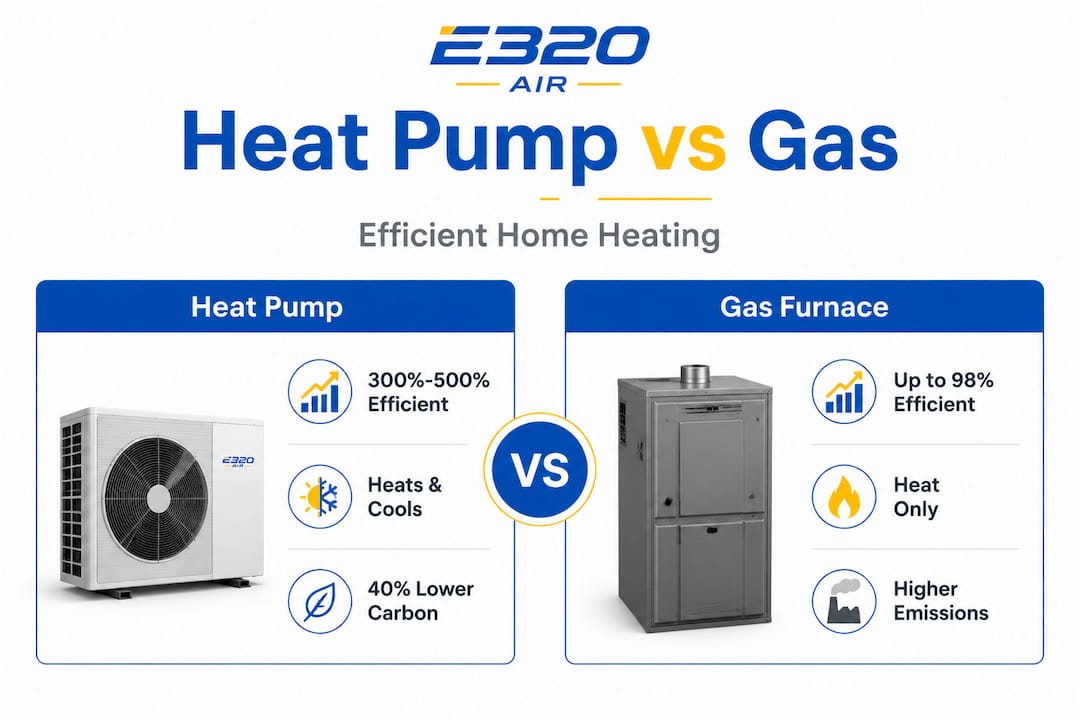
This "moving vs. making" distinction is where the efficiency gains come from. Modern heat pumps achieve 300% to 500% efficiency, meaning for every unit of electricity consumed, you get 3 to 5 units of usable heat delivered into your home. That ratio is called the Coefficient of Performance, or COP.
There are two main types worth knowing about:
- Air-source heat pumps pull heat from outdoor air. These are the most common type installed in California homes and work well in the mild climate most residents experience.
- Ground-source (geothermal) heat pumps extract heat from the earth, which stays at a more stable temperature year-round. They cost more to install but deliver even higher efficiency and are worth considering for homeowners doing a full renovation.
One more point that surprises many people: heat pumps run continuously at low levels rather than cycling on and off the way furnaces do. That steady operation is actually more efficient and creates noticeably more even temperatures throughout your home.
Pro Tip: Set your thermostat to a consistent temperature instead of using aggressive setback schedules. Heat pumps are built for stable settings, and fluctuating setpoints force the system to work harder, which can offset the efficiency gains you're paying for.
Real advantages of heat pumps for California homes
The advantages of heat pumps go well beyond efficiency numbers on a spec sheet. Here's what actually changes when you install one in a California home.
Significant energy cost savings. Replacing a gas furnace with a heat pump saves U.S. households an average of $1,530 annually in energy costs. If you're currently on electric resistance heating, the savings are comparable. That's not a small number. Over a 10-year system life, you're looking at potentially $15,000 or more back in your pocket.

One system for both heating and cooling. Most California homes need AC in summer and heat in winter. A heat pump handles both, which means you're buying and maintaining a single system instead of two. That matters for upfront cost, long-term maintenance, and the amount of equipment taking up space in your home.
Better indoor comfort. Because heat pumps maintain steadier indoor temperatures through continuous low-level operation, you don't get the hot-then-cold cycling that furnaces create. Many homeowners also notice improvements in indoor humidity control during both heating and cooling seasons, which connects directly to indoor air quality and overall comfort.
Lower carbon footprint. Heat pumps reduce carbon emissions by approximately 40% compared to gas furnaces. As California's electric grid continues to add renewable energy, that percentage improves automatically without any change to your equipment. You get cleaner heating without doing anything extra.
California incentives and rebates. State and federal programs make switching more affordable. The federal Inflation Reduction Act provides tax credits up to 30% of heat pump installation costs. California's TECH Clean California program offers additional rebates that can bring upfront costs down substantially. These incentives won't last forever, and the sooner you act, the more you can recover.
Climate suitability. Modern heat pumps perform well in moderate climates like California's and can meet most year-round heating and cooling needs without a backup system. The concern that heat pumps fail in cold weather applies to older technology and extreme climates. For most California zip codes, it simply doesn't apply.
Factors that affect heat pump performance in California
Knowing the advantages of heat pumps is one thing. Getting those advantages in your actual home is another. Several practical factors determine whether your heat pump performs at its potential.
-
Home insulation and air sealing. A well-insulated home is the single biggest factor in maximizing heat pump efficiency. If your walls, attic, and windows are leaking conditioned air, your system has to work harder to compensate. Before or alongside your heat pump installation, assess your building envelope. Adding attic insulation or sealing air gaps around doors and windows often pays back faster than the heat pump itself.
-
Ductwork condition. Air-source heat pumps use ductwork to distribute conditioned air, just like a traditional forced-air system. Leaky ducts can bleed off 20% to 30% of conditioned air before it reaches living spaces. A duct inspection before installation is worth the investment and can be part of the overall project quote.
-
Correct system sizing. An oversized heat pump short-cycles. An undersized one runs constantly without reaching target temperatures. Neither scenario is good for efficiency or comfort. This is where certified HVAC professionals earn their value. Proper load calculations using Manual J methodology tell you exactly what size system your home needs.
-
Hybrid systems for edge cases. If you live in a higher-elevation California location that sees sustained cold snaps below 30°F, a hybrid system pairing a heat pump with a gas furnace backup gives you efficiency most of the year with reliable backup heat when temperatures drop hard.
-
Upfront vs. long-term cost framing. Heat pumps typically cost more to purchase and install than a straight furnace replacement. The math changes when you factor in fuel savings, avoided cooling equipment costs, and available incentives. Most California homeowners recover the cost premium within 3 to 7 years.
Pro Tip: Ask your installer about California efficiency standards before selecting a model. Choosing equipment that qualifies for state rebate programs can reduce your out-of-pocket cost by thousands of dollars without compromising on quality.
Heat pumps vs. other heating and cooling options
When you're asking whether heat pumps are worth it, comparing them directly to alternatives makes the answer clearer.
| System type | Efficiency | Heating + cooling | Carbon impact | Average annual cost |
|---|---|---|---|---|
| Heat pump | 300% to 500% | Yes, one unit | Low (40% less than gas) | Lowest of all options |
| Gas furnace + AC | Up to 98% heating, 20 SEER cooling | No, two units | High | Moderate to high |
| Electric resistance + AC | 100% heating, 20 SEER cooling | No, two units | Moderate | High |
| Central AC only | N/A for heating | No | Moderate | Moderate |
A few points the table doesn't fully capture:
- Gas furnaces require venting and combustion safety inspections that heat pumps don't need. That's a maintenance simplification.
- Electric resistance heating is the most expensive way to heat a home. Switching to a heat pump saves about $1,530 per year and reduces peak electric demand on the grid, which can lower utility rates for everyone in the region.
- Traditional AC units don't provide any heating, so you're always paying for two systems. A heat pump consolidates both into one.
For the best HVAC options in California's climate, heat pumps consistently rank at the top for efficiency, total cost of ownership, and comfort. They're not the right fit in every situation, but they're the right fit for most California homes.
Steps to choosing and installing a heat pump in California
Ready to move from considering to acting? Here's how the process actually works.
-
Evaluate your current system and home. Look at what you're replacing, how old it is, and what your current energy bills look like. This baseline helps you quantify the savings you'll gain and sets expectations with your installer.
-
Assess your building envelope. Check attic insulation, window seals, and door weatherstripping. Fixing obvious air leaks before installation means your new heat pump runs less and saves more from day one.
-
Get quotes from certified HVAC professionals. Ask specifically about their experience with heat pump installations, not just general HVAC work. Request that quotes include Manual J load calculations to confirm proper sizing.
-
Research and apply for incentives before signing. Federal tax credits, TECH Clean California rebates, and utility-specific programs can each reduce your cost. Some programs require pre-approval or specific equipment models, so research this before you buy.
-
Set up a maintenance plan. Heat pumps need annual filter changes, coil cleaning, and refrigerant checks. A regular maintenance schedule extends system life and keeps efficiency from degrading over time.
-
Monitor performance after installation. Track your monthly energy bills for the first year. Compare them to the same months from the prior year. Most homeowners see the savings show up within the first heating season.
Pro Tip: Use a smart thermostat with your heat pump and program it to maintain consistent temperatures rather than large setbacks. The right thermostat settings can meaningfully improve heat pump efficiency without any additional equipment cost.
My honest take on heat pumps for California homes
I've seen a lot of HVAC decisions go well and a lot go sideways, and after working in this field for years, my view on heat pumps for California homeowners is straightforward. For most people in this state, they are the right call.
The hesitation I hear most often is about upfront cost. I get it. A heat pump installation is not cheap. But the comparison that matters isn't heat pump cost vs. zero cost. It's heat pump cost vs. what you're already paying, month after month, to run an inefficient gas furnace and a separate AC unit. When you stack the incentives on top of that, the upfront gap shrinks fast.
What I've also noticed is that homeowners who invest in insulation and air sealing alongside their heat pump installation get dramatically better results than those who just swap the equipment. The system is only as good as the home it's working in. That's not a flaw in the technology. It's just physics.
The technology has also gotten genuinely better. Cold-weather performance, which was a real limitation in older models, is no longer a meaningful concern for California climates. Modern units handle whatever this state typically throws at them without flinching.
If you're on the fence, I'd say this: get a quote, apply for the incentives, and run the numbers against your current utility bills. The math usually makes the decision for you.
— Edward
Ready to make the switch? E320air can help

At E320air, we specialize in heat pump installation for California homeowners and renters who want lower energy bills, better comfort, and a system they can rely on year-round. Our team handles everything from load calculations and equipment selection to installation and post-install support. We know California's rebate programs inside and out, so we help you capture every dollar you're entitled to. Curious what a heat pump would actually cost you after incentives? Visit E320air to schedule a consultation and see real results from past projects in our problem-solving gallery.
FAQ
Why choose heat pumps over a gas furnace in California?
Heat pumps deliver 300% to 500% efficiency compared to a gas furnace's 98% maximum, and they handle both heating and cooling in one system. California's mild climate means most homes rarely hit temperatures where a heat pump struggles.
How much can I save with a heat pump?
Switching from a gas furnace or electric resistance heating can save an average of $1,530 per year in energy costs. Actual savings vary based on your home size, insulation quality, and current utility rates.
Are heat pumps worth it in California's climate?
Yes. Modern heat pumps perform well in moderate climates and California's temperatures are well within the operating range where heat pumps are most efficient. Most California homeowners see savings within the first one to two years of operation.
How long do heat pumps last?
Most heat pumps last 15 to 20 years with proper maintenance, including annual coil cleaning, filter changes, and refrigerant checks. A regular maintenance plan protects both system life and efficiency over time.
Do heat pumps work when it gets cold at night in California?
Modern air-source heat pumps maintain strong performance down to temperatures well below freezing. For most California locations, nighttime winter lows don't approach the threshold where performance drops, making heat pumps a reliable year-round solution.