
TL;DR:
- UV air purifiers use UVGI at 254 nm to deactivate biological contaminants within HVAC systems. Proper installation, maintenance, and pairing with filtration are essential to maximize their effectiveness.
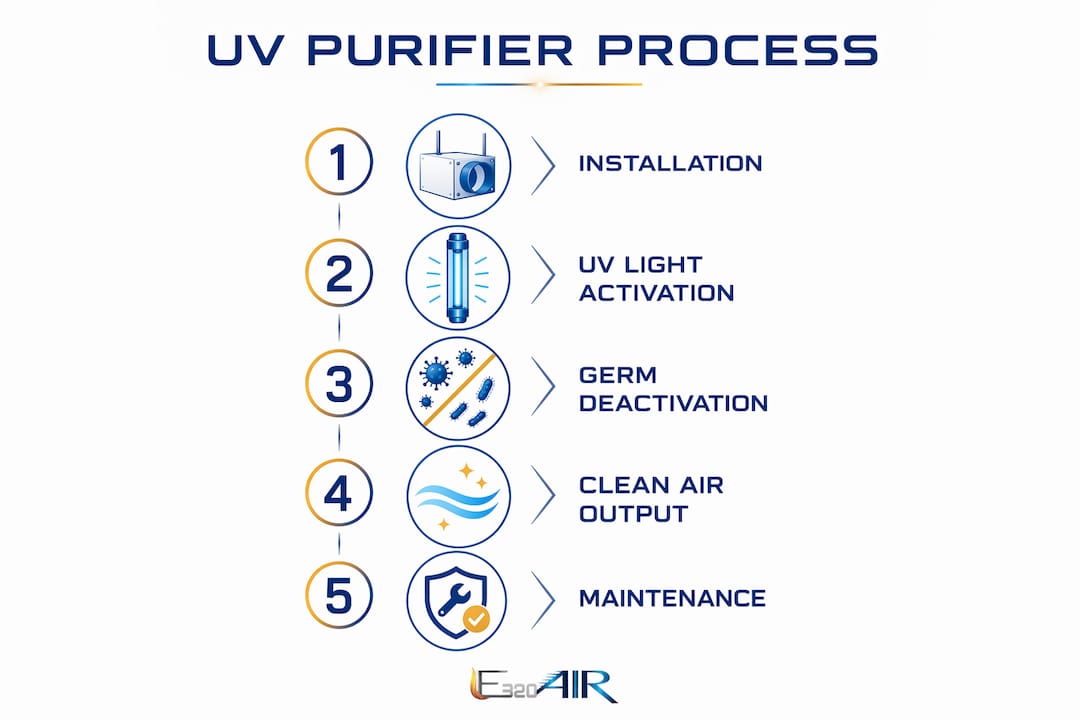
UV air purifiers integrated into HVAC systems use a process called ultraviolet germicidal irradiation (UVGI) to neutralize bacteria, viruses, mold, and other biological contaminants. At the core of how UV air purifiers work in HVAC is UVC light at 254 nm, which penetrates microorganism cell walls and disrupts their DNA or RNA, preventing reproduction. The organism does not always die outright; it is deactivated, meaning it can no longer replicate or cause infection.
Key functional elements of HVAC UV purification:
- Target organisms: bacteria, viruses, mold spores, and fungi
- Mechanism: UVC light damages DNA/RNA to prevent replication
- Primary wavelength: 254 nm for germicidal effect without ozone production
- Placement: near evaporator coils or inside ductwork, depending on the application
How UV air purifiers are installed in HVAC systems
Two installation methods cover most residential and commercial applications: coil sanitizing and air sanitizing.
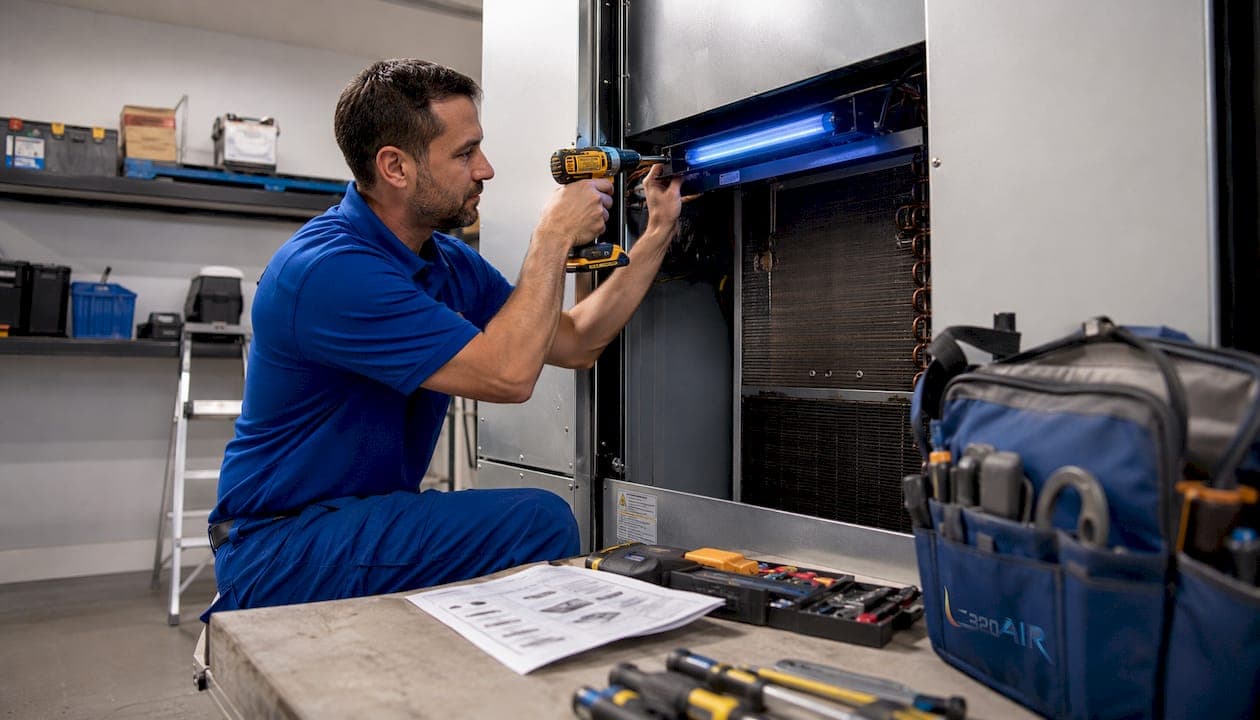
Coil sanitizing places a UV lamp directly above or beside the evaporator coil, where moisture and cool temperatures create ideal conditions for mold and bacterial growth. The lamp runs continuously, and because the coil is stationary, exposure time is essentially unlimited. This is the simpler and more common installation.
Air sanitizing mounts lamps inside the ductwork to target bioaerosols moving through the air stream. Because air moves fast through ducts, exposure time is very short, so these systems require significantly higher lamp intensity. A single lamp placed randomly in a duct accomplishes very little; strategic placement and sufficient intensity are what determine whether the system actually works.
Installation considerations at a glance:
- Coil sanitizing: lower intensity needed, continuous exposure, best for mold prevention on surfaces
- Air sanitizing: high intensity required, short exposure window, targets airborne pathogens
- Reflective surfaces inside the air handler can amplify UV effectiveness
- Incorrect lamp count, placement, or intensity causes the system to underperform
Effectiveness, limitations, and safety: what you need to know
What UVGI does well
On hard surfaces like evaporator coils and drain pans, UVGI kill rates can reach up to 99.9% for organisms in direct, sustained contact with the lamp. That is a meaningful result for mold control on coils. Airborne disinfection is more variable; effectiveness depends on air velocity, lamp intensity, temperature, and humidity.
Low-pressure UV lamps operate best between 72°F and 105°F. Performance drops below 72°F and the lamps stop working entirely below freezing. High air velocity compounds the problem by reducing exposure time and cooling the lamp surface, further cutting output.
What UVGI does not do
UVGI does not remove dust, allergens, or volatile organic compounds. It targets biological contaminants only. For particulate matter and chemical pollutants, physical filtration remains necessary.
Safety considerations
- Wavelength matters: 254 nm lamps avoid ozone production; 185 nm lamps generate ozone, which causes respiratory irritation indoors
- Material degradation: UV light degrades rubber, sealants, gaskets, and wiring insulation over time; vulnerable components need shielding or substitution
- Human exposure: UVC is harmful to skin and eyes; lamps must be powered off using lockout/tagout procedures during servicing
- Mercury: UV lamps contain small amounts of mercury; broken bulbs require careful handling
Expert advice for homeowners considering UV purifiers
NADCA is clear on one point: source removal remains the single best method for cleaning and decontaminating HVAC systems. UVGI is a supplement, not a replacement for duct cleaning and proper filtration. Treating it as a standalone fix leads to disappointment.
Professional installation matters more than most homeowners expect. Lamp type, placement, and intensity need to match the specific system. A technician who does not assess airflow speed, duct geometry, and ambient temperature before installing is guessing.
Pro Tip: Ask your installer to use reflective surfaces inside the air handler chamber. This amplifies UV irradiance and compensates for the short exposure time air gets as it moves through the system.
Best practices for homeowners:
- Have a licensed HVAC professional assess your system before purchasing any UV equipment
- Confirm the installer selects 254 nm lamps, not 185 nm
- Request shielding for any organic materials near the lamp
- Schedule periodic inspections to verify lamp output and check for material degradation
- Pair UV purification with quality HVAC filtration for complete coverage
Integrating UV purification into a broader indoor air quality strategy
UV purifiers handle the biological side of indoor air quality. For a complete strategy, they work alongside high-MERV filters that capture dust, pollen, and pet dander, and proper ventilation that dilutes indoor pollutants. Each layer addresses what the others miss.
UV lamps draw minimal energy, and keeping coils clean through UVGI actually improves overall HVAC efficiency, which can lower energy bills over time. The efficiency gain comes from cleaner heat-transfer surfaces, not the lamps themselves. Mold buildup on coils forces the system to work harder; eliminating it restores performance. Understanding mold in HVAC systems helps clarify why coil sanitizing UV lamps deliver such consistent results.
Integration benefits and considerations:
- UV + MERV 13 filtration covers both biological and particulate contaminants
- Humidity control (30–50% per EPA guidance) maximizes UV effectiveness and limits mold growth
- Whole-house coverage requires proper airflow balance after any new component is added
Maintaining your UV lamps: replacement schedule
UV lamps do not burn out the way incandescent bulbs do. They fade. Output decreases gradually, so a lamp that still glows may no longer deliver enough intensity to deactivate microorganisms. Replacement every 1–3 years is the standard guidance, with the exact interval depending on the manufacturer's specifications and hours of operation. Dirty lamps also lose effectiveness; cleaning them according to manufacturer instructions is part of routine maintenance.
How UV compares to other HVAC air purification technologies
| Technology | What it targets | Key limitation |
|---|---|---|
| UVGI | Bacteria, viruses, mold | Does not remove particles or VOCs |
| MERV 13 filters | Dust, pollen, dander, some pathogens | Increases static pressure; needs regular replacement |
| Electronic air cleaners | Fine particles, allergens | Requires plate cleaning; can produce trace ozone |
| Photo catalytic oxidation (PCO) | Gases, odors, pathogens | Higher cost; catalyst needs periodic replacement |
No single technology covers every contaminant category. A layered HVAC air quality approach consistently outperforms any single solution.
Regulatory standards and certifications for UV air purifiers
ASHRAE Standard 185.1 establishes the testing method for UVC lights used in air-handling units and ducts to inactivate airborne microorganisms. UL 2998 is the standard to ask about when evaluating whether a product produces zero ozone. ASHRAE's HVAC Systems and Equipment Handbook, Chapter 7, covers UV lamp system design in detail and is the reference NADCA directs installers toward. When evaluating any UV product, confirm it has been tested to these standards and that the manufacturer can provide documentation on lamp intensity and air path length requirements for your specific installation.
E320air handles UV purifier installation the right way
Getting UV purification right comes down to the installation. E320air provides professional HVAC installation services that include full system assessment before any UV equipment goes in, so lamp type, placement, and intensity are matched to your actual ductwork and airflow conditions.
Whether you are a homeowner dealing with recurring mold on the coil or a building manager looking to reduce airborne pathogens across a commercial space, E320air's team brings the technical depth to do it correctly. Visit E320air to schedule a consultation and get a system assessment before committing to any UV purification solution.
Key Takeaways
UV air purifiers in HVAC systems deactivate biological contaminants through UVGI, but only when properly installed, maintained, and paired with physical filtration.
| Point | Details |
|---|---|
| UVGI mechanism | UVC at 254 nm disrupts DNA/RNA to prevent microbial reproduction without producing ozone. |
| Surface vs. airborne performance | Kill rates reach up to 99.9% for organisms in direct, sustained contact with the lamp on coil surfaces; airborne results vary with airflow speed and lamp intensity. |
| Lamp replacement | UV lamps need replacement every 1–3 years; fading output is invisible without testing. |
| Safety and materials | Use 254 nm lamps only; shield rubber, sealants, and wiring from UV degradation. |
| E320air | Provides professional UV purifier installation with full system assessment for correct lamp placement and intensity. |