

TL;DR:
- The HVAC EER rating indicates the cooling efficiency of an air conditioner at peak outdoor conditions. EER2, introduced in 2023, provides a more accurate measure by testing units at higher duct static pressure. Homeowners in hot climates should prioritize EER2 ratings to better gauge performance during peak heat days.
The HVAC EER rating is the Energy Efficiency Ratio, a number that tells you exactly how many BTUs of cooling an air conditioner delivers per watt of electricity consumed at peak outdoor conditions. Specifically, what is HVAC EER rating means: the EER formula divides BTU/h cooling output by watts of electrical input, tested at 95°F outdoor temperature, 80°F indoor temperature, and 50% relative humidity. A higher EER means more cooling for every dollar you spend running the system. The U.S. Department of Energy uses this metric to set minimum efficiency standards for residential cooling equipment. Since 2023, a revised standard called EER2 has replaced the legacy EER for most new equipment, and understanding both helps you make smarter choices this cooling season.
What is HVAC EER rating and how is it calculated?
The EER formula is straightforward: divide the cooling output in BTU/h by the electrical input in watts. A unit that delivers 12,000 BTU/h while drawing 1,000 watts has an EER of 12. That single number tells you the system's efficiency at its hardest working moment.

The test conditions matter as much as the formula. The standard test scenario fixes outdoor temperature at 95°F, indoor temperature at 80°F, and relative humidity at 50%. These conditions simulate a hot summer afternoon, which is exactly when your system works hardest and your electricity bill climbs fastest.
Several physical factors pull EER down in real homes:
- Airflow restrictions: Dirty filters or undersized ducts reduce airflow, forcing the system to work harder for the same cooling output.
- Duct static pressure: Resistance inside ductwork consumes extra fan energy, lowering the effective efficiency you actually experience.
- Refrigerant charge: An over or undercharged system loses efficiency quickly, even if its rated EER is high.
- Installation quality: Poor refrigerant line insulation and improper unit sizing both reduce real-world performance below the rated number.
EER is a point-in-time metric, not a seasonal average. It captures efficiency at full load and peak heat. That distinction matters because your system rarely runs at those exact conditions all day. Understanding ductwork's impact on efficiency helps explain why two identical units can perform very differently in two different homes.
Pro Tip: Ask your contractor to show you the unit's EER test data sheet before installation. The rated number assumes clean ducts and proper airflow. If your ductwork is older or undersized, your actual efficiency will be lower.
The legacy EER used a duct static pressure of 0.1 inches of water column during testing. The updated EER2 standard uses 0.5 inches of water column, which better reflects the resistance found in real residential duct systems. That change makes EER2 a more honest number.
How do EER, EER2, and SEER2 differ?
These three ratings measure efficiency in different ways, and mixing them up leads to bad purchasing decisions.
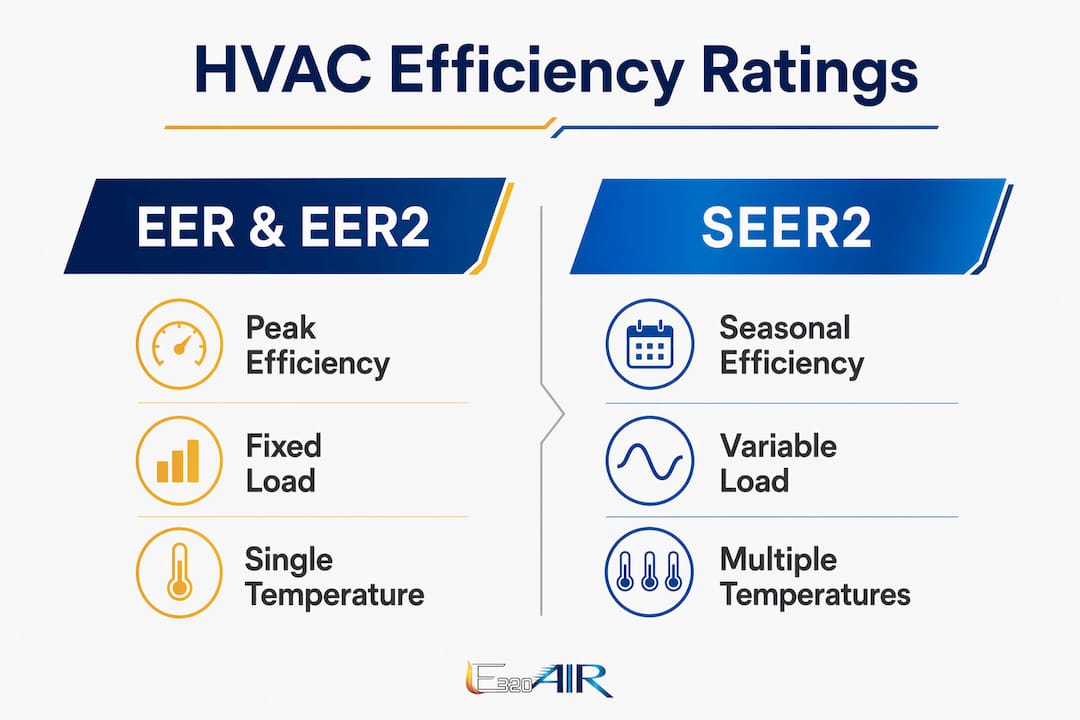
EER captures peak efficiency at a single fixed condition: full load on a 95°F day. Think of it as highway miles per gallon at one specific speed. It tells you how the system performs when the heat is at its worst.
EER2 is the 2023 update to that same peak-load test. The key change is the higher static pressure used during testing, 0.5 inches of water column instead of 0.1 inches. This simulates real duct resistance, so EER2 ratings run about 4–15% lower than legacy EER for the same unit. A lower number does not mean a worse product. It means a more accurate one.
SEER2 is a seasonal metric. It averages efficiency across a full cooling season, accounting for part-load operation, cooler nights, and mild spring days. EER measures a snapshot while SEER2 measures the whole film. SEER2 is the better number for estimating your annual energy bill. EER2 is the better number for estimating your bill during a heat wave.
| Rating | What it measures | Best used for |
|---|---|---|
| EER | Peak efficiency at 95°F, legacy test | Comparing older units |
| EER2 | Peak efficiency at 95°F, updated duct pressure test | Comparing new units accurately |
| SEER2 | Seasonal average efficiency, updated test | Estimating annual energy costs |
A common homeowner mistake is choosing a unit based on SEER2 alone and ignoring EER2. In mild climates where temperatures rarely exceed 90°F, SEER2 tells most of the story. In hot climates like the American Southwest, where 100°F days are routine, EER2 predicts performance during the exact conditions your system faces most often.
Pro Tip: When getting quotes for a new system, ask every contractor for both the EER2 and SEER2 ratings. If a contractor only quotes SEER2, they may be hiding a weak peak-load performance number.
Another misconception: a high SEER2 does not guarantee a high EER2. Variable-speed systems can earn strong SEER2 ratings by running efficiently at low loads, yet still underperform at full load on the hottest days. For homeowners in Phoenix, Las Vegas, or the Inland Empire, EER2 in hot climates is often the more relevant number.
What counts as a good EER rating for your home?
Benchmarks vary by equipment type, and cross-category comparisons produce misleading results. A window unit and a central air system serve different purposes and carry different EER expectations.
Here are the practical benchmarks to use:
- Window air conditioners: An EER of 11 or higher is considered good. Units below 10 are inefficient by current standards.
- Central air conditioners: Look for an EER2 of 12 or higher. Systems in this range deliver meaningful savings over lower-rated units during peak summer months.
- Mini-split systems: Efficient models reach EER2 ratings of 13–15. These systems tend to outperform central AC at peak conditions because they avoid duct losses entirely.
- Portable and room air conditioners: These units now use CEER instead of EER, which folds in standby power consumption. CEER gives a more complete picture of actual energy use for plug-in units.
Higher EER ratings pay back faster in hot climates. A unit with a strong EER2 rating can save a meaningful amount on energy costs within one or two cooling seasons compared to a lower-rated model running the same hours. The payback is faster when the system runs at full load frequently, which is exactly what happens during a Southwest summer.
The right EER benchmark also depends on your home's cooling load. A well-insulated home in a moderate climate can get by with a lower EER2 rating because the system cycles less. A poorly insulated home in a hot climate needs every efficiency point it can get, because the system runs longer and harder every single day.
For homeowners considering an upgrade, reviewing top replacement options for 2026 shows which systems hit the strongest EER2 benchmarks currently available.
How EER ratings affect your energy bills and HVAC choices
EER2 matters most during peak summer heat, which is also when electricity rates are highest. Many utilities charge more per kilowatt-hour during peak demand hours in the afternoon. A system with a strong EER2 draws less power during those exact hours, which compounds the savings.
Here is a practical way to apply EER knowledge when comparing quotes:
- Request EER2 alongside SEER2 for every unit quoted. Industry specialists recommend requesting both ratings to make well-informed decisions, especially in regions with long, hot summers.
- Check the test conditions. Confirm the EER2 figure comes from the updated 0.5-inch static pressure test, not the legacy 0.1-inch test. The numbers are not interchangeable.
- Factor in your ductwork condition. Even a high EER2 unit loses real-world efficiency in leaky or undersized ducts. Address duct problems before or during installation.
- Compare units within the same category. A mini-split EER2 of 14 and a window unit EER2 of 11 are not directly comparable. Each rating reflects different equipment types and installation conditions.
- Calculate the payback period. Estimate how many hours per year your system runs at full load. Multiply the wattage difference between two units by those hours and by your electricity rate. That gives you the annual savings from choosing the higher-rated unit.
Variable-speed systems add a layer of complexity. EER and EER2 ratings reflect a single point test at maximum load, so they do not capture the additional savings variable-speed compressors deliver at part-load. A variable-speed system may show a modest EER2 improvement over a single-stage unit, yet deliver significantly lower annual bills because it runs at reduced capacity most of the time.
Pro Tip: For homes in the Inland Empire or similar hot regions, prioritize EER2 over SEER2 when comparing quotes. Your system will spend more hours at or near peak load conditions than the seasonal average implies.
For a deeper look at how energy-efficient systems perform in extreme heat, the real-world data from local installations tells a clearer story than lab ratings alone.
Key Takeaways
The EER2 rating is the most reliable measure of residential HVAC efficiency at peak heat conditions, and homeowners in hot climates should prioritize it alongside SEER2 when selecting a new system.
| Point | Details |
|---|---|
| EER definition | EER equals BTU/h cooling output divided by watts input at 95°F outdoor conditions. |
| EER2 vs. legacy EER | EER2 uses higher duct static pressure in testing, producing ratings 4–15% lower but more accurate. |
| Good EER benchmarks | Aim for EER2 of 11+ for window units, 12+ for central AC, and 13–15 for mini-splits. |
| Climate matters | Homeowners in hot climates should weight EER2 heavily because peak-load conditions occur frequently. |
| CEER for room units | Portable and window ACs now use CEER, which includes standby power for a fuller efficiency picture. |
EER ratings: what I've learned from years in the field
Most homeowners I talk to have heard of SEER but have never seen EER2 on a quote sheet. That gap costs them money. Contractors who only present SEER2 are giving you the average-day number when you really need the worst-day number.
The 2023 shift to EER2 changed how I evaluate equipment for clients. The old EER was tested under conditions that barely resembled a real home with real ductwork. EER2 finally reflects what a system actually faces inside a house. When I compare two units now, EER2 is the first number I check for any home in a hot climate.
The confusion between EER and SEER is not just a homeowner problem. I have seen contractors mix them up on proposals. The practical rule I give every client: SEER2 tells you your annual bill, EER2 tells you your August bill. Both matter, but in a place where summer lasts five months, August matters more.
My advice is simple. Before you sign any installation contract, ask for the EER2 rating in writing. If the contractor cannot provide it, that is a signal worth paying attention to. The 2026 efficiency standards make EER2 a required data point for new equipment, so there is no reason it should be missing from any quote.
— Edward
E320air can help you find the right efficiency rating for your home
Choosing between systems based on EER2 and SEER2 is easier when you have someone who does this every day. E320air evaluates your home's cooling load, ductwork condition, and climate exposure to match you with a system that performs well on the days that actually stress it.

Whether you are replacing an aging central AC or adding a mini-split to a hot room, E320air brings the technical knowledge to interpret efficiency ratings in context, not just on paper. The team handles HVAC installation from equipment selection through final commissioning, so the EER2 rating you see on the spec sheet is the one you experience at home. Contact E320air to schedule an evaluation and get a quote that includes both EER2 and SEER2 for every system under consideration.
FAQ
What does EER stand for in HVAC?
EER stands for Energy Efficiency Ratio. It measures how many BTUs of cooling an air conditioner produces per watt of electricity consumed at a fixed test condition of 95°F outdoor temperature.
How is EER different from SEER?
EER measures peak efficiency at a single high-temperature condition, while SEER averages efficiency across an entire cooling season. EER reflects worst-day performance; SEER reflects typical annual performance.
What is EER2 and why does it matter?
EER2 is the updated efficiency standard introduced in 2023. It tests units at higher duct static pressure, producing ratings that are 4–15% lower than legacy EER but more accurate for real home conditions.
What is a good EER rating for a home air conditioner?
A good EER2 is 11 or higher for window units and 12 or higher for central air conditioners. Mini-split systems with EER2 ratings of 13–15 represent the high end of residential efficiency.
Should I compare EER ratings across different types of AC units?
No. EER ratings should only be compared within the same equipment category. Window unit EER and central AC EER reflect different test contexts and should not be used interchangeably when evaluating options.