
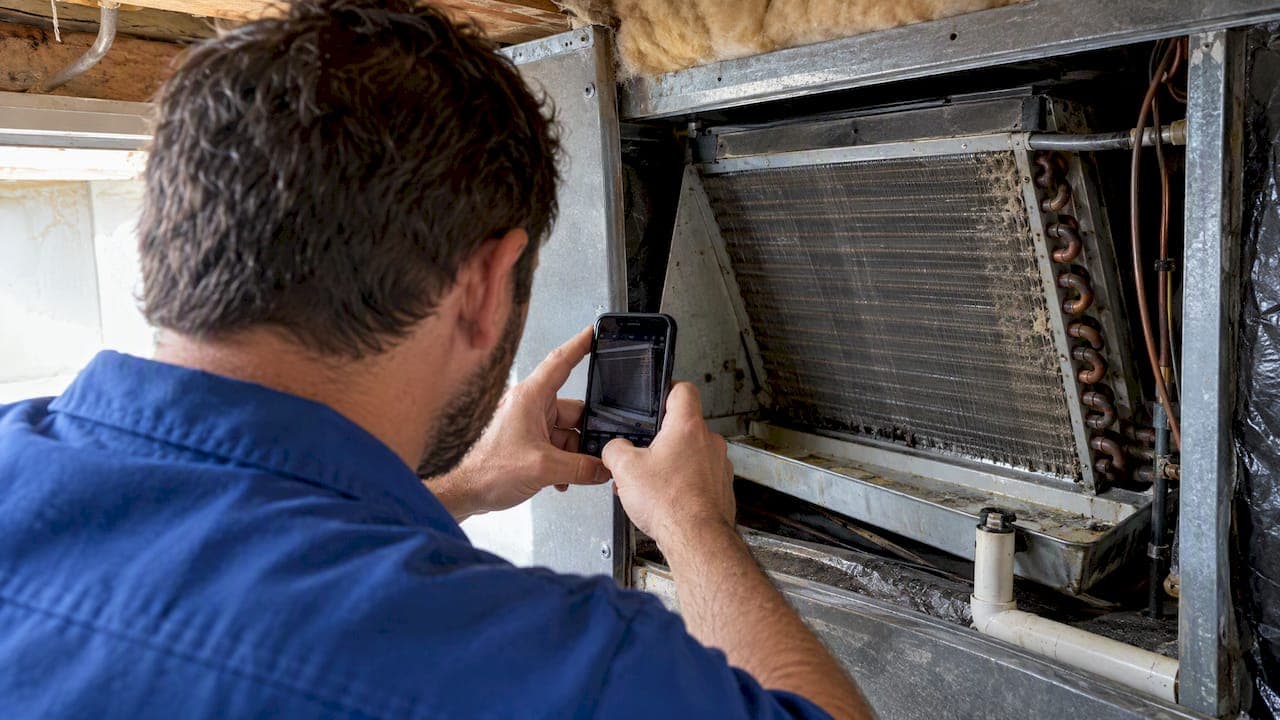
Stop any active water leak or condensation problem first and dry the area within 24 to 48 hours, since that window is what keeps a damp spot from turning into mold colony. If you spot substantial visible mold inside hard ductwork or on HVAC components, call a qualified contractor. If what you have is light surface dust or an occasional musty smell, you can usually handle it yourself with register cleaning and better humidity control.
TL;DR:
- Visible mold inside ducts or on HVAC components requires cleaning and addressing moisture sources such as leaks or condensation.
- DIY cleaning is limited to washing registers and vacuuming accessible surfaces with a HEPA filter, while mold on wet insulation must be replaced.
- Contractors should perform comprehensive inspections, including coil and drain pan checks, with clear scope and photo documentation before and after remediation.
- Maintaining indoor humidity below 50% and promptly repairing leaks prevents mold recurrence effectively.
- Short-term air testing is less reliable than visual inspection and smell detection for identifying hidden duct contamination.
Table of Contents
- Why mold in air ducts matters for your health
- How to check your ducts safely: a short inspection checklist
- When cleaning is enough versus when parts need replacing
- Removing mold from ducts yourself: what's safe and what isn't
- What a thorough contractor actually does in your ducts
- Preventing mold from coming back
- A practitioner's take on realistic mold remediation
- How our HVAC services address duct mold and moisture problems
- FAQ
- Sources
Why mold in air ducts matters for your health
Mold in your ductwork is less about the fungus itself and more about what a forced-air system does with it: spores and musty odors get pulled in and pushed through every room the system serves. That's why a small patch of growth near one register can end up smelling like a whole-house problem.
The symptoms are usually mild but noticeable. The CDC lists nasal congestion, coughing or wheezing, eye irritation, and skin rash as the common reactions, and people with allergies or asthma tend to feel them more intensely. Most people who breathe in everyday mold spores do not get sick from it, according to CDC and NIOSH guidance, though invasive mold infections can occur in people with weakened immune systems. That distinction matters when you're deciding how urgently to act: a musty smell in a healthy household is an air quality annoyance to fix, while the same smell in a home with an immunocompromised resident deserves faster attention.

How to check your ducts safely: a short inspection checklist
You don't need special equipment to do a first-pass inspection. A flashlight, a small mirror, and your own nose will tell you most of what you need to know before you decide whether to call anyone.
- Pull a few registers and grilles and look for black flecks, fuzzy growth, or discoloration on the visible metal.
- Check insulation near the register boot and in any accessible duct sections for dampness, sagging, or a soft, crumbly texture.
- Smell near each register when the system is running: a musty odor that's stronger at certain vents points to contamination near that branch.
- Use a flashlight and mirror, or a cheap consumer borescope, to look a few feet into the duct without touching or disturbing anything you suspect is mold.
- Photograph and video everything you find, including a wide shot and a close-up, before you touch it.
Those photos matter more than people expect. They give a contractor a baseline, and they give you proof later if a cleaning crew claims they fixed something they never actually touched.
Pro Tip: Take photos with a coin or a ruler in the frame so the size of any growth is obvious later, to yourself or to a second contractor.
When cleaning is enough versus when parts need replacing
The EPA's guidance draws a fairly clean line here, and it's worth following instead of guessing.
- Substantial visible mold growth inside hard-surface ducts or on HVAC components is a real reason to clean.
- Minor dust or light surface debris without visible mold usually doesn't justify full duct cleaning.
- Wet or moldy porous insulation, like the fiberglass liner inside some ducts, should be removed and replaced rather than cleaned, since that material holds moisture and spores in ways a vacuum can't fully reach.
- Cleaning that skips the moisture source behind the mold almost always lets the problem come back, regardless of how thorough the cleaning crew was.
This last point is the one homeowners miss most often. A contractor can do a technically perfect cleaning job and the mold still returns in a few months if nobody fixed the leaking drain pan or the poorly sealed duct joint that let humid air condense in the first place.
Removing mold from ducts yourself: what's safe and what isn't
A limited set of tasks are reasonable for a homeowner to handle. Beyond that list, you're better off hiring someone, both for safety and because the job stops being effective without the right equipment.
- Remove grilles and registers and wash them with warm water and detergent.
- Vacuum accessible surfaces with a vacuum that has a HEPA filter, not a standard shop vac that just redistributes spores through the room.
- Wipe hard surfaces you can reach with a detergent solution and let them dry completely before reinstalling anything.
- Wear gloves, an N95 or better respirator, and eye protection the entire time you're working.
- Skip the box fan. Blowing air across a suspected mold patch to "dry it out" just scatters spores into the rest of the house.
Where DIY stops is at the coils, condensate pan, blower compartment, or any section of duct with wet or moldy insulation, along with any growth that covers more than a small area. EPA-funded research on fungally contaminated duct liner found that vacuum cleaning reduced surface fungal levels right after treatment, but regrowth often showed up again within 6 to 12 weeks, and bound antimicrobial treatments didn't change that outcome under the study's conditions. That's a strong argument for replacing wet porous liner instead of trying to clean it, and for treating a "cleaned" duct that still has an unresolved moisture problem as a temporary fix at best. Skip ozone machines entirely, and be skeptical of any chemical biocide applied without a clear label match for the material being treated.
What a thorough contractor actually does in your ducts
A contractor worth hiring treats the duct system as one connected system, not a set of individual vents. That means checking the evaporator coil, condensate pan, and blower compartment along with whatever ductwork you can see, since EPA guidance notes that contamination at the coil or drain pan is often the real source of a smell that seems to be coming from a register.
- A pre-work inspection with photos of every area that shows growth, moisture damage, or deterioration.
- A written scope that spells out exactly what gets cleaned, what gets replaced, and why.
- Use of contact vacuuming or commercial-grade vacuum equipment on surfaces that can be cleaned effectively.
- Straightforward replacement of any wet or moldy fiberglass liner instead of attempting to clean it.
- Confirmation and repair of the moisture source, whether that's a condensate leak, a poorly sealed duct joint, or inadequate drainage.
- Post-work photos and a final check for lingering odor or visible growth, since that kind of verification is more reliable than a quick air sample.
Pro Tip: Ask any contractor to show you photos of the coil and drain pan specifically. If they can't produce those, they likely never inspected the components most often responsible for the smell.
A responsible quote never looks like a flat per-vent price. It should break out labor, materials, any insulation replacement, and the moisture repair itself, because those are different jobs with different costs.
Preventing mold from coming back
Fixing the mold once is only half the job. Keeping it from returning means managing moisture continuously, not just after you notice a smell.
- Keep indoor relative humidity at or below 50% using your air conditioner or a standalone dehumidifier; for comprehensive guidance, see our Top HVAC Mold Prevention Tips for Cleaner Indoor Air.
- Make sure bathroom and kitchen exhaust fans vent outdoors rather than into an attic or crawl space.
- Change filters on schedule and keep supply and return airflow unobstructed so the system doesn't run colder or wetter than it should.
- Have condensate drains and drip pans checked and cleared during routine maintenance visits, not just when something backs up.
- Call a professional promptly for persistent condensation, a slow leak, or any flooding event, since those are the moisture sources that cause recurring contamination if left alone.
A crawl space with a persistent musty smell or a mini split that smells musty when it kicks on are both usually pointing at the same underlying issue: trapped moisture somewhere in the system that hasn't been addressed.
A practitioner's take on realistic mold remediation
Homeowners often expect remediation to be a one-time fix, but the honest answer is that cleaning only holds if the moisture problem actually gets solved. I've seen plenty of ductwork get cleaned beautifully and still grow mold back within a season because nobody touched the leaking condensate line behind it. Treat the moisture repair as the real project and the cleaning as the easy part.
— Edward
How our HVAC services address duct mold and moisture problems
When a duct mold problem turns out to be bigger than a register wipe-down, we handle the parts of the job that require professional expertise: coil and drain pan inspection, condensate and leak repairs, insulation replacement, and full duct remediation where it's warranted. We show up with a camera and leave with a written scope, not a flat per-vent guess.

- Full-system inspection covering coils, drain pans, blower compartment, and accessible ductwork.
- Honest replacement of wet or moldy duct liner instead of attempting to clean material that won't hold up.
- Condensate and leak repairs that address the moisture source behind the mold, not just the symptom.
- Before-and-after photo documentation so you know exactly what was done.
If you've found visible growth or a musty smell that won't quit, schedule a residential HVAC assessment and get a real inspection instead of a guess.
This article is general information, not a substitute for advice from a qualified doctor. Consult a qualified healthcare professional about your own circumstances before acting on anything here.
FAQ
How do you get rid of mold in air ducts?
Start by removing the moisture source and drying the area, then clean accessible grilles and registers yourself with a HEPA vacuum and detergent. For substantial visible mold inside the ductwork or on HVAC components, EPA guidance supports hiring a professional who can inspect the coil and drain pan, replace wet insulation, and fix the underlying moisture problem.
How much does it cost to get rid of mold in air ducts?
Cost depends heavily on how much ductwork is affected, whether insulation needs replacing, and what moisture repairs are required, so a flat per-register price isn't a reliable way to estimate the job. A contractor should give you a written scope based on an actual inspection rather than a quote based on vent count alone.
What are the symptoms of mold in the air?
Common symptoms include nasal congestion, coughing or wheezing, and eye irritation, with stronger reactions in people who have allergies or asthma, according to the CDC. Most people tolerate everyday spore exposure without getting sick, though invasive infections can occur in people with weakened immune systems.
Is it worth testing the air for mold instead of just inspecting ducts?
Visual inspection and detecting a musty odor are often more useful than short-term air sampling, since NIOSH notes that a clean short-term air sample doesn't reliably rule out hidden contamination. A careful look at the ducts, coil, and drain pan, combined with a history of any dampness, usually tells you more than a one-time test.
Sources
- Should I have the air ducts in my home cleaned? | US EPA
- Effectiveness of Vacuum Cleaning on Fungally Contaminated Duct Materials (EPA research)