

TL;DR:
- Most AC breakdowns result from slow buildup of ignored warning signs, neglect, and system stress over time. Poor airflow caused by dirty filters and blocked vents is the most common failure trigger, leading to system strain and early failure. Regular maintenance, including filter changes and inspections, helps prevent costly repairs and system breakdowns.
Most homeowners assume an AC breakdown comes out of nowhere. One day it's working fine, and the next it's blowing warm air or not turning on at all. The reality is that what causes AC breakdowns is rarely a mystery — it's almost always a slow buildup of ignored warning signs, skipped maintenance, and conditions that quietly stress the system over time. Understanding the real AC breakdown causes puts you in a position to stop paying for the same repairs year after year.
Table of Contents
- Key takeaways
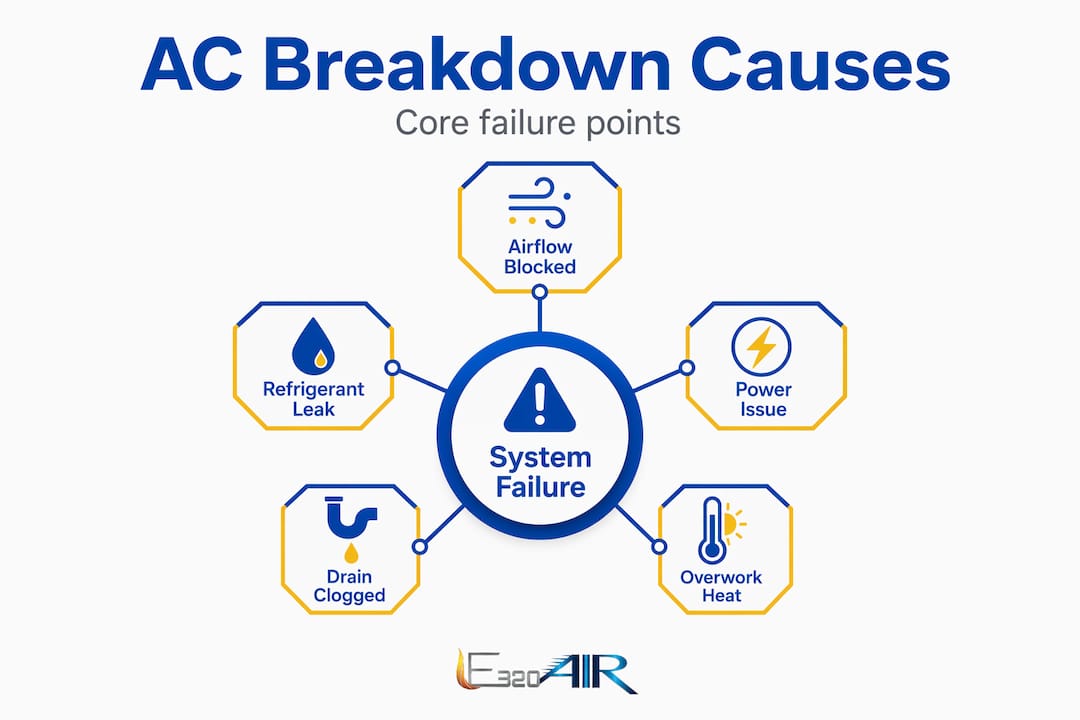
- What causes AC breakdowns: airflow disruption
- Refrigerant leaks and incorrect charging
- Electrical problems that lead to AC breakdown
- Drainage issues and why they matter
- Environmental and operational stress on your AC
- My take after years in the field
- Let E320air help you stay ahead of breakdowns
- FAQ
Key takeaways
| Point | Details |
|---|---|
| Airflow is the foundation | Dirty filters, blocked vents, and closed doors force your system to work harder and fail faster. |
| Refrigerant leaks need a fix first | Adding refrigerant without fixing the leak first is ineffective and wastes money. |
| Electrical faults are often subtle | Worn capacitors and corroded terminals cause random shutdowns before full system failure. |
| Drainage clogs cause real damage | A clogged condensate drain can trigger shutdowns and lead to mold growth inside your home. |
| Maintenance prevents most failures | Scheduling annual professional tune-ups catches the root causes before they become emergencies. |
What causes AC breakdowns: airflow disruption
Airflow is the lifeblood of your AC system. When air can't move freely through the system, every component works harder to keep up. That extra strain is one of the most common AC system failure reasons that homeowners walk right past without realizing it.
Here's what disrupts airflow most often:
- Dirty air filters. A clogged filter doesn't just slow things down. Restricted airflow forces components to operate outside their design specs, which risks compressor and fan failure over time. Filters should be replaced every 30 to 90 days depending on your home and usage.
- Closed doors and blocked vents. Your system was designed for a specific airflow volume. Closing interior doors or covering supply vents disrupts that balance and creates pressure issues throughout the ductwork.
- Dirty evaporator or condenser coils. When coils are coated in dust and grime, heat transfer drops dramatically. Dirty coils put the compressor and fan motor at premature failure risk, which is one of the most expensive repairs you can face.
- Duct leaks and faulty installation. Faulty installation can cause duct leaks that bleed conditioned air into unconditioned spaces, meaning your system runs longer to hit a temperature it can never quite reach.
Pro Tip: Check your air filter right now. Hold it up to a light source. If you can't see light through it, it's overdue for a change. That one step prevents a surprising number of "why does AC stop working" calls.
The good news: these airflow fixes are cheap. Changing a filter costs a few dollars. A duct inspection service costs a fraction of what a compressor replacement runs. Staying ahead of airflow problems is one of the simplest ways to prevent AC failure before it hits.
Refrigerant leaks and incorrect charging
Refrigerant doesn't get "used up" like fuel. Your system runs on a closed loop, so if the level is low, it means there's a leak somewhere or the system was undercharged during installation. Either way, running your AC with low refrigerant is like running an engine with low oil. Something will eventually give.
The most common signs of a refrigerant problem include:
- Warm or barely cool air coming from the vents even when the thermostat is set low
- Ice forming on the refrigerant lines or the indoor evaporator coil
- A hissing or bubbling sound near the indoor or outdoor unit
- Higher-than-usual electricity bills with no change in usage habits
Low refrigerant levels from leaks or incorrect initial charging are a major AC system failure reason that only a certified technician can properly diagnose. The fix has a specific order: find the leak, repair it, test the repair, then recharge the system. Skipping straight to adding refrigerant without fixing the source is a waste of money. Adding refrigerant without addressing the leak is also environmentally harmful, as refrigerants are regulated substances with strict handling requirements.
Pro Tip: If a technician offers to "top off" your refrigerant without inspecting for leaks, that's a red flag. A properly sealed system should never need a top-off.
Electrical problems that lead to AC breakdown
Your AC system runs on a surprisingly complex electrical setup. Capacitors start and run the motors. Contactors switch power on and off. Wiring connects it all. When any of those components deteriorate, the system behaves unpredictably, and eventually stops working.
Electrical faults including worn wiring, corroded terminals, and frequent on-off cycling are common air conditioner problems that often show up before a complete breakdown. Knowing the warning signs helps you catch them early:
- Random shutdowns. If your AC turns off before reaching the set temperature, a faulty capacitor or failing contactor could be the cause.
- System won't start. This is often a tripped breaker or a burned-out capacitor, both of which need immediate attention.
- Frequent short cycling. Short cycling means the system turns on and off in rapid succession. Worn capacitors and wiring cause intermittent shutdowns that shorten system life significantly.
- Burning smell or unusual sounds. These point to wiring issues that are a safety hazard, not just a mechanical inconvenience.
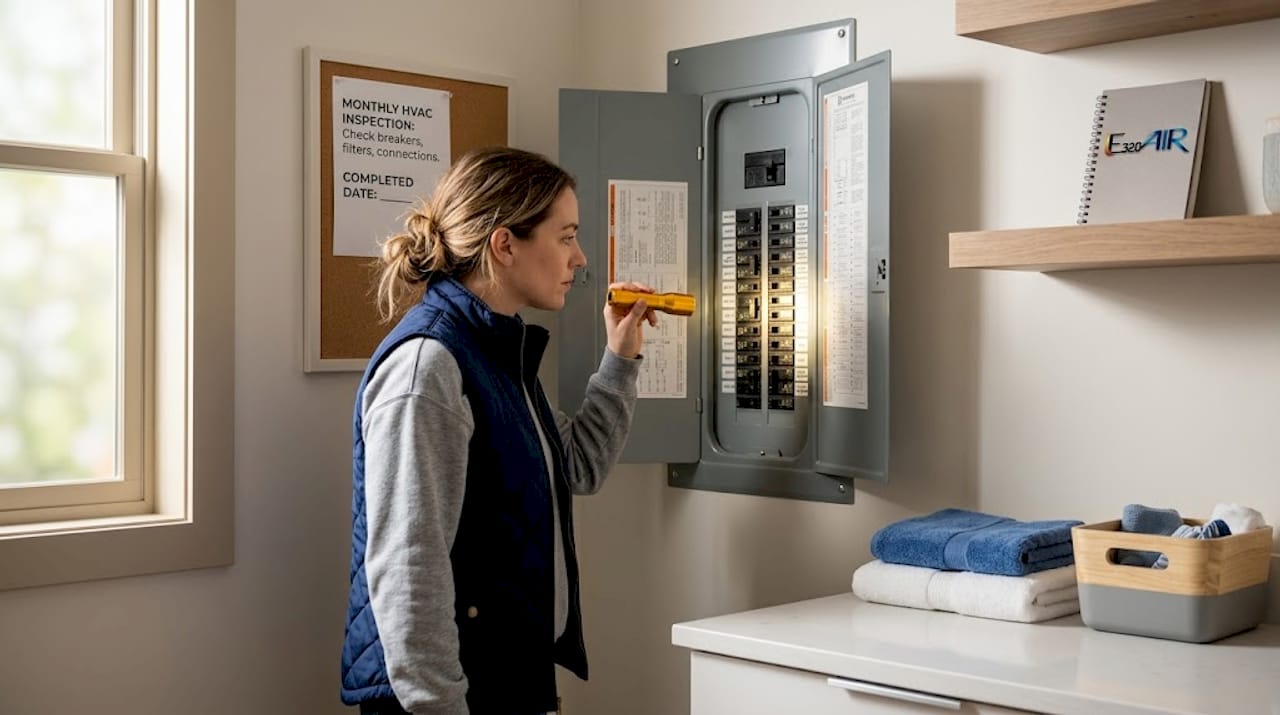
As a homeowner, you can safely check whether a tripped circuit breaker is the issue by inspecting your electrical panel. Beyond that, electrical diagnostics belong to a licensed technician. DIY electrical troubleshooting on your AC unit risks equipment damage and personal injury. For a broader look at how electrical maintenance connects to system performance, it's worth understanding how your home's electrical health affects appliances throughout the house.
Drainage issues and why they matter
Every time your AC runs, it pulls humidity out of your home's air. That moisture drips off the evaporator coil into a drain pan, then flows out through a condensate drain line. When that drain line clogs, water backs up. The results range from a nuisance to serious property damage.
Clogged condensate drains cause water backup and create conditions where mold can grow inside the air handler. Many modern AC systems have a float switch that shuts the unit off when the drain pan fills up. That's a safety feature, but from your perspective it looks exactly like an AC breakdown. You reset the system, it runs for a bit, then shuts off again.
The drain line clogs because algae, dust, and debris accumulate inside it over months of use. Regular flushing of drain lines with a diluted bleach-and-water solution keeps clogs from forming in the first place. A simple pour-through every few months is all it takes.
Improper unit installation also plays a role here. If the indoor air handler isn't level, the condensate pan doesn't drain completely, and standing water becomes a recurring problem. The same applies to condensate pumps, which must be kept clear of obstructions to function. If water damage from a backed-up drain line is left unaddressed, the costs can escalate far beyond what any HVAC repair would have run.
Pro Tip: Once a month, pour a cup of diluted bleach solution down your condensate drain line access point. This takes about 30 seconds and prevents the slow buildup that triggers most clog-related shutdowns.
Environmental and operational stress on your AC
Even a perfectly maintained AC system can break down faster when external conditions push it past its limits. This is an often-overlooked category of AC breakdown causes, and it's becoming more relevant as summer temperatures climb higher each year.
Consider what your system faces during a sustained heat wave:
- Extreme ambient temperatures. Extended operation in extreme heat accelerates compressor wear because the unit can never fully "rest" between cycles. The outdoor unit runs nearly continuously, and heat from outside makes heat rejection harder.
- Obstructed outdoor unit. The condenser unit needs clear space around it to release heat. Shrubs, fences, or debris blocking airflow around the outdoor cabinet force the compressor to run hotter.
- Voltage fluctuations. Power surges and unstable voltage are harder on AC components than many homeowners realize. A whole-home surge protector or voltage stabilizer can save you from a compressor failure tied to an electrical grid spike rather than any internal fault.
- Running without breaks. Thermostats set to extreme low temperatures don't cool your home faster. They just run the system longer and build up wear without proportional benefit.
The best operational practice is to keep your thermostat at a consistent, reasonable temperature rather than swinging it between extremes. Pair that with shade over the outdoor unit when possible and you remove two of the biggest compressor wear factors from the equation.
My take after years in the field
I've walked through a lot of homes where the AC broke down in the middle of summer, and the homeowner was genuinely shocked. But after talking through the history, the same patterns come up every time. The filter hadn't been changed in eight months. There was a slow drip near the air handler that nobody investigated. The system was making a clicking sound at startup for three weeks before it finally stopped turning on.
What I've learned is that most AC failures aren't failures at all. They're conclusions. The system was communicating a problem for weeks or months, and the warning signs were invisible to someone who didn't know what to look for. That's not a criticism. Most people don't spend time thinking about their AC until it stops working. But it means the real problem isn't mechanical. It's the assumption that "no breakdown yet" means "no problem."
The homeowners who rarely call for emergency repairs share one habit: they schedule a professional inspection before the cooling season starts. Not because something is wrong, but because catching something early costs a fraction of fixing it after failure. I've seen a worn capacitor caught during a spring tune-up save a homeowner from a compressor replacement that would have cost ten times more. That's the math that makes seasonal HVAC maintenance one of the highest-return habits a homeowner can build.
Ignoring early symptoms isn't saving money. It's borrowing against a bill that's coming regardless.
— Edward
Let E320air help you stay ahead of breakdowns
At E320air, we've seen nearly every AC breakdown cause covered in this article. More importantly, we know how to find the root issue before it becomes a full replacement. Whether your system is short cycling, blowing warm air, leaking water, or just running differently than it used to, our team provides honest diagnostics and repairs that actually solve the problem. We also offer HVAC installation for homeowners who need a fresh start with a properly sized and installed system. If you want to skip the emergency call next summer, ask us about a maintenance plan designed around your home's specific needs. Reach out to E320air today and stop guessing what's wrong.
FAQ
What is the most common cause of AC breakdowns?
Dirty air filters and restricted airflow are the most frequent culprits. When filters clog, the system strains to move air, which leads to frozen coils and eventual compressor failure.
Why does my AC stop working after running for a while?
This is often caused by a clogged condensate drain triggering the float switch, a refrigerant issue causing the coil to freeze, or an overheating compressor cutting off under load.
Can I add refrigerant myself to fix my AC?
No. Refrigerant handling requires certification, and adding refrigerant without finding and fixing the leak first will not solve the problem. The system will just lose charge again.
How often should I change my AC filter to prevent breakdowns?
Filters should be replaced every 30 to 90 days depending on your home's dust levels, pets, and how often the system runs. Monthly checks during peak season are a smart habit.
How do I prevent AC failure before summer?
Schedule a professional inspection in the spring before heavy use begins. A technician will check refrigerant levels, electrical components, drain lines, and airflow. Catching problems in April is far cheaper than an emergency breakdown in July.