
TL;DR:
- Claremont homeowners face specific AC issues like refrigerant leaks and capacitor failures due to hot summers.
- DIY repairs require proper tools and safety precautions, but refrigerant and electrical work should be handled by professionals.
- Replacement is recommended for older systems or frequent repairs, especially with R-22 refrigerant and rising energy costs.
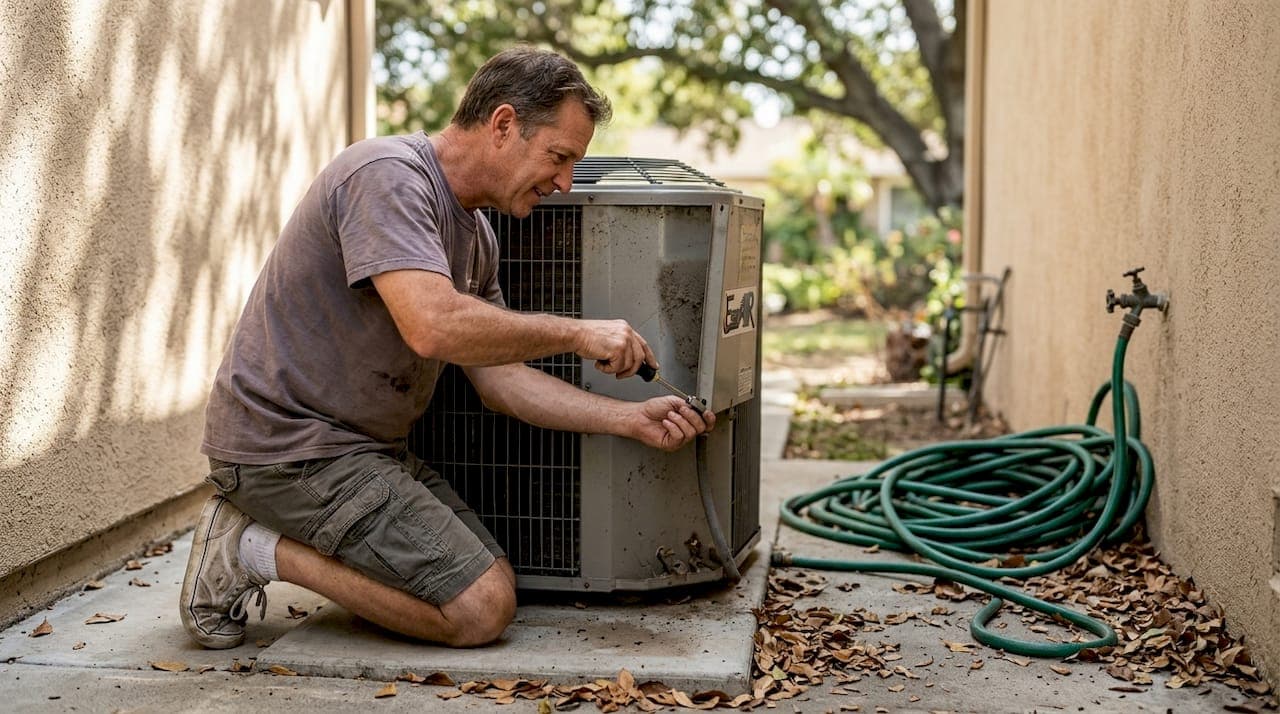
Sweltering Claremont summers are no joke. When your AC quits during a heat wave, the discomfort turns urgent fast, and a rushed decision can cost you hundreds more than necessary. Claremont sits in the Inland Empire, where summer temperatures regularly push past 95°F, making a reliable cooling system less of a luxury and more of a health necessity. This guide walks you through the most common AC problems, practical DIY fixes, safety essentials, and the honest truth about when to stop tinkering and call a licensed technician. Whether your system is blowing warm air or making strange noises, you'll find clear answers here.
Table of Contents
- Understanding common air conditioner problems in Claremont
- Tools, materials, and safety precautions for AC repairs
- Step-by-step guide for addressing basic AC issues
- When to call a professional: Repair vs. replacement guidance
- What most guides miss: Claremont's AC realities
- Next steps: Trusted Claremont AC solutions
- Frequently asked questions
Key Takeaways
| Point | Details |
|---|---|
| Identify top AC issues | Most Claremont AC failures are due to refrigerant leaks, electrical faults, or dirty filters. |
| DIY safe repairs | Homeowners can tackle filter changes and thermostat checks but should avoid electrical or refrigerant work. |
| Know when to call pros | Seek licensed professionals for advanced repairs or if costs are high, especially for older units. |
| Prepare with proper tools | Always use the right tools and follow strict safety steps before any repair attempt. |
| Choose local solutions | Claremont’s unique climate and market make local AC experts and timely maintenance essential. |
Understanding common air conditioner problems in Claremont
Claremont homeowners deal with a specific set of AC headaches, and most of them follow predictable patterns. Knowing what to look for saves you time, money, and a lot of frustration on a 100-degree afternoon.
The most frequent issues we see include:
- Refrigerant leaks: Your system loses cooling capacity, and you'll notice warm air even when the unit is running.
- Capacitor failures: The capacitor helps start and run the compressor and fan motors. When it fails, the unit may hum but not start.
- Electrical problems: Faulty wiring, tripped breakers, or corroded contacts can shut down the whole system.
- Compressor faults: The compressor is the heart of your AC. Strange clicking or grinding sounds often point here.
- Fan motor issues: Weak airflow or a unit that runs but doesn't cool effectively can mean a failing fan motor.
- Clogged air filters: This is the most overlooked cause of poor performance and it's completely preventable.
Here's a quick look at common symptoms and what they typically signal:
| Symptom | Likely cause | DIY or professional? |
|---|---|---|
| Warm air from vents | Low refrigerant or compressor fault | Professional |
| Weak airflow | Dirty filter or blocked ducts | DIY (filter); Pro (ducts) |
| Loud banging or clicking | Loose parts or compressor issue | Professional |
| Burning smell | Electrical fault | Professional immediately |
| Water leaks indoors | Clogged condensate drain | DIY possible |
| Unit won't turn on | Capacitor or electrical fault | Professional |
Understanding your system starts with knowing how central air works, which helps you connect symptoms to their root causes more accurately.
Important: Refrigerant handling and electrical repairs carry real safety risks. Professional services are recommended for refrigerant leaks, electrical issues, and compressor or fan motor faults, as DIY attempts risk safety hazards and further damage to your system.
For a deeper look at diagnosing your specific problem before calling anyone, our AC troubleshooting guide walks through the most common failure points step by step.
Tools, materials, and safety precautions for AC repairs
Before you touch anything on your AC system, preparation matters more than confidence. Having the right tools and understanding the risks keeps you safe and prevents a small fix from becoming an expensive mistake.
Essential tools for basic AC repairs:
- Flathead and Phillips screwdrivers
- Multimeter (for testing voltage and continuity)
- Fin comb (for straightening bent condenser fins)
- Coil cleaning brush
- Wet/dry vacuum (for clearing condensate drain lines)
- Safety gloves and safety glasses
Materials you may need on hand:
| Material | Purpose |
|---|---|
| Replacement air filters | Monthly or seasonal swap |
| Replacement fuses | Electrical panel protection |
| Foam insulation tape | Sealing gaps around refrigerant lines |
| Coil cleaner spray | Cleaning evaporator and condenser coils |
| Condensate drain tablets | Preventing algae buildup in drain lines |
Safety comes first, every single time. Here are the non-negotiable steps before starting any repair:
- Cut all power to the unit at both the thermostat and the breaker panel. Never assume the unit is off just because it's not running.
- Wait 30 minutes after shutting off power before opening the electrical panel on the unit. Capacitors store a charge and can deliver a serious shock.
- Never touch refrigerant lines with bare hands. The lines can be extremely cold and cause frostbite, and refrigerant itself is a regulated substance.
- Avoid working on the outdoor unit during peak heat hours. The metal components get dangerously hot.
Reminder: DIY refrigerant and electrical repairs create safety hazards and can void your equipment warranty. If you're unsure, stop.
Pro Tip: Compressor replacement is never a DIY job. The cost of tools, refrigerant recovery equipment, and the certification required makes it a task for licensed AC technicians only. Attempting it without proper training often results in a condemned unit.
If you want to see real-world examples of what proper repairs and installations look like, our problem solving gallery shows actual jobs completed for Claremont-area homeowners.
Step-by-step guide for addressing basic AC issues
Armed with tools and caution, homeowners can safely tackle these routine repairs. These are the fixes that don't require a license and make a real difference in system performance.
1. Replace or clean the air filter Locate the filter slot, usually in the return air vent or inside the air handler. Slide out the old filter, note the size printed on the frame, and insert a new one with the airflow arrow pointing toward the unit. For reusable filters, rinse with water, let dry completely, and reinstall. Do this every 30 to 90 days depending on dust levels and pets.
2. Check the thermostat Confirm the thermostat is set to "cool" and the target temperature is below the current room temperature. Replace the batteries if the display is dim or unresponsive. If you have a smart thermostat, check the app for error codes.
3. Reset the circuit breaker Go to your electrical panel and look for a tripped breaker labeled for the AC. Flip it fully off, then back on. If it trips again immediately, stop and call a professional. Repeated trips mean an underlying electrical fault.
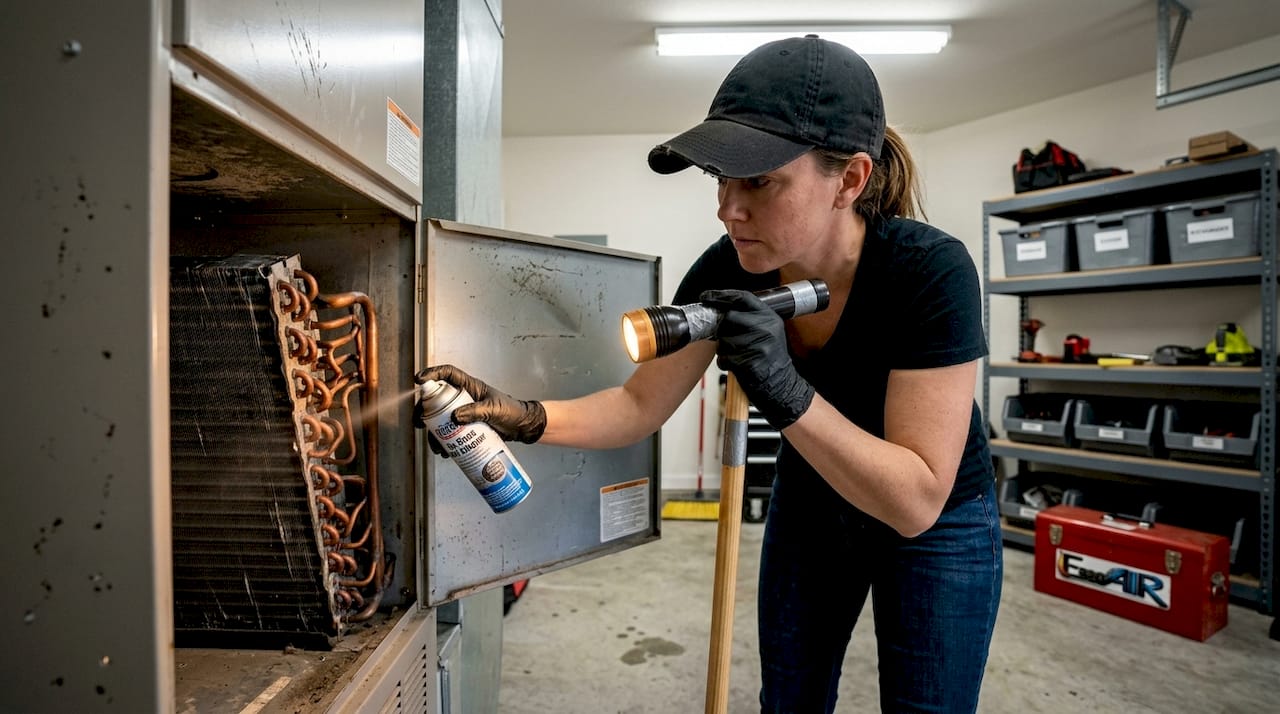
4. Clean the evaporator coils Turn off power, open the air handler panel, and apply a no-rinse coil cleaner spray to the coils. Let it foam and drip into the drain pan. Dirty coils reduce efficiency and can cause the unit to freeze up.
5. Clear the condensate drain line Find the white PVC pipe near the air handler. Use a wet/dry vacuum to suction out any blockage from the end of the drain line outside. Pour a cup of diluted bleach into the access port to kill algae.
Pro Tip: Improving your indoor air quality starts with clean filters and coils. These two steps alone can reduce allergens significantly and keep your system running efficiently.
If these steps don't restore cooling, the problem is likely beyond basic maintenance. Repair costs in the Claremont area range from $75 to $150 for a service call, $150 to $600 for common repairs, with the Inland Empire averaging $113 to $966 depending on complexity. Knowing this range helps you budget before calling for help. Review our AC troubleshooting steps if you want to narrow down the issue further before scheduling a service call.
When to call a professional: Repair vs. replacement guidance
Sometimes, DIY isn't enough. The next step is knowing your limits and when expert intervention is best.
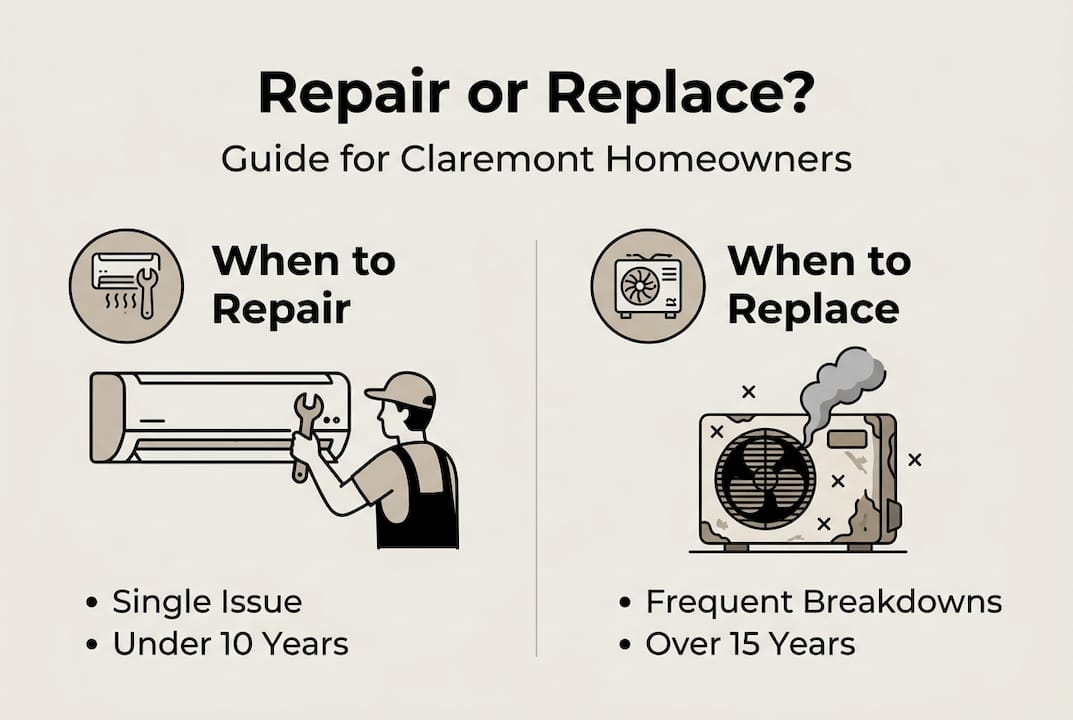
Not every repair is worth making. Older systems, escalating costs, and outdated refrigerants are signals that you may be throwing good money after bad.
Signs it's time to replace your AC unit:
- The unit is 10 to 15 years old or older
- You've had two or more major repairs in the past two years
- The system uses R-22 refrigerant, which is no longer manufactured and is expensive to source
- Repair costs exceed 50% of the price of a new unit
- Energy bills keep climbing despite no change in usage habits
- The unit struggles to cool your home even when running constantly
Here's a practical comparison to guide your decision:
| Situation | Recommended action |
|---|---|
| Unit under 10 years, single repair needed | Repair |
| Unit 10-15 years, repair under 30% of new cost | Consider repair |
| Unit over 15 years, R-22 refrigerant | Replace |
| Repair cost over 50% of new unit price | Replace |
| Frequent breakdowns, rising energy bills | Replace |
According to California AC repair guidance, if your unit is 10 to 15 years old, requires frequent repairs, runs on R-22 refrigerant, or faces repair costs exceeding 50% of a new system, replacement delivers better long-term efficiency and savings.
Pro Tip: Always ask for a written estimate before authorizing any repair over $200. Request warranty information on both parts and labor. Reputable contractors provide this without hesitation.
For homeowners ready to explore newer systems, our guide on replacement HVAC options covers what's available in California for 2026, including energy-efficient models that qualify for rebates. You can also compare providers and pricing through our Claremont service cost comparison resource. For independent reviews, local AC repair pros on Yelp near Claremont include well-rated options like Burgeson's, Solace Plumbing & Air, and All Air Masters.
What most guides miss: Claremont's AC realities
Most online AC guides are written for a generic national audience. They miss something important: Claremont's climate and service market have their own rules.
The Inland Empire heat cycle is brutal and predictable. Every summer, systems that survived a mild spring suddenly face 100-plus degree days for weeks straight. The homeowners who avoid emergency repair bills are the ones who schedule a tune-up in April, not July. Proactive maintenance isn't just good advice here. It's the difference between a $150 service visit and a $900 compressor repair.
We also see homeowners hold onto aging systems longer than they should because a repair seems cheaper in the moment. But a unit that needs a $600 fix today and another $500 fix next spring is costing you more than a new, efficient system would over the same period. The math rarely favors repeated repairs on older equipment.
Choosing a contractor who knows the Inland Empire market also matters. Local providers understand the specific load demands of Claremont homes, the soil conditions that affect ground-level equipment, and the permit requirements that apply here. Exploring California HVAC upgrades with a local expert who knows Yelp-rated Claremont providers gives you a real advantage over picking a name from a national directory.
The honest takeaway: treat your AC like the critical infrastructure it is, not an appliance you ignore until it fails.
Next steps: Trusted Claremont AC solutions
Once you've decided to call for expert help, connecting with a trusted provider makes all the difference. Diagnosing and fixing AC problems on your own has real limits, and the wrong repair can cost more than the original issue.
At E320 Air, we serve Claremont homeowners with licensed AC repair, full system installations, and maintenance programs built for Inland Empire conditions. Whether you need a fast diagnosis or a full replacement, our team provides written estimates, transparent pricing, and warranty-backed work. Browse our HVAC installation services to see what a new, efficient system could look like for your home, or check our AC solution gallery for real examples of completed local projects. We're here to keep your home cool all summer long.
Frequently asked questions
What are the warning signs that my AC needs professional repair?
Unusual noises, weak airflow, warm air output, burning smells, or a circuit breaker that keeps tripping are all signs to call a licensed technician. Professional repairs are recommended for electrical, refrigerant, and motor-related issues.
How much does air conditioner repair cost in Claremont?
Service calls typically run $75 to $150, with common repairs ranging from $150 to $600; Inland Empire repair averages span $113 to $966 depending on the complexity of the job. Emergency service adds a premium on top of standard rates.
Can I repair refrigerant leaks or electrical issues myself?
No. Only certified professionals should handle refrigerant and electrical problems, as DIY refrigerant repairs carry legal risks and serious safety hazards. Attempting these repairs yourself can also void your equipment warranty.
Is it better to repair or replace my older AC unit?
If your unit is over 10 to 15 years old, runs on R-22 refrigerant, or faces repair costs exceeding half the price of a new system, replacement is almost always the smarter financial decision.