
TL;DR:
- High efficiency AC units have a SEER2 rating of 16 or higher, using less energy to cool homes. Proper sizing, advanced variable-speed technology, and correct installation are essential to realize their energy savings. California homeowners benefit from lower bills, rebates, and improved comfort with the right system in place.
A high efficiency AC unit is defined as a central air conditioner with a SEER2 rating of 16 or higher, designed to deliver the same cooling output as a standard unit while using significantly less electricity. For California homeowners running their AC six or more months a year, that distinction translates directly into lower utility bills and better indoor comfort. High-efficiency central air conditioners use 20% to 40% less energy compared to systems that are 10 to 15 years old. That gap widens every summer when temperatures push past 100°F across the Central Valley, Inland Empire, and Southern California. The industry term you will see on every equipment label is SEER2, which stands for Seasonal Energy Efficiency Ratio 2, and it is the primary standard used to classify whether a unit qualifies as high efficiency.
What performance metrics define a high efficiency AC unit?
SEER2 is the core measurement for evaluating AC efficiency ratings in the United States. It calculates how many BTUs of cooling a system delivers per watt-hour of electricity consumed across an entire cooling season. The higher the number, the less power the unit burns to keep your home cool.
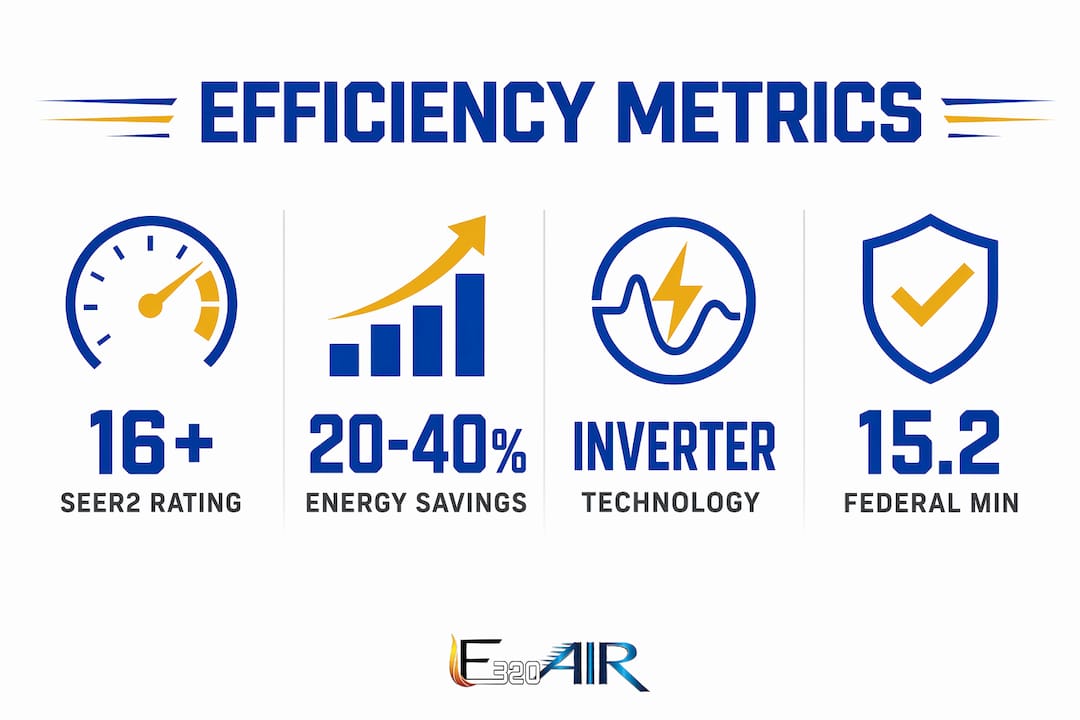
The federal minimum SEER2 for new residential systems in California is 15.2 as of 2023. A unit rated 16 SEER2 is considered good. A unit rated 18 SEER2 or higher is considered excellent and qualifies for federal tax credits and most state utility rebates. The 2026 ENERGY STAR Most Efficient designation requires a SEER2 of 22 or higher for split systems, which represents the current top tier of residential cooling technology. That threshold matters because units meeting it often qualify for the largest rebate amounts from California utilities like PG&E, SCE, and SDG&E.
EER2 is a second metric worth understanding. Where SEER2 measures seasonal average performance, EER2 measures efficiency at a fixed peak condition: 95°F outdoor temperature, 80°F indoor temperature, and 50% humidity. EER2 tells you how well the unit performs on the hottest days, which is exactly when California homeowners need it most.
| SEER2 Rating | Classification | Typical Energy Savings vs. 10-Year-Old Unit |
|---|---|---|
| 15.2 | Federal minimum | Baseline |
| 16–17 | Good | Up to 20% |
| 18–21 | Excellent | Up to 30% |
| 22+ | ENERGY STAR Most Efficient | Up to 40% |
Pro Tip: Ask your contractor for both the SEER2 and EER2 ratings before you commit to a unit. A high SEER2 with a weak EER2 means the system underperforms precisely when California heat peaks.
How does advanced technology improve high efficiency AC performance?
The technology inside a high efficiency unit is what separates it from a standard box. A conventional single-stage compressor runs at one speed: full blast. It turns on, cools the room to the set temperature, then shuts off. That constant cycling wastes energy and leaves humidity levels uneven.
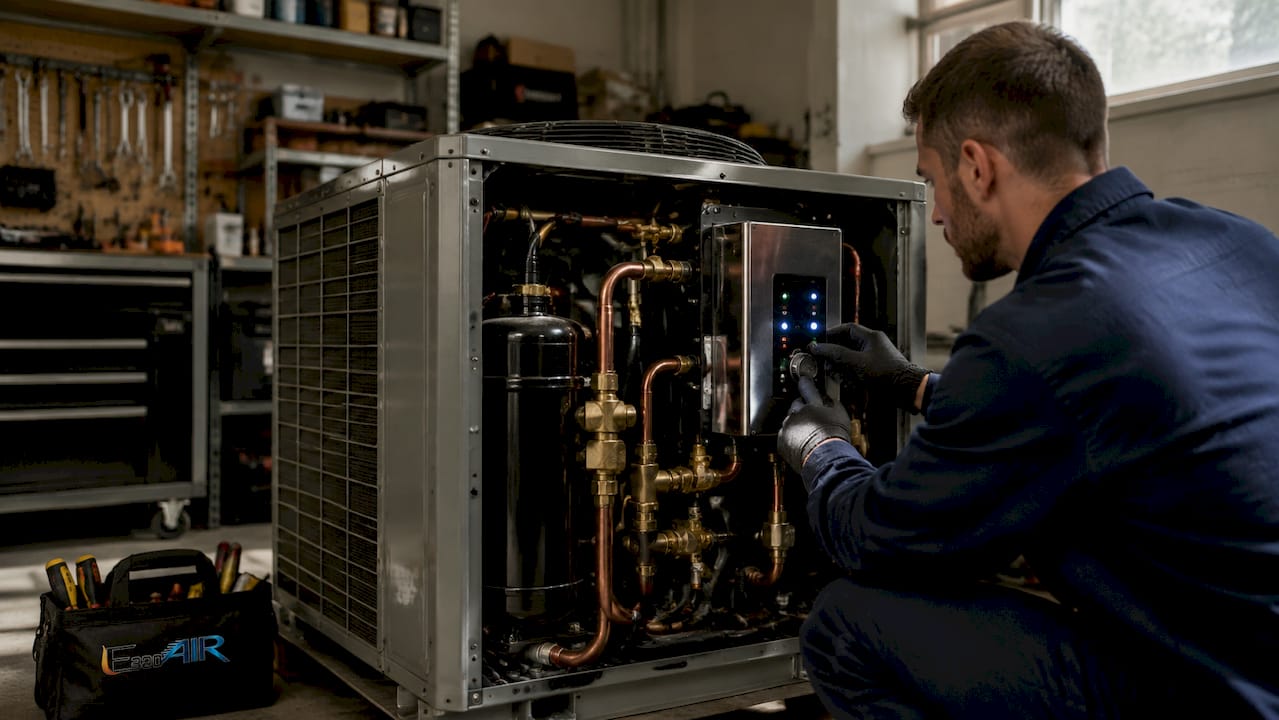
Variable-speed compressors run longer at lower speeds instead of cycling on and off repeatedly. This approach improves humidity control, maintains more consistent temperatures, and reduces total energy draw. The result is a home that feels cooler at the same thermostat setting, because lower humidity makes the air feel less heavy.
Inverter-driven compressors take variable-speed technology one step further. The inverter adjusts the motor's frequency in real time, matching output precisely to the current cooling load. On a mild evening, the compressor runs at 30% capacity. On a 108°F afternoon, it ramps up to full power. High-efficiency units reduce power spikes by eliminating the hard starts that draw the most electricity.
Refrigerant choice also affects efficiency and environmental impact. Modern high efficiency units use R-410A or the newer R-454B and R-32 refrigerants, which carry a lower global warming potential than the older R-22 that was phased out in 2020. Choosing a unit with a next-generation refrigerant protects your investment against future regulatory changes.
Key features that define a high efficiency unit:
- Variable-speed or inverter-driven compressor
- Two-stage or variable-speed air handler fan
- R-454B or R-32 low-GWP refrigerant
- Communicating controls compatible with smart thermostats
- Enhanced coil surface area for better heat exchange
- Sound-dampening compressor blankets for quieter operation
Pro Tip: Inverter technology is the single biggest driver of real-world efficiency gains. If a unit does not have an inverter-driven compressor, its SEER2 rating is largely theoretical for California's climate.
What practical factors affect choosing and installing a high efficiency AC unit?
Buying the highest SEER2 unit on the market does not guarantee lower bills. Proper sizing is the most critical factor in realizing the efficiency you paid for. An oversized unit short-cycles, meaning it reaches the set temperature too quickly, shuts off, and then restarts minutes later. Short-cycling defeats the purpose of variable-speed technology and leaves your home humid and uncomfortable.
A qualified contractor performs a Manual J load calculation to determine the exact cooling capacity your home needs. This calculation accounts for square footage, ceiling height, insulation levels, window orientation, and local climate data. Skipping this step is the most common mistake homeowners make when upgrading to a high efficiency system.
Thermostat compatibility is the second factor most homeowners overlook. Simple thermostats limit performance in high efficiency units because they cannot communicate with variable-speed compressors. A communicating or smart thermostat allows the system to modulate continuously and hit its rated SEER2. Without the right controls, you pay for a premium unit and get standard unit performance.
Maintenance complexity is also higher with advanced systems. High efficiency units contain more sensors, circuit boards, and electronic controls than single-stage units. Repairs require a technician trained on those specific components. Budgeting for annual professional maintenance protects the system's efficiency and extends its lifespan.
Key installation and ownership considerations:
- Require a Manual J load calculation before any equipment is selected
- Confirm thermostat compatibility before purchase, not after installation
- Verify the contractor is licensed and experienced with variable-speed systems
- Schedule annual maintenance to keep coils clean and refrigerant charged correctly
- Check manufacturer warranty terms, since some require registered professional installation
What are the specific benefits of high efficiency AC units for California homeowners?
California's cooling season is long. Many parts of the state run air conditioning from may through october, and in the Coachella Valley or Sacramento, that window stretches even further. In climates with AC use over six months annually, the energy savings from a high efficiency unit accumulate fast enough to meaningfully offset the higher purchase price.
Beyond the utility bill, comfort improves in ways that are immediately noticeable. Better humidity control means the air inside your home feels cooler at the same thermostat setting. Variable-speed units also run more quietly than single-stage systems, which matters when the unit runs for extended periods during a heat wave.
Rebate opportunities in California are real and worth pursuing. The federal Inflation Reduction Act provides a tax credit of up to $600 for qualifying high efficiency central air conditioners. California utility companies layer additional rebates on top of that, and some programs offer incentives for retiring older, less efficient systems. Units with a SEER2 of 18 or higher typically qualify for the broadest range of these programs.
The environmental benefit is also concrete. A system that uses 30% less electricity reduces your household's carbon footprint and puts less strain on the California grid during peak demand periods, when rolling blackouts are most likely.
How to evaluate upfront costs and long-term value of high efficiency AC units?
Cost is the first number most homeowners ask about, and it is a fair question. Replacement costs for high efficiency central air systems range from approximately $8,800 to over $20,000 for top-tier variable-speed models. That range reflects differences in unit capacity, brand tier, installation complexity, and local labor rates.
The payback calculation is straightforward for California homeowners. A household upgrading from a 10-year-old system to a high efficiency unit with a 30% energy reduction will see that savings reflected on every monthly bill from may through october. The longer your cooling season, the faster the payback.
A practical approach to evaluating value:
- Get your current average monthly cooling cost from your utility bill.
- Estimate 20% to 40% savings based on your current system's age and SEER2 rating.
- Calculate annual savings and divide the net cost (after rebates) by that number to find your payback period.
- Factor in the federal tax credit and any California utility rebates to reduce the net cost further.
- Compare financing options, since many manufacturers and contractors offer low-interest plans that make the monthly payment comparable to what you currently spend on electricity.
The long-term value of upgrading is strongest for homeowners who plan to stay in their homes for five or more years and who currently run an older, lower-efficiency system. For that group, the math consistently favors the upgrade.
Key Takeaways
A high efficiency AC unit delivers real savings only when the right SEER2 rating, variable-speed technology, proper sizing, and compatible controls are combined correctly.
| Point | Details |
|---|---|
| SEER2 is the primary metric | A rating of 16+ is good; 18+ qualifies for rebates; 22+ earns ENERGY STAR Most Efficient status. |
| Variable-speed technology matters most | Inverter-driven compressors cut energy use and improve humidity control beyond what SEER2 alone predicts. |
| Sizing determines real-world efficiency | An oversized unit short-cycles and wastes energy regardless of its rated SEER2. |
| California homeowners recover costs faster | Long cooling seasons accelerate payback, especially when federal credits and utility rebates are applied. |
| Maintenance costs are higher | Advanced electronics require trained technicians; budget for annual professional service. |
What I have learned after years of high efficiency AC installs
The homeowners who get the most out of a high efficiency system are not the ones who bought the highest SEER2 number. They are the ones who let us size the system correctly, matched it with the right thermostat, and kept up with annual maintenance. I have seen a 22 SEER2 unit underperform a 16 SEER2 unit because the installation was rushed and the thermostat was incompatible. The rating on the label is a ceiling, not a guarantee.
The other thing I tell every homeowner: do not overlook the comfort side of this equation. The humidity control you get from a variable-speed system is something you feel the moment you walk in the door on a 95°F day. Your home feels genuinely cooler at the same thermostat setting. That quality-of-life improvement is real, and it does not show up on any efficiency chart.
My honest advice for California homeowners is to prioritize the best HVAC fit for your home over chasing the highest SEER2 number. A properly sized 18 SEER2 system installed correctly will outperform a poorly installed 24 SEER2 system every time. Get the load calculation done. Verify the thermostat. Then let the technology do its job.
— Edward
E320air can help you upgrade to a high efficiency system
California summers are not getting cooler, and your energy bills reflect every degree of that reality. E320air handles the full process: load calculations, equipment selection, professional installation, and help identifying rebates and financing options that reduce your out-of-pocket cost.
Our team works with homeowners across California to match the right high efficiency unit to each home's specific cooling needs. We do not recommend equipment based on margin. We recommend it based on what will actually perform in your home. If you are ready to stop overpaying on your cooling bill, schedule an installation consultation with E320air or visit E320air's main site to learn more about our services.
FAQ
What SEER2 rating qualifies as high efficiency?
A SEER2 rating of 16 or higher is considered high efficiency. Units rated 18 or above qualify for federal tax credits and most California utility rebates.
How much can a high efficiency AC unit save on energy costs?
High efficiency central air conditioners use 20% to 40% less energy than systems that are 10 to 15 years old. Actual savings depend on your current system's age, your home's size, and how long your cooling season runs.
Does a higher SEER2 always mean lower bills?
Not automatically. Proper sizing, compatible thermostat controls, and correct installation are required to achieve the rated SEER2. An oversized or poorly installed unit will not deliver its advertised efficiency.
What is the 2026 ENERGY STAR Most Efficient standard for AC units?
The 2026 ENERGY STAR Most Efficient designation requires a SEER2 of 22 or higher for split systems. Units meeting this threshold represent the top tier of residential cooling efficiency currently available.
Are high efficiency AC units worth the higher upfront cost in California?
For homeowners with cooling seasons that run six months or longer, the payback period is shorter than in milder climates. Federal tax credits and California utility rebates reduce the net cost further, making the upgrade financially sound for most households planning to stay in their home five or more years.