
TL;DR:
- A package unit air conditioner contains all major components in one outdoor cabinet, making it ideal for homes without indoor mechanical rooms. Proper installation and regular maintenance are essential to ensure efficiency and a lifespan of 12 to 18 years. It suits specific housing types like manufactured and slab-on-grade homes but may have slightly lower efficiency and higher weather exposure than split systems.
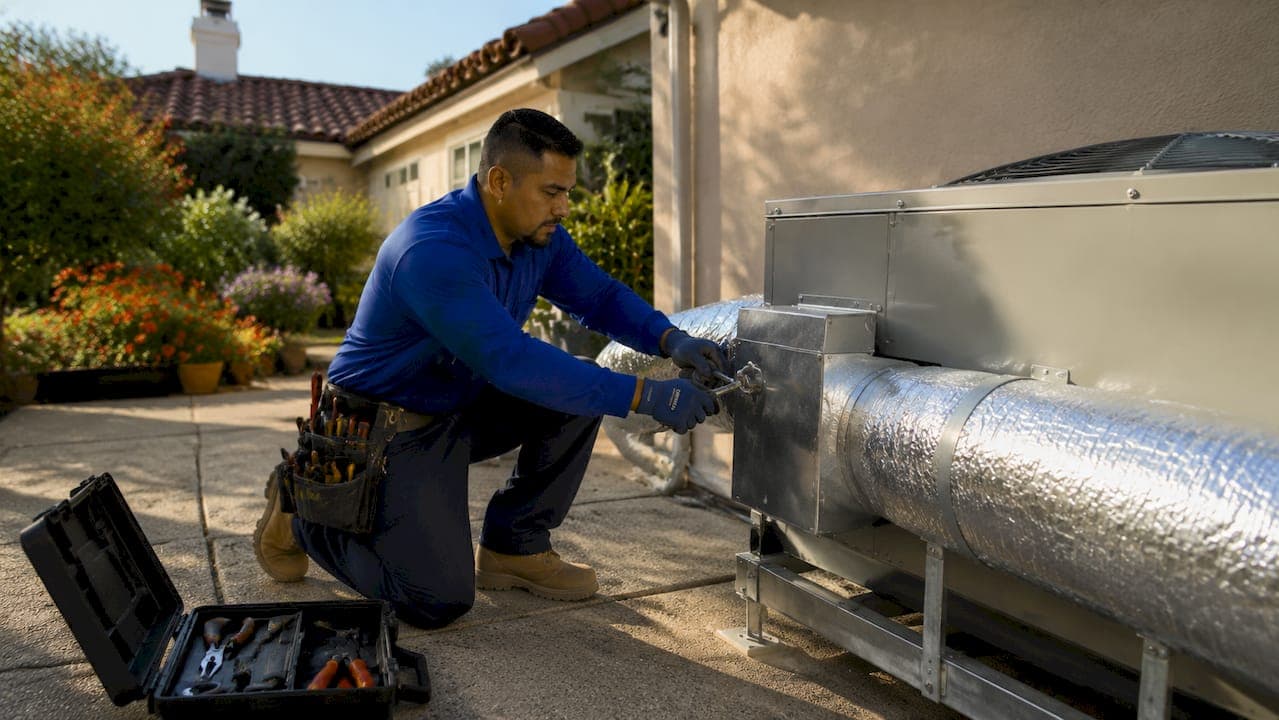
A package unit AC is a self-contained air conditioning system that houses every major HVAC component, including the compressor, condenser, evaporator coil, and air handler, inside a single outdoor cabinet. Unlike a split system, nothing goes inside your home except the ductwork. Residential models typically range from 1.5 to 5 tons (18,000–60,000 BTU/hr), with a standard 3-ton unit weighing around 523 lbs. For homeowners and property managers in Riverside and San Bernardino, where slab-on-grade construction and manufactured housing are common, this design solves a real problem: no attic, no basement, no indoor mechanical room required.
What is a package unit AC and how does it work?
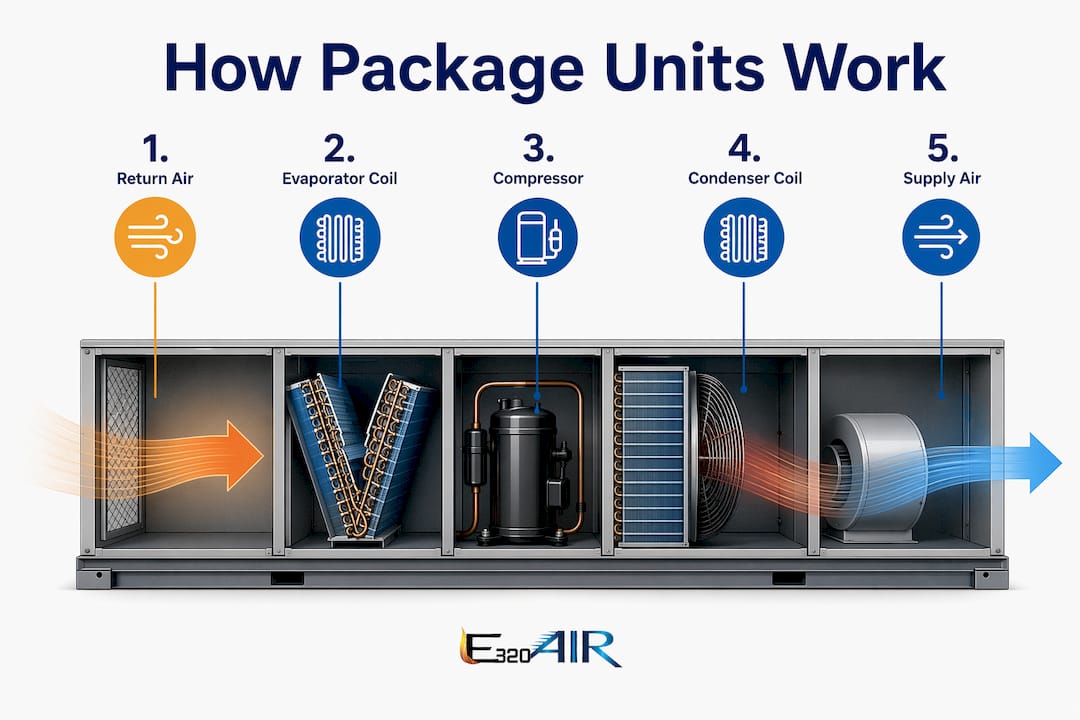
A package unit AC operates by running the entire refrigerant cycle inside one outdoor cabinet. That single fact separates it from every split system on the market and shapes everything about how you install, maintain, and live with it.
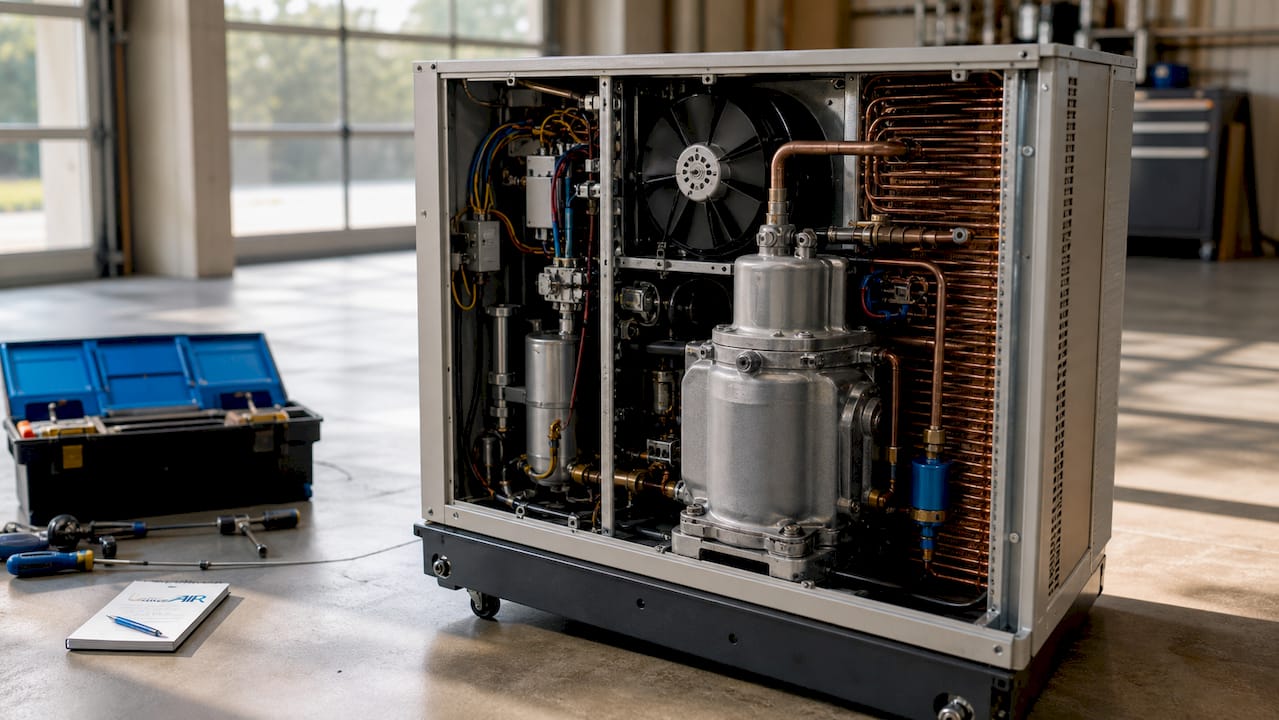
The components inside the cabinet
| Component | Role |
|---|---|
| Compressor | Pressurizes refrigerant to drive the cooling cycle |
| Condenser coil | Releases heat from refrigerant to the outdoor air |
| Evaporator coil | Absorbs heat from indoor return air |
| Air handler/blower | Moves conditioned air through the duct system |
| Expansion valve | Regulates refrigerant flow between coils |
Each component is factory-assembled before the unit ships. That factory pre-assembly cuts field labor significantly, but it does not eliminate the need for skilled installation. Ductwork and electrical connections still require a licensed HVAC technician.
How air moves through the system
Return air from your home travels through ducts to the outdoor cabinet. The evaporator coil pulls heat out of that air. The refrigerant carries that heat to the condenser coil, which dumps it outside. The blower then pushes the cooled air back through supply ducts into your living spaces. Because the refrigerant cycle stays entirely outdoors, there are no indoor refrigerant lines and no indoor leak risk.
Pro Tip: If your package unit is cooling unevenly room to room, check your duct connections at the cabinet first. That junction is the most common point of air loss in the whole system.
What are the benefits and limitations of package unit air conditioners?
Package units make strong sense for specific housing types and property situations. They also come with real trade-offs that Riverside and San Bernardino homeowners should weigh before buying.
Key benefits
- Space savings. All mechanical components sit outside. You reclaim every square foot of interior space that a split system's air handler would occupy.
- Simpler installation. One cabinet, one electrical connection, one refrigerant circuit. Homes without indoor mechanical rooms, including manufactured homes, modular homes, and slab-on-grade construction, get a complete HVAC solution without structural modifications.
- Easier access for service. A technician works on one outdoor unit rather than coordinating between an indoor air handler and an outdoor condenser.
- All-in-one design. Many package units combine heating and cooling in the same cabinet, either with a heat pump or a gas furnace section, eliminating the need for a separate furnace.
Real limitations to know
- Lower efficiency under heat stress. Package units tend to have slightly lower energy efficiency than split systems because every component endures year-round outdoor temperature extremes. In the Inland Empire, where summer highs regularly exceed 100°F, that stress is not theoretical.
- Weather exposure. All mechanical parts sit outside. Rain, debris, and UV radiation accelerate wear on cabinet seals, electrical connections, and coil fins.
- Rooftop access costs. Units installed on flat roofs require specialized equipment and labor for any significant repair, which raises your long-term service costs.
- Lifespan considerations. Outdoor exposure shortens the margin for error on maintenance. A neglected package unit in a hot climate ages faster than a split system with the same neglect.
For a broader look at how package units compare to other system types, the E320air guide on HVAC system types lays out the trade-offs clearly.
Pro Tip: In Riverside and San Bernardino, shade matters. If you can position a ground-mounted package unit on the north or east side of the building, you reduce direct sun exposure and lower the thermal load on the cabinet.
How is maintenance performed on a package unit AC?
A properly maintained package unit AC lasts 12–18 years. Skipping maintenance in a high-heat climate like the Inland Empire cuts that range significantly. The good news is that the maintenance routine is straightforward when you follow it consistently.
Annual maintenance routine
- Replace or clean air filters. Do this every 1–3 months during heavy use seasons. A clogged filter forces the blower to work harder and reduces airflow across the evaporator coil.
- Clean the condenser and evaporator coils. Dirt on the coils acts as insulation, blocking heat transfer. In dusty areas like San Bernardino, coil cleaning is a twice-yearly task, not an annual one.
- Inspect and seal ductwork. Duct leakage is the most common performance failure point in package unit systems. Leaky ducts waste conditioned air before it reaches your rooms, and homeowners often blame the unit itself.
- Check cabinet seals and weatherstripping. Gaps in the cabinet allow moisture and pests inside. Inspect seals after any major windstorm or rain event.
- Clear debris from around the unit. Leaves, dirt, and landscaping debris block airflow through the condenser. Keep a 2-foot clearance on all sides.
- Schedule a professional inspection. A licensed technician checks refrigerant charge, electrical connections, capacitors, and motor bearings. Do this before the summer cooling season starts, ideally in march or april.
- Verify rooftop access equipment. If your unit sits on the roof, confirm that safe ladder access and any required lift equipment are arranged before the service visit. Rooftop component replacement involves specialized labor and equipment that adds to repair costs when not planned in advance.
Proper duct sealing and insulation are often overlooked but are critical for preventing energy waste. The partner resource on air sealing for efficiency covers the specific techniques that apply to package unit duct connections.
What should property managers consider when installing a package unit AC?
Installation decisions made at the start of a project determine your operating costs for the next 15 years. Riverside and San Bernardino property managers face specific choices that deserve careful thought before any equipment is purchased.
Roof vs. ground slab installation
| Factor | Rooftop installation | Ground slab installation |
|---|---|---|
| Space use | Frees up ground space | Requires dedicated pad area |
| Access for service | Requires roof access equipment | Standard ground-level access |
| Weather exposure | Higher wind and UV exposure | Lower, but flood risk in some areas |
| Installation cost | Higher due to crane or lift needs | Lower, simpler rigging |
| Best suited for | Commercial buildings, flat-roof homes | Residential slab-on-grade properties |
Ground slab installation is the default choice for most Riverside and San Bernardino residential properties. Rooftop placement makes sense for commercial buildings or homes where ground space is genuinely unavailable.
Ductwork sizing and sealing
Ductwork is not a detail. The factory pre-assembly of the unit itself reduces field complexity, but the duct connections from the cabinet to your building must be professionally sized and sealed. Undersized ducts restrict airflow and make the system work harder. Oversized ducts reduce velocity and cause uneven cooling. Poor sealing causes energy loss that is routinely mistaken for unit malfunction.
Building type compatibility
Package units are the standard solution for manufactured and modular homes throughout the Inland Empire. They also work well for slab-on-grade construction where running refrigerant lines through walls is impractical. Before purchasing a unit, verify that your existing duct layout connects to the cabinet location you have chosen. Retrofitting duct runs after installation adds cost that a site assessment would have caught early.
For properties with specific commercial needs, E320air's commercial HVAC services page covers package unit applications beyond standard residential use.
Key takeaways
A package unit AC is the right choice for space-limited properties, but its long-term performance depends entirely on professional installation and consistent maintenance.
| Point | Details |
|---|---|
| All-in-one design | Every component sits in one outdoor cabinet, eliminating the need for indoor mechanical space. |
| Ideal housing match | Best suited for slab-on-grade, manufactured, and modular homes without attics or basements. |
| Efficiency trade-off | Outdoor exposure reduces efficiency slightly, especially in high-heat climates like Riverside and San Bernardino. |
| Ductwork is critical | Poorly sealed or undersized ducts cause energy loss that is often blamed on the unit itself. |
| Lifespan with maintenance | A well-maintained package unit lasts 12–18 years; skipping maintenance in hot climates shortens that range. |
What I've learned from package units in the Inland Empire
Most homeowners come to me thinking a package unit is the "budget option." That framing is wrong, and it leads to bad decisions. A package unit is a purpose-built solution for a specific housing situation. When the housing type matches, it performs as well as any split system. When it does not match, you are fighting the installation from day one.
The efficiency gap between package units and split systems is real but smaller than manufacturers' spec sheets suggest in practice. What actually kills efficiency in this region is not the system type. It is duct leakage and deferred maintenance. I have seen split systems perform worse than a well-maintained package unit simply because the homeowner never sealed the ducts.
The one thing I tell every property manager in San Bernardino and Riverside: plan your rooftop access before you buy. I have watched clients absorb significant extra costs on their first service call because no one thought about how a technician would safely reach the unit. That is a planning failure, not an equipment failure. Get the site assessment done first, then choose your unit.
— Edward
Professional package unit AC services from E320air
Choosing the right package unit AC for your Riverside or San Bernardino property is straightforward when you have the right team behind the installation.
E320air handles the full process: site assessment, unit selection, professional HVAC installation, duct sizing and sealing, and ongoing maintenance. Every installation includes proper duct integration and electrical connection by licensed technicians, which protects your equipment warranty and your system's long-term performance. Whether you manage a single-family home or a multi-unit property, E320air brings the regional experience to get it right the first time. Contact E320air to schedule a consultation and get a system matched to your property.
FAQ
What is a package unit AC in simple terms?
A package unit AC is a single outdoor cabinet that contains every component needed to heat and cool your home, including the compressor, condenser, evaporator, and blower. Ductwork connects the cabinet to your interior rooms.
How long does a package unit AC last?
A properly maintained package unit lasts 12–18 years. Regular filter changes, coil cleaning, and annual professional inspections are the main factors that determine where in that range your unit lands.
Is a package unit AC less efficient than a split system?
Package units are slightly less efficient than split systems because all components are exposed to outdoor temperature extremes year-round. In practice, duct leakage and skipped maintenance cause more efficiency loss than the system type itself.
What homes are best suited for a package unit air conditioner?
Package units are the best fit for manufactured homes, modular homes, and slab-on-grade construction where there is no attic, basement, or indoor mechanical room for a split system's air handler.
How often should a package unit AC be serviced in Riverside or San Bernardino?
Schedule a professional inspection once a year, ideally in the spring before peak cooling season. In dusty Inland Empire conditions, coil cleaning should happen twice a year to maintain heat transfer efficiency.