
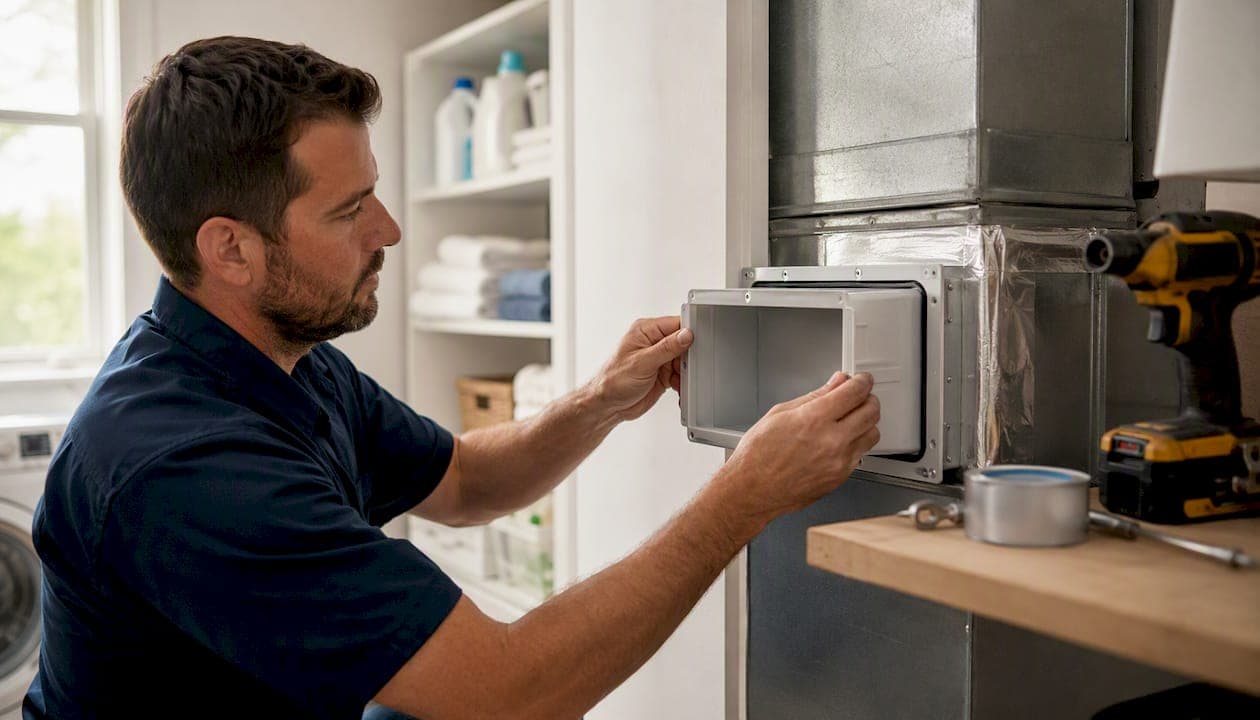
Most homeowners pay between $419 and $12,000 installed for a whole-house air purifier, with a frequently cited average near $2,610. Three variables control where your number lands: the technology you choose (a basic flat-media filter versus a UV or HEPA system), how compatible your existing HVAC is with that technology, and how complex the installation turns out to be. A single-furnace home with easy access to the air handler might come in well under $1,500. A multi-zone home needing duct modifications and an electrician can push past $5,000.
Quick stat: Mid-size homes using inline purifiers, UV-C modules, or modest HEPA retrofits typically land in a a more conservative $1,000–$3,000 band, with an average closer to $1,900 for straightforward furnace installs.
Here is what this guide covers:
- Cost by system type — unit-only and installed ranges for every major technology
- Operating costs — filter replacements, UV lamp service, and energy impact
- Quote checklist — the exact questions to ask before signing anything
Key Takeaways
Most homeowners installing a whole-house air purifier in a single-furnace home will pay between $550 and $2,200 installed, with system type, HVAC access, and electrical complexity controlling where the final number lands.
| Point | Details |
|---|---|
| Installed cost range | Most projects fall between $419 and $12,000; a realistic mid-range for single-furnace homes is $550–$2,200. |
| Biggest cost drivers | System type, number of furnaces, duct access difficulty, and whether electrical work is needed move the price most. |
| Recurring costs to budget | Plan $30–$250 per year depending on technology; HEPA and electronic systems cost the most to maintain. |
| HEPA compatibility risk | Standard blowers may not handle HEPA static pressure; always test ESP before selecting filters above MERV 13. |
| E320air next step | E320air provides itemized quotes, static pressure testing, and full installations across the Inland Empire. |
Table of Contents
- How much does whole house air purifier cost by system type?
- What factors affect the price of a whole-house air purifier?
- What does HVAC air purifier installation actually cost in labor?
- What are the ongoing costs of a whole-house air purifier?
- Sample pricing scenarios for three common home situations
- Is a whole-house air purifier worth the cost?
- How to get an accurate quote from an HVAC installer
- When can you DIY, and when do you need a professional?
- Why HEPA and high-MERV filters can damage your HVAC blower
- An installer's perspective on budgeting this work
- E320air handles the whole install, from site check to final test
- Sources
How much does whole house air purifier cost by system type?
Per-technology installed ranges vary more than most homeowners expect. A flat-media filter upgrade and a true HEPA retrofit are both "whole-house air purifiers" on paper, but they sit at opposite ends of the price spectrum and solve different problems.
| System Type | Unit-Only Cost | Typical Installed Range | Best Home/CFM Fit | Annual Maintenance | Quick Pros/Cons |
|---|---|---|---|---|---|
| Flat/panel filter (MERV 11–13) | $30–$80 | $100–$250 | Any size; standard duct | $30–$80 (filter replacements) | Low cost, easy swap; limited particle capture |
| Extended media (MERV 11–13) | $150–$400 | $500–$1,000 | 1,500–2,000 sq ft | $50–$120/yr | Better filtration, low pressure drop; bulkier housing |
| Electronic/ionization (APCO-style) | $250–$400 | $350–$1,200 | 1,000–3,000 sq ft | $80–$250/yr (cells, cleaning) | Handles odors and biologicals; ozone risk if poorly selected |
| UV-C germicidal module | $200–$400 | $750–$1,500 | Any ducted system | $80–$150/yr (lamp replacement) | Kills biologicals; does not remove particles |
| True HEPA in-duct retrofit | $500–$2,000+ | $2,000–$5,000+ | Larger homes; upgraded blower required | $150–$400/yr (HEPA filter) | Highest particle capture; high static pressure risk |
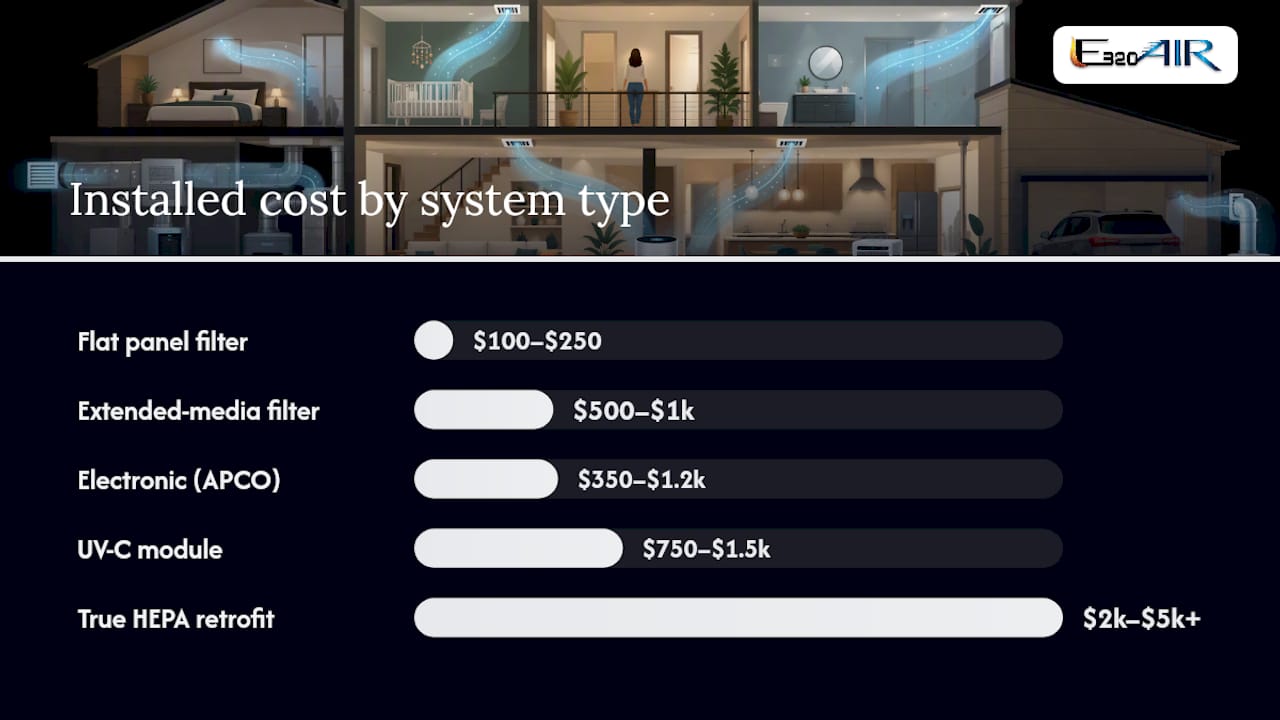
APCO-style modules deserve a specific callout. These in-duct oxidation/adsorption units typically run $350–$1,200 installed for a single-furnace home, with replacement cells running $80–$250. They cost far less than a HEPA retrofit and require minimal duct modification, which is why they are a common first recommendation for odor and biological control.
HEPA retrofits cost more for a reason beyond the filter itself. The dense media creates high static pressure, and standard residential blowers often cannot handle it without upgrades. That blower work adds cost before you even count the filter housing.
UV-C modules do not filter particles at all. They are germicidal, not mechanical. Pairing a UV lamp with a quality extended-media filter gives you both particle control and biological protection, which is often the most cost-effective combined strategy.
Typical replacement cycles to budget for:
- Flat/panel filters: every 1–3 months, $5–$25 each
- Extended media cartridges: every 6–12 months, $30–$80 each
- Electronic cell cleaning: every 3–6 months (DIY possible); cell replacement every 2–5 years, $80–$250
- UV-C lamps: annually, $50–$150 per lamp
- HEPA filters: every 1–3 years, $100–$300+ depending on size
Pro Tip: Pairing an extended-media filter (MERV 11–13) with a UV-C module gives you particle capture plus germicidal coverage while staying within most standard blower capacities. That combination usually costs less installed than a HEPA retrofit and avoids the static-pressure problems that come with it. Learn more about how UV air purifiers work in HVAC before committing to a technology.
What factors affect the price of a whole-house air purifier?
The equipment cost is only part of the bill. These are the line items that most commonly inflate a quote beyond the base unit price:
- Home square footage and CFM requirements. Larger homes need higher-capacity units or multiple modules. A 4,000 sq ft home may need a unit rated for 2,000+ CFM, which costs more than a standard 1,200 CFM module.
- Number of furnaces or air handlers. Each furnace needs its own purifier module. A two-furnace home doubles the equipment cost and adds labor for the second install.
- Duct access and routing. Attic or crawlspace access adds $150–$400 to labor; multi-zone duct modifications can add $300–$900. Full duct rerouting runs $1,500–$9,000 depending on scope.
- HVAC blower capacity. If your blower cannot handle the static pressure of the chosen filter, you may need a variable-speed blower upgrade before installation. That alone can add $500–$1,500.
- Permits and inspections. Required in many jurisdictions for electrical work or duct modifications. Budget $50–$200 for a basic permit; more complex projects can run higher.
- Electrician time. Some UV and electronic modules need a dedicated outlet or hardwired connection. Electrician rates typically run $50–$100/hour, with a simple outlet install costing $100–$450 as a fixed charge.
- Regional labor rates. HVAC labor in high-cost metros (Los Angeles, New York, San Francisco) runs toward the top of the $100–$250/hour range. Rural markets often come in closer to $75–$120/hour.
- Brand and model selection. Aprilaire and Honeywell whole-home systems carry higher unit costs than generic alternatives, but they typically include better warranty terms and more consistent replacement-part availability. That premium is often worth it for long-term reliability.
Cost callout: HVAC labor commonly runs $100–$250 per hour. A straightforward single-furnace install might take 2–3 hours; a complex attic job with electrical work can run 5–7 hours. That spread alone accounts for $300–$1,750 in labor variance before a single part is priced.
When a quote comes in significantly higher than expected, duct access and electrical work are usually the culprits. Ask the installer to break those out as separate line items so you can see exactly what is driving the number. Understanding why ductwork matters for HVAC efficiency helps you evaluate whether those charges are reasonable.
What does HVAC air purifier installation actually cost in labor?
Labor is where quotes diverge most. Here is what a professional installation typically involves, and what each task costs in time:
- Site prep and access: Clearing the area around the air handler, confirming measurements, and verifying electrical availability. Usually 30–60 minutes.
- Duct collar or plenum work: Cutting the opening, fitting the module housing, and sealing the collar. 45–90 minutes for a standard install; longer for attic or tight-space access.
- Module mounting and securing: Physically installing the purifier unit into the duct or air handler. 30–60 minutes.
- Electrical wiring: Running power to the unit, connecting to the HVAC control board or a dedicated circuit. 30–120 minutes depending on whether an outlet exists nearby.
- Airflow and static pressure testing: Checking that the system moves adequate CFM after installation. 30–45 minutes.
- System startup and verification: Confirming the unit powers on, cycles correctly, and that no error codes appear. 15–30 minutes.
A clean single-furnace install in an accessible utility room typically runs 2–3 hours total. An attic install with no existing outlet can stretch to 5–7 hours. At $100–$250/hour for HVAC labor, that is $200–$750 for the simple job and $500–$1,750 for the complex one, before any electrician time.
Pro Tip: Always request an itemized quote that separates materials, labor, permits, and any subcontractor charges (like electrician work). A single lump-sum number makes it impossible to compare quotes from different contractors or spot inflated line items. Ask specifically: "Can you break this into equipment cost, labor hours and rate, permit fees, and any electrical work?" Most reputable installers will do this without hesitation.
Typical lead time from initial site visit to completed installation runs 3–10 business days for standard jobs. If the unit needs to be ordered or if permits require inspection scheduling, add another 1–2 weeks. Permits are typically pulled by the installing contractor, not the homeowner, but confirm this upfront so there are no surprises on inspection day.
What are the ongoing costs of a whole-house air purifier?
The installed price is a one-time expense. The recurring costs run for the life of the system, and they vary significantly by technology.
Homeowners should budget roughly $80–$250 per year for electronic or UV system components, while standard pleated filter replacements typically stay under $100 annually when changed on schedule.
Energy and airflow considerations:
- Higher-MERV and HEPA filters increase static pressure, which forces the blower to work harder. This raises energy consumption and can shorten blower motor life if the system is not sized for it.
- UV-C modules add minimal electrical draw, typically 15–40 watts per lamp, which adds only a few dollars per month to the electric bill.
- Electronic ionization modules draw similarly low wattage but require periodic cell cleaning to maintain efficiency. A dirty cell does not just underperform; it can produce elevated ozone levels in some units.
- Annual professional maintenance for electronic or UV systems typically runs $100–$200 and includes cell inspection, lamp output testing, and a basic HVAC health check. Skipping this service is a common way homeowners end up with a system that is running but not actually cleaning the air. For more on keeping your system performing well, these HVAC lifespan tips apply directly to purifier-equipped systems.
Sample pricing scenarios for three common home situations
These three scenarios show how the same technology choice produces very different final costs depending on home size and installation conditions.
What drove each total:
- Scenario 1 stays low because the air handler is in a finished utility room, an outlet is already present, and a single APCO-style or extended-media module handles the whole home. This is the scenario most homeowners in newer construction will face.
- Scenario 2 costs significantly more because attic access adds labor time, the electrician must run a new circuit, and the older ductwork may need collar modifications. The unit cost is similar; the labor and electrical work double the total.
- Scenario 3 reflects a large home with two separate HVAC systems, each needing its own purifier. Doubling the equipment and labor is unavoidable. Choosing UV plus extended media on each unit rather than HEPA keeps the cost from climbing further.
To adapt these to your home: add roughly $400–$900 per additional furnace or air handler, and add $150–$400 if your air handler is in an attic or crawlspace rather than a finished mechanical room.
Is a whole-house air purifier worth the cost?
The honest answer depends on what problem you are actually trying to solve and how your home is laid out.
Whole-house systems tend to be worth it when:
- Allergy or asthma symptoms affect multiple family members across the whole house, not just one room
- Smoke, cooking odors, or VOCs circulate through the entire HVAC system
- You want to avoid running three or four portable units in different rooms, each with its own filter replacement schedule
- You have pets and want consistent particle control throughout the home
- Your HVAC already runs frequently, meaning the purifier gets adequate runtime to be effective
Portable or targeted solutions make more sense when:
- The air quality problem is limited to one room (a bedroom, a home office)
- Your HVAC system is incompatible with in-duct modules without expensive modifications
- Your budget is under $500 and you need a solution now
- You rent and cannot authorize duct modifications
Pro Tip: A practical middle ground: install an extended-media filter at the furnace for whole-home particle control, then add a portable HEPA unit in the bedroom where you spend the most time sleeping. You get the coverage of a whole-house system for particles and a high-efficiency filter exactly where it matters most for sleep quality, without paying for a full HEPA retrofit. Some homeowners also supplement with houseplants known to support air quality as a low-cost complement to mechanical filtration.
The EPA's indoor air quality guidance makes a point worth repeating: filtration is one component of an overall IAQ approach. Source control (fixing moisture problems, reducing VOC sources) and ventilation matter just as much. A whole-house purifier will not compensate for a home with serious moisture or off-gassing issues. For a broader look at HVAC air quality improvements, the comparison between whole-house and portable options is worth reviewing before you commit.
How to get an accurate quote from an HVAC installer
Getting three quotes is standard advice. Getting three comparable quotes requires a little preparation.
Have these ready before any installer visit:
- Make and model of your furnace or air handler (on the data plate inside the unit)
- Current filter size (written on the existing filter frame)
- Measured square footage of the home and number of floors
- Number of furnaces or air handlers
- Photos of the air handler location, access path, and nearby electrical outlets
- Any existing IAQ equipment already installed
Questions to ask every installer:
- Does this quote include permits, and who pulls them?
- Are materials, labor, and any subcontractor charges (electrician) itemized separately?
- Will you test static pressure and blower capacity before and after installation?
- What are the replacement part costs and recommended service intervals for this specific unit?
- What warranty does the equipment carry, and what does your labor warranty cover?
- If the blower needs an upgrade to handle this filter, is that included in this quote or a separate line item?
- What happens if you find duct issues during installation that were not visible during the site visit?
Ask for the scope of work in writing before signing. A reliable installer will not hesitate to provide an itemized breakdown. One who resists is worth reconsidering.
When can you DIY, and when do you need a professional?
Some tasks are genuinely homeowner-friendly. Others carry real risk if done without HVAC training.
Tasks most homeowners can handle safely:
- Replacing flat panel or pleated filters (the standard 1-inch or 4-inch filter in the existing slot)
- Adding a basic inline filter housing designed for homeowner installation, where no duct cutting is required
- Cleaning accessible electronic cell plates on units designed for DIY maintenance
- Measuring filter dimensions and photographing the air handler before calling a pro
Tasks that require a licensed HVAC technician:
- Cutting into ductwork or the plenum to mount an in-duct module
- Any electrical wiring, including adding an outlet near the air handler
- Installing UV-C systems that connect to the HVAC control board
- HEPA retrofits requiring blower assessment or replacement
- Any work that requires a permit in your jurisdiction
Pro Tip: Before booking a pro, spend 10 minutes doing these checks yourself: measure your existing filter slot, photograph the air handler and the path to it from the nearest door, and write down the blower model number from the data plate. That information cuts the site-visit time and gives the installer what they need to quote accurately without a second trip.
Attempting major duct modifications without a permit can void your homeowner's insurance coverage for related damage and will void most equipment warranties. It can also create liability if you sell the home and the unpermitted work is discovered during inspection. The cost of a permit is almost always less than the cost of those consequences. For a detailed look at common HVAC installation mistakes that homeowners and contractors make, that resource covers the pitfalls worth knowing before work starts.
Why HEPA and high-MERV filters can damage your HVAC blower
This is the caution most homeowners do not hear until after something goes wrong.
That performance comes from extremely dense filter media. Dense media means high resistance to airflow, which translates directly into increased static pressure inside your duct system. Standard residential blowers are designed to operate within a specific external static pressure (ESP) range, typically 0.5–0.8 inches of water column. A true HEPA filter can push that well beyond the blower's rated capacity.
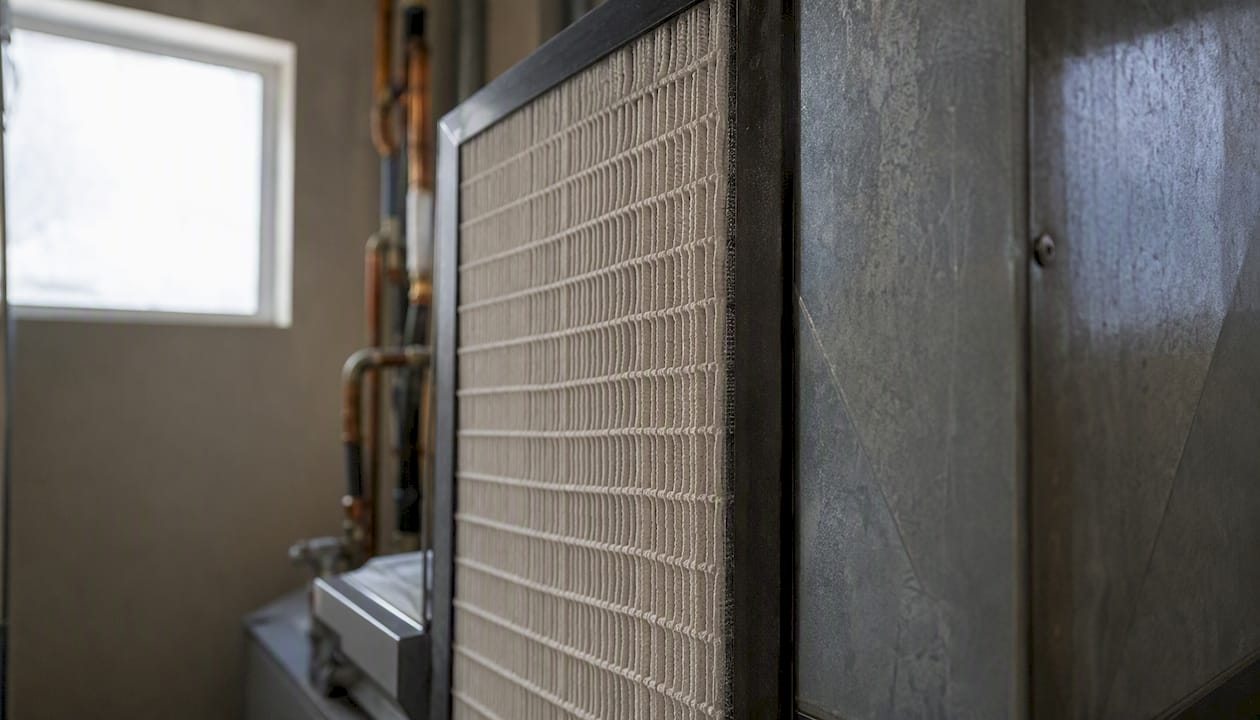
The consequences are not subtle. Reduced airflow means the system cannot adequately heat or cool the home. The blower motor runs hotter and longer to compensate, shortening its lifespan. In severe cases, the motor fails outright. None of this shows up immediately; it develops over months of operation, which is why homeowners often do not connect the blower failure to the filter upgrade they made a year earlier.
High-efficiency filters are not always the correct residential choice precisely because their density can produce detrimental static pressure on standard blowers. Selecting the right MERV rating means matching it to your blower's actual capacity, not simply choosing the highest number available.
Pro Tip: Ask your HVAC technician to measure external static pressure before selecting any filter above MERV 13. If the current ESP is already near the top of the blower's rated range, adding a high-resistance filter will push it over. A variable-speed blower upgrade, which typically costs $500–$1,500, may be necessary before a HEPA retrofit makes sense. Budget for that possibility before committing to HEPA.
EEAT callout: An HVAC health check before installing high-resistance modules typically costs $100–$500 and can prevent a blower failure that costs far more to repair. If the blower, motor, or ductwork is undersized or already degraded, a high-MERV purifier can reduce system performance rather than improve indoor air quality. For a deeper look at HVAC filter essentials and how filter choice affects system efficiency, that resource covers the tradeoffs in practical terms.
An installer's perspective on budgeting this work
When E320air technicians arrive for a site visit on a whole-house purifier install, the first thing they check is not the unit the homeowner wants to buy. It is the condition and capacity of the existing HVAC system.
What a thorough site visit should cover:
- Blower capacity and current static pressure reading
- Duct condition, access points, and any existing restrictions
- Electrical availability near the air handler
- Filter slot dimensions and current filter type
- Number of zones or air handlers requiring coverage
- Any safety or code concerns that affect permitting
A few things E320air sees consistently on quotes that homeowners should watch for: lump-sum pricing with no itemization, quotes that do not mention static pressure testing, and proposals for HEPA retrofits on older systems without any mention of blower assessment. Those are red flags, not just oversights.
For most single-furnace homes in standard condition, a quality extended-media or APCO-style install is the right starting point. It delivers meaningful air quality improvement, stays within blower capacity, and keeps the total installed cost in a range most homeowners can manage without financing. Always keep the written warranty documentation and confirm in writing what replacement parts cost and where to source them before the installer leaves.
E320air handles the whole install, from site check to final test
Budgeting for a whole-house air purifier is straightforward when you have a contractor who itemizes everything upfront. E320air provides residential HVAC air purifier installations across the Inland Empire, covering the full scope: on-site HVAC compatibility assessment, static pressure testing, itemized written quotes (equipment, labor, permits, and electrical work separated), permit handling, installation, post-install airflow verification, and follow-up maintenance scheduling.
No lump-sum guesswork. Homeowners get a clear line-item quote before any work starts, so the final bill matches what was agreed. E320air installs Aprilaire, Honeywell, and APCO-compatible systems, and the team flags blower compatibility issues before they become expensive surprises. Ready to know exactly what your home needs and what it will cost? Schedule an on-site assessment or request a detailed quote from E320air today.
Sources
The price ranges and technical guidance in this article draw from the following primary sources. Unit costs, installed ranges, and labor bands were combined with access modifiers and permit estimates to produce the sample scenarios above.
- What Does a Whole House Purification System Cost?
- How Much Does a Whole-Home Air Purifier Cost? (2025)
- APCO in-Duct Air Purifier Cost for Home HVAC Systems 2026 - Pick Comfort
- Air Purifier for Furnace Cost: Price Ranges, Install, and Savings 2026 – Current Cost
- Epa