
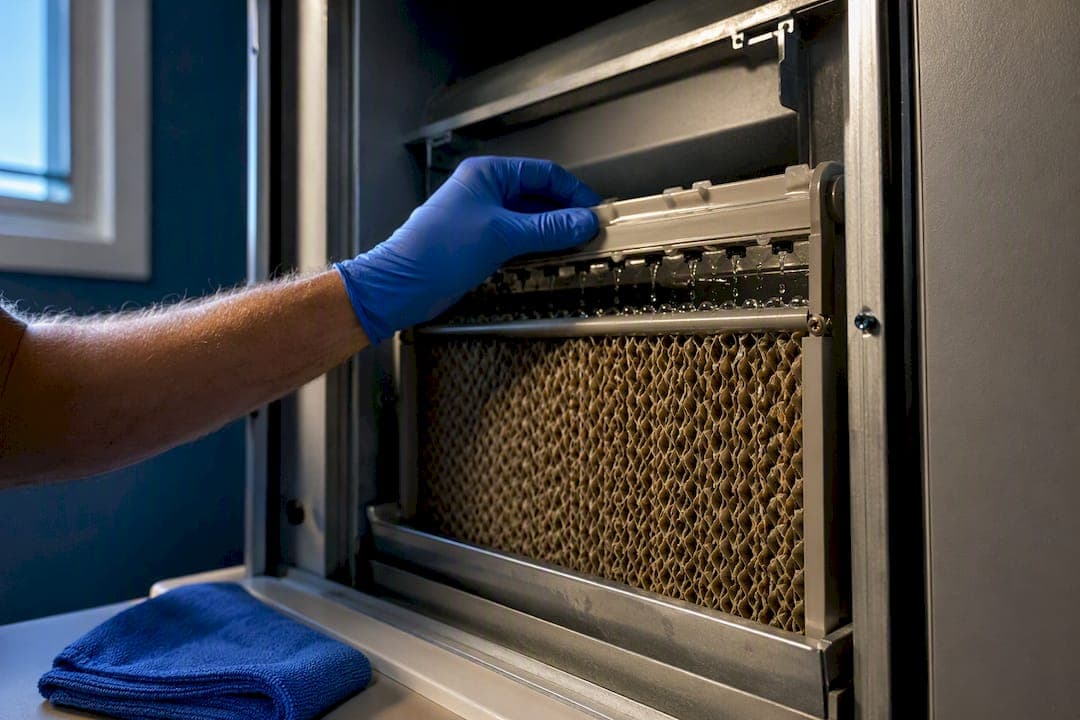
For homes that suffer persistent low indoor humidity, a whole-house humidifier delivers measurable health, comfort, energy, and home-protection benefits, provided it's installed and maintained correctly. Homes that gain the most are those fighting cracked skin, static shocks, and creaky floors all winter long. The tradeoff is real too: skip the maintenance or run the humidistat too high, and you trade dry air for mold risk and window condensation.
TL;DR:
- Whole-house humidifiers keep humidity within the recommended 30% to 50% range, benefiting overall health, comfort, and home preservation across all rooms.
- Proper maintenance, including humidistat calibration and regular pad replacement, is essential to prevent mold growth and window condensation.
- Installation costs vary by system type, with bypass units being most affordable, and fall is the ideal season for installation to ensure winter effectiveness.
- Thousands of households see benefits in reduced wood cracking, static shocks, and improved sleep quality, especially when humidity control is correctly sized for their home.
- Portable humidifiers may suffice for single-room use, but homes with consistent dry air and valuable wood features should consider a whole-house system for long-term efficiency.
Table of Contents
- Whole-House Humidifier Benefits at a Glance
- How Humidity Improves Indoor Air Quality and Health
- Comfort and Energy Savings: Why Humid Air Feels Warmer
- How Whole-House Humidifiers Protect Wood, Paint, and Furniture
- Whole-House vs. Portable Humidifiers: Which One Fits Your Home?
- Whole-House Humidifier Risks and How to Maintain One Safely
- What a Whole-House Humidifier Costs and When to Install One
- E320air's Contractor Guidance for Whole-House Humidification
- Is a Whole-House Humidifier Worth It for Your Home?
- Energy Consumption and Environmental Impact of Whole-House Humidifiers
- Whole-House Humidifiers vs. Air Purifiers and Full HVAC Integration
- Is a Whole-House Humidifier Worth the Long-Term Cost?
- A Practitioner's Take on Whole-House Humidification
- Sizing a humidifier wrong, or skipping the maintenance that keeps one running safely, is how homeowners end up disappointed with a system that should have worked. Professional contractors handle the part most DIY research can't: an in-home assessment that accounts for your specific duct layout, furnace type, and water hardness before recommending a bypass, fan-powered, or steam unit sized correctly for your square footage.
- Sources
- FAQ
Whole-House Humidifier Benefits at a Glance
A whole-house system tackles more problems at once than most homeowners expect, and it does so without the daily refilling that portable units demand. Here's the quick rundown before we get into specifics:
- Health: eases dry sinuses, nosebleeds, and irritated airways, and may support easier breathing for people with allergies or asthma.
- Comfort and energy: humid air feels warmer at the same temperature, which can let you nudge the thermostat down a degree or two.
- Home protection: guards wood floors, furniture, and paint from the shrinking and cracking that dry air causes.
- Static reduction: fewer shocks off doorknobs and less static cling on clothes and hair.
- Maintenance trade-off: pads, filters, and humidistats need regular attention, or the system can overshoot into mold territory.
The EPA recommends keeping indoor relative humidity between 30% and 50% to limit dust mites, mold, and other irritants. A whole-house unit maintains that range across every room tied into your ductwork. A portable humidifier only covers the one room it sits in.
How Humidity Improves Indoor Air Quality and Health
Dry air pulls moisture straight out of your nose, throat, and skin, making RSV newborn safety during flu season a crucial consideration for households with infants. Once relative humidity drops much below 30%, mucous membranes lose the thin layer of moisture they rely on to trap dust and filter incoming air. That's when dry throat, cracked lips, and random nosebleeds start showing up, especially overnight when your furnace has been running for hours.
By the numbers: The EPA's indoor air quality guidance sets 30% to 50% as the target range for limiting biological contaminants and respiratory irritation indoors.
Humidity does more than soothe your throat. Research on respiratory virus transmission links low humidity to longer airborne persistence of some viral particles, meaning drier air can let certain respiratory viruses linger longer than they would in properly humidified conditions. That's not a claim that a humidifier prevents illness. It's a reason humidity control belongs in the same conversation as filtration and ventilation when you're thinking about indoor air quality.
For people managing allergies or asthma, keeping humidity in range can ease some of the irritation that dry air triggers, though results vary by individual and underlying condition. Many homeowners also notice better sleep once humidity is dialed in. Dry nasal passages contribute to snoring for some people, and a properly humidified bedroom can take the edge off. Above that, you're inviting the mold and dust mite growth the EPA guidance warns against.
Comfort and Energy Savings: Why Humid Air Feels Warmer
Humid air holds heat against your skin more effectively than dry air at the same temperature, which is why a 68°F room at 40% humidity feels noticeably warmer than the same room at 20% humidity. That perception isn't a trick. It's why hospitals and greenhouses run higher humidity to maintain comfort at lower energy input.
The practical upside: once your home holds a steady 35% to 45% RH, you can often set the thermostat a degree or two lower and still feel just as warm. Energy notes that small, consistent thermostat adjustments are one of the more reliable ways to cut heating costs over a season, and pairing that strategy with humidity control makes those setbacks easier to live with.
A few things to keep in mind if you're chasing savings:
- Savings are real but modest. Don't expect a humidifier to replace insulation or a furnace tune-up.
- The comfort gain compounds with a programmable thermostat, not instead of one.
- Setbacks work best when they're gradual and scheduled, not manual swings you forget to reverse.
You'll likely sleep just as warm using less fuel than you would at low humidity and a higher setpoint.*
How Whole-House Humidifiers Protect Wood, Paint, and Furniture
Wood is hygroscopic. It absorbs and releases moisture based on the air around it, and when that air runs dry all winter, wood floors and furniture shrink. That's what causes the gaps between hardwood planks, the cracked joints in antique furniture, and hairline fractures in painted trim that show up every January.
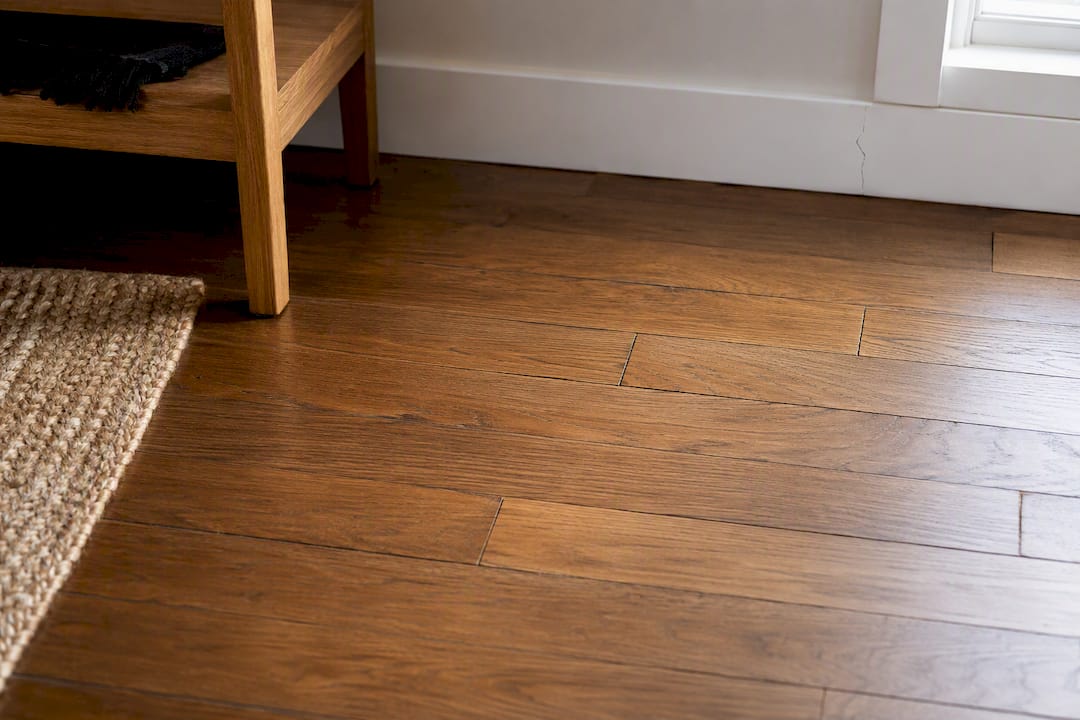
A whole-house system keeps humidity consistent across every room tied into your ductwork, not just the one room where you happen to place a portable unit. That matters because wood floors in a hallway or a formal dining room rarely sit near a portable humidifier, yet they suffer the same drying stress as the living room does.
Practical steps to protect what you own:
- Track humidity with a simple hygrometer in a couple of rooms, not just near the thermostat.
- Keep prized wood furniture and instruments away from direct heating vents regardless of humidity levels.
- Watch trim and baseboards each fall for early gapping. It's the first sign your home is running too dry.
Whole-house humidifiers reduce static electricity and help protect wood surfaces throughout the home, an advantage portables can't match at whole-home scale.
Whole-House vs. Portable Humidifiers: Which One Fits Your Home?
Three whole-house designs cover most residential needs, and each fits a different situation:
- Bypass humidifiers use your furnace's blower to push air through a moistened pad, making them the most affordable whole-house option for homes with standard forced-air heat. They work well for moderate climates and typical-size homes.
- Fan-powered (evaporative) units add their own fan to push more air through the pad, which means faster humidification for larger homes or homes with longer duct runs.
- Steam humidifiers heat water to generate vapor independent of furnace airflow, giving the most precise, fastest humidity control. They're the right call for very dry climates or homes with zoned HVAC systems, where a single bypass unit tied to one zone can under-humidify rooms on a separate zone.
Portable units still make sense in specific situations. They typically cover 400 to 800 square feet, which is fine for a nursery, a home office, or a single bedroom with a dry-air complaint. If your whole home runs dry every winter and you own wood floors or a piano you care about, a portable is a stopgap, not a solution. If only one room has a problem, a portable is the sensible, cheaper fix.
Whole-House Humidifier Risks and How to Maintain One Safely
The most common failure mode isn't the equipment. It's neglect. Left unchecked, a humidifier set too high causes window condensation, and persistent condensation is an early sign of conditions that can lead to hidden mold growth inside wall cavities.
Keep problems away with a short seasonal routine:
- Check the humidistat calibration at the start of heating season. Cheap aftermarket sensors drift and can quietly push humidity higher than the dial shows.
- Replace evaporator pads or filters on the schedule your manufacturer recommends, more often if your water is hard.
- Inspect the unit annually alongside your furnace tune-up.
- Treat mineral buildup with a water conditioner if you have hard water; scale reduces efficiency and shortens equipment life.
Pro Tip: If your windows fog up regularly on cold mornings, that's your house telling you the humidistat needs a lower setpoint, not a bigger humidifier.
What a Whole-House Humidifier Costs and When to Install One
Costs vary by unit type, ductwork access, and whether you choose bypass, fan-powered, or steam. Steam units generally cost more than bypass or evaporative models because they need dedicated electrical work and more complex installation.
A few things shape the final price and timing:
- Unit type drives most of the cost spread. Bypass units are the entry point; steam units sit at the top for both equipment and labor.
- Fall, before heating season starts, is the best time to install. Contractors have more scheduling flexibility and you get full use of the system all winter.
- Duct access and existing HVAC layout determine labor time. An installer will assess your furnace type, duct routing, and water supply line access before quoting.
Ask any contractor you're considering how they'll integrate the humidistat with your existing thermostat, and confirm whether your ductwork needs modification. Homeowners can speed up the visit by having furnace specs and recent water hardness readings on hand.
E320air's Contractor Guidance for Whole-House Humidification
It is recommended to check the humidifier during your annual HVAC tune-up, and to replace pads or filters once per heating season, more often with hard water. The most common issue technicians find on service calls is a miscalibrated humidistat quietly overshooting the target range, which is why that check belongs on every seasonal visit.
Is a Whole-House Humidifier Worth It for Your Home?
Install one if you're dealing with persistent low humidity, wood floors or furniture showing seasonal damage, or household-wide dry-air symptoms. A portable unit still makes sense for a single dry room or temporary need.
Energy Consumption and Environmental Impact of Whole-House Humidifiers
Whole-house humidifiers use very little electricity on their own. Bypass and fan-powered units draw only enough power to run a small fan or open a damper, since they rely on your furnace's existing blower to move air. Steam units draw more power because they heat water directly, which is part of why they cost more to run and install.
The bigger environmental variable is water, not electricity. A whole-house system continuously pulls from your home's water supply, and depending on unit type and your home's size, that adds up over a full heating season. Homes with hard water also generate mineral scale that eventually gets flushed or scraped away during maintenance, which is a small but real waste stream most homeowners don't think about until they're staring at a crusted evaporator pad.
The indirect environmental upside is the same one that helps your energy bill: humidified air that feels warmer supports modest thermostat setbacks, and lower heating demand reduces the fuel or electricity your furnace burns over a season. That's not a dramatic reduction, and it won't offset a poorly insulated home. But it's a legitimate, if modest, environmental case for humidity control that goes beyond comfort alone.
Compared to running multiple portable units, a whole-house system is generally the more efficient choice per square foot covered, since portables each carry their own standby power draw, plastic components, and disposable filters that add up across a household running two or three units to cover the same space one whole-house system handles.
Whole-House Humidifiers vs. Air Purifiers and Full HVAC Integration
A whole-house humidifier and a whole-house air purifier solve different problems, and confusing the two leads to disappointed homeowners. A humidifier controls moisture. An air purifier removes particulates, allergens, and some airborne contaminants. Dry air and dirty air are separate complaints, and treating one doesn't fix the other.
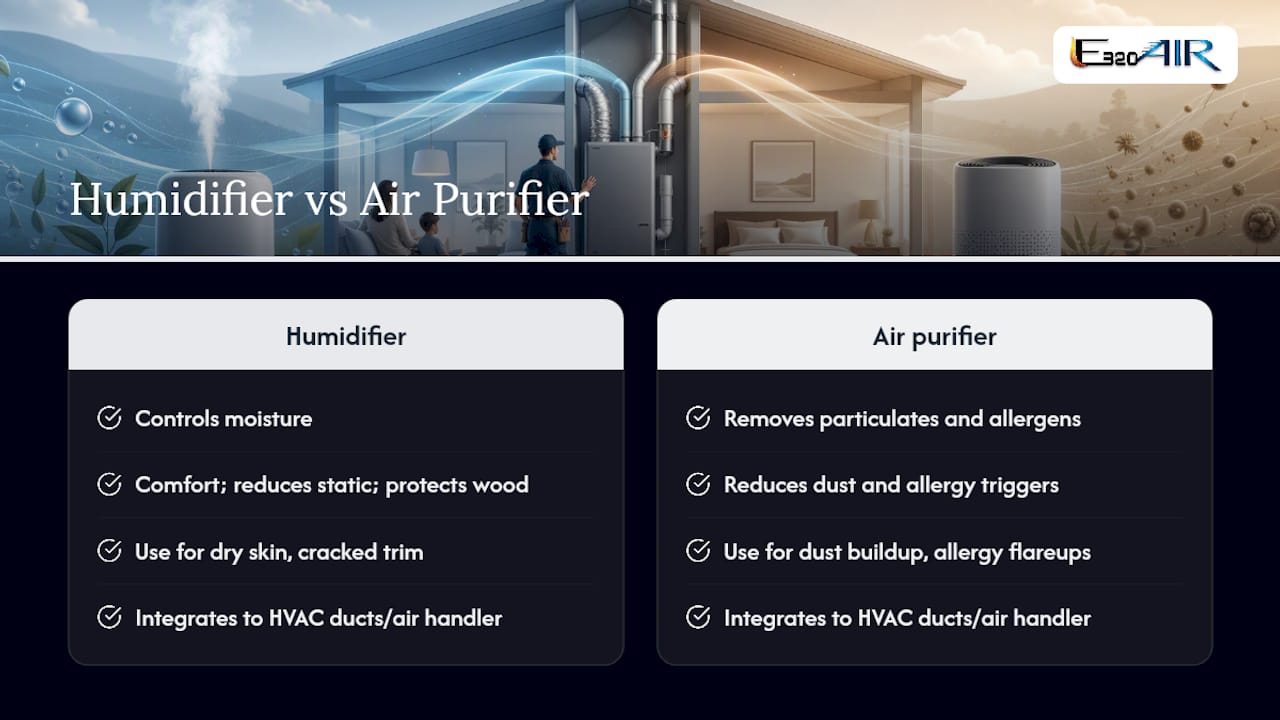
That said, both systems share the same delivery mechanism: your HVAC ductwork. Whichever HVAC service you already trust for furnace and duct work can typically integrate a humidifier alongside filtration upgrades in the same service visit, since both tie into the same air handler and duct system. That's a real advantage over standalone portable units of either type, which each need their own footprint, power outlet, and maintenance schedule scattered around the house.
If you're weighing a whole-house air purifier against a whole-house humidifier, the honest answer is that most dry-climate homes eventually want both. Humidity control addresses comfort, static, and wood protection. Filtration addresses dust, pet allergens, and particulate load. Homeowners often start with whichever problem is more urgent (persistent dry skin and cracked trim point to humidity, while dust buildup and allergy flareups point to filtration), and add the second system once the first proves its worth. Because both integrate into the same ductwork, sequencing them doesn't waste any installation work already done.
Is a Whole-House Humidifier Worth the Long-Term Cost?
The upfront cost of a whole-house system is higher than a portable humidifier, but the long-term math tends to favor the whole-house install for homes with a persistent dry-air problem. HVAC industry guidance frames whole-house units as a permanent infrastructure investment suited to homes with recurring seasonal dryness, versus portables, which are better suited to temporary or single-room needs.
Run the comparison honestly. A portable unit costs less upfront, but it needs manual refilling every day or two, replacement filters every few weeks, and it only covers one room. Multiply that across three or four rooms that all run dry, and you're buying, cleaning, and refilling multiple units all winter. A whole-house system trades that daily labor for a seasonal maintenance routine: pad changes, a humidistat check, and an annual inspection.
The maintenance costs on the whole-house side are real and worth budgeting for. Neglecting them is where homeowners lose the cost advantage, since a fouled pad or drifted humidistat can quietly waste water and invite the mold problems covered earlier. But for a home that's fighting cracked wood floors, static shocks, and dry-air symptoms across multiple rooms every winter, the avoided cost of floor refinishing, furniture repair, and the sheer time spent tending portable units usually outweighs the annual maintenance bill on a whole-house system. The savings aren't dramatic on their own. They're cumulative, showing up more in what you don't have to repair or replace than in a line item on your utility bill.
A Practitioner's Take on Whole-House Humidification
Most complaints about whole-house humidifiers trace back to sizing or neglect, not the technology itself. Match the system to your home's actual square footage and HVAC layout, then commit to the seasonal maintenance routine. Skip either step, and you'll get the downsides people warn about. Get both right, and the benefits hold up exactly as described.
— Edward
Sizing a humidifier wrong, or skipping the maintenance that keeps one running safely, is how homeowners end up disappointed with a system that should have worked. Professional contractors handle the part most DIY research can't: an in-home assessment that accounts for your specific duct layout, furnace type, and water hardness before recommending a bypass, fan-powered, or steam unit sized correctly for your square footage.

Beyond installation, E320air offers seasonal maintenance visits that catch the humidistat drift and pad wear that cause most of the problems covered in this guide, the same checks covered under HVAC installation services. If you're seeing window condensation, dry-air symptoms across multiple rooms, or wood floors showing seasonal gaps, that's your cue to get a professional read on your home rather than guess at a portable-unit fix. Start with an assessment and quote to find out what your home actually needs before heating season locks in another year of dry air.
Sources
- Care for Your Air: A Guide to Indoor Air Quality — EPA
- Role of humidity in respiratory virus transmission — PMC
FAQ
What Is the Downside of a Whole-House Humidifier?
The main downsides are maintenance neglect and over-humidification, which can cause window condensation and, if left unaddressed, mold risk inside walls. Regular humidistat checks and pad replacement prevent both.
What Are the Benefits of a Whole-House Humidifier?
Whole-house humidifiers ease dry-air symptoms like nosebleeds and irritated sinuses, let humid air feel warmer at lower thermostat settings, and protect wood floors, furniture, and paint from cracking. They also reduce static electricity throughout the home rather than in just one room.
Is It Healthy to Sleep With a Humidifier Every Night?
Going above that range regularly raises the risk of mold and dust mite growth, so a calibrated humidistat matters more than running it constantly.
Do Whole-House Humidifiers Actually Work?
Yes, when sized correctly for the home and maintained on schedule, whole-house humidifiers reliably hold indoor humidity in the target range across every room tied into the ductwork. A service like E320air's assessment and installation process is designed to size the unit correctly from the start, which is the biggest factor in whether one performs as expected.
Should I Choose a Whole-House or Portable Humidifier?
Choose whole-house if your entire home runs dry every winter or you have wood floors and furniture to protect. Choose portable if only one room, like a nursery or bedroom, has the problem, since portables cover roughly 400 to 800 square feet at most.