
TL;DR:
- HVAC comfort control uses sensors, controllers, and actuators to regulate indoor temperature, humidity, and airflow continuously. It improves comfort by maintaining precise conditions and reducing energy consumption through advanced modulation and zoning features. Proper setup and control adjustments often offer cost-effective solutions for better indoor climate without replacing equipment.
HVAC comfort control is the technology and process that regulates your home's temperature, humidity, and airflow to keep indoor conditions comfortable while using as little energy as possible. Most homeowners think of it as just a thermostat, but the full system includes sensors, controllers, and actuators working together in a continuous loop. Industry standards like ASHRAE Standard 55 define the target zone as 68–76°F with 30–60% relative humidity. Hitting that range consistently is what separates a well-controlled home from one that feels stuffy in summer and dry in winter. Understanding what is HVAC comfort control gives you the knowledge to get more from the system you already own.
How does HVAC comfort control work?
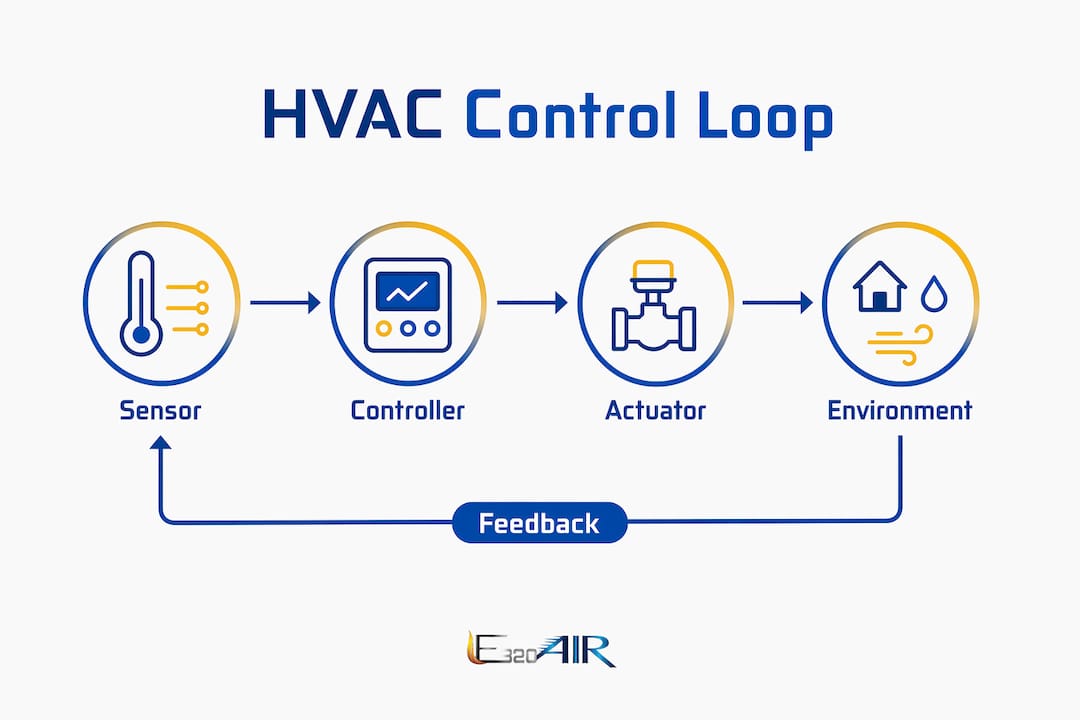
The core control loop uses three components: sensors, a controller, and actuators. Each plays a specific role, and the loop runs continuously, often every few seconds.
Sensors measure the current state of your indoor environment. Temperature sensors are the most common, but modern systems also track relative humidity, carbon dioxide levels, and airflow rates. The sensor sends a reading to the controller.
The controller compares that reading to your setpoint. If your thermostat is set to 72°F and the sensor reads 76°F, the controller calculates the difference and decides what action to take. Simple thermostats make a binary call: on or off. Advanced building automation systems use proportional, integral, and derivative logic to modulate output gradually.
Actuators carry out the controller's decision. They open or close dampers, adjust compressor speed, modulate valves, and change fan output. The result feeds back to the sensors, and the loop starts again.
The variables controlled go well beyond temperature. Humidity management is critical because poor equipment configuration causes clammy or overly dry air, even when temperature reads correctly. Ventilation controls manage fresh air intake to protect indoor air quality. Each variable has its own sensor-controller-actuator chain, all coordinated by the central control system.
Controllers range from a basic programmable thermostat to a full building automation system like those made by Honeywell, Johnson Controls, or Siemens. For most homeowners, the thermostat is the controller. For larger homes or multi-zone setups, a dedicated zone controller coordinates multiple thermostats and dampers.
Pro Tip: Place your thermostat on an interior wall, away from windows, exterior doors, and supply vents. Poor thermostat placement in drafty hallways or near heat sources gives the controller false readings, causing the system to cycle incorrectly and leaving rooms uncomfortable.
What are the benefits of advanced HVAC comfort control systems?
Advanced comfort control systems deliver two things at once: better comfort and lower energy bills. Those two goals usually conflict, but well-designed controls resolve the tension.
Comfort accuracy
Modulating controls, which use variable speed compressors and ECM motors, hold indoor temperature within a very tight range. A basic on/off system swings temperature by several degrees before it kicks back on. A modulating system runs at partial capacity continuously, keeping conditions steady and reducing the noise and wear that come with constant cycling.
Energy savings
HVAC systems consume an average of 39% of a facility's total energy, making control upgrades one of the highest-return investments available. Simple control improvements and maintenance can deliver up to 30% annual savings over a 3–5 year period. That is not a replacement project. That is a settings and hardware upgrade.
Advanced methods push savings further. LLM-assisted model predictive control can reduce daily HVAC energy consumption by 15% to 33.3% compared to traditional on/off control. Model predictive control works by forecasting future conditions, such as outdoor temperature changes, and adjusting the system before discomfort occurs rather than reacting after the fact.
Pro Tip: If you have a heat pump, check your thermostat's auxiliary heat lockout setting. Heat pump thermostats often default to aggressive auxiliary electric heat activation, which can double your heating bill. Setting the lockout temperature correctly keeps the heat pump running efficiently before calling for backup heat.
Legacy vs. advanced control: a direct comparison
| Feature | Legacy on/off control | Advanced modulating control |
|---|---|---|
| Temperature accuracy | ±3–5°F swing | ±0.5–1°F swing |
| Humidity management | Minimal | Active, with dedicated sensors |
| Energy use | Higher, due to constant cycling | Lower, due to variable output |
| Noise level | Loud start/stop cycles | Quieter, continuous operation |
| Zoning capability | Single zone only | Multi-zone with damper control |
| Remote access | Rarely available | Standard on most smart systems |
What HVAC comfort control features actually impact your home?
Modern comfort control systems include several features that directly change how your home feels and what you pay each month. Knowing which features matter most helps you prioritize upgrades.
Temperature zoning
HVAC zoning divides your home into separate areas, each with its own thermostat and dampers. The bedroom wing can stay cooler at night while the living area stays warmer. Without zoning, a single thermostat controls the whole house, which means some rooms are always too hot or too cold. Zoning solves that problem without requiring a second HVAC system.
Smart and programmable thermostats
A programmable thermostat lets you set different temperatures for different times of day. A smart thermostat, such as the Ecobee or Google Nest, learns your schedule, adjusts automatically, and reports energy usage through an app. The role of modern thermostats in reducing utility costs is well documented. Smart thermostats also integrate with demand response programs, allowing your utility to briefly adjust your setpoint during peak grid demand in exchange for bill credits.
Humidity and ventilation control
Humidity control is a feature many homeowners overlook until they feel the difference. A whole-home humidifier or dehumidifier, controlled by a humidistat, keeps relative humidity in the ASHRAE-recommended 30–60% range year-round. Ventilation controls manage how much fresh outdoor air enters the home, balancing indoor air quality against energy use.
Common homeowner upgrade options for comfort control include:
- Smart thermostat replacement (most cost-effective first step)
- Whole-home humidifier or dehumidifier with humidistat
- Zoning dampers and zone controller for multi-room control
- CO2 or air quality sensors tied to ventilation controls
- Variable speed air handler or heat pump upgrade
- Energy monitoring integration through a home automation hub
How to optimize your HVAC comfort control
Many homeowners achieve better comfort and lower bills by adjusting existing controls rather than replacing equipment. The first step is always to check what you already have before spending money on new hardware.
Thermostat placement and settings
Move your thermostat to an interior wall in a room you use regularly. Avoid placement near windows, exterior doors, supply vents, or appliances that generate heat. Once placed correctly, set your temperature differential, the gap between setpoint and trigger, as tightly as your system allows without constant cycling.
For heating, the U.S. Department of Energy recommends 68°F when you are home and lower when you are away or asleep. For cooling, 78°F when home is the standard efficiency target. These ranges keep comfort acceptable while reducing runtime significantly.
Heat pump and staging settings
If your home uses a heat pump, verify the auxiliary heat lockout temperature in your thermostat settings. Most defaults are too aggressive. Setting the lockout at a temperature where your heat pump still operates efficiently prevents the backup electric resistance heat from running unnecessarily.
Pro Tip: Balance comfort and efficiency by running your system at a steady setpoint rather than making large temperature swings. Dropping the thermostat 10°F at night and then demanding a fast recovery in the morning forces the system to use more energy than maintaining a moderate temperature throughout.
Immediate checks and when to call a professional
Do-it-yourself checks you can do today:
- Verify thermostat location and move it if it is near a vent or window
- Check and replace air filters (clogged filters reduce airflow and hurt control accuracy)
- Review your thermostat's schedule and update it to match your actual routine
- Test each zone if you have a zoned system and confirm dampers open and close
- Look at your energy usage report in your smart thermostat app and identify high-use periods
Call a professional when you notice temperature swings larger than 3°F from setpoint, when humidity stays outside the 30–60% range despite controls, or when your system short-cycles. These are signs of a control calibration issue, a sensor failure, or a sizing problem that requires HVAC design review.
A common myth worth correcting: cranking the thermostat to an extreme temperature does not heat or cool your home faster. Your system runs at the same speed regardless of how far the setpoint is from current conditions. Setting it to 90°F to warm up quickly just means it overshoots and wastes energy.
Key takeaways
HVAC comfort control is the most cost-effective lever homeowners have for improving indoor climate and reducing energy bills without replacing equipment.
| Point | Details |
|---|---|
| Control loop basics | Sensors, controllers, and actuators work together in a continuous cycle to regulate temperature and humidity. |
| Energy savings potential | Simple control upgrades can deliver up to 30% annual energy savings over 3–5 years. |
| Thermostat placement matters | A thermostat in a drafty or sun-exposed location gives false readings and hurts comfort throughout the home. |
| Modulating controls outperform on/off | Variable speed systems hold temperature within ±1°F and run quieter with less wear. |
| Zoning adds room-level control | Zoning dampers let different areas of the home run at different temperatures without a second system. |
What I've learned after years of working on comfort control systems
Most homeowners I talk to assume their comfort problem is an equipment problem. They want a new unit. Nine times out of ten, the equipment is fine. The controls are the issue.
A thermostat sitting in a hallway next to the return air vent is reading mixed air, not room air. The system responds to that reading, not to what you actually feel in the living room. Moving the thermostat costs almost nothing. The comfort improvement is immediate and real.
The other pattern I see constantly is heat pump owners paying electric bills that make no sense. Their heat pump is working fine, but the auxiliary heat is running every time the temperature drops below 40°F because nobody ever changed the default lockout setting. That one configuration change can cut a winter heating bill noticeably.
My honest advice: before you spend money on a new system, spend an afternoon understanding your current controls. Read the thermostat manual. Check the staging settings. Look at your energy report. The controls are often the easiest and most cost-effective upgrade available, and they are almost always the last thing homeowners look at. HVAC maintenance myths often steer people toward expensive fixes when a simple control adjustment would solve the problem.
Smart technology is making this easier. Ecobee and Google Nest give you real data on runtime, humidity, and energy use. That data tells you exactly where your system is working hard and where it is wasting energy. Use it.
— Edward
E320air can help you get more from your HVAC system
Knowing what your system should do and getting it to actually do it are two different things. E320air specializes in residential HVAC installation, repairs, and upgrades across the Inland Empire, with direct experience in comfort control tuning, smart thermostat installation, and zoning system setup.

Whether your home needs a smart thermostat configured correctly for a heat pump, a zoning system installed to solve room-by-room temperature problems, or a full HVAC installation with advanced comfort controls built in from the start, E320air has the experience to do it right. The team at E320air works with homeowners who want real results, not just a new piece of equipment. Contact E320air to schedule a comfort assessment and find out what your system is actually capable of.
FAQ
What is HVAC comfort control in simple terms?
HVAC comfort control is the system that automatically regulates your home's temperature, humidity, and airflow to keep conditions comfortable. It uses sensors, a thermostat or controller, and mechanical components like dampers and compressors to maintain your target settings.
How does HVAC temperature regulation actually work?
A sensor measures current indoor conditions and sends the reading to a controller, which compares it to your setpoint and signals actuators to adjust heating, cooling, or airflow. This loop runs continuously, often every few seconds, to keep conditions stable.
What temperature and humidity range should my HVAC target?
ASHRAE Standard 55 defines comfortable indoor conditions as 68–76°F with 30–60% relative humidity. Most comfort control systems use these ranges as their target setpoints.
What is temperature zoning and do I need it?
Temperature zoning divides your home into separate control areas, each with its own thermostat and dampers, so different rooms can run at different temperatures. You need it if some rooms are consistently too hot or too cold while others feel fine.
Can I improve comfort without replacing my HVAC system?
Yes. Adjusting existing controls, correcting thermostat placement, and tuning staging and lockout settings often resolve comfort problems without any equipment replacement. A smart thermostat upgrade is typically the most cost-effective first step.