
TL;DR:
- Proper HVAC design ensures home comfort by accurately sizing equipment, optimizing ductwork, and implementing smart controls. It also improves air quality through effective filtration, ventilation, and humidity management, reducing energy waste and health risks. Comprehensive system planning prevents temperature swings, drafts, mold growth, and stale air, providing consistent and efficient indoor environments.
HVAC design is the single greatest determinant of indoor comfort in any residential space. The way your system is sized, laid out, and controlled decides whether your home stays at a consistent temperature or swings between too hot and too cold. Poor design wastes energy, strains equipment, and leaves you uncomfortable regardless of how new or expensive the unit is. Understanding how HVAC design affects home comfort gives you the knowledge to ask the right questions before any installation or upgrade.
What are the key HVAC design factors that influence indoor comfort?
Four design factors determine whether your HVAC system delivers consistent comfort: equipment sizing, ductwork layout, zoning, and humidity control. Each one affects the others. Get one wrong and the whole system underperforms.
Equipment sizing
An oversized unit cools or heats a space too fast, then shuts off before completing a full cycle. This is called short-cycling, and it creates temperature swings, poor humidity removal, and unnecessary wear on components. An undersized unit runs constantly and still cannot reach the set temperature on extreme days. Proper sizing at 80–90% of peak load produces the most consistent comfort and the lowest energy bills.
Ductwork design and sealing
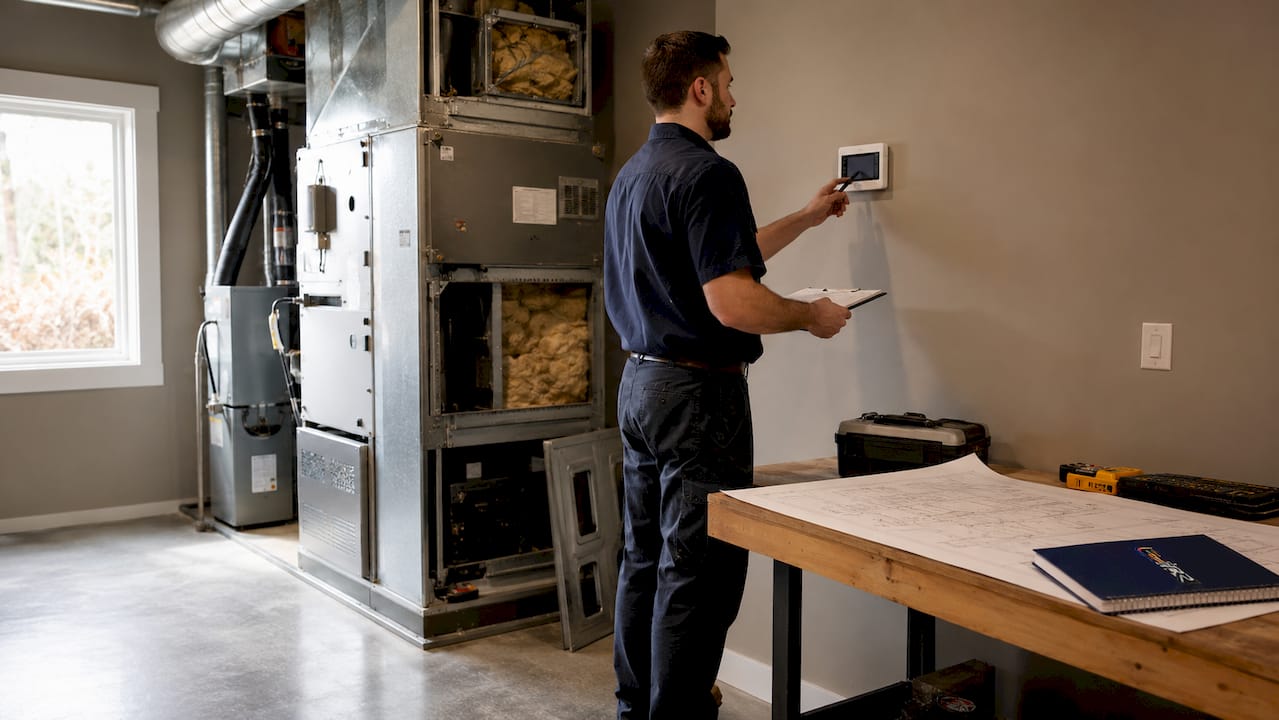
Ducts carry conditioned air from your equipment to every room. Leaky or poorly routed ducts can lose 20–30% of that air before it reaches its destination. Beyond leakage, duct placement matters. Blowing air directly on occupants creates drafts and makes a room feel colder than the thermostat reads. Registers should be positioned to mix air across the room, not aimed at chairs, beds, or desks.
Zoning and thermostat placement
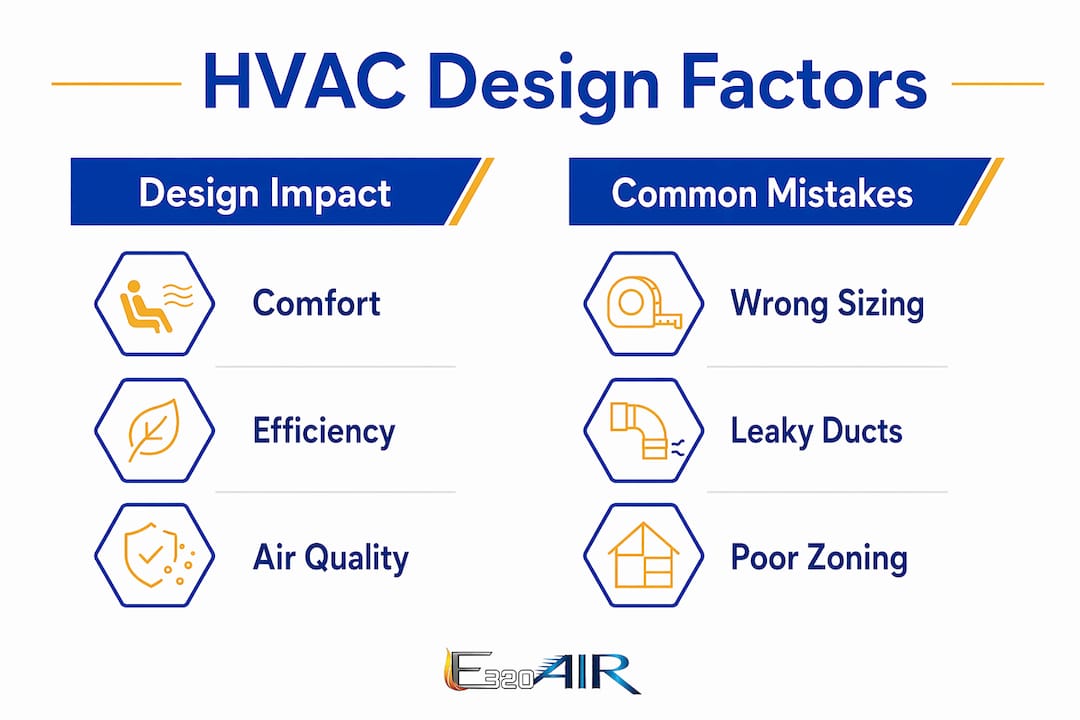
A single thermostat in a hallway cannot accurately represent the temperature in a bedroom or a sunlit living room. HVAC zoning splits your home into independently controlled areas, so each space gets exactly what it needs. Thermostat placement away from heat sources, drafts, and exterior walls is just as important as the zoning strategy itself.
Humidity control and ventilation
Humidity affects how warm or cool a space feels. High humidity makes 75°F feel like 85°F. Low humidity in winter causes dry skin, static electricity, and respiratory irritation. A well-designed system manages both heating and cooling loads while keeping relative humidity in the 40–60% range for year-round comfort.
| Design factor | Comfort impact | Common mistake |
|---|---|---|
| Equipment sizing | Temperature consistency | Oversizing for "safety margin" |
| Ductwork layout | Even air distribution | Leaks, poor routing, direct airflow |
| Zoning | Room-by-room control | Single thermostat for whole home |
| Humidity control | Perceived temperature accuracy | Ignoring moisture management |
| Ventilation | Fresh air and pollutant removal | Sealing tight without fresh air intake |
Pro Tip: Have a Manual J load calculation done before any new installation. This is the industry standard method for sizing HVAC equipment to your home's actual heat gain and loss, not a rough square footage estimate.
How does HVAC design affect indoor air quality and occupant health?
HVAC design and indoor climate are inseparable when it comes to air quality. Your system does not just heat and cool. It filters, ventilates, and controls moisture. A poorly designed system spreads pollutants, grows mold, and leaves occupants breathing stale air.
Filtration done right vs. done wrong
Higher-MERV filters capture more particles, including dust, pollen, pet dander, and some bacteria. The problem is that high-MERV filters increase airflow resistance, which can freeze the evaporator coil or burn out the blower motor if the ductwork and fan are not sized to handle the added restriction. Upgrading your filter without adjusting the system is one of the most common and damaging mistakes homeowners make.
Ventilation and moisture balance
Tight, well-insulated homes trap pollutants indoors. Without a deliberate ventilation strategy, indoor air quality degrades quickly. Energy Recovery Ventilators (ERVs) achieve up to 57% HVAC operational energy savings while continuously exchanging stale indoor air for fresh outdoor air. ERVs also precondition incoming air, so they do not spike your heating or cooling load the way a simple exhaust fan would.
For a deeper look at how your system handles pollutants and moisture, the homeowner's guide to HVAC air quality covers filtration, ventilation, and humidity control in practical terms.
Good HVAC design produces:
- Consistent humidity between 40–60% relative humidity
- Fresh air exchange without large energy penalties
- Filtered air matched to the system's actual airflow capacity
- No stagnant zones where pollutants accumulate
Poor HVAC design produces:
- Mold growth from excess humidity or condensation on ducts
- Coil freezing or motor failure from oversized filters
- Stale, recirculated air with rising CO2 and VOC levels
- Uneven humidity that makes some rooms feel damp and others feel dry
Pro Tip: If you want to upgrade to a MERV 13 filter for better particle capture, ask your HVAC technician to check your system's static pressure first. Many residential systems are designed for MERV 8. The fix may be as simple as a blower speed adjustment, but skipping that step can shorten your equipment's life significantly.
Maintaining clean indoor air also depends on factors beyond the HVAC system itself. Cleaning practices affect indoor air quality in ways that work alongside your HVAC filtration strategy.
Why is proper HVAC equipment sizing critical for home comfort?
Sizing is the most consequential decision in any HVAC installation. It determines whether the system can handle your home's actual heating and cooling loads without wasting energy or cycling erratically.
Oversized HVAC equipment causes short-cycling, higher energy costs, humidity control problems, and reduced occupant comfort. Short-cycling means the compressor starts and stops frequently, which is the most energy-intensive part of the refrigeration cycle. It also means the system never runs long enough to dehumidify the air properly, leaving the home feeling clammy even when the temperature reads correctly.
Undersized equipment has the opposite problem. It runs continuously on the hottest and coldest days, never reaching the set temperature. Occupants compensate by lowering the thermostat further, which increases energy use without improving comfort.
The effects of wrong sizing at a glance:
- Oversized: Short-cycling, humidity problems, temperature swings, premature equipment failure
- Undersized: Continuous operation, inability to reach set temperature, high energy bills on peak days
- Correctly sized: Full cycle completion, proper dehumidification, consistent temperature, longer equipment life
Temperature variations exceeding 2–3°C in a single space cause occupant stress, headaches, and discomfort. That range is easy to exceed with a poorly sized system. Correct sizing keeps temperature swings within acceptable limits throughout the day.
The industry standard for residential sizing is the Manual J calculation, developed by the Air Conditioning Contractors of America (ACCA). It accounts for insulation levels, window area, orientation, local climate data, and occupancy. Any contractor who sizes your system based on square footage alone is skipping this step.
How do advanced HVAC control strategies improve comfort and cut energy costs?
Control strategy is where modern HVAC design separates itself from older approaches. A well-designed system with poor controls still delivers inconsistent comfort. The right controls make the same equipment perform significantly better.
Load Reset Control vs. fixed setpoint
Traditional systems hold a fixed supply air temperature regardless of conditions. Load Reset Control (LRC) adjusts supply temperature dynamically based on actual heating and cooling demand. LRC systems deliver 4–8% higher load removal and 1–8% lower energy use compared to fixed setpoint controls. That combination of better comfort and lower bills makes LRC one of the most practical upgrades available for residential systems.
Smart thermostats and zoning
Smart thermostats from brands like Ecobee and Honeywell Home learn occupancy patterns and adjust temperatures before you arrive in a room. Combined with a zoning system, they eliminate the need to condition unused spaces. Thermostats transform HVAC efficiency most dramatically when paired with multi-zone setups, where each zone responds to its own sensor rather than a single hallway reading.
AI-driven occupant comfort
Research published in 2026 shows that occupant mood significantly influences perceived thermal comfort, sometimes overriding the actual physical environment. AI-based systems that factor in occupant feedback and behavioral patterns can adjust setpoints to match how people actually feel, not just what the thermometer reads. This technology is moving from commercial buildings into high-end residential applications.
Residential thermal comfort models must account for spatiotemporal dynamics and individual behaviors. Static thermostat assumptions fail in real homes where people move between rooms, cook, exercise, and sleep at different times.
| Control strategy | Comfort benefit | Energy benefit |
|---|---|---|
| Fixed setpoint | Predictable but inflexible | Baseline efficiency |
| Load Reset Control | Dynamic temperature matching | 1–8% lower energy use |
| Smart thermostat with zoning | Room-by-room precision | Avoids conditioning empty spaces |
| AI-driven adaptive control | Responds to occupant mood and behavior | Reduces overcooling and overheating |
Pro Tip: If a full zoning system is outside your budget, start with a smart thermostat and remote sensors in the rooms you use most. Ecobee's SmartSensor and Honeywell Home's T9 both support multi-room temperature averaging, which is a meaningful improvement over a single fixed thermostat.
Key Takeaways
Proper HVAC design controls temperature, airflow, humidity, and air quality together, and no single element works well when the others are ignored.
| Point | Details |
|---|---|
| Sizing determines comfort baseline | Equipment sized at 80–90% of peak load prevents short-cycling and humidity problems. |
| Ductwork layout shapes air distribution | Leaky or misdirected ducts waste energy and create drafts that lower perceived comfort. |
| Zoning and smart controls add precision | Multi-zone systems with smart thermostats eliminate temperature swings room by room. |
| ERVs improve air quality and save energy | Energy Recovery Ventilators exchange stale air while cutting HVAC energy use by up to 57%. |
| Advanced controls outperform fixed setpoints | Load Reset Control delivers better comfort and 1–8% lower energy use than traditional fixed controls. |
What I've learned from years of residential HVAC work
The most common mistake I see is homeowners focusing on equipment brand while ignoring system design. A premium variable-speed unit installed with undersized ducts and a single thermostat will underperform a basic system that is properly sized and zoned. The equipment is only as good as the design around it.
The second mistake is treating comfort and efficiency as competing goals. They are not. A correctly sized system with good ductwork and smart controls uses less energy precisely because it is not fighting against its own design. Short-cycling, oversized units, and leaky ducts all waste energy while making the home less comfortable at the same time.
What surprises most homeowners is how much the psychological side of comfort matters. The research on mood-adaptive HVAC is new, but the underlying observation is not. People in the same room at the same temperature report wildly different comfort levels based on activity, stress, and expectation. That is why occupant feedback matters in any serious comfort strategy. A thermostat that learns your patterns is not a luxury feature. It is a practical response to how people actually live.
My recommendation: before spending money on a new unit, have a qualified contractor audit your existing ductwork and calculate your actual load. In most homes I have worked on, the ductwork is the limiting factor, not the equipment.
— Edward
Get the HVAC design your home actually needs
Most comfort problems in residential homes trace back to design decisions made at installation, not equipment failure. E320air specializes in residential HVAC design, installation, and system audits that address the root causes of uneven temperatures, high energy bills, and poor air quality. Whether you need a new installation sized correctly from the start or a full assessment of your current system, E320air's team brings the technical depth to get it right. See what a properly designed system looks like by visiting E320air's installation services or explore real-world results on the problem solving gallery.
FAQ
What is the biggest factor in HVAC comfort design?
Equipment sizing is the most critical factor. An oversized or undersized system causes temperature swings, humidity problems, and higher energy costs regardless of how advanced the controls are.
Do HVAC systems affect air quality in the home?
Yes. HVAC systems filter, ventilate, and control humidity, all of which directly affect indoor air quality. Poor design spreads pollutants, allows mold growth, and recirculates stale air.
How does HVAC zoning improve home comfort?
Zoning divides your home into independently controlled areas, so each room gets the temperature it needs. A single thermostat cannot account for sunlit rooms, occupied bedrooms, or unused spaces.
What is Load Reset Control and why does it matter?
Load Reset Control adjusts supply air temperature based on real-time demand rather than holding a fixed setpoint. It delivers 4–8% better load removal and 1–8% lower energy use compared to traditional fixed controls.
Can upgrading my filter hurt my HVAC system?
Yes. High-MERV filters increase airflow resistance. Installing a MERV 13 filter in a system designed for MERV 8 can freeze the evaporator coil or burn out the blower motor without a corresponding blower adjustment.