
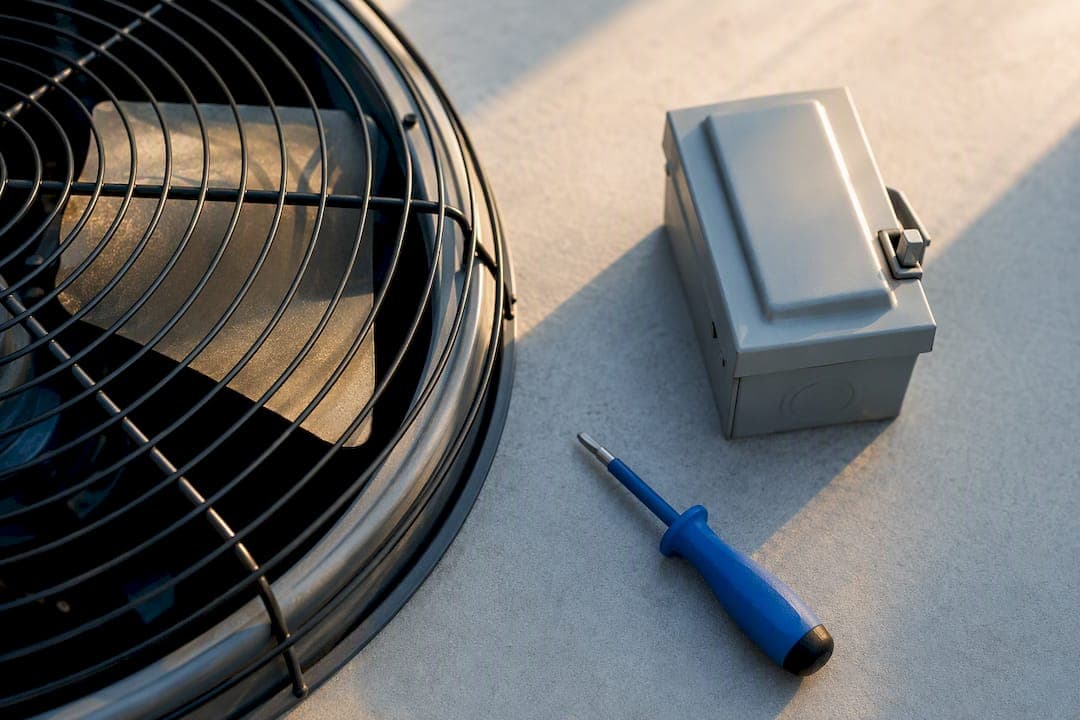
Most of the time, an AC fan that won't spin traces back to a thermostat or power problem, or to a failed capacitor or motor. Start with the quick, safe checks: thermostat setting, breaker, and air filter. If you notice burning smells, exposed wiring, humming without movement, or anything involving refrigerant lines, stop and call a licensed technician.
TL;DR:
- Most fan failures are caused by simple issues like thermostat missettings, tripped breakers, or clogged filters, which homeowners can fix easily.
- Capacitor, motor, and refrigerant-related problems require professional service, especially if there are burning smells, exposed wiring, or refrigerant concerns.
- Identifying whether the indoor blower or outdoor fan is silent helps locate the failure source, with outdoor issues often involving capacitors or contactors.
- Regular maintenance, such as filter replacements and outdoor unit clearance, can prevent most fan failures and extend system lifespan.
- Repeated breaker trips or burning odors signal underlying electrical or mechanical faults that need a licensed technician's diagnosis and repair.
Table of Contents
- What causes an AC fan to stop spinning?
- Safe checks you can run right now
- Is it the indoor blower or the outdoor fan?
- When to stop and call a licensed technician
- Preventive maintenance that reduces fan failures
- Why we favor a safety-first approach to fan repairs
- How E320air handles AC fan repairs
- Sources
- FAQ
What causes an AC fan to stop spinning?
Several problems can stop a fan blade from turning, and they range from a five-minute fix to a repair that needs a licensed professional. Working through them in order of likelihood saves time and avoids unnecessary parts replacement.
- Thermostat issues: the system may not be calling for cooling because of the wrong mode, a dead battery, or a setpoint above room temperature.
- Power interruptions: a tripped breaker or blown fuse cuts power to the outdoor unit or the indoor blower before the fan ever gets a signal.
- Airflow restriction: a clogged or dirty air filter chokes airflow through the system and can trigger safety shutoffs.
- A failed run or start capacitor: according to Department of Energy diagnostic guidance, bad capacitors are a frequent cause of condenser fan failures.
- A burnt-out or seized fan motor: worn bearings or windings that have overheated will keep the blade from turning even with power present.
- A faulty contactor or control board: these components relay the signal from the thermostat to the outdoor unit, and a failure means the fan never gets the command to run.
- A frozen evaporator coil: ice buildup from restricted airflow can shut the whole system down, not just the fan.
- Physical obstructions or bent blades: debris, nests, or storm damage can jam the blade or throw it off balance.
Capacitor and motor failures usually require a technician, while thermostat settings, breakers, and filters are safe for a homeowner to check first.
Safe checks you can run right now
Work through these in order, and stop the moment anything looks electrical or smells off.
- Check the thermostat. Confirm it is set to "Cool," not "Off" or "Heat," and that the setpoint sits below the current room temperature.
- Find the power source. Locate the outdoor unit's disconnect switch and your home's breaker panel, and reset a tripped breaker once. Repeated trips point to a deeper electrical fault, not a fluke.
- Inspect the air filter. A clogged filter restricts airflow enough to cause performance problems, and swapping it often brings the fan back to life within minutes.
- Look, but don't touch. Walk out to the condenser and check for leaves, grass clippings, or a bent fan guard, but keep fingers and tools away from the unit while it's powered.
- Listen for a hum. A fan that hums but doesn't spin often points to a failed capacitor, a sign that means it's time to call a technician rather than keep testing.
Filters with very high MERV ratings can restrict airflow enough to cause problems on older blower systems, according to the Department of Energy's measure guide, so match filter choice to your system's blower capacity rather than picking the highest rating on the shelf. You can read more on how airflow and CFM affect performance if you want the full picture.
Pro Tip: If you smell burning, see arcing, or notice oil residue near the motor, cut power at the breaker immediately and call a technician instead of continuing to inspect.

Is it the indoor blower or the outdoor fan?
The two fans fail differently, and figuring out which one is silent tells you where to look next.
- Indoor blower problems show up as weak or no airflow at the vents, a humming or rattling sound from the furnace or air handler, and sometimes a burning smell from an overheating blower motor.
- Outdoor condenser fan problems show up as the compressor running while the fan stays still, which means the system is generating heat but can't expel it, often accompanied by the unit tripping off on high pressure.
- Indoor issues usually trace to ducts, filters, or the blower motor itself, while outdoor issues more often trace to the capacitor, motor, or contactor at the condenser.
- Low airflow from either fan can cause the evaporator coil to ice over, which then affects both sides of the system at once. If you see ice on the coil or refrigerant lines, that's your signal the two problems have merged.
When to stop and call a licensed technician
Some repairs cross a line homeowners should never attempt. Anything involving the refrigerant circuit, including attaching gauges or adding refrigerant, falls under EPA Section 608 certification requirements, which means only a certified technician can legally perform that work.
Frequent breaker trips are a warning sign of an underlying issue such as an overload, a short, or a failing component, not something to keep resetting on your own.
Electrical Safety Foundation International
Burning smells, exposed wiring, or a capacitor that needs replacing all belong to a technician too. A professional visit typically includes checking voltage at the unit, testing capacitor health, inspecting the contactor, and measuring motor windings and airflow with calibrated tools, the kind of readings a multimeter or a guess simply can't match.
Preventive maintenance that reduces fan failures
A few habits catch small problems before they become no-cool emergencies.
- Replace filters on a regular schedule, and choose a filter rated for your blower's capacity rather than the highest MERV number available, as covered in this filter selection guide.
- Keep the outdoor unit clear of leaves, vines, and nesting debris, with at least two feet of open clearance on all sides.
- Book an annual tune-up so a technician can inspect capacitors, contactors, motor bearings, and refrigerant charge before they fail outright.
- On units older than eight to ten years, ask about proactively replacing aging capacitors or contactors rather than waiting for a breakdown during a heat wave.
Pro Tip: Mark your filter change date on the filter frame itself so you're never guessing how long it's been in place.
Why we favor a safety-first approach to fan repairs
Quick checks like the thermostat, breaker, and filter solve a real share of "fan won't spin" calls, and we think every homeowner should try them first. But once the issue points to a capacitor, a motor, or anything near the refrigerant lines, the smart move is a trained technician, not another round of guesswork. That balance, fast triage paired with qualified repair, is what keeps small problems from turning into bigger ones.
— Edward
How E320air handles AC fan repairs
When a fan won't spin and the easy fixes don't work, E320air sends a technician who can diagnose and repair the actual cause instead of guessing at parts.

- Inspection covering the capacitor, contactor, motor, wiring, and refrigerant charge.
- Refrigerant handling performed according to applicable regulations for any work that touches the sealed system.
- A written estimate provided before any repair begins, with options for immediate repair or scheduled service.
You can see examples of past repairs in our problem-solving gallery, or head to E320air to book a technician for your Residential HVAC needs.
Sources
Technical claims on airflow, diagnostics, and safety come from the Department of Energy's measure guide, Energy, EPA Section 608, ESFI electrical safety guidance, and InspectApedia's condenser fan guide.
- Measure Guideline: Air Conditioner Diagnostics, Maintenance, and Replacement — U.S. Department of Energy
- Section 608 Technician Certification Requirements — U.S. EPA
FAQ
How do I reset my outside AC fan?
Turn off power at the breaker or the outdoor disconnect switch, wait about a minute, then restore power and switch the thermostat to "Cool." If the fan still doesn't spin, don't reset the breaker again; a repeated trip signals an electrical fault that needs a technician.
What should I do if my AC blower fan isn't spinning?
First check that the thermostat calls for cooling and that the air filter isn't clogged, since restricted airflow can shut a blower down. If the blower hums without turning or you hear grinding, the motor or capacitor is likely at fault and needs professional diagnosis.
How can I tell if a fan motor or capacitor is bad?
A fan that hums but won't start, and then runs if you carefully turn the blades by hand with the power off, usually points to a failed start or run capacitor. A motor that stays silent even after that test, or that feels seized, more likely needs replacement rather than a capacitor swap.
Can I run my AC if the fan is not working?
Running the system with the condenser fan not spinning lets heat build up in the compressor, which risks further damage the longer it runs. Turn the system off at the thermostat or breaker and get it inspected before using it again.