
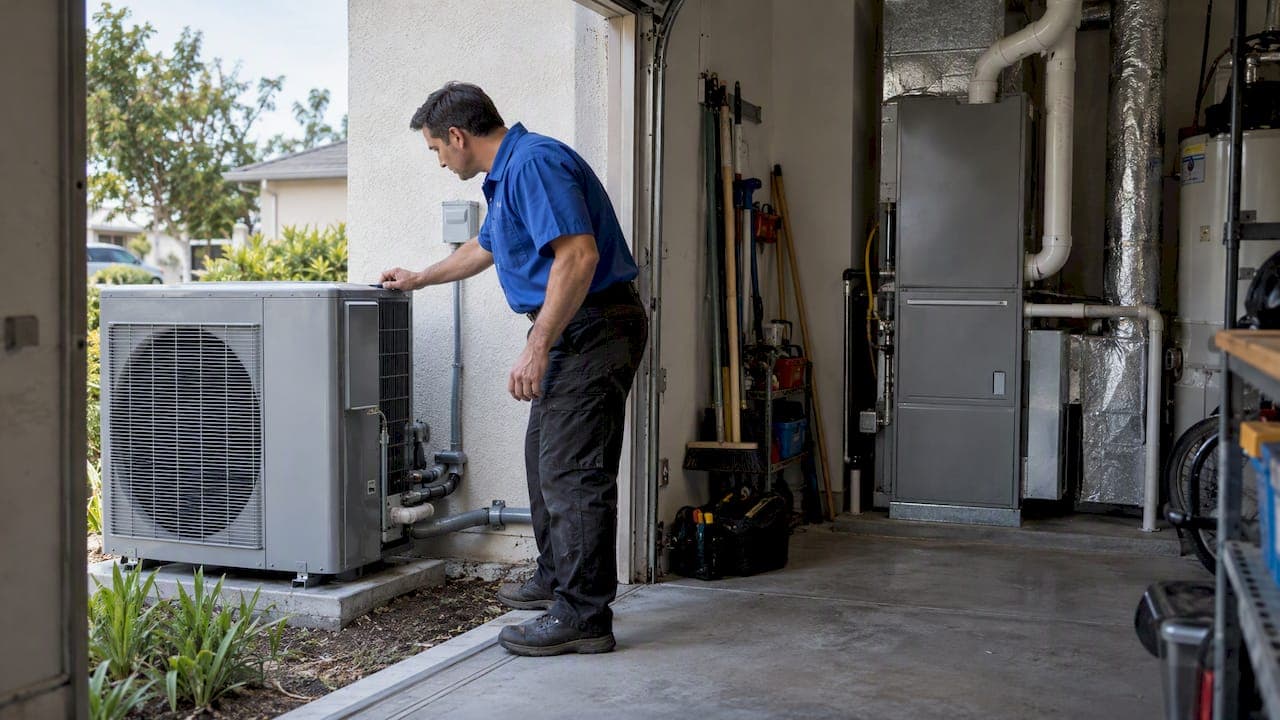
A dual fuel heat pump pairs an electric heat pump with a gas or propane furnace, running on the heat pump for most heating and cooling while switching to the furnace only when temperatures drop low enough to strain its capacity. This setup fits homeowners who already have a working furnace, live somewhere with cold winters, and want lower energy bills without giving up reliable backup heat.
TL;DR:
- Ask the installer to document switchover temperature, sensors, and thermostat compatibility; capacity based controls keep the heat pump running until it cannot meet demand.
- Require a Manual J load calculation, airflow and refrigerant checks, and tested controls; duct or electrical panel upgrades can raise retrofit costs.
- A pilot estimated annual operating cost savings of $273 to $1,085 per site, with the strongest results in homes previously heated with propane.
- A federal credit covered 30% of heat pump costs, capped at $2,000 annually, for systems placed in service by December 31, 2025; confirm 2026 rules.
Table of Contents
- What a Hybrid Heat Pump System Actually Includes
- How the System Runs Through Heating and Cooling Seasons
- Controls and Switchover Strategies Installers Use
- Benefits Homeowners Can Expect From a Dual Fuel Setup
- Is a Dual Fuel Heat Pump Right for Your Home? A Suitability Checklist
- Costs and Incentives: What to Expect and How Federal Credits Apply
- Installation, Sizing, and Maintenance: What a Quality Contractor Will Do
- E320 Air's Practical Tips and What to Ask Your Installer
- Dual Fuel as a Practical Bridge to Electrification
- How E320 Air Can Help: Services and a Clear Next Step
- FAQ
- Sources
What a Hybrid Heat Pump System Actually Includes
A hybrid system connects three main parts: an outdoor heat pump unit, an indoor coil or air handler, and a gas or propane furnace, all tied into the same ductwork. The furnace typically sits downstream of the heat pump's indoor coil, so air passes through one system or the other depending on which is active.
Two common configurations show up on estimates:
- Retrofit setups keep an existing furnace and add a heat pump outdoor unit and coil, which is the most common and usually the least expensive path.
- Integrated combo units or cold-climate heat pumps are matched from the factory or selected specifically to extend heat pump operation into colder weather before the furnace takes over.
You'll also see efficiency ratings on quotes: AFUE measures furnace efficiency, SEER and HSPF measure the heat pump's cooling and heating efficiency, and COP describes how much heat the pump delivers per unit of electricity it consumes. These numbers determine how far into winter the heat pump can carry the load before the furnace needs to engage.
How the System Runs Through Heating and Cooling Seasons
In summer, the heat pump handles all cooling exactly like a standard air conditioner. In the shoulder seasons and through most winter, it also handles heating, often more efficiently than a furnace running on its own. The furnace only kicks in when outdoor temperatures drop below the heat pump's efficient operating range or when the home needs more heating capacity than the heat pump can deliver on its own.
A few things happen during normal operation that can look unusual if you don't know what to expect:
- The outdoor unit occasionally pauses and runs a defrost cycle, briefly reversing to melt frost buildup on the coil, which can produce steam or a short blast of cooler air indoors.
- The thermostat (or a dedicated dual-fuel controller) decides which system runs based on outdoor temperature, and sometimes indoor demand, switching automatically without homeowner input.
- During a switchover, you may notice warmer air from furnace operation compared to the gentler, longer heat pump cycles, which is expected and not a malfunction.
If you want to confirm the system is working as designed, check the thermostat display for a mode indicator (often marked "aux heat" or "emergency heat"), and track your utility bills across a full season to see the pattern of gas versus electric use.
Pro Tip: Keep a simple log of outdoor temperature and which system is running for a week or two after installation. It's the fastest way to confirm your switchover point matches what your contractor configured.
Controls and Switchover Strategies Installers Use
The switchover decision usually comes down to one of two methods. Outdoor temperature lockout simply switches to the furnace below a set outdoor temperature, which is simple and reliable. Indoor or capacity-based control instead watches whether the heat pump can keep up with the thermostat's demand, switching to the furnace only when it can't, which tends to maximize heat pump runtime.
Some installers talk about an "economic balance point," the temperature where furnace fuel cost equals heat pump electric cost. In practice this is hard to calculate precisely and harder to maintain as utility rates change, so many contractors instead prioritize the heat pump and let capacity, not cost modeling, decide when the furnace engages, according to contractor guidance on dual-fuel controls.
More advanced, grid-responsive controllers can factor in real-time electricity pricing or utility signals, squeezing more savings out of the system for homeowners willing to pay for the added hardware.
Before your installer finishes the job, confirm:
- The exact switchover temperature programmed into the thermostat or controller.
- Which sensors (outdoor, indoor, or both) drive the decision.
- That your thermostat is actually compatible with dual-fuel staging, since not every smart thermostat supports it out of the box.
Benefits Homeowners Can Expect From a Dual Fuel Setup
The main payoff is lower energy use for most of the year, since the heat pump covers the bulk of heating hours more efficiently than a furnace running alone. You also get a single system that handles both heating and cooling well, rather than relying on a furnace plus a separate, aging air conditioner.
- Lower combined energy use when the heat pump handles most heating hours.
- Dependable backup heat on the coldest days, with no gap in comfort.
- Reduced emissions compared with furnace-only heating, since the heat pump displaces most fossil fuel combustion.
- Variable-speed and cold-climate heat pump models extend the useful heat pump range further into winter, shrinking furnace runtime even more.
A field monitoring pilot of dual-fuel air-source heat pump installations found estimated annual operational cost savings of several hundred to over a thousand dollars per site, with the largest savings in homes that had previously relied on propane, according to the dual fuel heat pump pilot report.
Is a Dual Fuel Heat Pump Right for Your Home? A Suitability Checklist
Before committing, walk through a short list of facts about your house:
- Check your furnace's remaining service life. A furnace with several years left is a good candidate to pair with a heat pump rather than replace outright.
- Compare your local climate and heating-degree days against the heat pump's rated capacity, since colder climates lean more heavily on the furnace.
- Confirm your electrical panel has enough capacity for the new heat pump, and budget for a panel upgrade if it doesn't.
- Have your ductwork and insulation inspected, and insist on a Manual J load calculation before anyone sizes equipment. Manual J sizing is the gatekeeper step that prevents an oversized or undersized system.
- Factor in your budget, available incentives, and whether you see this as a step toward fuller electrification later. Smaller, well-insulated homes also carry smaller heating loads to begin with, which affects how much heat pump capacity you actually need, according to guidance on home size and heating loads.
Costs and Incentives: What to Expect and How Federal Credits Apply
Retrofit cost depends mainly on how much ductwork modification is needed, the heat pump's capacity, and whether your controls require upgrading for dual-fuel staging. A straightforward retrofit onto existing ducts costs less than a job requiring duct resizing or a panel upgrade, and regional cost examples show how those line items add up.
On the incentive side, the IRS Energy Efficient Home Improvement Credit lets taxpayers claim 30% of the cost of a qualifying heat pump installation, up to a $2,000 annual cap, for property placed in service through December 31, 2025, according to the IRS energy efficient home improvement credit page. Qualifying split-system heat pumps need to meet CEE's highest efficiency tier, and homeowners should verify current effective dates before relying on the credit for a project in 2026.
- ENERGY STAR documents two eligibility pathways for air-source heat pumps, cold-climate and a cooling/dual-fuel pathway, and recommends using its product lookup tools to confirm a specific combination qualifies.
- Combining envelope upgrades (insulation, sealing) with equipment upgrades across separate tax years can help you stay under annual credit caps while still claiming the full benefit over time.
- Our guide on HVAC tax credits and rebate timing breaks down how federal and state incentives stack for a typical installation.
Installation, Sizing, and Maintenance: What a Quality Contractor Will Do
A proper installation starts with a Manual J load calculation, not a rule of thumb based on the old furnace's size. That calculation determines the right heat pump capacity for your actual house, not an oversized unit that short-cycles or an undersized one that leans too hard on the furnace.
Beyond sizing, a thorough contractor will:
- Assess existing ductwork for airflow restrictions before connecting a heat pump that needs higher airflow than many older furnaces were designed around.
- Verify refrigerant charge and test airflow at commissioning, not just at final walkthrough.
- Program and test the switchover settings, confirming the thermostat actually executes the staging logic as intended.
- Set a maintenance schedule covering both systems, since a dual-fuel setup has two sets of filters, coils, and moving parts to service.
Pro Tip: Ask your contractor to separate the heat pump's setpoint and the furnace's backup setpoint by 2 to 4 degrees Fahrenheit. That gap prevents both systems from fighting for the same call and cuts down on unnecessary cycling.
Properly commissioned, a heat pump typically lasts 15 years and a furnace can run 15 to 20 years, so a well-maintained dual-fuel system can deliver two full equipment lifecycles before major replacement is needed.
E320 Air's Practical Tips and What to Ask Your Installer
We handle Manual J calculations, retrofit installation, control commissioning, and ongoing routine maintenance for dual-fuel systems, and a few homeowner checks go a long way between visits.
Watch for a defrost cycle that runs more than once every hour or two, which can signal a sensor or airflow problem worth a service call. Confirm your switchover setpoint annually since thermostat updates occasionally reset it. When you schedule commissioning, ask to see the Manual J results, how the controls are configured, and what warranty and financing options apply to the installed equipment.

Dual Fuel as a Practical Bridge to Electrification
Dual-fuel systems let homeowners shift most heating load off fossil fuels without betting everything on electric resistance backup, which keeps peak electric demand lower on the coldest days. How much that matters for broader electrification depends on control quality and incentive design, not just equipment choice. Advanced, grid-aware controllers and well-targeted credits will decide how far hybrid systems carry that bridge.
— Edward
How E320 Air Can Help: Services and a Clear Next Step
Our services include Manual J sizing, retrofit installation, control commissioning, and maintenance to help ensure a dual-fuel system performs as designed. Getting the switchover logic and sizing right calls for a licensed contractor who can commission both systems as one coordinated unit, not two separate afterthoughts.

Ready to find out if your home is a good fit? Schedule an HVAC installation assessment to get a load calculation before any equipment quotation.
FAQ
What are the downsides of dual fuel heat pumps?
The main tradeoff is added complexity: two systems means more components to maintain, and incorrect switchover settings can lead to higher bills if the furnace runs more than it should. Retrofit costs also rise when ductwork or electrical panel upgrades are needed, and installation complexity around ductwork compatibility is a common point of failure called out in industry coverage.
Is a dual fuel heat pump worth it?
For homeowners with a serviceable existing furnace and a climate with real winter cold, a dual-fuel system often pays off through reduced energy use for most of the heating season. A dual-fuel pilot monitoring report found estimated annual savings of roughly $273 to $1,085 per site, with the strongest results in homes that previously relied on propane.
What is a dual fuel heat pump?
A dual fuel heat pump combines an electric heat pump with a gas or propane furnace on shared ductwork, using the heat pump for most heating and cooling and the furnace only when outdoor temperatures drop below the heat pump's efficient range. It's also called a hybrid heating system.
How much does a dual fuel HVAC system cost?
Cost depends heavily on retrofit complexity, heat pump capacity, and whether ductwork or panel upgrades are needed, so there's no single flat price. Regional cost examples for heat pump installation show how those variables shift the total, and federal credits can offset a portion of qualifying equipment costs.
Sources
- Energy Efficient Home Improvement Credit | Internal Revenue Service
- Air Source Heat Pumps Tax Credit | ENERGY STAR
- CEE controls guidance: Controls for a heat pump with secondary heating (contractor guidance)
- Dual fuel air-source heat pump pilot monitoring report
- Hybrid heating systems: the integration of furnaces with heat pumps | Air Conditioning Today