
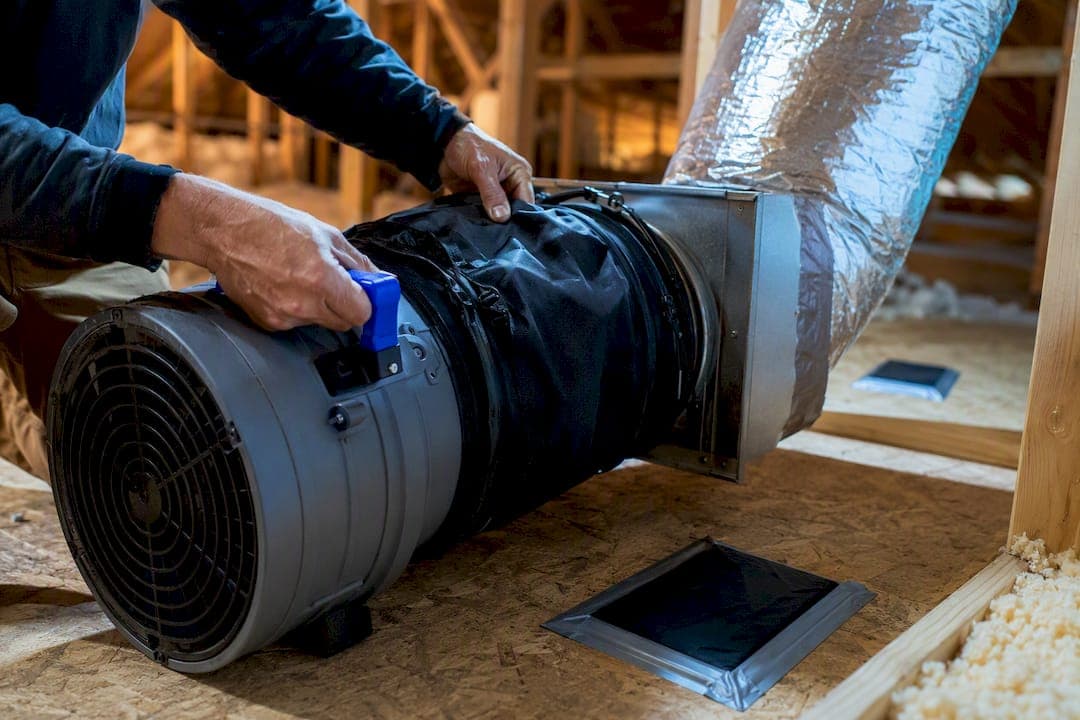
A duct leakage test measures how much conditioned air escapes your ductwork before it reaches the vents, using a calibrated fan and manometer to pressurize the system to a standard 25 Pa (0.1 in. w.g.). Most U.S. codes cap acceptable leakage at roughly 4 CFM25 per 100 square feet of conditioned floor area, though the exact number depends on your code version and whether the air handler sits inside conditioned space.
TL;DR:
- Duct leakage tests measure airflow in cubic feet per minute at 25 Pa, with most U.S. codes requiring limits around 4 CFM25 per 100 square feet of conditioned space.
- Tests are performed with registers sealed and require stabilization of pressure readings before recording, ensuring accurate and comparable results across different homes and technicians.
- Passing thresholds depend on local codes, which vary by cycle, and include total duct leakage or leakage to outside, with retests necessary after duct modifications.
- Fixing leaks typically involves sealing accessible joints with mastic and tape, and retesting confirms improvements needed to meet code and efficiency standards.
- Homeowners should ensure clear access and prioritize testing during new builds or major remodels, as skipping can lead to costly future repairs and inefficiencies.
Table of Contents
- What Does a Duct Leakage Test Actually Measure?
- What U.S. Codes and Standards Govern Duct Testing?
- Total Duct Leakage vs. Leakage to Outside: Which Test Do You Need?
- How Is a Professional Duct Leakage Test Performed?
- What Do Your Duct Leakage Test Results Actually Mean?
- Who Performs Duct Testing, and What Should You Expect to Pay?
- What Should Homeowners Do Before a Duct Test?
- When Is Duct Testing Non-Negotiable?
- Get Your Ducts Tested and Sealed by E320air
- Where to Find the Official Standards and Procedures
- Sources
What Does a Duct Leakage Test Actually Measure?
The test quantifies airflow, not just pressure. A technician seals every register and grille, then uses a calibrated fan to push or pull air through the duct system until it holds steady at 25 Pa. Whatever airflow the fan needs to maintain that pressure equals your duct leakage, reported as CFM25.
That number connects directly to what you feel in your house. Leaky supply ducts running through an attic can dump 20 to 30 percent of your cooled or heated air into a space nobody lives in. Leaky return ducts do the opposite: they pull attic dust, insulation fibers, and unconditioned air into your system, which is why duct leakage shows up on both energy bills and indoor air quality complaints.
A tight duct system delivers more of the air your equipment actually produces, cuts wasted energy, and reduces the intrusion of polluted attic or crawlspace air into your living space. That last point matters as much as the utility bill:
- Comfort improves because rooms far from the air handler finally get the airflow they were designed for.
- Energy waste drops because the system isn't fighting leaks to hit thermostat setpoints.
- Indoor air quality improves because return leaks stop pulling in dust and moisture from unconditioned spaces.
- Code compliance becomes possible, since most jurisdictions won't sign off on a system they haven't verified.
What U.S. Codes and Standards Govern Duct Testing?
Duct leakage testing isn't optional guesswork. It is written into building code, and the numeric limits vary by code cycle and construction type. Under the 2012 IECC, total duct leakage is capped at 4 CFM25 per 100 square feet of conditioned floor area when the air handler is already installed at the time of test, and older code versions list different thresholds depending on rough-in versus final testing.
Statistic Callout: Testing occurs at a fixed pressure of 0.1 inches of water gauge, equal to 25 Pa, with every register and grille sealed. That single pressure standard is what makes results from different houses, testers, and states comparable.
Programs layer requirements on top of base code:
- Most jurisdictions require testing for new construction before final inspection.
- ENERGY STAR-rated homes require duct leakage verification tied to HERS scoring.
- Certain retrofit or major remodel permits trigger a retest, especially when ductwork is extended or replaced.
- Local amendments can tighten or loosen the state code's default numbers, so the enforced limit in your city may not match the base IECC figure.
Always confirm which code cycle your local building department has adopted. A house that would pass under an older IECC version might fail under a newer one, and the reverse happens too when a jurisdiction hasn't updated its amendments in years.
Total Duct Leakage vs. Leakage to Outside: Which Test Do You Need?
Not every duct test measures the same thing, and knowing the difference keeps you from misreading your report.
- Total Duct Leakage (TDL) measures every leak in the system, whether air escapes into conditioned space or unconditioned space. It's the simpler test and often sufficient when ducts run entirely inside the home's conditioned envelope.
- Leakage to Outside (LTO) isolates only the leaks that vent into unconditioned areas like attics, crawlspaces, or garages, since that's the air you're actually paying to lose. ENERGY STAR and Building America guidance calls for LTO testing whenever ducts run through unconditioned space, though it can sometimes be waived if the entire system sits inside conditioned space.
- Timing adds another layer. Rough-in testing happens before drywall, flooring, and registers go in, which means any leak found is still accessible and cheap to fix. Final testing happens after the house is finished, which catches damage from other trades but makes repairs more invasive and expensive.
For multi-system homes, testing has to happen per system, not per house. A passing result on one air handler tells you nothing about the second unit serving the other half of the building.
How Is a Professional Duct Leakage Test Performed?
The procedure is standardized enough that any two certified testers should get the same number on the same duct system. Here's what that actually looks like on site.
Equipment needed:
- A calibrated duct blower (fan) sized to the system
- A digital manometer capable of reading pressure differentials at 25 Pa
- Tape, plastic sheeting, or duct blaster boots to seal every register and grille
- Hoses connecting the blower to the duct system and the manometer to a reference point
Two installation methods are approved: connecting the duct blower at the air handler's blower compartment, or connecting at the largest return grille. The second method carries conditional allowances and requires extra probe configuration to stay accurate.
Before powering anything up, the technician turns off HVAC fans, pulls the air filter, and seals all supply and return openings except the one connected to the blower. Then comes the part most homeowners never see: stabilization. RESNET protocol calls for setting the manometer to a 1 second average while ramping fan speed up to 25 Pa, then switching to a 10 second average once pressure holds steady. That switch is what turns a jumpy instant reading into a repeatable number.
Pro Tip: Ask your technician for a photo of the manometer display at the final reading, not just a typed number on the report. It's the fastest way to confirm the test actually stabilized before the number was recorded.
What Do Your Duct Leakage Test Results Actually Mean?
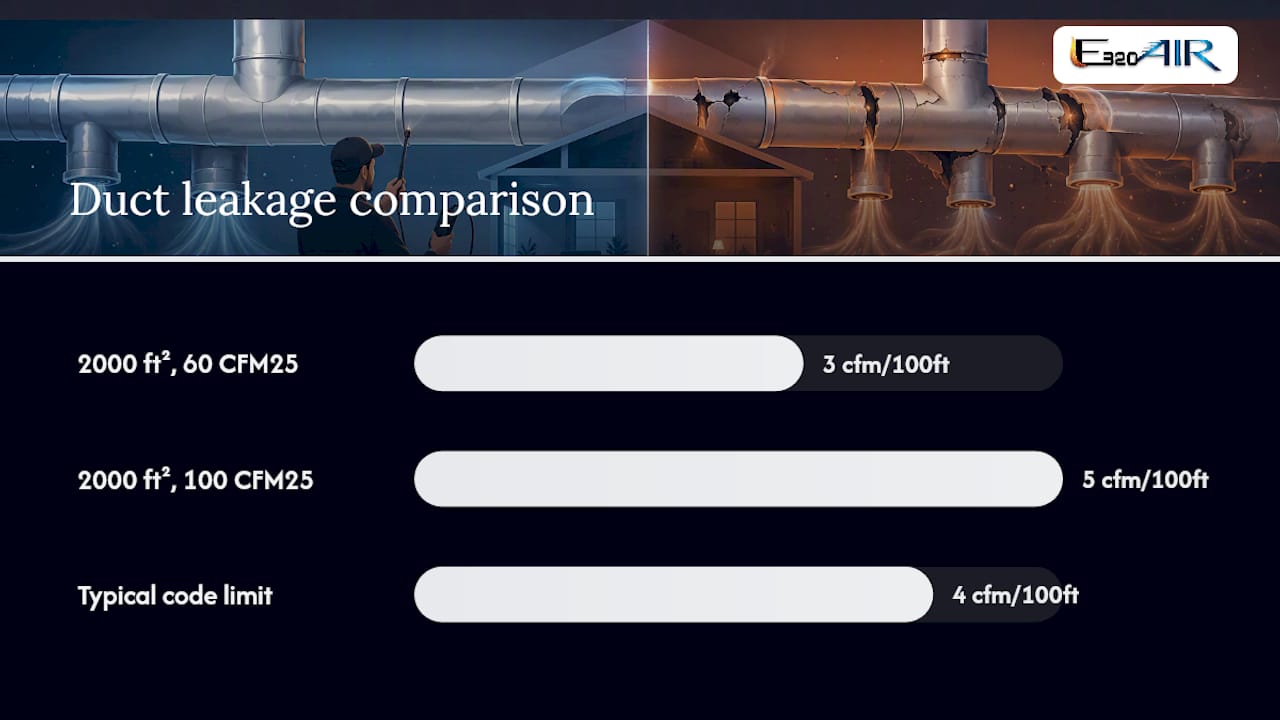
Raw CFM25 numbers don't mean much until you normalize them. Divide your CFM25 reading by your conditioned floor area, then multiply by 100, to get CFM25 per 100 square feet. That's the figure code officials and HERS raters compare against the limit for your jurisdiction's adopted code.
A few real-world scenarios show how this plays out:
- A 2,000 square foot house testing at 60 CFM25 total leakage works out to 3 CFM25 per 100 square feet, which passes most current IECC thresholds comfortably.
- The same house testing at 100 CFM25 total leakage hits 5 CFM25 per 100 square feet, which fails a 4 CFM25 limit and requires sealing before it can pass inspection or HERS scoring.
- A failing LTO result on ducts running through a vented attic usually points to disconnected boots, gaps at the plenum, or unsealed joints where flex duct meets metal fittings.
Remediation typically starts with mastic sealant and mesh tape at accessible joints, foil tape at register boots, and re-securing any duct that has pulled loose from a fitting. Homeowners considering duct sealing solutions after a failed test usually see a measurable drop in CFM25 on the retest, along with better airflow at the rooms that were previously starved.
Who Performs Duct Testing, and What Should You Expect to Pay?
Duct leakage tests are generally performed by RESNET-certified HERS raters or HVAC technicians trained to the same protocol, since the standardized procedure is what makes results legally defensible for code compliance. Certification matters because an uncalibrated fan or a skipped stabilization step produces a number that won't hold up at inspection.
Statistic Callout: Cost drivers include house size, number of separate HVAC systems (each one needs its own test), ductwork accessibility, and whether you're doing rough-in or final testing. Rough-in tests are often cheaper per system because there's no finished drywall or flooring to work around.
A valid report should include:
- The test protocol used (TDL, LTO, or both)
- Raw manometer readings and calculated CFM25
- Photos of sealed registers and the final display reading
- The rater or technician's certification ID
What Should Homeowners Do Before a Duct Test?
Clear access to your air handler, attic hatch, and any crawlspace ductwork before the technician arrives. Turn off exhaust fans and note every separate HVAC system in the house, since each one gets tested individually. If your project schedule allows it, push for rough-in testing. Catching a disconnected duct boot before drywall goes up turns a wall-opening repair into a five-minute fix, which is the core reasoning behind why ductwork condition drives HVAC efficiency more than most homeowners assume.
When Is Duct Testing Non-Negotiable?
New construction and major remodels should never skip this test. Code requires it, and skipping it on a retrofit just delays discovering a problem you'll eventually pay more to fix. If a room runs hot or cold no matter what the thermostat says, that's usually duct leakage, not equipment failure, and a test costs far less than another guess-and-replace repair cycle.
— Edward
Get Your Ducts Tested and Sealed by E320air
E320air runs certified duct leakage testing using the same calibrated fan and manometer procedure outlined above, then handles the sealing and repair work in the same visit when access allows it. That's the real advantage over hiring a tester and a separate repair crew: one company measures your CFM25, fixes what's failing, and reruns the test to confirm the number actually dropped before calling the job done.

Homeowners across the Inland Empire have used this verified before-and-after approach to catch return leaks pulling attic dust into their supply air, and to fix rough-in leaks other trades missed before drywall went up. If your system is due for a checkup, is part of a remodel, or has never been tested, schedule a duct leakage test with E320air and get a documented report you can actually use for compliance or peace of mind.
Where to Find the Official Standards and Procedures
For the code language itself, read the Building Energy Codes Program's guidance on IECC requirements. For procedural detail down to probe placement, ANSI/RESNET/ICC 380-2022 is the governing standard. Technicians building their skills should work through the BSESC training module, and RESNET's technical bulletin covers the stabilization protocol in full.
Sources
- What are the requirements for duct leakage testing? | Building Energy Codes Program
- Duct Leakage Tests | Building America Solution Center
- CHAPTER 5 PROCEDURE FOR MEASURING AIRTIGHTNESS OF DUCT SYSTEMS - 2022 ANSI/RESNET/ICC 380
- Technical Bulletin: Duct Leakage Testing for HERS® Ratings - RESNET
- HVAC - Duct Leakage Testing - Building Science Education