
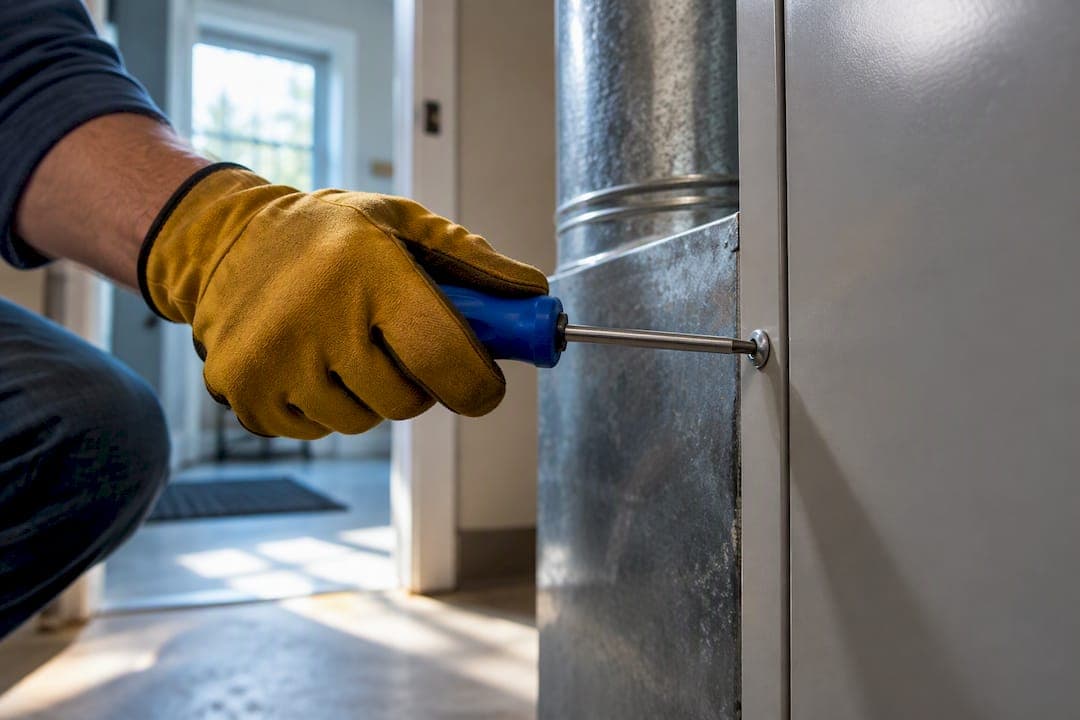
Start by finding where the noise comes from, then decouple any vibrating parts from the structure, and only after that adjust airflow to cut aerodynamic sound. Most homeowners can quiet a system noticeably with these three moves before ever picking up the phone, though persistent low-frequency rumbling or structure-borne vibration usually calls for a licensed contractor like E320 Air. This guide walks through both paths.
TL;DR:
- DIY solutions such as tightening panels, replacing worn belts, and clearing obstructions can noticeably reduce rattles and buzzes before professional intervention is needed.
- Vibration pads and duct wrap address mid-frequency hums and drone, but significant noise reduction often requires airflow adjustments or duct rework to lower velocity.
- Low-frequency rumbling or vibrations transmitted through walls typically indicate structural-borne noise, necessitating a licensed contractor’s diagnostic tools and solutions.
- When noise persists after basic fixes or comes from equipment that seems oversized or constantly rumbling, professional measures like duct silencer installation or fan balancing are essential.
- Proper product selection for silencers, duct lining, and vibration isolation depends on understanding insertion loss, generated noise, and pressure drop, with product performance verified by standards like ASTM E477.
Table of Contents
- Where HVAC noise originates: source, path, and receiver
- Low-cost fixes and safe DIY steps to try first
- Professional solutions: what contractors do and when to hire one
- Choosing materials and products: silencers, duct lining, and vibration isolation explained
- A short diagnostic checklist: isolate the source and test fixes safely
- E320 Air's experience with HVAC noise problems
- Common mistakes, realistic outcomes, and planning
- How E320 Air can help with diagnostic visits and noise-control installations
- Sources
- FAQ
Where HVAC noise originates: source, path, and receiver
Noise-control engineers break every HVAC noise complaint into three parts: the source, the path it travels, and the receiver who hears it. The EPA's quieting guidance frames the whole problem this way, and it's the fastest way to figure out what you're actually dealing with.
- Mechanical noise comes from moving parts: motors, compressors, loose belts, worn bearings.
- Aerodynamic noise comes from air moving too fast through ducts, grilles, or undersized openings.
- Structure-borne noise happens when vibration travels through mounts, framing, or ductwork into walls and ceilings, turning your house into a speaker.
The path matters as much as the source. Sound travels through duct walls, plenums, casings, and rigid mounting points, and each one is an opportunity to interrupt it. The tradeoff you'll run into constantly is insertion loss versus pressure drop: adding sound-absorbing material or a silencer cuts noise, but it can also restrict airflow if it's chosen or placed poorly, which the ASHRAE handbook chapter covers in its noise and vibration control guidance. Fixing noise without checking that tradeoff can just trade one problem for another.
Low-cost fixes and safe DIY steps to try first
Before spending money on parts, rule out the easy stuff. Loose panels, worn belts, and blocked filters cause a surprising share of the rattles and hums people assume are expensive mechanical failures.
- Tighten access panels and cabinet screws; a loose panel buzzes against the frame every cycle.
- Check the blower belt for cracking or glazing and replace it if it looks worn.
- Clear obstructions from return grilles, supply diffusers, and the outdoor condenser fins.
- Slip inexpensive neoprene or rubber vibration pads under the outdoor unit's feet if it sits on a hard pad and shakes visibly.
- Wrap accessible duct sections near the air handler with acoustic duct wrap, checking that it's rated for your duct material and doesn't block a fire-rated assembly.
- Open partially closed diffusers and, where your thermostat allows it, drop the blower to a lower speed setting to reduce whistling at the grilles.
Pro Tip: Lowering blower speed quiets whistling registers fast, but watch your system's airflow specs first: too low a speed can cause icing on a cooling coil or poor heat distribution in winter.
Manage your expectations. Tightening panels and clearing obstructions usually makes a system "noticeably quieter," especially for rattles and buzzes. Vibration pads and duct wrap help with hums and mid-frequency drone, but they rarely produce a "major reduction" on their own, and airflow adjustments only help if velocity was actually too high to begin with. Reducing duct velocity significantly can meaningfully cut aerodynamic noise, according to ASHRAE's noise and vibration guidance, so airflow tweaks are worth trying, just don't expect a whisper-quiet system from panel tightening alone.
Professional solutions: what contractors do and when to hire one
DIY fixes run out of road when the noise is low-frequency and constant, when you suspect the equipment is oversized for the space, or when vibration is clearly transmitting through the floor or wall framing rather than just the air. Our tonnage sizing guide walks through why an oversized unit cycles harder and louder than it should.
At that point, a licensed contractor typically works through a short list of interventions:
- Balancing or replacing a fan that's worn, mismatched to the duct system, or simply too large for the job.
- Installing duct silencers or attenuators at the source of aerodynamic noise.
- Reworking duct sizing where sections are undersized and forcing air through at high velocity.
- Adding spring hangers and flexible duct connectors to isolate vibration from framing.
- Replacing a compressor that has developed internal mechanical noise beyond what a pad or blanket can fix.
Expect the process to follow inspect, diagnose, then propose options. Contractors measure sound spectrum across octave bands, check CFM and static pressure, and look for system effects, meaning losses caused by fittings or transitions near the fan, as described in the DOE fan sourcebook. A straightforward diagnostic visit usually wraps up in under an hour; duct rework or equipment replacement is scheduled separately once you've seen the options.
Choosing materials and products: silencers, duct lining, and vibration isolation explained
Once you're past basic DIY fixes, the products get more specific and the spec sheets matter. A duct silencer or attenuator reduces sound as air passes through it, but its real-world value depends on three numbers: insertion loss (how much noise it removes), generated noise (how much noise the silencer itself adds as air moves through it), and pressure drop (how much resistance it adds to the system). The AMCA technical guidance explains how these three interact and recommends testing to the ASTM E477 standard when comparing products.
- Duct lining and absorptive foam or fiber media work best on mid- and high-frequency noise, like whistling or hissing at grilles.
- Mass-based solutions, such as denser duct wrap or barrier composites, are needed for low-frequency drone, since absorptive foam alone does little at those frequencies.
- Vibration isolation splits by application: neoprene pads suit light equipment on a slab, spring hangers suit suspended ductwork and rooftop units, and flexible couplers isolate vibration where ductwork connects directly to a fan or compressor housing.
When reading a silencer's performance curve, look at insertion loss by octave band rather than a single average number, and confirm the pressure drop at your system's actual airflow. Check the fire rating on any duct liner or wrap before installing it near a plenum, and confirm the product's warranty covers your duct material.
A short diagnostic checklist: isolate the source and test fixes safely
You don't need special equipment to narrow down where noise is coming from, just a system you can control zone by zone.
- Note when the noise happens: at startup, during steady running, or at shutdown.
- Turn off the outdoor unit only, if your system allows it, and listen: if the noise stops, the source is likely the compressor or outdoor fan.
- Walk to different supply and return grilles while the system runs; consistent noise at every grille points to duct breakout or airflow velocity, not equipment.
- Use a smartphone decibel meter app for a rough before-and-after comparison near the same spot each time, understanding it's not lab-grade.
- Touch (carefully) accessible ductwork or the air handler cabinet for a buzzing or rattling vibration, which suggests a loose mount or panel.
If turning zones off doesn't isolate the sound, or the noise seems to come from inside a wall or floor rather than a single unit, that's a structure-borne vibration case that's hard to test safely without a contractor's tools.
E320 Air's experience with HVAC noise problems
Some HVAC contractors handle residential and commercial HVAC repair, installation, and routine maintenance, and noise complaints can be a routine part of that work. Our approach mirrors the source-path-receiver framework: inspect the equipment first, measure airflow and vibration where the complaint points, then lay out repair options rather than guessing. Real examples of that process, including outdoor unit vibration fixes and duct rework, are documented in our Problem Solving Gallery. If a noise issue has outlasted the easy fixes, that's the point to bring in a technician who can measure rather than estimate.

Common mistakes, realistic outcomes, and planning
The mistake I see most often is people throwing absorptive foam at a low-frequency hum, when foam barely touches low frequencies and mass is what's needed. A close second is oversizing: a bigger unit isn't a quieter one, it's usually louder because it cycles harder than the space needs. Set your expectations accordingly: DIY fixes clean up rattles and hums, professional work handles drone and vibration. Budget for diagnosis before you budget for parts, since the wrong fix wastes both.
— Edward
How E320 Air can help with diagnostic visits and noise-control installations
If you've tried the DIY steps and the noise is still there, a diagnostic visit is the next step, not a shot in the dark. E320 Air's residential HVAC and system enhancement services cover the interventions this guide describes: vibration isolation, ductwork upgrades, and fan or compressor replacement when equipment is beyond a fix.

Here's what to expect: a technician inspects the equipment, checks mounts and ductwork, measures airflow, and walks you through the options before any work starts.
- Diagnostic visits that pinpoint whether the noise is mechanical, aerodynamic, or structure-borne.
- Vibration isolation upgrades, including spring hangers and flexible connectors.
- Ductwork rework where undersized sections are pushing air too fast.
- Fan balancing, replacement, or compressor swaps when internal wear is the cause.
For equipment replacement specifically, our HVAC installation page covers what that process involves, and our commercial HVAC and maintenance services cover ongoing upkeep that prevents noise from creeping back. Reach out through E320air to schedule a visit.
Sources
For spec-level detail beyond this guide, the EPA's quieting guidance covers source-path-receiver strategy, the ASHRAE handbook details duct velocity and vibration isolation, the AMCA guidance explains silencer selection, and the DOE fan sourcebook covers fan sizing and system effects. A secondary practical rundown is available from this HVAC noise reduction overview as well.
- Quieting in the Home (EPA)
- ASHRAE Handbook chapter: Noise and vibration control (Chapter 49)
- Understanding & Reducing Air System Noise (AMCA)
- Improving Fan System Performance - A Sourcebook for Industry (DOE/EERE)
FAQ
What is the $5,000 rule for HVAC?
This isn't a formal noise-control standard; it refers informally to a repair-versus-replace rule of thumb some contractors use, multiplying a repair estimate by the unit's age to decide if replacement makes more financial sense. It has no direct bearing on noise levels or acoustic treatment.
How can I reduce noise traveling through my HVAC vents?
Duct lining or absorptive wrap on accessible sections reduces mid- and high-frequency noise like whistling, while a properly sized duct silencer targets airflow noise at the source, as outlined in AMCA's guidance. Reducing air velocity, such as opening restricted diffusers, also helps since aerodynamic noise rises sharply with speed.
What is an HVAC silencer?
An HVAC silencer, or duct attenuator, is a lined section installed in ductwork to absorb sound as air passes through it. Its performance depends on insertion loss, generated noise, and pressure drop, all of which AMCA's technical guidance recommends checking before installation.
How can I reduce the noise from my HVAC fan?
Start by checking for loose belts, worn bearings, or debris in the fan housing, since these mechanical issues are often the easiest to fix. If the fan is properly maintained but still loud, it may be oversized or mismatched to the duct system, a sizing issue our tonnage guide explains further, and a contractor can balance or replace it.
When should I call a professional instead of trying DIY fixes?
Call a professional when the noise is a persistent low-frequency hum or rumble, when you suspect the equipment is oversized, or when vibration seems to be coming from inside walls or floors rather than the unit itself. E320 Air's diagnostic and installation services can measure and address these cases directly.