
TL;DR:
- HVAC scams drain about $2 billion annually from U.S. homeowners through fraudulent repairs and deceptive tactics.
- Homeowners can protect themselves by verifying contractor licenses, understanding legal rights, and avoiding pressure sales.
HVAC scams are deliberate fraudulent tactics used by dishonest contractors to trick homeowners into paying for unnecessary repairs, fake emergencies, or overpriced equipment replacements. HVAC fraud costs US homeowners approximately $2 billion annually, driven by fabricated equipment failures, high-pressure sales, and deceptive refrigerant work. Southern California homeowners are especially exposed because the region's year-round reliance on air conditioning creates constant service demand, and that demand attracts bad actors. This guide breaks down the most common scam tactics, the legal protections you already have, and the exact steps to vet any contractor before you hand over a dollar.
What are the most common HVAC scams homeowners face?
The cracked heat exchanger scam is one of the most profitable frauds in the industry. A technician inspects your furnace, then shows you a photo of a cracked component and tells you the unit is leaking carbon monoxide. The shutdown is immediate, the danger sounds life-threatening, and the replacement quote follows within minutes. Real cracked heat exchangers occur below 1% per year, and legitimate diagnosis requires unit-specific photos tied to your serial number plus a CO draft test. Heat exchangers also carry manufacturer warranties of 10 to 20 years, so a claim of sudden catastrophic failure on a mid-age unit deserves serious skepticism.
The refrigerant topping-off scam is equally widespread. A technician says your system is low on refrigerant, adds some R-22 or R-410A, and charges you for the service without ever finding the leak. Topping off refrigerant without locating and repairing the leak violates EPA 40 CFR 82.157, making the work illegal. You will be back in the same situation within weeks, and the technician is counting on that repeat call.
Other common tactics include:
- Same-day replacement pressure. The technician declares your system dead and offers a "today only" price on a new unit. Legitimate quotes are held for at least 14 to 30 days. Any contractor who pulls the offer the moment you ask for time to think is using psychological manipulation, not honest sales.
- Bait-and-switch quotes. A low advertised price gets you to book, then the technician discovers a string of "necessary" add-ons once they are inside your home. Each add-on sounds urgent and technical.
- Fake air quality tests. A contractor runs a quick test, declares your indoor air dangerously polluted, and sells you a UV purifier or whole-home filtration system you do not need. Independent air quality monitors from brands like Airthings or IQAir cost under $200 and give you a baseline before any contractor visit.
Pro Tip: Keep a CO detector like the Kidde 900-0076 near your furnace year-round. If a technician claims your heat exchanger is cracked and leaking CO, check the detector reading yourself before agreeing to anything.
How do HVAC scammers operate and why are homeowners vulnerable?
Scammers build credibility before they ever knock on your door. Fraud rings use over 15,000 fake local business profiles to appear as trusted neighborhood contractors on Google, Yelp, and Nextdoor. These profiles carry fabricated reviews, local phone numbers, and professional-looking websites. By the time a homeowner realizes something is wrong, the technician has already been paid.
Once inside your home, scammers follow a predictable playbook:
- Create urgency. A fabricated emergency, such as a cracked heat exchanger or a failing compressor, puts you in fear mode. Fear shuts down comparison shopping.
- Exploit technical ignorance. Most homeowners cannot tell a capacitor from a contactor. Scammers use that knowledge gap to invent problems that sound plausible.
- Apply commission pressure. Many fraudulent operations pay technicians on commission. The technician's income depends on the size of the sale, not the accuracy of the diagnosis.
- Offer a suspiciously cheap inspection. A $29 tune-up gets them access to your system. The real money comes from the "problems" they find once they are there.
- Isolate the decision. They push for a signature before you can call a spouse, a neighbor, or a second contractor.
Southern California homeowners face specific vulnerabilities. Summer heat waves create genuine emergencies, and when your AC fails at 105°F in the Inland Empire, waiting three days for a second opinion feels impossible. Scammers time their calls and door-knocks around heat events for exactly this reason. About 85% of HVAC no-heat calls are resolved with inexpensive component replacements costing under $200. A contractor who skips diagnostics and jumps straight to full replacement is almost certainly not working in your interest.
What legal protections can help you avoid HVAC contractor scams?
Southern California homeowners have more legal leverage than most realize. The FTC Cooling-Off Rule gives you three business days to cancel any in-home contract signed for more than $25, without penalty and without explanation. That right must be disclosed in writing by the contractor at the time of signing. If they did not give you a cancellation notice, the rescission window may extend further.
Legitimate HVAC contracts must include the full scope of work, equipment model numbers, a payment schedule with 10 to 30 percent upfront, permit details, and written labor and equipment warranties. Any verbal promise about warranty coverage or included services is legally unenforceable. Get it in writing or treat it as nonexistent.
Key contract elements to verify before signing:
- Scope of work with specific equipment model numbers and serial numbers
- Payment schedule with no more than 30 percent due before work begins
- Permit responsibility clearly assigned to the contractor
- Written warranties covering both labor and equipment
- Change order clause requiring your written approval for any cost additions
Pro Tip: Before any service call, search the contractor's license number on the California Contractors State License Board (CSLB) website at cslb.ca.gov. An unlicensed contractor has no legal standing to perform HVAC work in California, and you have no recourse if the work fails.
| Protection | What it covers |
|---|---|
| FTC Cooling-Off Rule | Cancel any in-home contract within 3 business days, no penalty |
| EPA 40 CFR 82.157 | Prohibits refrigerant top-offs without locating and repairing the leak |
| CSLB license verification | Confirms contractor is legally authorized to work in California |
| Written change orders | Prevents unauthorized cost additions after work begins |
| BBB and AG complaints | Creates a formal record and may trigger investigation |
How to vet HVAC contractors and protect yourself practically
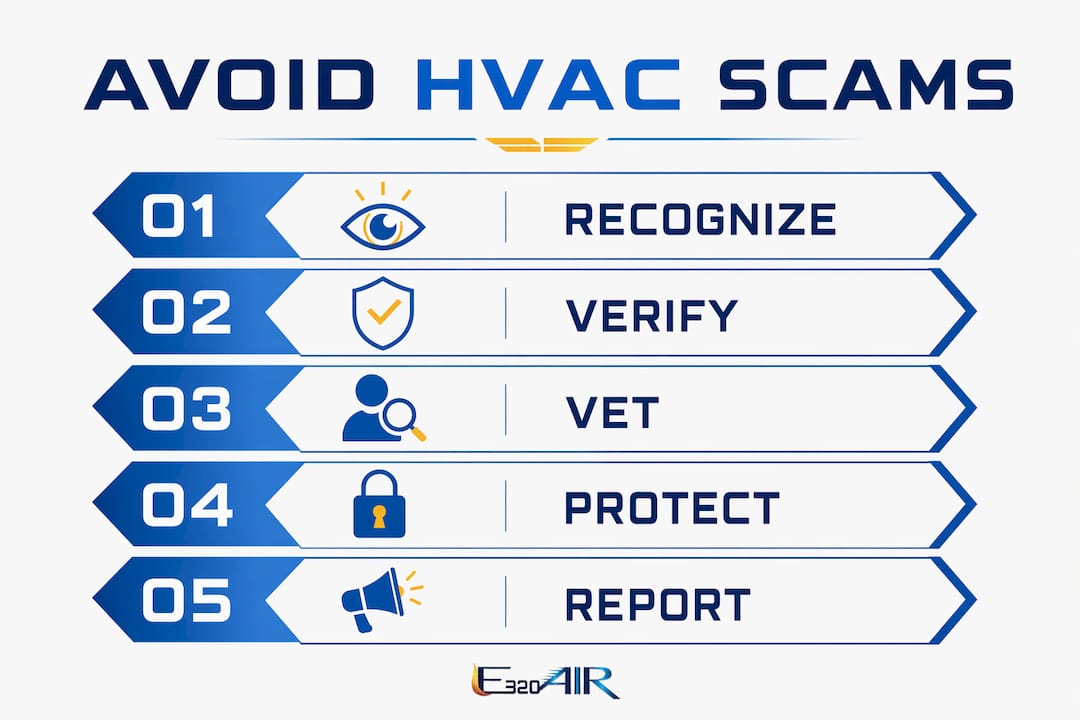
Vetting a contractor takes about 20 minutes and can save you thousands. Follow this sequence before booking any service:
- Verify the license. Check the contractor's CSLB license at cslb.ca.gov. Confirm it is active, covers HVAC work (C-20 classification), and matches the company name on the invoice.
- Confirm EPA Section 608 certification. Any technician handling refrigerants must hold this federal certification. Ask for the card. A legitimate tech carries it.
- Check insurance. Request a certificate of general liability and workers' compensation insurance. If a technician is injured on your property and the contractor is uninsured, you may be liable.
- Read the critical reviews. Filter for one-star and two-star reviews on Google and Yelp. Search the company name plus "scam" or "complaint." Proper contractor vetting includes reading critical online reviews alongside credential checks.
- Request a Manual J load calculation. Any contractor recommending a new system should size it using a Manual J calculation that accounts for your home's insulation, square footage, and local climate. Skipping this calculation signals poor quality or a potential upsell scam.
- Get at least three bids. Compare line-item quotes, not just totals. A bid that is 40 percent below the others is not a deal. It is a warning.
| Green flag | Red flag |
|---|---|
| Active CSLB C-20 license | No license or license mismatch |
| EPA Section 608 certification on hand | Technician cannot produce certification |
| Written itemized quote valid 14+ days | "Today only" pricing with pressure to sign |
| Manual J calculation for new installs | System sized by rule of thumb or guesswork |
| Permit pulled before installation | Contractor says permits are unnecessary |
For HVAC service prices in California, understanding typical cost ranges before a technician arrives gives you an immediate benchmark for spotting inflated quotes.
What to do if you suspect you have been scammed
Speed matters once you recognize a scam. The FTC Cooling-Off Rule's three-day window starts the moment you sign, so act before it closes.
- Stop payment immediately. If you paid by credit card, call your card issuer and dispute the charge. If you financed through the contractor, contact the lender and invoke your rescission rights in writing.
- Document everything. Photograph the unit, the red-tag notice, any parts the technician claimed to replace, and all written communications. Save every text and email.
- File a complaint with the CSLB. The California Contractors State License Board investigates fraud complaints and can suspend or revoke a contractor's license. File at cslb.ca.gov.
- Report to the California Attorney General. The AG's office handles consumer fraud and can pursue cases that affect multiple homeowners.
- Contact the EPA. If the scam involved illegal refrigerant work, report it to the EPA's enforcement division. Violations of 40 CFR 82.157 carry significant penalties.
- Warn your neighbors. Post the contractor's name and license number in your neighborhood Facebook group or Nextdoor. Scam contractors often work the same zip codes repeatedly.
For guidance on what to do when your HVAC stops working, understanding the real diagnostic steps a legitimate technician follows helps you spot when someone is cutting corners or manufacturing a crisis.
Key takeaways
Protecting yourself from HVAC fraud starts with knowing the specific tactics scammers use and the legal tools already available to you.
| Point | Details |
|---|---|
| Fraud costs billions annually | HVAC scams drain approximately $2 billion from US homeowners each year through fabricated emergencies and deceptive repairs. |
| Refrigerant top-offs are often illegal | Adding refrigerant without finding and fixing the leak violates EPA 40 CFR 82.157 and is a recurring scam tactic. |
| You have a 3-day cancellation right | The FTC Cooling-Off Rule lets you cancel any in-home contract within three business days without penalty. |
| Verify credentials before booking | Check the CSLB license, EPA Section 608 certification, and insurance before any technician enters your home. |
| Pressure to sign is a red flag | Legitimate quotes hold for 14 to 30 days. Any "today only" offer is designed to prevent you from comparing bids. |
What I have learned after years of watching homeowners get burned
I have been in HVAC long enough to know that fear is the scammer's most reliable tool. A homeowner who believes their furnace is leaking carbon monoxide will sign almost anything. That is not a character flaw. It is a human response to a perceived threat to their family's safety.
What I tell every homeowner I work with: the moment a technician creates urgency without evidence, slow down. Ask for the photo tied to your unit's serial number. Ask for the CO reading from a calibrated detector. Ask why the quote expires today. A legitimate contractor will answer every one of those questions without irritation. A scammer will get defensive, repeat the danger claim, or suddenly find a way to extend the offer.
The other mistake I see constantly is homeowners who rely on verbal assurances. A technician says the warranty covers parts and labor for five years. The contract says one year on labor. When the compressor fails in year two, the verbal promise means nothing. Verbal promises about warranties are unenforceable. The contract is the only document that matters in a dispute.
Southern California's heat creates real pressure to make fast decisions. I get it. But a reputable contractor will give you time to think, because they know their work and pricing will hold up to scrutiny. Build a relationship with a licensed local contractor before you need emergency service. That one step eliminates most of the vulnerability.
— Edward
Why Southern California homeowners trust E320air
E320air serves Southern California homeowners with licensed, insured, and EPA Section 608-certified technicians who follow every job with a written, itemized contract. There are no "today only" prices, no fabricated emergencies, and no refrigerant work without a proper leak diagnosis. Every installation includes permit pulling and comes backed by written labor and equipment warranties. If you want to see the kind of problems E320air actually solves, the problem-solving gallery shows real jobs with real documentation. For transparent HVAC service from a contractor who will answer every question you have, visit E320air and schedule your inspection today.
FAQ
What are the most common signs of an HVAC scam?
The clearest signs include same-day pressure to replace equipment, refrigerant top-offs without a leak diagnosis, and cracked heat exchanger claims without unit-specific photo evidence. Any contractor who cannot produce a CSLB license number on request is also a serious red flag.
Is it illegal to add refrigerant without fixing a leak?
Yes. EPA regulation 40 CFR 82.157 prohibits topping off refrigerant on a leaking closed-loop system without locating and repairing the leak first. A technician who offers this service is breaking federal law.
How many bids should I get before replacing my HVAC system?
Get at least three written, itemized bids. Legitimate quotes are valid for 14 to 30 days, so there is no reason to rush. A bid significantly below the others often signals unlicensed work, inferior equipment, or a bait-and-switch setup.
Can I cancel an HVAC contract after signing it?
The FTC Cooling-Off Rule gives you three business days to cancel any in-home contract signed for more than $25, with no penalty. The contractor must provide written notice of this right at the time of signing.
Where do I report an HVAC scam in California?
File complaints with the California Contractors State License Board at cslb.ca.gov, the California Attorney General's consumer protection office, and the Better Business Bureau. If illegal refrigerant work was involved, report it to the EPA's enforcement division as well.