
TL;DR:
- Homeowners in warm climates often neglect seasonal HVAC maintenance, leading to dust buildup and corrosion that cause no-heat issues during cold months. Troubleshooting steps such as checking thermostat settings, replacing filters, and inspecting electrical connections can resolve most problems; however, complex faults like refrigerant leaks or defective heat exchangers require professional help. Regular fall inspections and filter upkeep are vital to prevent costly breakdowns, with system age and repair costs guiding whether to repair or replace equipment.
Getting no heat from your HVAC when you finally need it is one of the most frustrating things a homeowner can experience. In warmer climates, where heating systems often sit unused for months at a time, system inactivity causes dust buildup and humidity-driven corrosion that quietly degrades components. When the temperature finally drops, the system that seemed fine last spring suddenly blows cold air or refuses to run at all. This guide walks you through exactly what to check, what to fix yourself, and when to stop guessing and call a professional.
Table of Contents
- Key takeaways
- No heat from HVAC: what to check before you troubleshoot
- Step-by-step troubleshooting for HVAC not heating
- Common mistakes that make HVAC heating problems worse
- When to call a professional for HVAC heating repair
- My honest take on HVAC heating issues in warm climates
- Let E320air handle your heating system problems
- FAQ
Key takeaways
| Point | Details |
|---|---|
| Thermostat settings cause most complaints | Switching fan mode from ON to AUTO often resolves cold air issues without any repairs. |
| Dirty filters trigger shutdowns | A clogged filter is the most common cause of HVAC heating failure and costs almost nothing to fix. |
| Heat pump cold air can be normal | Brief cold air during a defrost cycle is expected behavior, not a system failure. |
| Know when to stop DIY troubleshooting | Electrical faults, gas issues, and reversing valve problems require a licensed technician. |
| Use the 50% rule for replacement | If repair costs exceed half the price of a new system, replacement is usually the smarter investment. |
No heat from HVAC: what to check before you troubleshoot
Before touching any component on your HVAC system, take a few minutes to prepare properly. Skipping this step leads to misdiagnosis, wasted time, and in some cases, real safety risks.
Safety first. Turn off the system at the thermostat before inspecting any physical components. If you smell gas at any point during this process, leave the house and call your gas company immediately. Do not attempt to troubleshoot a gas furnace if you suspect a leak.
Know your system type. The troubleshooting steps for a gas furnace differ significantly from those for a heat pump or a hybrid system. Check your unit's label or your owner's manual to confirm what you have. Heat pumps are especially common in warmer climates because they are designed for mild winters, which also means their heating behavior is often misunderstood.
Gather a few basic items before you start:
- Fresh thermostat batteries (even if the display looks active, weak batteries cause erratic behavior)
- A replacement air filter sized for your specific unit
- A flashlight for inspecting the furnace cabinet and outdoor unit
- Your system's owner's manual or the model number to look up specifications
Here is a quick reference for what to expect from each system type:
| System type | Heat source | Common warm-climate issue |
|---|---|---|
| Gas furnace | Natural gas burner | Flame sensor corrosion, pilot light failure |
| Heat pump | Transfers outdoor heat inside | Defrost cycle confusion, reversing valve misconfiguration |
| Hybrid system | Heat pump plus gas backup | Incorrect switchover temperature settings |
| Electric furnace | Resistance heating coils | Tripped breakers, failed heating elements |
Pro Tip: Before assuming your system is broken, confirm your thermostat is set to HEAT mode and the set temperature is at least 3 to 5 degrees above the current room temperature. This single check resolves a surprising number of no-heat complaints.
Review your system's breaker at the electrical panel and confirm the disconnect switch near the outdoor unit or furnace is in the ON position. Power interruptions from storms or tripped breakers are common triggers for heating failures and take seconds to check.
Step-by-step troubleshooting for HVAC not heating
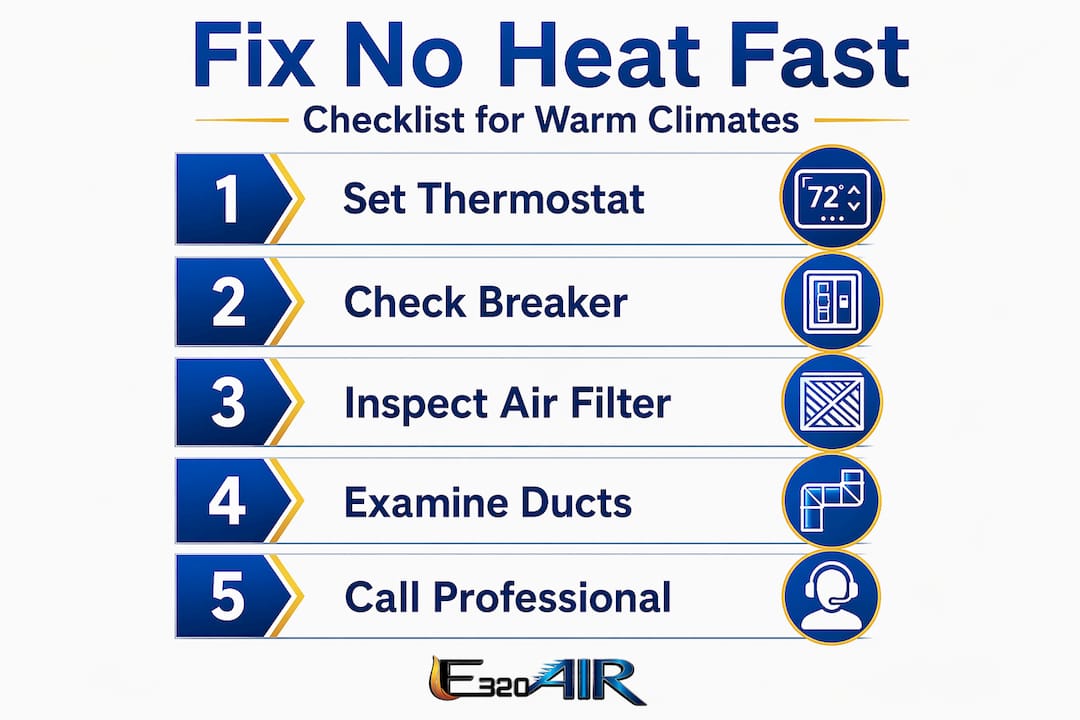
Work through these steps in order. Most heating failures are resolved within the first three or four steps.
-
Check the thermostat fan setting. If the fan is set to ON instead of AUTO, the fan runs continuously and pushes unheated air through your vents even when the furnace or heat pump is not actively producing heat. Switch the setting to AUTO so the fan only runs during a heating cycle.
-
Replace the air filter. A clogged air filter is the single most common cause of HVAC heating problems. Restricted airflow causes the system to overheat and trigger a safety shutoff. Pull the filter out and hold it up to light. If you cannot see light through it, replace it immediately.
-
Check thermostat batteries and wiring. Dead batteries or reversed wiring terminals cause the thermostat to send incorrect signals to your system, which results in cold air even when heat mode is selected. Replace the batteries and visually inspect that wiring connections are snug and correctly placed.
-
Inspect the furnace ignitor or pilot light. Gas furnaces ignite fuel using either a hot surface ignitor or a standing pilot light. If the furnace cycles on but shuts off quickly without producing heat, the flame sensor may be coated in oxidation. Cleaning oxidized flame sensor rods with a fine-grit abrasive pad is a common fix that restores proper ignition and avoids a service call.
-
Reset the breaker and power sources. Go to your electrical panel and look for any tripped breakers. A tripped breaker sits between the ON and OFF position. Flip it fully to OFF, then back to ON. Do the same with the disconnect switch near your unit if it has one.
-
Look at your heat pump's outdoor unit. If you have a heat pump and notice it blowing cool air, check whether the outdoor unit is in defrost mode. Heat pumps blow cool air briefly while melting ice buildup from the coils. This cycle typically lasts 5 to 15 minutes. If cold air continues well beyond that window or your indoor temperature keeps dropping, that is a real problem worth investigating further.
-
Check the O/B wire configuration for heat pumps. If your heat pump consistently runs in cooling mode when heat is selected, a reversed reversing valve wire is likely the cause. The O/B terminal setting on your thermostat controls whether the reversing valve energizes in heating or cooling. This setting must match your specific heat pump manufacturer's specification.
-
Test emergency heat mode. If you have a heat pump, switch the thermostat to emergency heat. Emergency heat bypasses the heat pump entirely and uses electric resistance strips to warm your home. If heat returns in this mode, the problem is isolated to the heat pump itself rather than the air handler or ductwork.
Pro Tip: Check your ductwork for disconnected sections or gaps near the air handler. Blocked or leaky ductwork causes cold air at registers even when the system is heating properly. A visual inspection of accessible duct runs in your attic or garage takes five minutes and can save you an unnecessary service call.
Common mistakes that make HVAC heating problems worse
Even well-meaning homeowners make these errors, and some of them create bigger problems than the original heating failure.
-
Running the fan on ON mode continuously. This is probably the most widespread source of "why is my HVAC cold?" complaints. The fix is one thermostat button press, yet it gets overlooked every season.
-
Using sharp tools to chip ice off the outdoor unit. If your heat pump's outdoor coil has ice on it, you may be tempted to chip it off. Do not. You will damage the refrigerant coils, which turns a simple defrost issue into an expensive refrigerant leak repair.
-
Resetting components repeatedly without fixing the root cause. The high limit switch tripping is a warning that airflow is restricted or the blower motor is failing. Resetting it gets your heat back temporarily, but the switch trips again until you fix the underlying problem. Each reset cycle stresses the system further.
-
Ignoring unusual smells or sounds. A burning smell when the heat first kicks on after months of inactivity is often just dust burning off. But a persistent chemical or burning plastic smell, or a loud banging noise on startup, signals something that needs professional attention.
Treating your HVAC system like it's set-and-forget in a warm climate is the fastest way to guarantee a heating failure on the coldest night of the year. A 15-minute inspection every fall costs nothing. An emergency service call in January costs considerably more.
- Overlooking system age. If your furnace or heat pump is 15 or more years old and you are troubleshooting it with increasing frequency, the real issue is not any single component. The system is aging out. Spending money on parts for an old unit in a high-humidity environment delays the inevitable.
When to call a professional for HVAC heating repair
Some troubleshooting outcomes tell you the fix is beyond DIY territory. Knowing where that line sits saves you time and prevents you from making a small problem worse.
If you complete every step above and still have no warm air from your furnace or heat pump, the remaining causes are almost certainly electrical or mechanical faults. These include a failed blower motor, a cracked heat exchanger, a faulty control board, or a refrigerant issue in a heat pump. None of these are safe or practical for homeowners to address without proper tools, training, and in some cases, an EPA refrigerant handling certification.
Here is a quick comparison to help you decide:
| Situation | DIY appropriate | Call a pro |
|---|---|---|
| Thermostat setting wrong | Yes | No |
| Dirty or clogged filter | Yes | No |
| Tripped breaker | Yes | No |
| Flame sensor cleaning | Yes (with comfort) | If unsure |
| Reversing valve misconfiguration | Thermostat setting only | Wiring changes |
| Cracked heat exchanger | No | Yes |
| Refrigerant loss | No | Yes |
| Blower motor failure | No | Yes |
| Control board failure | No | Yes |
When repair costs come up during a technician visit, use the 50% repair rule as your decision framework. If the repair quote exceeds half the cost of a new system, replacement gives you a better return. This is especially true in warm, humid climates where corrosion accelerates component wear. You can explore repair versus replacement guidance to understand the full picture before committing to either option.
Pro Tip: Always ask a technician to give you the repair cost and the replacement cost side by side. Any reputable contractor will provide both without pressure. If they push hard for the expensive option without explaining the tradeoff, get a second opinion.
My honest take on HVAC heating issues in warm climates
I've been in and out of homes across warmer regions for years, and the pattern I see most consistently is this: homeowners in warm climates treat their heating system like it's maintenance-free because they rarely use it. That assumption is expensive.
A gas furnace or heat pump that runs for just six weeks a year still accumulates humidity exposure, dust on the flame sensor, and oxidation on electrical contacts all year long. When you fire it up in November or December, you're asking a piece of equipment to perform after ten months of neglect in a high-humidity environment. Most of the time it cooperates. Sometimes it doesn't.
What I've found actually works is scheduling a quick fall HVAC checkup in September or October, before you ever need the heat. A technician can clean the flame sensor, check refrigerant levels in a heat pump, test the ignitor, and verify thermostat calibration in under an hour. That single visit eliminates 80% of the no-heat calls I see during cold snaps.
The other thing I'd tell homeowners is to take the HVAC filter seriously year-round, not just in summer. Dust from a warm-climate attic or garage loads up filters fast, and a clogged filter in November causes your furnace to shut off on its first real heating night. That's not a system failure. That's a $15 filter that wasn't changed.
— Edward
Let E320air handle your heating system problems
When your troubleshooting hits a wall, E320air is the team warm-climate homeowners rely on. Whether you're dealing with a heat pump that keeps blowing cold air, a furnace that cycles off after a few minutes, or a system that simply won't turn on, E320air brings the diagnostics, tools, and field experience to get it right the first time. Check the problem-solving gallery to see real heating failures the team has resolved across the region. For homeowners weighing a full system swap, E320air's HVAC installation services cover everything from sizing to setup. Emergency heating repairs are available when you cannot wait. Visit E320air to schedule a service call or ask about maintenance plans designed for homes in warm, humid climates.
FAQ
Why does my HVAC blow cold air when set to heat?
The most common reasons are a fan set to ON instead of AUTO, a clogged air filter triggering a safety shutoff, or a heat pump stuck in defrost mode. Check these three items first before calling for service.
What does the defrost cycle mean on a heat pump?
The defrost cycle is a normal function where the heat pump temporarily reverses to melt ice off the outdoor coil, which causes brief cold air from your vents. It typically lasts under 15 minutes and is not a system failure.
How do I know if my HVAC heating issue needs a professional?
If your heater is not turning on after checking power, thermostat settings, and the air filter, or if you notice burning smells, loud noises, or repeated shutdowns, those are signs of electrical or mechanical faults that require a licensed technician.
What is the 50% rule for HVAC repair vs. replacement?
The 50% rule says that if the cost to repair your heating system exceeds half the price of a new replacement system, it is usually more cost-effective to replace the unit rather than invest in a failing one.
Can I clean my furnace flame sensor myself?
Yes, in many cases. If your furnace lights briefly then shuts off, an oxidized flame sensor is a likely cause. Gently cleaning the sensor rod with a fine-grit abrasive pad can restore function, though you should be comfortable working around furnace components before attempting this.