
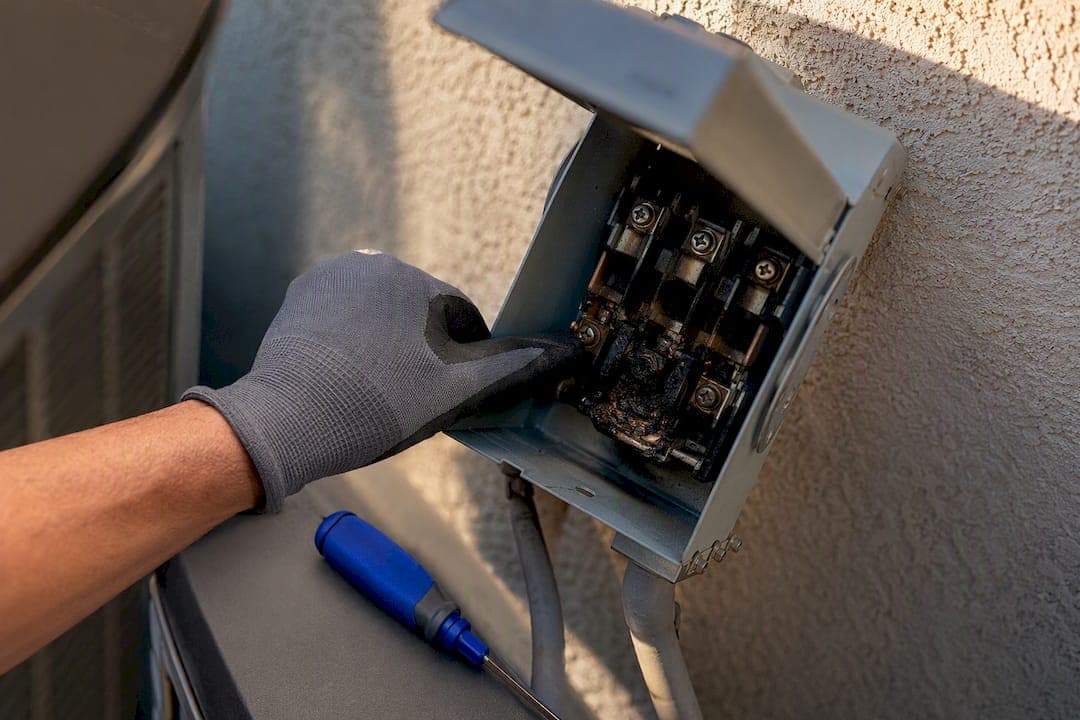
Yes, a power surge can damage HVAC electronics and control circuits. Control boards, capacitors, and ECM blower motors are the most common casualties. If you suspect a surge, check for a burning smell first, then check the HVAC breaker. If you smell smoke or see visible damage, shut off power at the breaker and call a technician before touching anything else.
TL;DR:
- Power surges are often caused by lightning, utility switching, or internal motor inrush, especially when the wiring is faulty or runs long distances.
- Control boards and low-voltage components like thermostats and capacitors are the most vulnerable to transient voltage spikes, with damage sometimes appearing after repeated smaller surges.
- If a power surge occurs, homeowners should first check for smells or smoke, then reset the breaker and inspect the outdoor unit before calling a technician.
- Repeated breaker trips, persistent error codes, or physical damage like scorch marks are signs that professional diagnosis and repair are necessary.
- Installing layered surge protection devices at both the panel and outdoor unit increases equipment safety, but proper maintenance and verification of device status are essential.
Table of Contents
- What Causes a Power Surge That Damages HVAC Equipment?
- Which HVAC Components Fail First When a Surge Hits?
- What Should You Check Before Calling a Technician?
- When Should You Stop Troubleshooting and Call a Professional?
- Is Surge Protection Worth Installing on Your HVAC System?
- How Do You Document Surge Damage for an Insurance Claim?
- How E320air Diagnoses Surge Damage and Reduces Repeat Risk
- What Actually Matters After a Surge, and What Doesn't
- Schedule a Surge Damage Inspection or Protection Install With E320air
- Sources
- FAQ
What Causes a Power Surge That Damages HVAC Equipment?
A power surge, technically called a voltage transient, is a brief spike above normal line voltage, often lasting only microseconds to a few milliseconds. Short as it is, that spike can push far more voltage into a circuit than HVAC components are built to handle.
External causes include lightning strikes, even ones that hit a transformer block away, along with utility switching operations and grid restoration after an outage. When power comes back online after a neighborhood-wide blackout, the reconnection itself can create a transient as the grid stabilizes.
Internal causes are just as common. A compressor or blower motor kicking on draws a heavy inrush of current, which can create a smaller surge inside your own wiring. Faulty wiring, loose panel connections, and poor ground bonding all make that worse. Outdoor condensers sit at the end of long conductor runs from the panel, and that length itself increases exposure. The farther the wire travels, the more opportunity there is for induced voltage from nearby strikes or switching events.
Which HVAC Components Fail First When a Surge Hits?
Not every part of your system is equally exposed. The circuit board that manages your thermostat signals, ignition sequence, and blower timing is usually the most sensitive part in the whole system, because it runs on low-voltage logic that has almost no tolerance for a spike.
| Component | Why it's vulnerable | Common symptom |
|---|---|---|
| Control board | Low-voltage logic circuits with minimal surge tolerance | Blank display, error codes, no response to thermostat |
| Capacitors | Store electrical charge; surges cause internal breakdown | Humming sound, compressor won't start, weak airflow |
| Contactors | Switching contacts pitted or fused by excess current | Unit won't cycle on, or runs continuously |
| ECM blower motor | Built-in electronics regulate speed and are surge-sensitive | Blower runs erratically or not at all |
| Thermostat | Low-voltage device often tied to the same circuit path | Blank screen, lost programming, no signal to the system |
| Compressor circuit | High electrical load makes it prone to winding damage | Tripped breaker, humming with no start, burning smell |
Some failures show up immediately: a breaker trips the moment the surge hits, or the outdoor unit goes dead on the spot. Others are cumulative. A capacitor or control board absorbs a series of smaller transients over months without failing outright, then finally gives out on what looks like an ordinary hot afternoon. Technicians see surge-related failures show up as control-board errors or thermostat faults more often than obvious motor damage, which is part of why the same symptom, a dead system, can point to very different repairs.
What Should You Check Before Calling a Technician?
Burning smell or visible smoke changes everything. If you notice either, shut off power at the breaker immediately and call for help; if it feels like a fire risk, call emergency services first. Everything below applies only when there's no smell, smoke, or scorching.
Here's the safe sequence to follow, in order:
- Check for odors or smoke around the indoor unit and the outdoor condenser.
- Reset the HVAC breaker: flip it fully off, wait a few seconds, then back on.
- Check the outdoor disconnect box near the condenser to confirm it's seated and on.
- Replace the thermostat batteries and confirm the display powers up.
- Wait several minutes before expecting the compressor to start; most systems build in a protection delay after a power interruption.
- Walk outside and visually inspect the condenser for debris, damage, or scorch marks.
This mirrors the non-invasive reset sequence recommended after outages, and it covers many "my AC won't come back on" calls actually turn out to be nothing more than the compressor delay or a tripped breaker. Our air conditioner troubleshooting guide walks through this same process in more depth if your system still won't start.
Pro Tip: Never flip the breaker back and forth repeatedly hoping it will "catch." If it trips a second time, stop. A repeated trip means something downstream is drawing a fault current, and resetting it again risks turning a repairable board into a fried one.
When Should You Stop Troubleshooting and Call a Professional?
Some signs mean it's time to put the checklist down and pick up the phone. Homeowners should stick to non-invasive checks and call a technician once red flags appear, including:
- The breaker trips a second time after you reset it.
- You hear the compressor humming but the system never actually starts.
- The thermostat screen stays blank even with fresh batteries.
- The unit displays an error code you can't clear.
- You see ice building up on the refrigerant lines.
- You spot scorch marks, melted insulation, or a burnt odor near the electrical panel.
A technician's visit typically starts with a visual inspection of the panel and disconnect, then moves to bench-testing the control board, checking capacitors and contactors for continuity, and running electrical tests on the compressor windings. That diagnostic work is what separates a cheap fix from an expensive one. Our homeowner's guide to HVAC repair services covers what a typical service call includes.
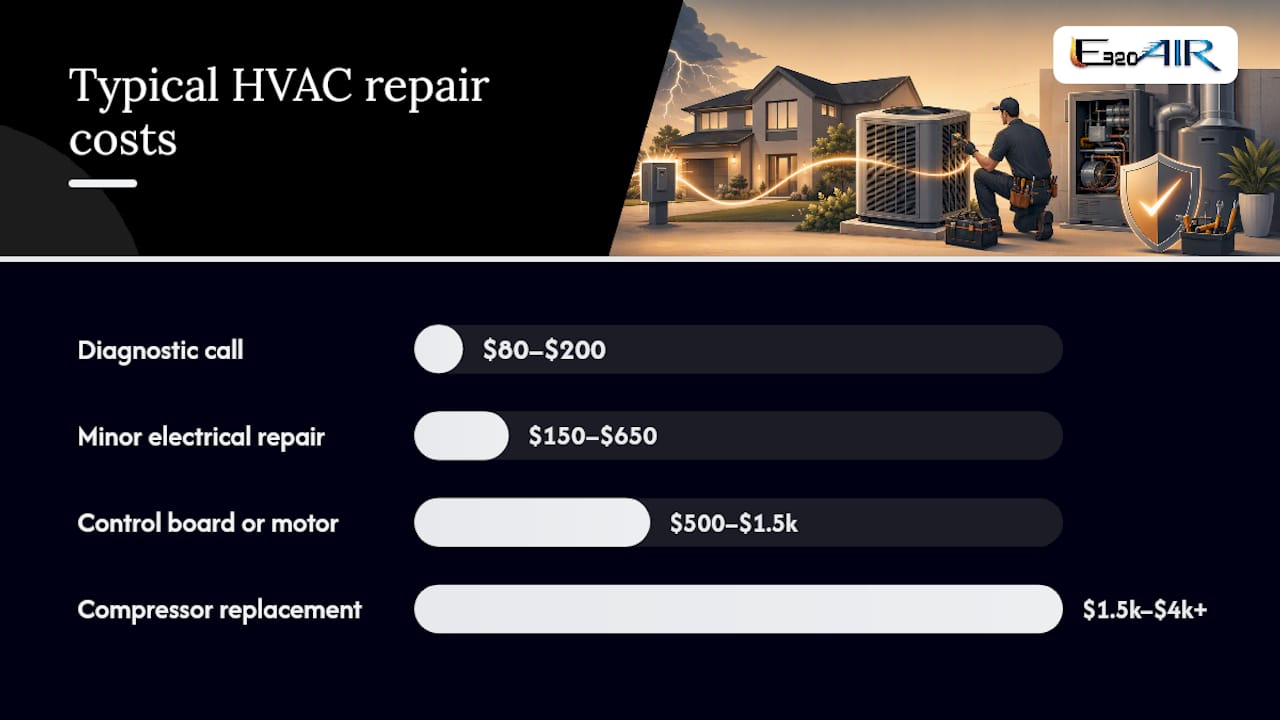
Cost ranges vary by region and system, but a general diagnostic call usually runs $80 to $200, with minor electrical repairs landing between $150 and $650. Control board or motor replacement tends to fall between $500 and $1,500, and a full compressor replacement can run $1,500 to $4,000 or more.
Is Surge Protection Worth Installing on Your HVAC System?
Two levels of protection work together better than either one alone. A whole-house surge protective device (SPD) installed at your main panel catches large transients from lightning or utility switching before they spread through your home's wiring. But the farther your outdoor unit sits from the panel, the less protection reaches the equipment terminals, because voltage let-through increases with wire distance.
That's why a dedicated HVAC SPD, mounted directly at the outdoor disconnect, is often recommended alongside the whole-house unit. Layering both devices reduces let-through voltage more effectively than relying on the panel alone. When wiring distance to the unit is significant, keeping the conductor run between the SPD and the equipment as short as possible measurably improves protection.
A few practical notes on installation and upkeep:
- Whole-house SPDs at the panel typically run $300 to $700 installed.
- Dedicated equipment-level HVAC SPDs vary in cost depending on the unit and disconnect setup.
- Most SPDs use MOV components that absorb transients and degrade over time. Repeated transients age MOV-based devices, so check the built-in status indicator periodically to confirm the device is still active.
Surge protection reduces risk, but it doesn't eliminate it. Even well-protected systems can experience a failure severe enough to overwhelm the device, so treat an SPD as a strong layer of defense, not a guarantee.
How Do You Document Surge Damage for an Insurance Claim?
Insurers want evidence, not just a story. Take photos of any scorch marks, the breaker's tripped position, and burnt or discolored components before anything gets repaired or thrown away. Note the time the outage or storm occurred, since pairing outage timestamps with a technician's written diagnostic report strengthens a surge-damage claim.
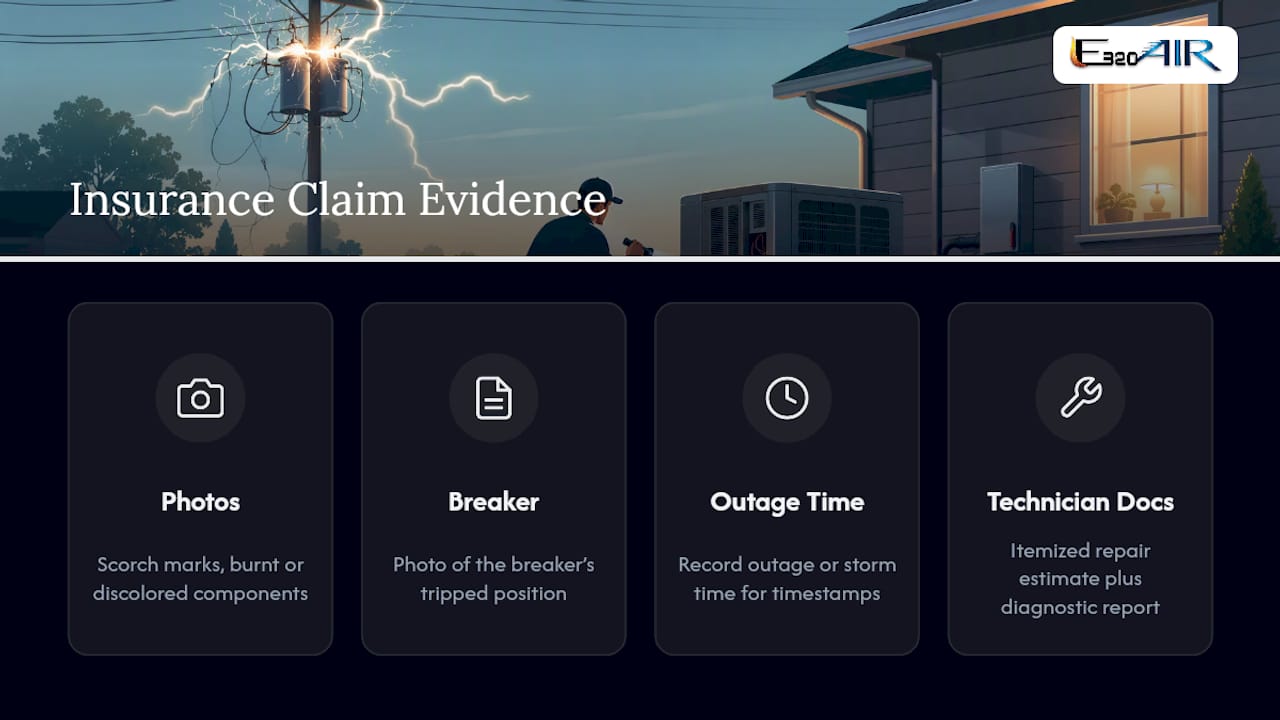
Check your policy language before assuming coverage. Standard homeowners policies frequently exclude or limit surge-related claims unless you've added specific equipment coverage or an endorsement. Keep the technician's itemized repair estimate alongside their diagnostic notes. That paperwork is often what determines whether a claim gets approved or denied, and it's much easier to gather right after the incident than weeks later.
How E320air Diagnoses Surge Damage and Reduces Repeat Risk
When a system comes in after a suspected surge, E320air's diagnostic visits start the same way a homeowner's checks should: ruling out the simple stuff before assuming the worst. We inspect the control board, test capacitors and contactors, and check compressor windings, then handle the repair, whether that's a board replacement or a full SPD installation at the disconnect.
One installation detail we see overlooked constantly: SPD conductor runs left too long between the device and the equipment, which quietly undercuts the protection it's supposed to provide. We coordinate with electricians on panel-level work when needed and always confirm the unit's status indicator before calling a job done.
Before your visit, gather photos of any damage, note the approximate time of the outage or storm, and pull your last maintenance record if you have one. It saves diagnostic time and often speeds up the repair estimate.
What Actually Matters After a Surge, and What Doesn't
Most advice on this topic spends too much time on prevention theater and not enough on the first ten minutes after a suspected surge. Homeowners get told to buy a surge protector, and that's true, but it skips the more urgent question: what do you do right now, tonight, when the AC won't start and you don't know if it's dangerous?
The honest priority order is smell and smoke first, breaker second, patience third. That compressor delay trips up more people than any wiring fault ever will. People reset the breaker three times in a panic, assume the worst, and turn a five-minute wait into a burnt contactor.
Where conventional advice falls short is treating surge protection as a one-time purchase instead of a maintained system. An SPD with a dead status indicator is doing nothing, and almost nobody checks it. If you take one thing from this article, let it be this: protection matters, but only if you actually verify it's still working. That single habit prevents more repeat failures than any product upgrade.
— Edward
Schedule a Surge Damage Inspection or Protection Install With E320air
A local HVAC contractor is a practical option when a surge has you second-guessing your HVAC system. Instead of guessing whether that dead thermostat means an inexpensive fix or a costly one, a diagnostic visit can provide an accurate assessment backed by electrical testing on components like the control board, capacitors, and compressor circuit.
A service visit typically includes an inspection checklist covering control board function, capacitor and contactor condition, compressor electrical tests, and inspection of outdoor disconnect wiring. You'll walk away with a written estimate before any repair work starts. If your system survived this time but you want to avoid a repeat scare, contractors can also handle whole-house and dedicated equipment-level surge protector installations, positioned and wired to reduce let-through voltage at your unit.
Browse real repair examples in our problem-solving gallery, or head to E320air to schedule an inspection, repair, or surge protection install this week. If your system needs a full replacement after compressor damage, our HVAC installation page covers what that process looks like.
Sources
Save these for your own research or to hand to a claims adjuster:
- Surge Protection for HVAC: Protect Your Heating and Cooling System - LSP
- Check HVAC After Power Outage: Safety & Restart Guide - HVACDatabase
- After a Power Surge: HVAC system won’t restart? Safe steps to take first - The Hidden Homes
FAQ
Does Homeowners Insurance Cover Power Surge Damage?
It depends on your policy. Many standard policies limit or exclude surge damage unless you've added specific equipment coverage, so check your policy language and keep documentation ready either way.
How Much Does It Cost to Install a Surge Protector on an HVAC System?
A whole-house SPD at the main panel typically costs $300 to $700 installed, while a dedicated equipment-level HVAC SPD's cost varies based on your disconnect setup and wiring distance.
How Do You Prove a Power Surge Damaged Your HVAC System?
Photograph scorch marks, burnt components, and the breaker's position, note the outage time, and keep the technician's written diagnostic report and repair estimate for your claim.
How Do You Reset an AC After a Power Surge?
Check for smell or smoke first, then reset the breaker off and back on, confirm the outdoor disconnect is seated, replace thermostat batteries, and wait several minutes for the compressor delay before assuming it's broken.