
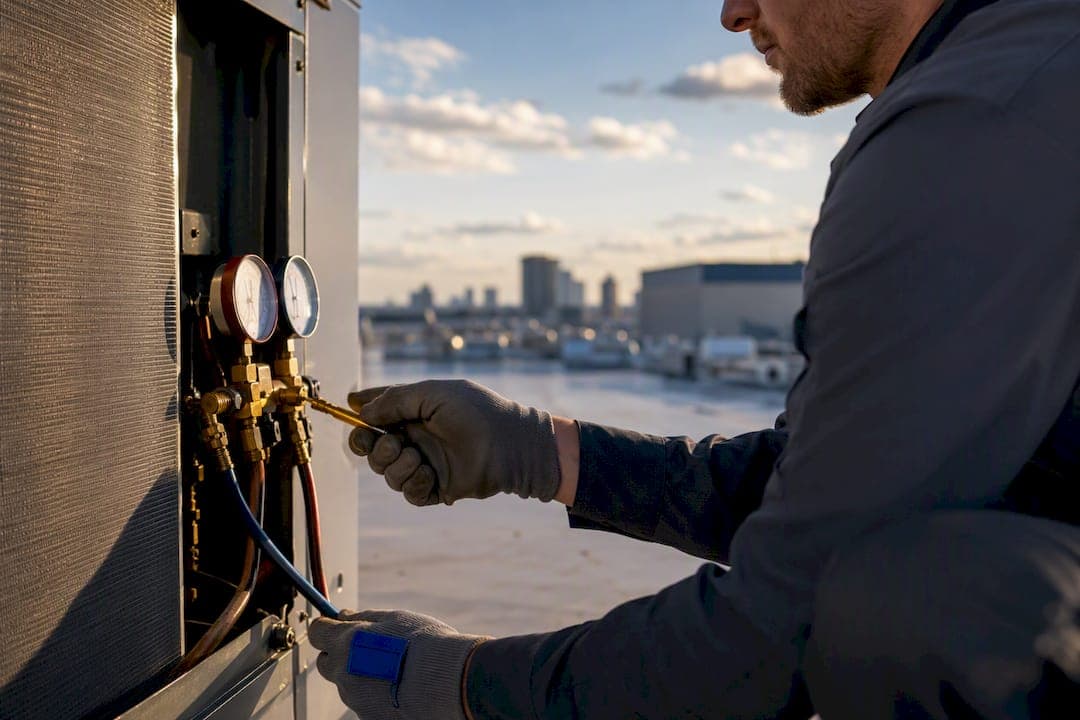
A complete rooftop unit maintenance checklist covers eight core task groups: filters and airflow, coils and condensate, refrigerant circuit and compressor, electrical components, fans and belts, economizer controls, structural and roof curb integrity, and diagnostics logging. The baseline cadence is quarterly service with major inspections in spring and fall, filter changes as often as monthly in dirty environments, and every visit requires lockout/tagout before panels open and a logged entry in your CMMS.
TL;DR:
- Monthly visits should include filter inspection and replacement based on pressure drop, with spare filters in easy-to-access locations to prevent callbacks.
- Coil cleaning is crucial for energy efficiency and compressor longevity, especially for rooftop units near coastal salt air or kitchen exhaust, requiring more frequent maintenance.
- Recording refrigerant pressures, superheat, subcooling, and compressor amperage during each visit helps detect early signs of leaks or compressor failure before costly breakdowns occur.
- Electrical checks must follow safety protocols: verify lockout/tagout, torque connections, test capacitors, and record voltage readings, as loose connections and overheated contactors cause most failures.
- Regular documentation and trend analysis of readings in CMMS, including filters, pressures, and electrical values, enable early detection of issues and prevent emergency repairs.
Table of Contents
- Rooftop Unit Maintenance Checklist: Schedule at a Glance
- Rooftop Unit Airflow and Filter Inspection: What to Check
- Cleaning Evaporator and Condenser Coils and Condensate Drains
- Refrigerant Circuit and Compressor Checks That Catch Failures Early
- Electrical Component Checks: Torque, Contactors, and Capacitors
- Fans, Belts, and Motor Maintenance for Rooftop Units
- Economizer Damper Calibration and Controls Testing
- Roof Curb, Access, and Structural Safety Checks
- Diagnostics and CMMS Documentation for Rooftop Units
- Scheduling Rooftop Unit Maintenance and What to Put in a Service Contract
- E320air's Approach to Commercial Rooftop Unit PM
- Safety Protocols Specific to Rooftop Unit Maintenance
- Tips for Troubleshooting Common Rooftop Unit Problems
- Recommended Tools and Equipment for Rooftop Unit Maintenance
- Field Perspective: Why Consistent RTU PM Actually Prevents Emergencies
- Book a Commercial Rooftop Unit Maintenance Visit
- Sources
- FAQ
Rooftop Unit Maintenance Checklist: Schedule at a Glance
Most facility teams break rooftop unit (RTU) preventive maintenance into four frequency bands. ANSI/ASHRAE Standard 180 documents this Level I inspection sequence and backs the quarterly-plus-seasonal cadence most commercial contracts already follow.
- Monthly or every visit: Walk the roof, scan for unusual noise or vibration, check filters, log the visit and any readings.
- Quarterly: Check belt tension, inspect coil surfaces for debris, lubricate bearings per spec, clear drain pans and traps.
- Spring (pre-cooling season): Clean condenser coils, verify refrigerant charge against nameplate data, prep economizer for free cooling.
- Fall (pre-heating season): Inspect burners or heat exchangers for cracks and corrosion, confirm the economizer's heating lockout is active.
Rooftop Unit Airflow and Filter Inspection: What to Check
For most commercial spaces, MERV 8 to MERV 13 covers general comfort applications without punishing the fan motor with excess static pressure. Jumping to MERV 14 or higher on a unit not sized for it can spike energy draw and starve airflow, so check the manufacturer's fan curve before upgrading filter media.
- Inspect filters visually every visit; replace on a fixed interval or based on measured pressure drop.
- Use a magnehelic gauge across the filter bank if one is installed, and replace once DP climbs 30 to 50 percent above the clean baseline.
- Wipe down filter track grooves and rubber gaskets so the frame seats tight, with no bypass gap.
- Confirm airflow direction arrows on pleated media match the unit's actual flow.
Pro Tip: Keep one spare filter set per unit in a labeled bin on the roof or in a rooftop equipment closet, and write the install date directly on the frame in marker. It saves a callback when a tech shows up short a filter size.
Cleaning Evaporator and Condenser Coils and Condensate Drains
Dirty coils are the quiet budget killer on a rooftop unit. A fouled condenser coil raises head pressure and can push energy consumption noticeably higher while shortening compressor life, which is exactly why coil cleaning ranks among the highest-return tasks on this checklist.
- Brush loose debris off the fins, then rinse with a low-pressure coil cleaner rated for aluminum fin stock. Straighten bent fins with a fin comb before they choke airflow further.
- Pull the condensate pan cover, flush the pan, and clear the P-trap of algae or sediment buildup.
- In freeze-prone climates, verify heat trace on exposed drain lines or reroute condensate to an indoor drain.
- Watch for rising head pressure or reduced cooling capacity as early fouling signs, and adjust cleaning frequency upward near coastal air, dusty rooftops, or kitchen exhaust discharge.
Units near restaurant exhaust or coastal salt air often need coil cleaning twice as often as a typical office rooftop, so match the interval to the actual environment, not a generic calendar.
Refrigerant Circuit and Compressor Checks That Catch Failures Early
Record suction and discharge pressures every visit, then calculate superheat and subcooling against the manufacturer's target range stamped on the unit's data plate. A subcooling reading that has drifted more than a few degrees from baseline usually points to a charge or metering problem before the compressor ever trips a fault code.
- Log compressor amperage and compare it to the prior visit's reading; a jump of 10 percent or more against baseline is worth flagging for follow-up.
- Check for oil streaks around fittings and braze joints, which usually mean a slow leak long before a gauge shows low charge.
- Verify the filter drier hasn't exceeded its service life, especially after any compressor replacement.
- Stop and call a certified technician for anything involving refrigerant recovery or charge adjustment. EPA Section 608 certification requirements govern who can legally handle refrigerant work on commercial systems.
Compressor amp drift is one of the earliest warning signs of a failing motor or refrigerant issue, and catching it during a routine visit is far cheaper than an emergency compressor swap mid-summer.
Electrical Component Checks: Torque, Contactors, and Capacitors
Nothing on a rooftop unit checklist matters more than doing electrical work safely. Before any panel opens, verify lockout/tagout per your facility's written procedure and OSHA's control-of-hazardous-energy standard, confirm zero voltage with a meter, and never rely on a breaker label alone.
- Torque every electrical connection to the manufacturer's spec; loose lugs cause the arcing and heat damage behind most contactor failures.
- Inspect contactor contacts for pitting or discoloration, both signs of chronic overheating.
- Test run capacitors against their rated microfarad value; anything more than 10 percent off spec should be replaced, not monitored.
- Record measured line voltage and control voltage on the PM report so drift over multiple visits becomes visible.
Fans, Belts, and Motor Maintenance for Rooftop Units
A belt riding loose or glazed from age wastes fan energy and eventually snaps at the worst possible time, usually during a heat wave when the unit is running hardest.
- Inspect belts for glazing, fraying, or cracking, and check tension with a belt tension gauge rather than a thumb press.
- Confirm pulley alignment with a straightedge; misalignment wears belts and bearings faster than normal use ever would.
- Lubricate bearings on the manufacturer's interval, and consider ultrasonic grease guns on critical units to avoid over-greasing.
- Measure motor amp draw and compare against the nameplate full-load amps (FLA); unusual vibration alongside rising amps often signals a bearing on its way out.
Pro Tip: Stock a spare belt, a capacitor, and a handful of common fasteners in a rooftop lockbox for each unit model on site. A five-minute belt swap beats a four-hour parts run every time.
Economizer Damper Calibration and Controls Testing
Economizer failures rarely come from a broken part. More often it's sensor drift or a worn linkage quietly throwing off the mixed-air calculation, which makes stroke and sensor checks some of the highest-impact minutes you'll spend on the roof.
- Verify full damper stroke travel from 0 to 100 percent, and inspect blade seals for gaps that let unconditioned air leak past.
- Check enthalpy or dry-bulb sensor readings against a calibrated reference thermometer.
- Confirm the heating-season lockout is active and test free-cooling logic during startup to catch conflicting stage calls.
- A damper stuck partially open in winter is the single most common economizer complaint, and it's almost always a linkage or actuator issue, not a control board failure.
Roof Curb, Access, and Structural Safety Checks
The curb interface is where most roof leaks originate, and it rarely gets the attention the mechanical components do.
- Inspect curb seals, flashing, and fasteners for cracking, rust, or gaps that let water track into the building envelope.
- Confirm a clear access path wide enough for a filter cart, and verify clearances match the manufacturer's service specs.
- Check emergency disconnects, panel locks, and any powered maintenance outlets for damage or corrosion.
- Document roof-penetration defects in writing and route them to your roofing contractor before they become an interior ceiling problem.
Diagnostics and CMMS Documentation for Rooftop Units
A checklist only prevents failures if the numbers get written down somewhere trends can surface. Every PM visit should generate the same set of readings, recorded the same way, so a technician six months from now can spot a slow decline instead of discovering a dead unit.
- Capture volts and amps on every motor, suction and discharge pressures, supply and return air temperatures, and filter pressure drop.
- Log every reading in your CMMS and set automated alerts for values outside tolerance.
- Flag anything with amps up 10 percent against baseline or subcooling that's stayed low across two consecutive visits.
- Templated PM task codes, similar to the sample RTU checklist fields used across the industry, keep every technician recording the same data points.
| PM Field | Example Entry |
|---|---|
| Filter DP | 35% to 50% above baseline |
| Compressor amps | amps up 10 percent against baseline |
| Subcooling | 9°F (target 10 to 12°F) |
| Supply/return delta T | supply/return temperature delta |
Scheduling Rooftop Unit Maintenance and What to Put in a Service Contract
Quarterly PM is the floor, not the ceiling. Units running long hours, sitting near coastal salt air, or serving kitchen exhaust need tighter intervals, and a solid seasonal maintenance program adjusts for that instead of applying one calendar to every rooftop.
- Set PM cadence by run-hours and calendar date together, not calendar alone, especially on units with variable load profiles.
- A service contract should spell out scope, technician certifications, response-time commitments for emergency calls, and what documentation you receive after each visit.
- Budget routine PM against the cost of an emergency compressor or heat exchanger replacement. The math almost always favors the checklist over the emergency call.
E320air's Approach to Commercial Rooftop Unit PM
A professional PM visit should leave you with more than a signature on a clipboard. Every stop should produce a digital report with measured readings, a list of any parts approaching end of life, and clear next steps if something needs escalation. That kind of documentation trail is also what protects a warranty claim if a compressor fails inside its coverage window.
Technicians from an experienced HVAC provider work from checklists built around the same component groups covered here: filters, coils, refrigerant circuit, electrical, fans and belts, and economizer controls, all logged and handed back to the building manager after every visit.
Safety Protocols Specific to Rooftop Unit Maintenance
Rooftop work carries fall risk the moment a technician steps off the ladder onto the equipment platform. Any rooftop without a permanent parapet, guardrail, or anchor point needs a documented fall-protection plan before work starts, not after someone gets close to an edge.
A harness and lanyard rated for the specific anchor point in use is the minimum standard on unguarded roofs, and the anchor itself needs a visual inspection every time, since UV exposure degrades webbing faster than most people expect. Roof hatches and skylights near the work path should get temporary covers or barricades. A tech focused on a gauge reading is not watching their feet.
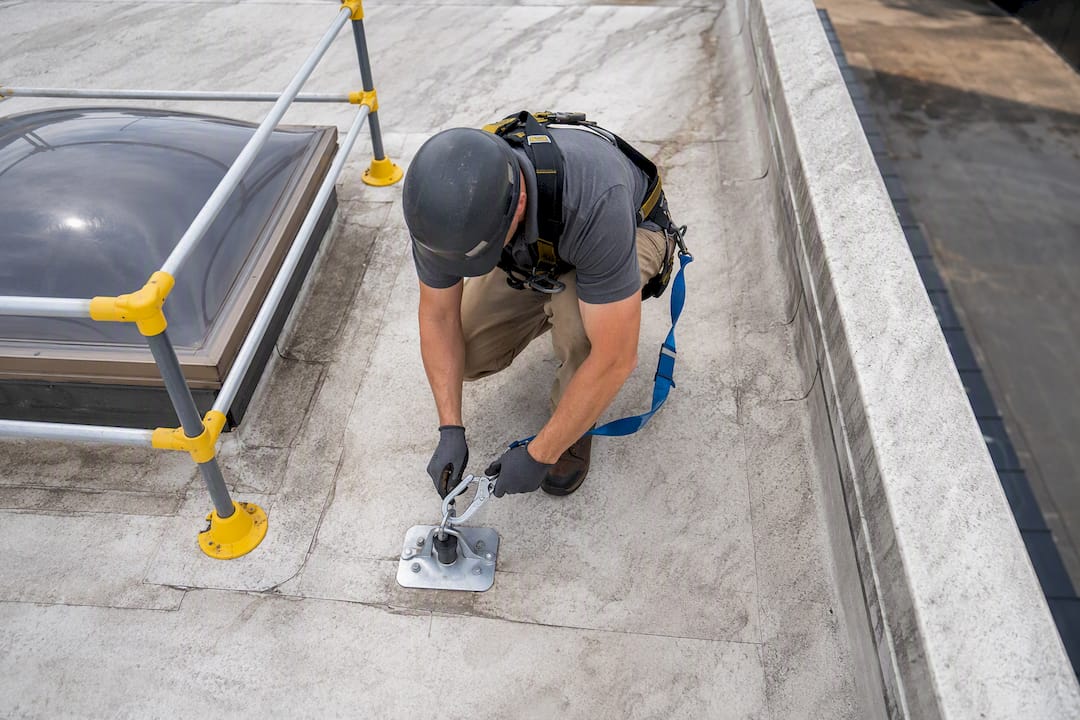
Electrical PPE matters just as much as fall gear. Insulated gloves rated for the voltage present, safety glasses for any refrigerant work, and hearing protection near large fan assemblies all belong in the roof kit, not left in the truck. Lockout/tagout applies every single time a panel opens, no exceptions for a "quick check."
Weather adds its own layer of risk. Wet coil surfaces make footing treacherous, and lightning within range should end rooftop work immediately regardless of how close the job is to finished. Heat stress is a real factor on a black membrane roof in July, and a two-person crew on any unit above a single story is a reasonable minimum for most commercial buildings, since a fall or electrical incident with no one else present can turn a manageable injury into something far worse.
Tips for Troubleshooting Common Rooftop Unit Problems
Most rooftop unit complaints trace back to one of a handful of root causes, and working through them in order saves a lot of wasted diagnostic time.
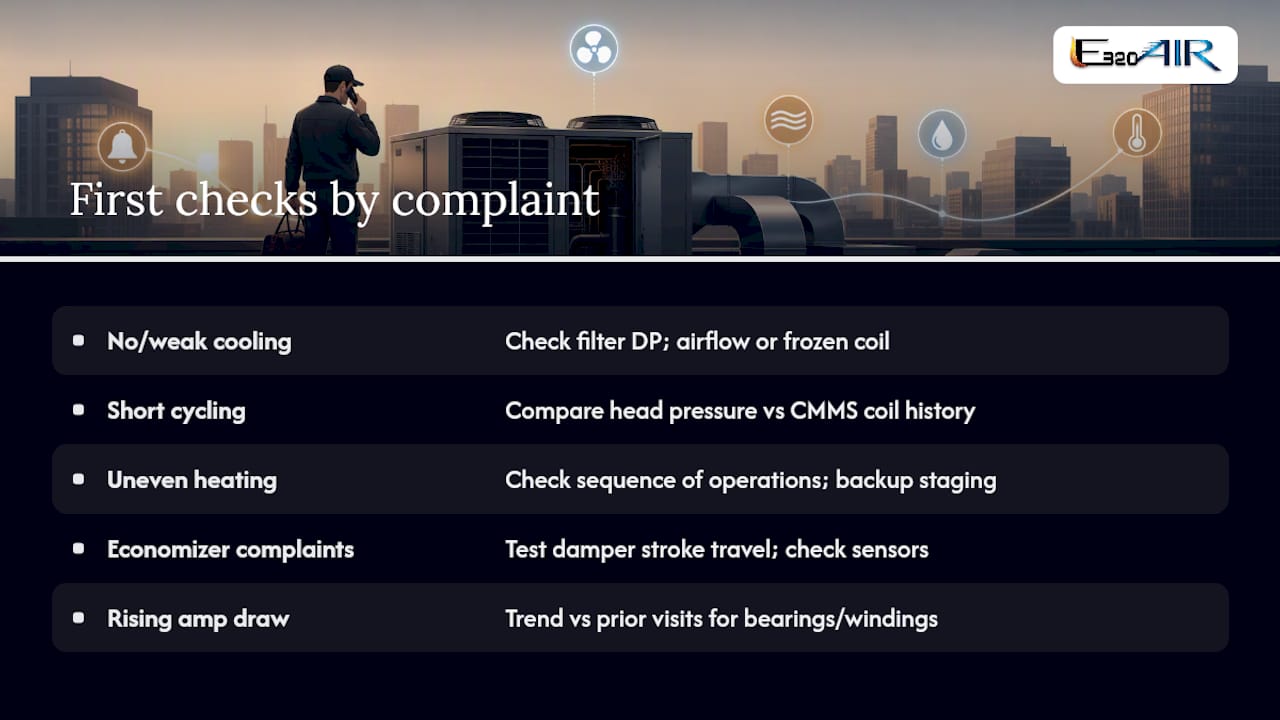
No cooling or weak cooling usually starts with the filter. A clogged filter starves airflow across the evaporator coil, which can freeze the coil and mimic a low-charge symptom that sends a tech chasing the wrong problem. Check filter DP before touching a gauge manifold.
Short cycling points toward a dirty condenser coil, a failing pressure switch, or a thermostat differential set too tight. Compare head pressure against the coil-cleaning history logged in the CMMS before assuming it's a control board issue.
Uneven heating on units with backup electric heat or gas heat staged behind a heat pump often comes down to a sequence-of-operations conflict, where the backup stage fires at the same time as the primary heat source. This is one of the most frequently missed checks in the field, and it can damage a heat exchanger fast if it goes unnoticed for more than a few cycles.
Economizer complaints in winter almost always trace to a stuck damper or drifted sensor rather than a dead actuator. Test stroke travel before replacing a part.
Rising amp draw with no other symptom is the checklist earning its keep. It rarely means anything urgent on its own, but trended against three or four prior visits, it tells a technician exactly when a bearing or winding is heading toward failure.
Recommended Tools and Equipment for Rooftop Unit Maintenance
A technician showing up without the right gear ends up guessing at readings instead of measuring them, and guessing is how small problems turn into replacement quotes.
A refrigerant gauge manifold with digital readout, a clamp-on amp meter, and a combustion analyzer for gas-fired units cover the core diagnostic work. A magnehelic gauge or digital manometer for filter pressure drop belongs in every kit, along with an infrared thermometer for quick surface temperature checks on coils and motor housings. A belt tension gauge takes the guesswork out of tension checks that far too many technicians still eyeball.
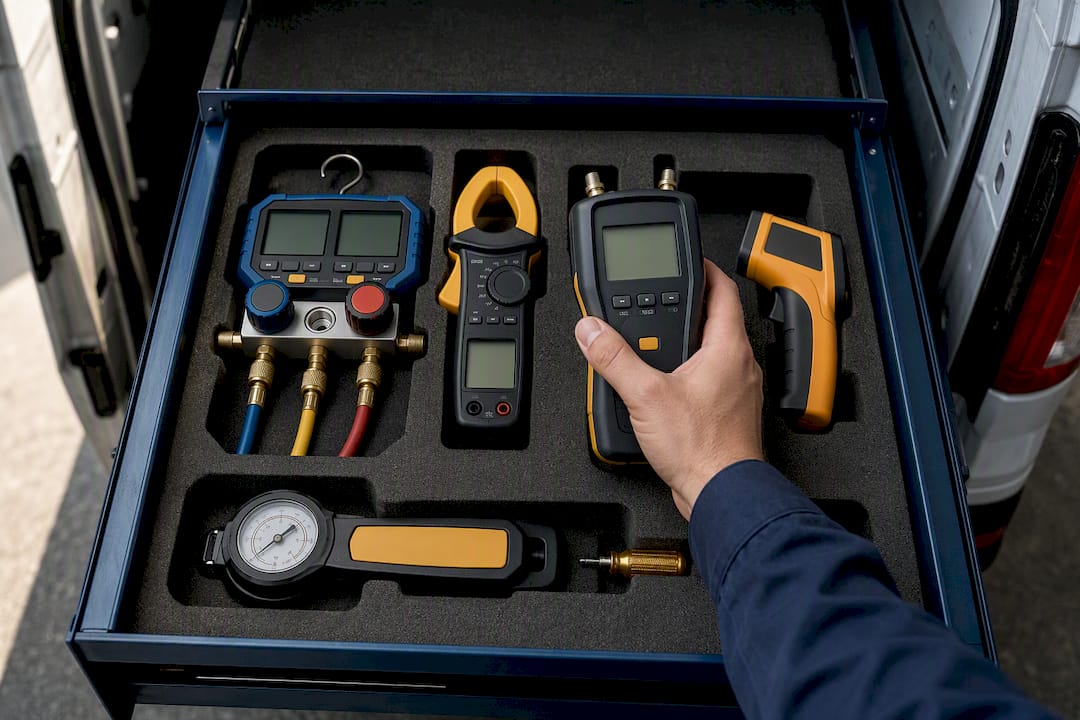
For electrical work, insulated hand tools, a torque wrench set to manufacturer spec, and a capacitor tester round out the panel work. A fin comb, coil cleaner rated for aluminum, and a low-pressure sprayer handle coil maintenance without bending fins.
On the safety side, a harness and lanyard rated for the roof's anchor points, insulated gloves, and a two-way radio for crews working solo on a large rooftop are non-negotiable line items on the equipment list, not optional extras. A rolling filter cart and a lockbox stocked with the common spares mentioned earlier round out a kit built to actually finish the job instead of triggering a second trip.
Field Perspective: Why Consistent RTU PM Actually Prevents Emergencies
The pattern is almost always the same: a unit that gets skipped for one PM cycle shows up on the emergency list within two seasons. A rising amp reading caught in March is a five-minute note. If ignored, it's a July compressor replacement with a building full of unhappy tenants. Good documentation is what turns a hunch into an early warning. Where staffing is tight, a checklist handed to a trained technician, or a professional PM contract, closes that gap before it becomes a callout.
— Edward
Book a Commercial Rooftop Unit Maintenance Visit
Running this checklist quarterly catches most problems before they become downtime, but a lot of building managers are stretched thin across a dozen other priorities and simply don't have the hours to do it themselves. That's where E320air fits in.

Commercial maintenance packages can cover the full scope outlined above: scheduled filter and coil service, electrical inspections with logged torque and voltage readings, economizer calibration, and a digital report after every visit so you have a real asset history instead of a stack of paper. Emergency response coverage can back up the scheduled work when something can't wait for the next quarterly stop. For airflow-related upgrades or replacement fan components, Greenheck alternatives are worth a look alongside your unit's spec sheet.
If your rooftop units haven't had a documented inspection this quarter, request a quote or ask for a sample digital PM report through E320air's commercial HVAC maintenance page and get a technician on the schedule before the next season change.
Sources
FAQ
What Is the Average Lifespan of a Rooftop Unit?
Commercial rooftop unit lifespan varies depending on environment and maintenance. Skipping filter changes and coil cleaning is one of the fastest ways to cut that lifespan short.
What Maintenance Needs to Be Done on an AC Unit?
Core AC maintenance covers filter replacement, coil cleaning, condensate drain checks, refrigerant pressure verification, and electrical inspections including contactors and capacitors. A rooftop unit preventive maintenance checklist organizes these into a repeatable quarterly and seasonal routine.
What Are Five Items That Regularly Scheduled Maintenance Checks?
A standard PM visit checks filters and airflow, coil condition, refrigerant pressures, electrical connections, and belt or motor condition. Each item gets measured and logged so changes over time are visible in the CMMS record.
What Are the Five Types of Preventive Maintenance?
Common categories include time-based PM (calendar intervals), usage-based PM (run-hours), condition-based PM (triggered by a measured reading like amp draw), predictive PM (trend analysis over multiple visits), and seasonal PM (spring and fall major inspections). Most commercial rooftop unit programs blend time-based and seasonal PM as the baseline.
Can E320air Handle Ongoing Rooftop Unit Maintenance for My Building?
Yes. E320air's commercial HVAC services include routine maintenance and emergency repair coverage built around the same component checklist outlined in this guide. Current pricing details are available directly on the site.