
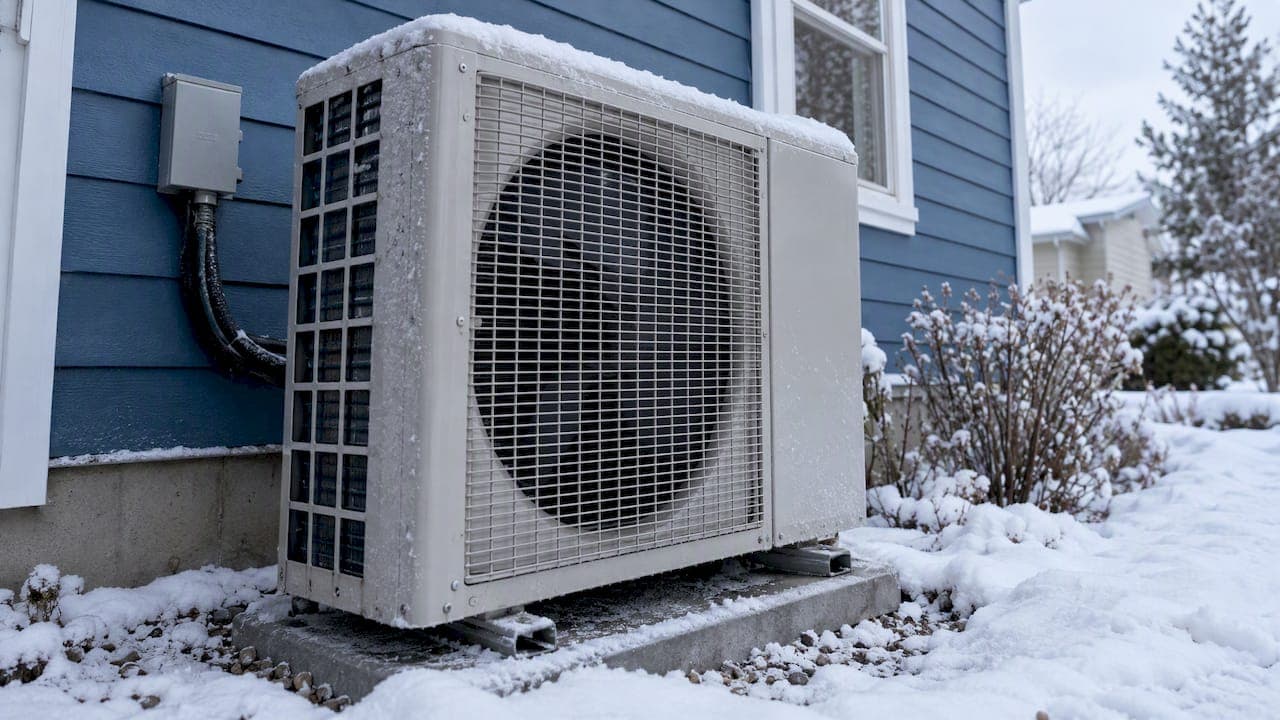
Yes, modern cold-climate heat pumps work in very cold weather and typically stay cheaper to run than electric resistance heat even at low temperatures. Capacity and efficiency decline as the thermometer drops, and auxiliary heat may kick in during the coldest stretches, but a properly sized and installed system keeps most of that heating load on the compressor. The real variable is not the technology, it is whether the equipment carries cold-climate certification and whether the installation was done right.
TL;DR:
- Choose an ENERGY STAR Cold Climate certified unit: it must deliver a COP of at least 1.75 and retain 70% capacity at 5°F.
- Between 40°F and 20°F, quality cold climate units typically achieve a COP of 2.5 to 3.5; below 0°F, backup heat may run more often.
- Ask for a Manual J load calculation and capacity figures at 47°F, 17°F, and 5°F; these show when your home will need auxiliary heat.
- Keep overnight thermostat setbacks modest, around 2 to 3 degrees, to avoid morning recovery loads that can trigger unnecessary auxiliary heat.
- Auxiliary heat that runs for hours after outdoor temperatures recover usually signals a control, sensor, airflow, or defrost problem rather than genuine cold weather.
Table of Contents
- How do heat pumps move heat when it's cold outside?
- What performance to expect as temperatures drop
- What makes a heat pump officially cold-climate rated?
- Understanding your home's balance point
- Why installation quality decides cold-weather results
- Steps you can take to get more from your system
- What we look for when specifying a cold-climate system
- Get your heat pump ready for winter with E320air
- FAQ
- Sources
How do heat pumps move heat when it's cold outside?
A heat pump does not create heat, it moves it. In heating mode, a refrigerant absorbs warmth from the outdoor air, even air that feels cold, and a compressor raises that refrigerant's pressure and temperature before releasing the heat indoors. This works because refrigerant boils at very low temperatures, so even 20°F outdoor air holds enough thermal energy to transfer.
The efficiency of that transfer is measured by coefficient of performance, or COP: the ratio of heat delivered to electricity consumed. A COP of 3 means three units of heat for every unit of electricity, which is why heat pumps beat electric resistance heating, which tops out at a COP of 1. The catch is that COP is not fixed. It shifts with the outdoor air temperature because:
- Colder outdoor air holds less recoverable heat, so the compressor has to work harder to extract the same amount.
- The temperature difference between outdoor air and the indoor target grows, which increases the compressor's workload per unit of heat delivered.
- Refrigerant pressure and flow rates shift at low temperatures, which can reduce the system's rated heating capacity along with its COP.
Ground-source (geothermal) systems avoid most of this swing because they draw heat from soil or groundwater that stays at a stable temperature year-round regardless of the weather. Air-source systems, the kind most homeowners install, are inherently tied to outdoor air temperature (OAT), which is why their performance curve matters so much when you're shopping and when you're troubleshooting a system that seems to be struggling.
What performance to expect as temperatures drop
Performance does not fall off a cliff. It declines on a curve, and the shape of that curve depends heavily on the equipment. In the 40°F to 20°F range, a quality cold-climate heat pump typically holds a COP between 2.5 and 3.5, delivering most or all of a home's heating load without help. Between 20°F and 0°F, COP commonly drops into the 2 to 2.5 range, and capacity retention becomes the bigger question than efficiency alone. Below 0°F, well-built systems can still function, but auxiliary heat starts supplementing more often depending on sizing and the home's heat loss.
Field data backs this up. NREL/DOE field validation of air-source heat pumps found average seasonal compressor-based heating COPs around 2.5, with site-to-site ranges from about 1.7 to 3.5. That spread is not random. The same study traced it to sizing, airflow, and control issues, the exact factors an installer controls.

One field dataset found seasonal average COPs that were generally above typical electric resistance heating levels across monitored sites, with the best-performing installations more than double the efficiency of the worst ones, a gap explained almost entirely by how the systems were specified and set up rather than by brand differences.
Separate Building America monitoring of inverter-driven heat pumps in cold climates recorded monthly COPs ranging from roughly 1.1 to 3.1. Even at the low end of that range, most monitored systems still cost less to run than oil, propane, or electric resistance heat. A separate performance analysis found that some modern cold-climate units maintain a COP near 2.0 at around -20°C, or -4°F, meaning they still deliver roughly twice the heat per unit of electricity compared with a resistance system even in genuinely extreme cold.
The practical consequence shows up in your electric bill when auxiliary heat runs often:
- Electric resistance backup has a COP of 1, so every hour it runs costs two to three times more per unit of heat than the compressor alone.
- Frequent auxiliary use during a single cold snap is normal and not a sign of failure.
- Auxiliary heat running for hours after temperatures recover usually points to a control, sensor, or defrost problem rather than genuine heating need.
Defrost cycles are part of this picture, too. Field reports show defrost-related auxiliary heat sometimes exceeding 20% of compressor-based heating energy at certain sites, which is a meaningful chunk of your winter energy use if defrost is misconfigured. We cover what a healthy defrost cycle looks like and when it signals trouble in more detail, since it is one of the easiest things for a homeowner to monitor.
What makes a heat pump officially cold-climate rated?
Not every heat pump marketed for cold weather actually performs in it, which is why objective standards matter more than a brand's marketing copy. The ENERGY STAR Cold Climate certification, effective since January 1, 2024, requires a unit to maintain a COP of at least 1.75 at 5°F and retain at least 70% of its nominal 47°F heating capacity at that same temperature. Those two numbers are the clearest proof point available to a shopper: a system that cannot meet them is not a true cold-climate unit, regardless of what the nameplate says.
The Department of Energy backs this with a defined test procedure for calculating COP at 5°F, referencing Appendix M1 as the method manufacturers use to generate these cold-temperature numbers in a lab setting. That standardization matters because it lets you compare units on an apples-to-apples basis instead of relying on a single advertised efficiency figure measured at a mild outdoor temperature.
The Cold Climate Heat Pump Challenge pushed this further. That is useful context, but lab results and field results are not the same thing, which is exactly why the field validation data cited earlier carries so much weight for a homeowner trying to predict real-world performance.
Before buying, ask for:
- A performance table showing capacity and COP at 47°F, 17°F, and 5°F, not just the headline efficiency rating.
- Confirmation of ENERGY STAR Cold Climate certification rather than a generic "works in cold weather" claim.
- Appendix M1 test results if a manufacturer or installer cites a 5°F performance number.
For more on how different heat pump types are built for year-round use, see our overview of how heat pump systems deliver efficient comfort across seasons.
Understanding your home's balance point
The balance point is the outdoor temperature at which your heat pump's heating capacity exactly equals your home's heat loss. Above that temperature, the compressor alone covers the full load. Below it, the compressor falls short and auxiliary heat makes up the difference. This single number, more than any spec sheet, determines how often you will see backup heat running through a given winter.
Estimating it is straightforward in concept, even if the inputs take some work to gather:
- Determine your home's design heat loss at your region's outdoor design temperature, typically from a Manual J calculation.
- Plot your heat pump's rated capacity at several outdoor temperatures, usually 47°F, 17°F, and 5°F, from the manufacturer's performance data.
- Find where the capacity curve crosses your heat loss curve: that intersection is your balance point.
- Compare that balance point to your region's typical winter lows to estimate how often auxiliary heat will be needed.
A tighter building envelope moves that balance point down, meaning the compressor alone covers a wider range of outdoor temperatures. Air sealing, upgraded insulation, and modern windows all reduce heat loss, which is why two identical heat pumps can behave very differently in two houses on the same street. Builders working with insulated panel systems or prefab construction often address this at the design stage, and our partners at prefab building specialists outline the envelope specs that matter most for cold-climate performance. Infiltration around doors is a common and fixable culprit too; simple steps like the ones in this door winterization guide can meaningfully cut draft-driven heat loss.
Indoor airflow and thermostat behavior matter just as much as the envelope. Supply and return placement affects how evenly heat distributes, and a thermostat set to deep nighttime setbacks can force a large morning recovery load that trips auxiliary heat unnecessarily.
Pro Tip: Keep thermostat setbacks modest, 2-3 degrees, rather than deep overnight drops. A gentler setback avoids the large recovery load that often triggers auxiliary heat the compressor could have handled on its own.
Why installation quality decides cold-weather results
Most heat pump complaints trace back to specification or installation, not the equipment itself. Practitioner reporting consistently points to the same culprits: skipped or sloppy Manual J load calculations, duct and airflow problems, and control wiring errors, rather than any inherent limitation of the technology.
Sizing is the first decision point, and it is easy to get wrong in both directions. Oversizing causes short-cycling, uneven comfort, and wasted capital on a bigger unit than the home needs. Undersizing pushes the balance point up, meaning auxiliary heat runs more often than it should. A correctly run Manual J calculation, paired with a conscious decision about how much of the extreme cold load to cover with staged auxiliary heat rather than gross oversizing, is the foundation everything else builds on. We go deeper into this trade-off in our guide to proper HVAC sizing.
Beyond sizing, a handful of field issues show up again and again:
- Indoor airflow measured well below the manufacturer's listed specification, which can come from undersized ductwork, closed supply registers, or a fan speed set too low, dramatically cuts both capacity and COP.
- Outdoor unit clearance problems, including snow drift accumulation or placement too close to a wall, restrict airflow across the outdoor coil and hurt heat extraction.
- Thermostat or control wiring errors can disable proper staging between the compressor and auxiliary heat, causing backup heat to run far more than the outdoor temperature justifies.
- Defrost sensor faults or miscalibrated defrost timers can leave auxiliary heat engaged well after a defrost cycle ends, burning electricity for no heating benefit.
Pro Tip: If your auxiliary heat indicator stays lit for more than an hour after temperatures stabilize, that is rarely a cold-weather limitation. It usually points to a control or sensor issue worth a diagnostic visit.
If your system seems to be running constantly or never quite catches up, our breakdown of what contractors check first when a heat pump isn't heating walks through the diagnostic order technicians follow, starting with airflow and sizing before anything else.
Steps you can take to get more from your system
A handful of homeowner-level actions move the needle more than people expect, and most take less than an hour.
- Replace or clean air filters on a regular schedule: restricted airflow at the indoor coil is one of the fastest ways to lose capacity and efficiency.
- Keep the outdoor coil clear of snow, ice, and debris, with at least a couple of feet of clearance on all sides for proper airflow.
- Set indoor fan speed to the manufacturer's recommended setting rather than a lower "quiet" mode, since reduced airflow drags down delivered capacity.
- Use modest thermostat setbacks instead of deep nightly drops to avoid recovery loads that trigger auxiliary heat.
- Address obvious infiltration points, drafty doors, gaps around windows, and attic air leaks, since each one effectively raises your home's heat loss and pushes the balance point in the wrong direction.
- Track how often auxiliary heat engages and for how long, along with outdoor temperatures when it happens, so you have real data rather than a vague impression.
That last point matters more than it sounds. A contractor working from actual run-time data, defrost frequency, and the outdoor temperatures at which auxiliary heat engages can diagnose a problem in one visit instead of several. Our seasonal maintenance checklist lays out the full list of tasks that keep cold-weather performance where it should be, broken down by time of year.
If you've done the basics and auxiliary heat still seems to run more than the outdoor temperature justifies, that is the point to call a contractor rather than keep adjusting settings on your own.
What we look for when specifying a cold-climate system
In our field work, the gap between a heat pump that performs well below freezing and one that disappoints a homeowner almost never comes down to the equipment badge. It comes down to whether someone ran the numbers before the installation instead of after the complaint call.
Our approach starts with a real Manual J load calculation rather than a rule-of-thumb sizing estimate, because every balance point conversation depends on getting that number right first. From there, we measure actual indoor airflow against the manufacturer's rated specification rather than assuming the ductwork matches the equipment, since that mismatch is one of the most common and most fixable sources of underperformance we see. We also watch defrost behavior directly during commissioning, because a system that lingers in auxiliary heat after a defrost cycle is telling you something about its controls, not about the weather.
None of this is complicated work, but skipping it is exactly how a perfectly good heat pump ends up labeled as "doesn't work in the cold."
— Edward
Get your heat pump ready for winter with E320air
Reliable cold-weather performance starts with getting the fundamentals right the first time, and that is where we focus. We handle HVAC installation with a proper Manual J calculation behind every sizing decision, so your system is matched to your home's actual heat loss rather than a generic estimate.

If you already have a heat pump that seems to lean on auxiliary heat too often, our heater repair service includes defrost and control diagnostics to find out whether the issue is a sensor fault, airflow restriction, or wiring problem rather than a genuine limitation of the equipment. For ongoing performance, our maintenance services cover filter changes, coil clearance checks, and airflow verification that keep a cold-climate system working the way it was designed to.
Our technicians work on all major brands and offer flexible payment options, including financing, with service available around the clock, including weekends and holidays. If winter has you wondering whether your current setup is actually sized and configured correctly, reach out through E320air to book an inspection or request a written performance estimate before the next cold snap arrives.
FAQ
Can heat pumps be effective in cold weather?
Yes, modern cold-climate heat pumps remain effective well below freezing, though capacity and efficiency decline as outdoor temperatures drop. ENERGY STAR Cold Climate certified units must retain at least 70% of their rated capacity at 5°F, and field data shows many systems maintain a seasonal COP around 2.5, well above electric resistance heating.
How does a heat pump's balance point affect my winter heating bill?
Your balance point is the outdoor temperature where your heat pump's capacity exactly matches your home's heat loss, and below it, auxiliary heat makes up the difference. A tighter building envelope and correctly sized equipment push that balance point lower, which reduces how often more expensive auxiliary heat needs to run.
What is the main disadvantage of a heat pump?
The main trade-off is declining heating capacity and efficiency as outdoor temperatures fall, which can require auxiliary electric resistance heat during extreme cold. This is manageable with correct sizing, ENERGY STAR Cold Climate certified equipment, and quality installation, which field studies tie directly to consistent performance.
How do I know if my heat pump is properly sized for cold weather?
Ask your installer for a Manual J load calculation and a performance table showing capacity at 47°F, 17°F, and 5°F rather than relying on square footage rules of thumb. If auxiliary heat runs for hours after temperatures stabilize, that typically signals a sizing, airflow, or control issue rather than a genuine cold-weather limitation.
Sources
- Field validation of air-source heat pumps for cold climates (Winkler & Ramaraj, 2023)
- ScienceDirect article reporting cold-climate heat pump performance
- Field Performance of Inverter-Driven Heat Pumps in Cold Climates (Building America / CARB)