
TL;DR:
- Many Riverside County homeowners underestimate heat pumps' efficiency and versatility in warm climates.
- Proper installation, insulation, and maintenance are crucial for optimal performance and energy savings.
- Modern cold-climate models suit our region's mild winters, providing reliable heating and cooling year-round.
Most Riverside County homeowners have heard of heat pumps, but plenty still think these systems are a gamble for anything other than a perpetually mild beach town. That's a costly misconception. A heat pump can heat your home in January and cool it in July, using the same equipment, and often at a fraction of what a traditional furnace-plus-AC setup costs to run. Whether you're tired of high summer utility bills or you want to replace aging equipment with something smarter, understanding how heat pumps actually work could change the way you think about comfort in your home for good.
Table of Contents
- What is a heat pump system and how does it work?
- Heat pump efficiency: What SEER and HSPF ratings really mean
- Riverside County climate and heat pumps: What to consider
- Is a heat pump system right for your home? Key decision checklist
- What most homeowners miss about heat pump comfort and reliability
- Ready to upgrade to a heat pump? Expert help for Riverside County homes
- Frequently asked questions
Key Takeaways
| Point | Details |
|---|---|
| Dual-function systems | Heat pumps provide both heating and cooling, making them a versatile HVAC solution. |
| Efficiency metrics matter | Understanding SEER and HSPF ratings helps you compare and pick the most efficient heat pump. |
| Climate fit for Riverside | Most modern heat pumps work efficiently in Riverside County’s mild climate, with cold-climate models available for rare extremes. |
| Installation impacts results | Proper sizing and professional installation are key to maximizing comfort and savings. |
| Checklist guides decisions | A thoughtful checklist makes selecting the right heat pump for your home easier and more effective. |
What is a heat pump system and how does it work?
Let's start at the foundation. A heat pump system is an HVAC comfort system that provides both heating and cooling using a closed-loop vapor-compression refrigeration cycle that transfers heat rather than generating it. Read that again: it transfers heat. It does not burn fuel or use electric resistance coils to create warmth from scratch. That single distinction is what makes heat pumps so much more efficient than conventional systems.
Think of it like a refrigerator working in reverse for heating mode. Your fridge pulls heat from inside the box and pushes it out the back into your kitchen. A heat pump pulls heat from the outdoor air and moves it inside your home. Even when it feels cold outside, the outdoor air still contains usable thermal energy down to surprisingly low temperatures.
The four-step refrigeration cycle
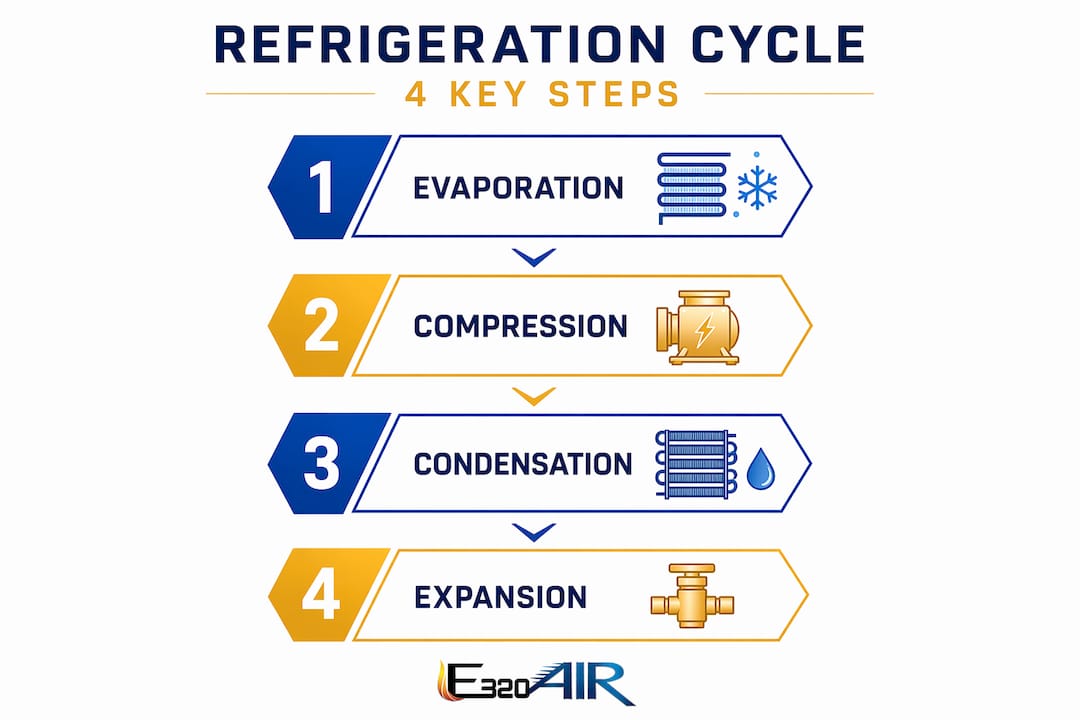
The refrigeration cycle has four core steps, and a reversing valve is what allows the system to switch between heating and cooling:
- Evaporation: Refrigerant absorbs heat from a source (outdoor air in heating mode) and evaporates into a gas.
- Compression: The compressor raises the refrigerant's pressure and temperature dramatically.
- Condensation: The hot, pressurized gas releases its heat into your home (or outdoors in cooling mode) and returns to liquid form.
- Expansion: A valve drops the pressure, cooling the refrigerant so it can absorb heat again.
The reversing valve swaps which coil acts as the evaporator and which acts as the condenser. Flip the valve, and the same system that was heating your home all winter becomes an air conditioner for summer. You're looking at one piece of equipment handling both jobs, which is exactly why more Riverside County homeowners are making the switch when comparing types of HVAC systems for their homes.
| Operating Mode | Heat Source | Heat Destination | Effect |
|---|---|---|---|
| Heating | Outdoor air | Indoor air | Warms your home |
| Cooling | Indoor air | Outdoor air | Cools your home |
"A heat pump moves thermal energy rather than creating it, which is why a well-sized, properly installed system can deliver two to three times more heating energy than the electrical energy it consumes."
That ratio is called the Coefficient of Performance (COP), and it's one of the core reasons energy-conscious homeowners are paying close attention to heat pump technology.
Heat pump efficiency: What SEER and HSPF ratings really mean
Once you understand the basic mechanics, the next hurdle is decoding the alphabet soup on spec sheets. Efficiency is measured with seasonal metrics: SEER for cooling and HSPF (or HSPF2) for heating, with higher values indicating more efficient operation.
Here's a plain-language breakdown:
- SEER (Seasonal Energy Efficiency Ratio): Total cooling output over a season divided by total electrical energy used. Higher is better.
- SEER2: The updated testing standard introduced in 2023, which uses more realistic external static pressure conditions. A SEER2 score will be slightly lower than the older SEER score for the same unit.
- HSPF (Heating Seasonal Performance Factor): Total heating output over a season divided by electrical energy consumed. Again, higher is better.
- HSPF2: The updated version of HSPF, reflecting the same revised testing methodology as SEER2.
California sets some of the toughest baselines in the country. You can learn more about current California HVAC efficiency standards before you shop, because buying below the minimum threshold means your system won't pass inspection.
Efficiency comparison by tier
| Tier | SEER2 Range | HSPF2 Range | Best For |
|---|---|---|---|
| Standard | 14.3 to 15.9 | 7.2 to 8.1 | Budget-conscious buyers |
| High efficiency | 16 to 19 | 8.2 to 9.5 | Most Riverside County homes |
| Premium | 20 and above | 9.6 and above | Max savings, larger homes |
For a typical Inland Empire home, upgrading from a 14-SEER2 unit to a 20-SEER2 unit can reduce cooling costs by 25 to 35 percent annually. That's real money back in your pocket each summer. Pairing a high-efficiency system with energy-saving HVAC practices amplifies those gains further.
Here's the part most spec sheets leave out: real-world performance depends on installation quality, airflow and ducts, insulation, and proper sizing. A premium 22-SEER2 unit installed poorly, in a leaky duct system, in an under-insulated attic, will underperform a mid-tier unit that was set up correctly from day one.
Pro Tip: Before you compare ratings between models, get a duct leakage test on your current system. If you're losing 20 to 30 percent of conditioned air through duct gaps, upgrading equipment alone won't deliver the savings you expect. Fix the envelope first.
You might also explore energy efficiency window treatments and other passive strategies that reduce the load on your system year-round, which makes any heat pump work less and last longer.
Riverside County climate and heat pumps: What to consider
Now let's get specific to where you live. Riverside County has long, hot summers with temperatures regularly climbing past 100°F in the inland valleys, and winters that are mostly mild but can still surprise you with a brief cold snap dropping into the upper 20s or low 30s.
The good news? Modern air-source heat pumps are designed for exactly this kind of climate. Cold-climate-rated models meet additional ENERGY STAR criteria, including a required COP at 5°F, which means they've been tested and verified to deliver adequate heat even in temperatures most Riverside County winters never reach.
Standard (non-cold-climate-rated) heat pumps typically maintain strong heating performance down to about 35 to 40°F. Cold-climate models push that threshold to 5°F or even lower. For our region, either category handles the vast majority of winter days without breaking a sweat.
How to get the most from your heat pump in Riverside County
Follow these steps to maximize performance and lifespan:
- Schedule seasonal maintenance. Seasonal HVAC maintenance before summer and again before winter keeps the system running at rated efficiency and catches small problems before they become expensive repairs.
- Upgrade attic insulation. In our climate zone, inadequate attic insulation forces your heat pump to work harder during both summer cooling and winter heating. R-38 or higher is the current recommendation for Riverside County.
- Seal your ductwork. Leaky ducts are one of the most common reasons a properly rated system underdelivers. Mastic sealant or aerosol duct sealing can reclaim a significant portion of lost capacity.
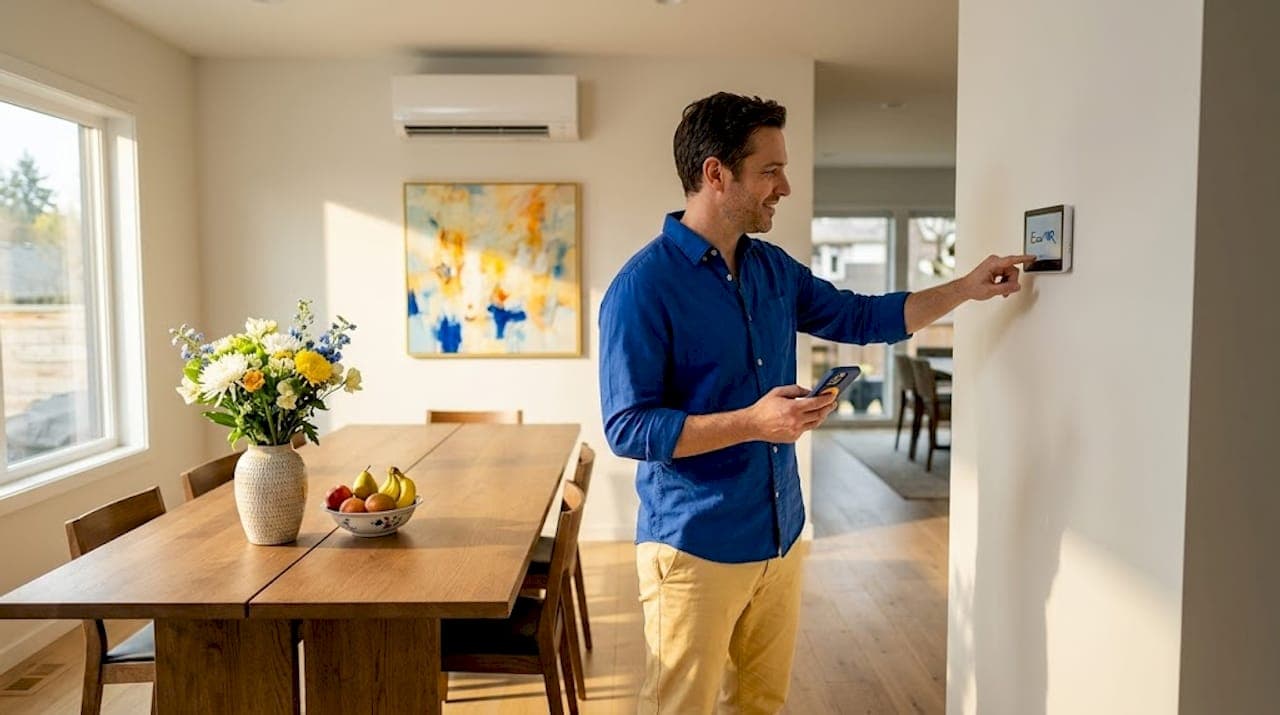
- Install a smart thermostat. Programmable and learning thermostats let the system respond to your schedule, reducing runtime when you're away and pre-conditioning before you return.
- Consider cold-climate-rated equipment. Even though our rare cold snaps are brief, a cold-climate-rated model gives you a performance buffer without a significant cost premium.
When it comes to HVAC replacement stages, it's worth thinking through each step carefully before you commit to equipment, because what you choose today will be with you for 15 to 20 years.
A dual-fuel system pairs a heat pump with a gas furnace backup. The heat pump handles most of the work throughout the year, and the furnace kicks in only during the coldest hours. For Riverside County homes already connected to a gas line, this is a practical hedge if you want total peace of mind during those rare cold nights.
Is a heat pump system right for your home? Key decision checklist
Understanding the climate is only half the equation. Your home's specific characteristics matter just as much. Work through this checklist before committing to any equipment:
- Evaluate your insulation levels. Check your attic and wall insulation. Poor insulation dramatically increases the size of system you need, which raises both purchase cost and operating cost.
- Inspect your existing ductwork. If your ducts are deteriorating, undersized, or routed through unconditioned spaces, address these issues before installation. A ductless mini-split heat pump is a solid alternative if duct repair is cost-prohibitive.
- Assess your home's orientation and sun exposure. South-facing windows and poor shading increase cooling loads significantly. Factor this into your system size estimate.
- Request a Manual J load calculation. This is the industry-standard method for correctly sizing HVAC equipment. Any reputable contractor will perform this before recommending a system. Skipping it leads to oversized or undersized equipment, both of which hurt efficiency and comfort.
- Calculate your ROI. Compare the installed cost of a heat pump against your current annual heating and cooling bills. Many Riverside County homeowners see payback periods of 5 to 8 years, and federal tax credits under the Inflation Reduction Act can cover up to 30 percent of qualified installation costs.
- Check available incentives. Southern California Edison and SoCal Gas both offer rebates on qualifying heat pump equipment. Stack these with federal credits for maximum savings.
- Think about your timeline. If your furnace or AC is more than 12 years old, the math typically favors proactive replacement over reactive repair.
Understanding how your thermostat impacts HVAC efficiency is worth a look too, because a well-programmed smart thermostat can add another 10 to 15 percent in annual savings on top of whatever your new heat pump delivers on its own.
For homeowners with rare but genuine concerns about cold-snap reliability, consider cold-climate-rated equipment or a backup heating option, rather than letting that one-week-a-year scenario talk you out of a system that will outperform your old setup for the other 51 weeks.
Pro Tip: Smart thermostats with geofencing activate comfort settings based on your phone's location. Your home starts conditioning itself before you pull into the driveway, so you never walk into a hot house again.
What most homeowners miss about heat pump comfort and reliability
Here's the honest truth we share with every homeowner we work with: the numbers on paper are only the beginning. We've seen homeowners agonize over choosing between a 20-SEER2 and a 22-SEER2 unit, split the difference on price, and then get an installation that left the refrigerant charge slightly off and the airflow poorly balanced. The result? A premium system running below a mid-tier system's real-world output.
Real-world performance depends on installation quality, airflow and ducts, insulation, and sizing. We've seen this play out dozens of times. The spec sheet matters less than who installs the system and how well the whole house is prepared for it.
The second thing most homeowners miss is decision fatigue. There are now hundreds of heat pump models across dozens of brands, each with layered rebate eligibility, efficiency tiers, and feature sets. Many homeowners spend months comparing options and end up either choosing the wrong system or delaying the upgrade entirely while their old system racks up costly repair bills. Our recommendation: narrow your shortlist to two or three correctly sized, properly rated units, then prioritize the contractor's installation track record over squeezing out the last fraction of a SEER2 point.
Comfort and reliability come from a system that fits your home, installed by people who know what they're doing, and maintained consistently. That's the whole formula. Chasing the highest spec number without covering those basics is like buying the fastest car in the lot and never changing the oil.
Ready to upgrade to a heat pump? Expert help for Riverside County homes
If you've worked through this guide and you're ready to take the next step, you don't have to figure it out alone. Choosing the right system for a Riverside County home requires local knowledge, from understanding micro-climate variations between Temecula and Palm Springs to knowing which incentive programs are currently active and which rebates are stackable.

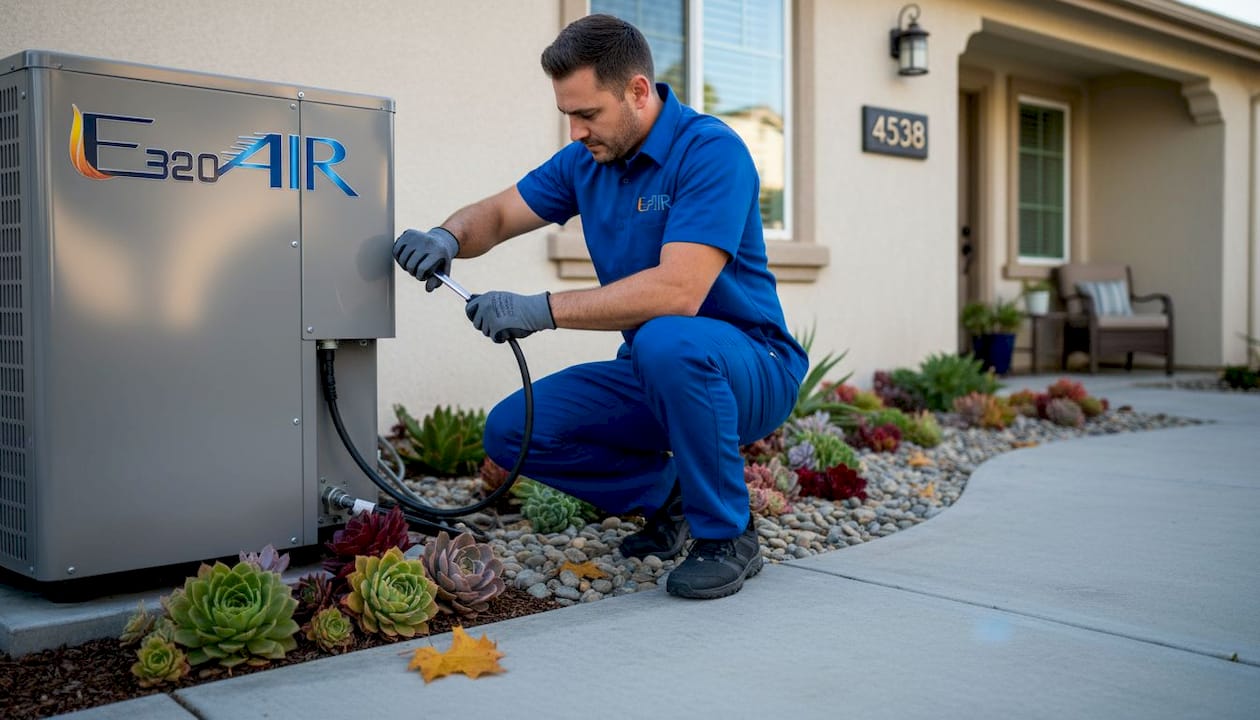
Our team at E320 Air specializes in professional heat pump installation for homes exactly like yours. We perform Manual J load calculations, inspect your ductwork before recommending equipment, and make sure every installation meets California efficiency standards and qualifies for all available rebates. Take a look at our successful HVAC solutions to see real examples of how we've solved unique challenges for Riverside County homeowners. Contact us today for a no-pressure consultation and find out what the right heat pump system can do for your comfort and your utility bill.
Frequently asked questions
Do heat pump systems work well in Riverside County's climate?
Yes, modern heat pumps are highly efficient in Riverside County's mild winters and hot summers. In heating mode, an air-source heat pump pulls heat from outdoor air and delivers it indoors, and in cooling mode it removes indoor heat and rejects it outdoors, making it ideal for our region's year-round needs.
What do SEER2 and HSPF2 mean when shopping for a heat pump?
SEER2 rates seasonal cooling efficiency and HSPF2 measures heating efficiency. Higher values indicate greater energy savings across the full heating and cooling season.
Do heat pumps provide enough heat during a cold snap?
Cold-climate-rated heat pumps deliver reliable heat in lower temperatures, but during extremely rare cold snaps, a backup or dual-fuel system may be advisable. Heat pumps can lose heating capacity as outdoor temperatures drop, which is why ENERGY STAR sets specific cold-climate performance criteria.
How important is installation quality for heat pump performance?
Installation quality is every bit as important as the equipment rating. Installation quality, airflow, ducts, insulation, and sizing all directly determine whether your heat pump delivers its rated efficiency in the real world.