
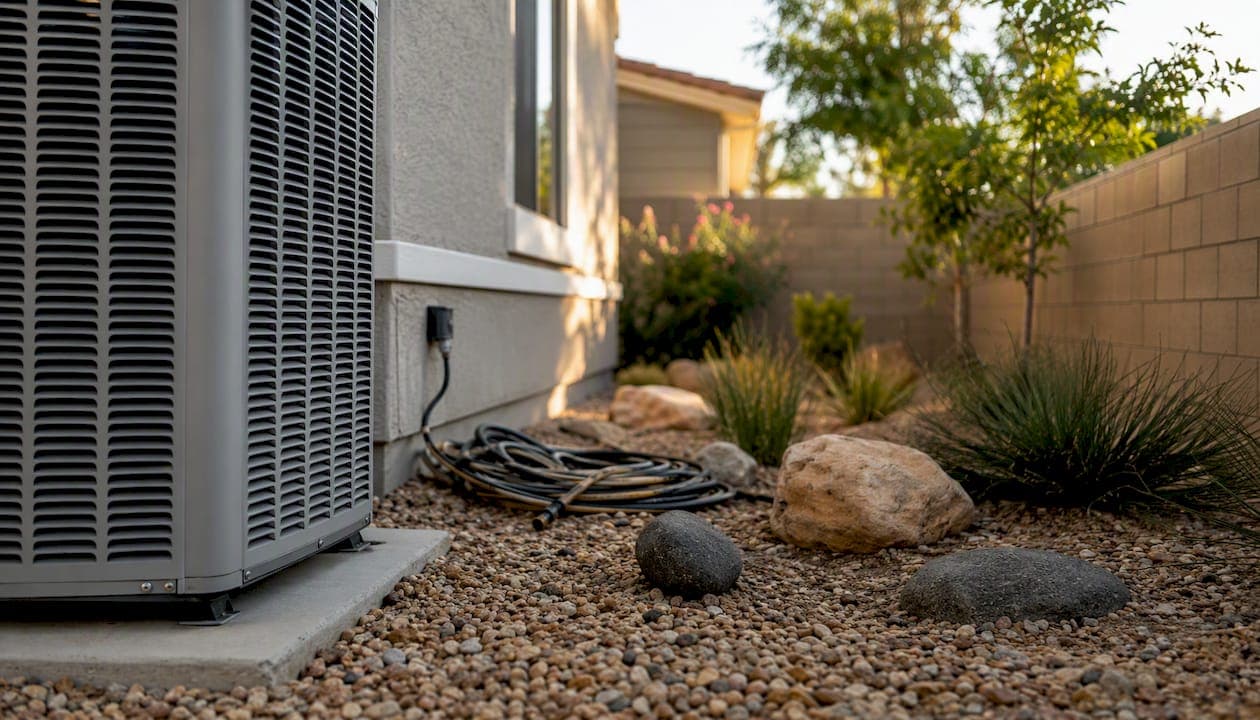
A heat pump's outdoor unit typically runs between 40 and 60 dBA at the casing, roughly the volume of a refrigerator hum or light rainfall on a roof. Indoor units are quieter still, usually landing in the 19 to 35 dBA range, which is closer to a whisper than a conversation. If your system falls in those bands and produces a steady hum or gentle whoosh, it's operating normally.
Problems show up as a different category of sound entirely. Rattling, grinding, screeching, or a sudden jump in volume are not "just how heat pumps sound." Those noises point to loose panels, worn fan bearings, or a compressor issue that needs attention before it gets expensive.
Here's what to listen for and expect:
- Normal: continuous low hum, airflow whoosh, brief clicking during cycling, a short whoosh during defrost.
- Not normal: metallic grinding, rattling that changes with wind or fan speed, high-pitched screeching, or vibration you can feel through a wall or floor.
- Context matters: distance, mounting, and site layout usually affect what you hear more than which brand you bought.
Quick reference: Outdoor units: 40–60 dBA. Indoor units: 19–35 dBA. A quiet suburban night averages around 40–50 dBA in ambient background noise, which is why a well-sited heat pump often disappears into the background.
Key Takeaways
Modern inverter heat pumps typically run 40 to 60 dBA outdoors and 19 to 35 dBA indoors, and correct siting and mounting matter more to perceived noise than the model you buy.
| Point | Details |
|---|---|
| Typical noise ranges | Outdoor units run roughly 40 to 60 dBA; indoor units run roughly 19 to 35 dBA. |
| Distance cuts noise fast | Sound pressure drops about 6 dB every time distance from the unit doubles. |
| Know the difference | Normal sounds are steady hums and whooshes; grinding, screeching, and rattling signal a problem. |
| Cheapest fixes first | Rotate or re-site the unit and add anti-vibration pads before considering a replacement. |
| Call a pro early | Persistent mechanical noise, indoor vibration, or unresolved rattling after basic fixes need a licensed contractor. |
| Plan before installing | E320air provides onsite noise assessments and full-power LwA based sound predictions before you sign a contract. |
Table of Contents
- Understanding Heat Pump Noise Levels and What the Numbers Mean
- What Do Real-World Heat Pump Decibel Levels Sound Like?
- Which Heat Pump Sounds Are Normal and Which Signal a Problem?
- Why Do Some Heat Pumps Sound Louder Than Others?
- How Do You Measure Heat Pump Noise Correctly?
- What Actually Reduces Heat Pump Noise?
- When Should You Call an HVAC Contractor About Noise?
- The Checklist to Give Your HVAC Installer
- Get an Onsite Noise Assessment Before You Install or Troubleshoot
- Frequently Asked Questions
- Sources
Understanding Heat Pump Noise Levels and What the Numbers Mean
A-weighted decibels, written as dBA, measure sound the way the human ear actually perceives it, filtering out frequencies we barely notice and emphasizing the ones that grab our attention. It's the standard unit for any consumer noise spec, and it's what you should ask for when comparing heat pump models.
Decibels are logarithmic, not linear, which trips up a lot of people the first time they see a spec sheet. A jump from 40 dBA to 50 dBA doesn't sound "25% louder." It sounds roughly twice as loud to the human ear, because each 10 dB increase represents a tenfold increase in sound intensity. That's the gap between a quiet refrigerator and a loud conversation.
Manufacturers report two different numbers, and mixing them up leads to bad expectations:
- Sound power level (LwA): a fixed value describing total sound energy the unit emits, independent of distance or environment.
- Sound pressure level (dBA): what you actually hear at a specific point, which depends heavily on distance, obstacles, and reflective surfaces.
Ask installers for the LwA number when you're evaluating equipment for a specific site, since that's the figure used in real acoustic planning. A scientific review of heat pump acoustic testing found that relying on a single LwA value oversimplifies things, because it can hide tonal or low-frequency components that people find disproportionately irritating even when the overall number looks fine.
Distance changes everything. As a rule of thumb, sound pressure drops about 6 dB every time you double the distance from the source, in open, unobstructed conditions. A unit measured at 60 dBA one meter from the casing drops to roughly 54 dBA at two meters, and around 48 dBA at four meters. That's the distance attenuation principle that makes siting such a powerful noise-control lever, often more powerful than the model you choose.
One marketing pitfall worth knowing: some brochures advertise "quiet mode" numbers that only apply at reduced compressor speed, not full power operation. Full-power LwA is the number planning calculations and neighbor-impact assessments actually require.
What Do Real-World Heat Pump Decibel Levels Sound Like?
Outdoor casings typically run 40 to 60 dBA, with premium inverter models advertised as low as the high 20s to low 40s dBA under favorable conditions, according to manufacturer data on heat pump sound levels. Indoor units are a different story: ductless heads and air handlers commonly sit in the 19 to 35 dBA range, quiet enough that most people forget they're running at all, based on measurements from The Independent's review of heat pump sound experiences. If you're weighing a ductless mini split for a room addition, indoor noise is rarely the deciding factor.
Here's how those numbers map to things you already know:
- 19–35 dBA (indoor unit): quieter than a library, closer to leaves rustling.
- 40–50 dBA (outdoor unit at moderate distance): similar to a running refrigerator or light rainfall.
- 50–60 dBA (outdoor unit close up): comparable to normal conversation at a few feet.
Distance reshapes all of this fast. A unit rated at 55 dBA one meter from the casing lands around 49 dBA at two meters and roughly 43 dBA at four meters, thanks to that 6 dB per doubling rule. At a property boundary 10 to 15 meters away, most residential units fade into ambient neighborhood noise entirely, assuming there's no wall or fence reflecting sound back toward a window.
Spec sheets sometimes list only LwA, the sound power figure, which tends to run 5 to 15 dB higher than the sound pressure you'd actually measure at typical listening distances. If a brochure lists LwA at 65 dB, don't assume you'll hear 65 dBA standing in your yard. You need the sound pressure conversion at your specific distance, which is exactly what a proper installation quote should include.
Which Heat Pump Sounds Are Normal and Which Signal a Problem?
Normal operation produces a short, predictable list of sounds, and knowing them cuts down on unnecessary worry. A steady, low-pitched hum comes from the compressor running at a stable speed. A soft whoosh is airflow moving across the outdoor coil or through indoor vents. You might hear a brief whoosh or gurgle during defrost cycles in cold weather, when the system reverses briefly to melt frost off the outdoor coil, a normal behavior Energy. Light clicking when the unit starts or stops is just relays and valves switching.
Warning sounds are a different animal entirely:
- Loud rattling: usually a loose panel, screw, or debris caught in the fan cage.
- Grinding or scraping: often a failing fan motor bearing or a fan blade contacting something it shouldn't.
- High-pitched screeching: frequently a belt or bearing issue, or in some cases a refrigerant-related compressor problem.
- Continuous buzzing that wasn't there before: can indicate an electrical component, a loose contactor, or a failing capacitor.
Before assuming the worst, try the simple stuff. Check for visible debris in the fan cage, tighten any panel screws you can safely reach, and confirm nothing is resting against the unit. If the sound persists after that, it's past the DIY stage.
Pro Tip: Record a short video of the noise with your phone before calling anyone. A contractor who hears the actual sound, not your verbal description of it, diagnoses the problem faster and often over the phone.
Escalate quickly if the sound gets louder over days or weeks, if you feel vibration transmitted into interior walls or floors, or if the noise coincides with a drop in heating or cooling performance. Those combinations point to mechanical wear that won't fix itself.
Why Do Some Heat Pumps Sound Louder Than Others?
Five factors drive most of the noise difference between installations: compressor type, fan design, casing insulation, mounting quality, and site acoustics. Compressor type matters most. Inverter-driven compressors modulate speed to match the actual heating or cooling load, running at low speed most of the time instead of cycling on and off at full power. That modulation is a major reason modern inverter systems run quieter than older fixed-speed units, which slam on at full output every cycle.
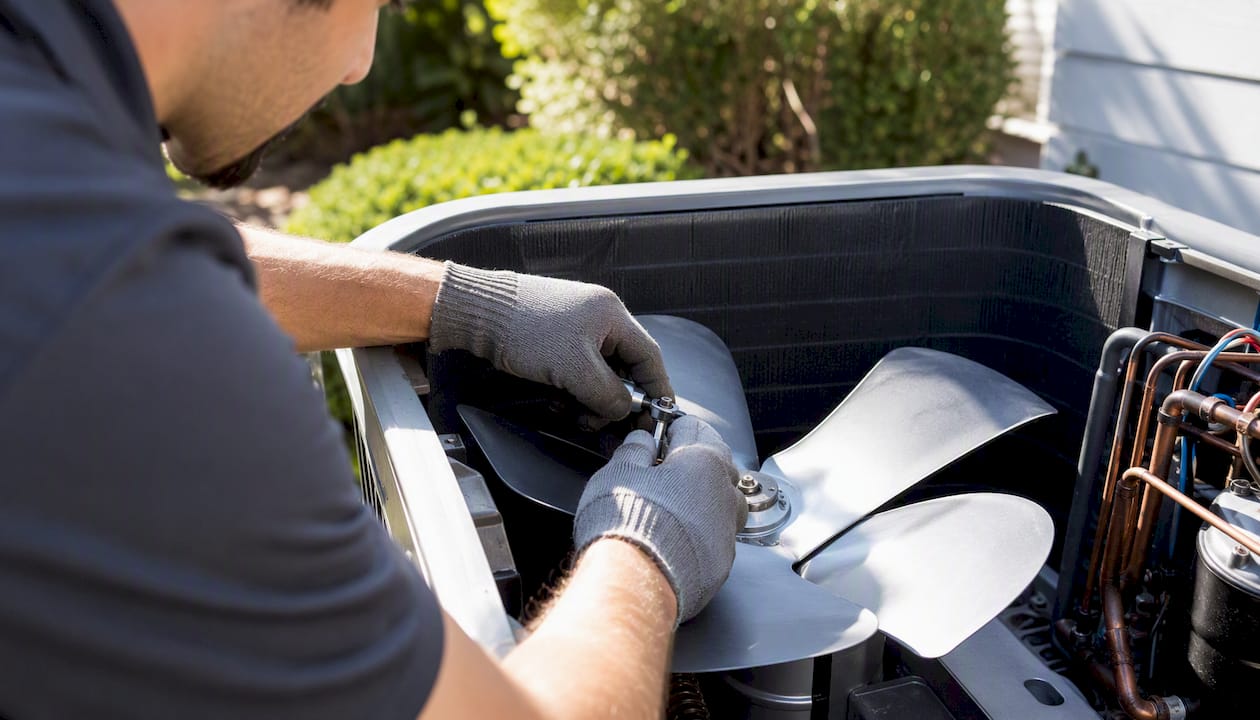
Fan blade design and casing insulation affect how much of that internal noise escapes. Better-engineered units use larger, slower-turning fans (quieter than small fans spinning fast to move the same air) and denser acoustic insulation inside the cabinet.
Mounting is where a lot of installations go wrong, and it's entirely fixable. A unit bolted directly to a wooden deck or a wall-mounted bracket without vibration isolation transmits compressor hum straight into the structure, turning a quiet unit into an audible one indoors. Anti-vibration mounts and a stable, level concrete or paver pad absorb that energy before it travels. Installation errors around mounting and clearance are common enough that they're worth reviewing before you sign a contract; see common HVAC installation mistakes for specifics.
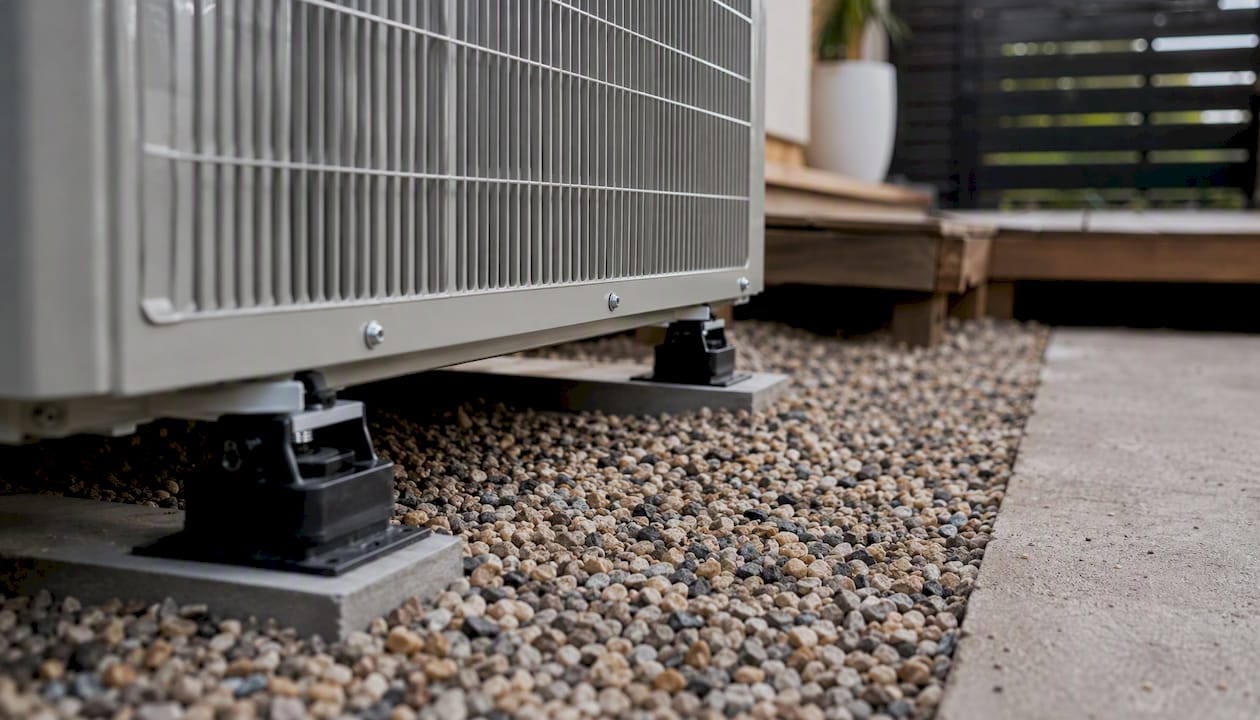
Site acoustics finish the picture. A unit tucked into a corner between two walls reflects sound back and amplifies it, sometimes by several decibels, compared to open placement.
Pro Tip: Rotating an outdoor unit 90 degrees to point the fan discharge away from a bedroom window, instead of toward it, often does more for perceived noise than upgrading to a marginally quieter model. This kind of siting adjustment is a practical fix recommended by HVAC trade experts precisely because it costs nothing but labor.
How Do You Measure Heat Pump Noise Correctly?
Measure with a calibrated sound meter, at a consistent distance, during representative operating conditions, and always note the background noise level first. Skipping any one of those steps produces a number that misleads you or your contractor.
Follow this sequence for a reading you can actually trust:
- Pick a calm time of day with minimal wind, traffic, or other ambient noise, and measure the background level with the unit off.
- Use a calibrated sound meter if you have access to one through a contractor; smartphone apps can work for rough estimates but often run several decibels off from a real meter, especially at low frequencies.
- Measure at a standardized distance, commonly one meter from the casing and again at the property boundary or nearest window.
- Note the operating mode: full power, quiet mode, or mid-cycle, since readings can swing by 10 dB or more between modes.
- Repeat the measurement at a different time of day if possible, since colder weather increases compressor demand and can temporarily raise noise output.
For neighbor-impact assessments, measure at the nearest habitable window on the adjoining property, not just at your own boundary line. That's the location any dispute or planning conversation will actually center on.
A short checklist worth handing to an installer:
- Ambient (background) reading with unit off
- Reading at 1 meter from the unit, full power
- Reading at the property boundary or nearest neighbor window
- Operating mode noted for each reading
- Manufacturer's full-power LwA figure, not the quiet-mode number
Common mistakes include measuring only when the unit happens to be running in quiet mode, using an uncalibrated app and treating the result as gospel, and taking readings too close to a reflective wall or fence, which can inflate the apparent level by several decibels. If you're already troubleshooting an existing noise complaint, our guide on diagnosing AC noise walks through the same logic in more depth.
What Actually Reduces Heat Pump Noise?
Start with the cheapest fixes, because they solve the majority of noise complaints without spending a dollar on new equipment. Re-siting or rotating the unit to redirect the fan discharge away from windows, adding rubber anti-vibration pads under the feet, and tightening any loose panels or pipework are the first three moves, in that order.
- Re-site or rotate the unit away from windows and reflective walls.
- Install anti-vibration pads or isolation mounts between the unit and its base.
- Tighten access panels, brackets, and refrigerant line clamps that may be buzzing loose.
- Add an acoustic screen with airflow-compliant gaps if line-of-sight to a neighbor's window is unavoidable.
- Upgrade to a fan or compressor isolation kit if the existing unit has aged mounting hardware.
- Replace the unit with a lower-noise inverter model if the current system is a decade or older and running at full speed constantly.
Medium-cost options like acoustic screens and improved mounting platforms typically shave several decibels off perceived noise without touching the equipment itself. Structural acoustic isolation techniques used in commercial settings, like decoupled mounting platforms and vibration-damping materials, scale down effectively for residential use.
Higher-cost fixes make sense when the existing unit is old, undersized for the load (which forces it to run harder and louder), or simply reaching the end of its service life. Replacing with a modern inverter system, paired with a sustainable HVAC upgrade, often solves noise and efficiency problems in the same project.
Pro Tip: Never seal a unit's airflow paths tightly to reduce noise. Restricting intake or discharge airflow forces the compressor to work harder, which increases noise and can shorten equipment life. Any acoustic screen needs engineered gaps for airflow.
Whatever fix you pursue, ask your installer for a sound prediction report using the equipment's full-power LwA rather than a quiet-mode figure. That's the only number that holds up for planning purposes or neighbor disputes.
When Should You Call an HVAC Contractor About Noise?
Call a licensed contractor when you hear mechanical noises like grinding or screeching, when vibration transmits into your home's structure, or when simple fixes like tightening panels don't resolve the issue within a day or two. Waiting on a legitimate mechanical problem rarely makes it cheaper to fix.
Professionals typically address noise complaints with a short list of repairs: re-mounting the unit on proper isolation pads, servicing or replacing a failing compressor, swapping worn fan bearings, and rebalancing refrigerant charge if the compressor is cycling abnormally. Diagnosis usually happens same-day to within 48 hours of the service call; the repair itself can take anywhere from a single afternoon to a couple of weeks if a specialty part needs ordering.
Cost ranges vary by fix, though they're worth knowing as rough benchmarks:
- Tightening panels or re-mounting hardware: low cost, often bundled into a standard service call.
- Anti-vibration mounts and platform upgrades: low to medium cost, depending on materials and access.
- Compressor or major component replacement: medium to high cost, since parts and labor both climb quickly.
These are approximate ranges; your actual quote depends on your system, your region, and how accessible the unit is. If your equipment is aging and repeatedly noisy, it may be more cost-effective to plan a staged replacement rather than repairing the same unit multiple times in a year.
Before you schedule repairs, ask for documentation: a written sound report with before-and-after readings, and a clear explanation of what the contractor believes is causing the noise. That paper trail protects you if the issue recurs.
The Checklist to Give Your HVAC Installer
Ask for a site-specific acoustic assessment and a written noise-prediction report based on the equipment's full-power LwA and your exact proposed mounting location, before you sign anything. A generic spec sheet number tells you almost nothing about what you'll actually hear from your patio or bedroom window.
Bring this list to any installation quote:
- Modeled dBA at the nearest habitable window (yours and any neighbor's)
- Mounting detail: pad type, anti-vibration isolation, and base stability
- Clearances confirmed for airflow intake and discharge on all sides
- Planned service access maintained for future maintenance
- Full-power LwA confirmed in writing, not a quiet-mode figure
- A plan of action if predicted levels exceed comfortable or code-relevant limits
Pro Tip: Ask the installer to show you exactly where they'll take the sound measurement, before and after installation. A contractor confident in their siting choices will welcome the request; one who hesitates is worth a second opinion.
Industry guidance from HVAC trade educators consistently recommends this kind of pre-installation planning, treating acoustic comfort as a design decision rather than an afterthought you discover after the unit is already running. Reviewing real before-and-after fixes, like the ones in E320air's problem-solving gallery, gives a sense of how much a mounting or siting correction can change the outcome on an existing installation.
What field experience reveals about heat pump noise complaints
Modern inverter systems are quieter than the units they're replacing, but most noise complaints we encounter trace back to siting and mounting decisions, not the equipment itself. That distinction changes how you should approach a noise problem: before assuming you need a new compressor, look at where the old one sits and how it's attached to the structure beneath it.
Two patterns show up again and again. Units installed in narrow service alleys between two houses get boxed in by walls that reflect sound directly at a neighbor's window, turning a perfectly normal 50 dBA unit into a persistent complaint. Units bolted straight to wooden deck framing, with no isolation pad underneath, transmit compressor hum through the joists and into a bedroom floor two rooms away. In both cases, a $200 to $400 fix, rotating the unit or adding proper isolation mounts, solved what looked like an equipment failure.
The lesson holds across almost every noise call we take: measure before you diagnose, prioritize where the unit sits before you consider replacing it, and bring a contractor into the conversation before installation day rather than after the complaints start.
Get an Onsite Noise Assessment Before You Install or Troubleshoot
E320air offers onsite noise assessments, sound measurement, and installation with proper anti-vibration mounting, plus post-install readings to confirm the numbers match what was promised. That combination matters because a spec sheet can't tell you what your specific yard, deck, or property line will actually sound like.
Hiring a professional for this step gets you three things a DIY approach can't: an accurate sound prediction tied to your exact site, correctly sized equipment instead of an oversized unit running harder than it needs to, and a documented before-and-after record if a neighbor ever raises a concern. During an inspection, expect a technician to check your proposed unit location, measure ambient background noise, review mounting options, and walk you through the manufacturer's full-power LwA figures rather than marketing numbers.
If you're dealing with an existing noise complaint or planning a new heat pump installation, request an onsite assessment and get a written sound prediction before committing to a mounting location. It's a lot easier to fix on paper than after the concrete pad is poured.
Frequently Asked Questions
Is heat pump noise normal, or should I be concerned?
A steady hum or gentle whoosh at 40 to 60 dBA outdoors is normal operation. Grinding, screeching, or rattling that wasn't there before, or noise that worsens over days, is not normal and warrants a service call.
How loud are heat pumps compared to central air conditioners?
Modern inverter heat pumps generally run comparable to or quieter than older central AC condensers, largely because inverter compressors modulate speed instead of cycling on and off at full power.
What's a good decibel level for a quiet heat pump?
Anything in the high 20s to low 40s dBA at the casing counts as a quiet model by current standards, though the number that matters most is the full-power LwA figure, not a marketing "quiet mode" claim.
Can I reduce heat pump noise without buying a new unit?
Yes. Rotating the unit away from windows, adding anti-vibration pads, and tightening loose panels resolve a large share of noise complaints without any equipment replacement.
How do I know if my heat pump noise complaint is about the unit or the installation?
If the noise changes with fan speed or defrost cycles, it's likely the unit. If it's a constant rattle or hum tied to a specific surface (a deck, a wall bracket), it's almost always a mounting or siting issue.
Sources
For readers who want to go deeper on the standards and testing behind these numbers, a few sources stand out. Energy.gov's heat pump systems guidance covers the operational basics behind defrost cycles and seasonal noise changes. Consumer Reports' heat pump testing shows how independent lab measurement compares to manufacturer claims. AHRI's certification programs set the testing standards installers reference for performance reporting. The scientific review of heat pump acoustic signatures is the most technical resource here, useful if you want to understand why single-number LwA ratings can miss low-frequency annoyance. And HVACR School's practical guidance translates a lot of this into siting advice contractors actually use in the field.