
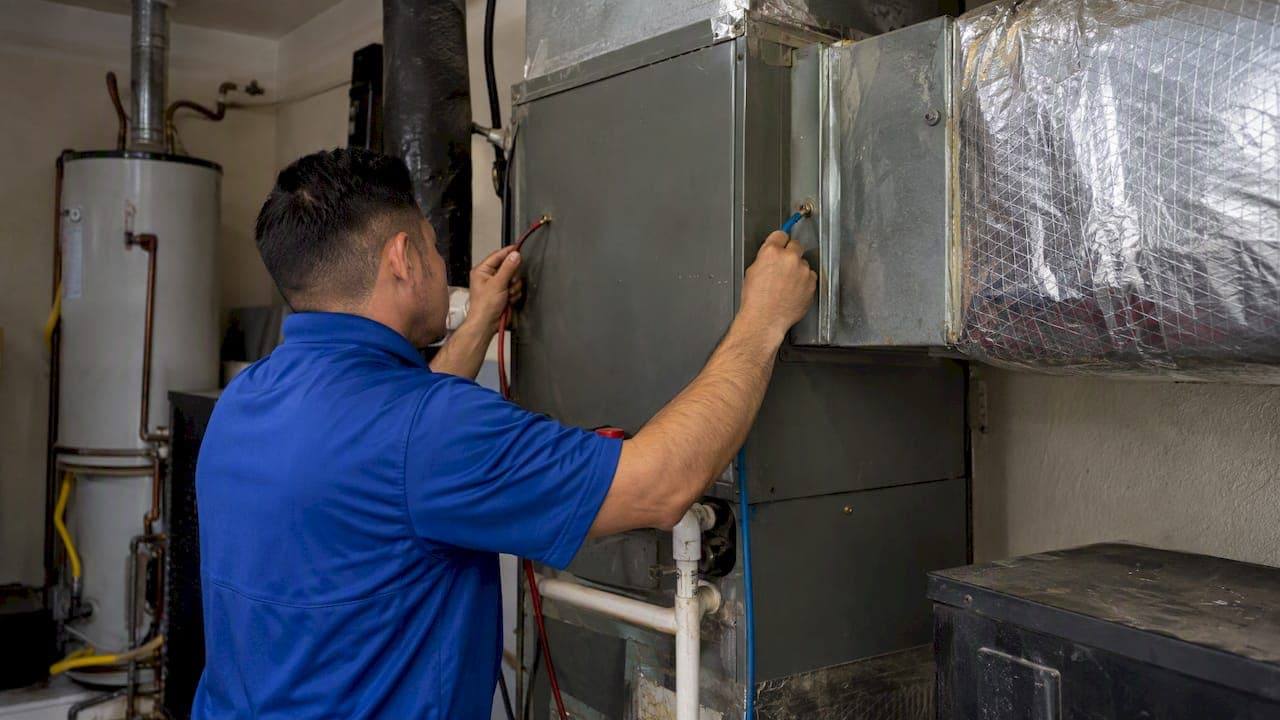
High static pressure means your system faces excessive airflow resistance, and that resistance reduces airflow while stressing the blower and other components. Check the filter and return paths first since those are the most common culprits. If symptoms persist after those basic checks, schedule a diagnostic test that measures total external static pressure with a manometer to confirm the problem and locate its source.
TL;DR:
- High static pressure is primarily caused by dirty or undersized filters, crushed ductwork, and poorly designed or restrictive duct transitions.
- Measuring the total external static pressure with a manometer and comparing it to the unit's rated static pressure is essential for accurate diagnosis.
- Symptom signs include uneven airflow, noisy ducts, longer run times, increased energy bills, and ice buildup on coils.
- DIY checks like replacing filters and clearing return obstructions can resolve mild cases, but thorough diagnosis requires professional tools and knowledge.
- A static pressure reading above 0.8 inches water column often indicates a significant airflow restriction needing duct or system modifications.
Table of Contents
- What static pressure means and why it matters
- How technicians measure and interpret static pressure
- Signs your system is fighting high static pressure
- What actually drives static pressure up
- Fixing high static pressure: DIY steps versus pro work
- When to call a licensed contractor
- How field diagnostics confirm and correct high static pressure
- What homeowners get wrong about static pressure
- Get a static pressure diagnostic done right
- FAQ
- Sources
What static pressure means and why it matters
Static pressure is the resistance a blower has to push against to move air through filters, coils, ducts, and registers, and it's measured in inches of water column, or in. w.c. That unit sounds technical, but it just describes a small amount of pressure difference, similar to how a thin column of water would be pushed up a tube. Velocity pressure is the energy of the air actually moving forward, and total pressure is the combination of both. Technicians focus on static pressure because it reveals how hard the system is working against friction, not just how fast air happens to be moving at any one point.
Pressure is highest right near the air handler or furnace, where the blower first pushes air into the duct system, and it drops as air travels farther from that point. Every filter, coil, elbow, and transition adds a little resistance, and all of that resistance adds up at the blower.
A few things worth remembering:
- Static pressure reflects total resistance, not speed of airflow.
- It's measured in inches of water column (in. w.c.), a very small unit.
- The blower has to work harder as resistance climbs, which cuts into airflow and efficiency.
How technicians measure and interpret static pressure
A proper reading starts with total external static pressure, or TESP, which is the single number that tells you how hard the blower is working against the whole duct system. According to HVAC Today's explanation of static pressure testing, this measurement pinpoints hidden restrictions at the filter, coil, and ductwork before they cause bigger problems.
The basic process looks like this:
- A technician inserts a manometer probe into a test port on the return side, upstream of the blower, and records that reading.
- A second probe goes into a test port on the supply side, downstream of the blower, and records that reading.
- TESP is the sum of the magnitudes of those two readings, as explained in this breakdown of how to calculate TESP.
- The measured TESP gets compared against the equipment's rated external static pressure, printed on the unit's nameplate.
That comparison matters more than the raw number. A furnace or air handler is engineered to move its rated airflow at a specific external static pressure, and a reading that climbs well past that rating signals a real airflow problem rather than just a quirky number on a gauge.
Static pressure alone doesn't tell the whole story. As Fieldpiece notes in its manometer measurement guide, a pressure reading by itself is inconclusive for airflow, so technicians plot the measured TESP and blower speed against the manufacturer's fan table, or run a separate airflow test, to confirm actual CFM. For readers who want a deeper look at how CFM relates to system sizing, this guide to HVAC airflow and CFM fills in that piece.
Pro Tip: Ask whoever performs your diagnostic to show you both the supply and return readings separately, not just a combined TESP number, since the split often points straight to the problem side.
Signs your system is fighting high static pressure
Several everyday symptoms point toward excessive airflow resistance, and they often show up together rather than alone.
- Weak or uneven airflow at some vents while others blow fine.
- Ductwork that whistles, rattles, or roars, especially near the air handler.
- Longer run cycles than the system used to need to reach set temperature.
- Energy bills that creep up without an obvious cause.
- A frozen evaporator coil, which can show as ice on the indoor coil or refrigerant lines.
- A furnace with abnormal temperature rise across the heat exchanger.
Visible clues help confirm the diagnosis. A disposable filter that's visibly bent or sucked inward toward the blower is a strong sign the system is straining to pull air through it. Crushed or kinked flex duct in an attic or crawlspace, and gaps around a filter rack that let unfiltered air bypass the filter entirely, are also common findings. According to ACCA's guidance on how high static pressure affects system performance, restricted airflow can let the evaporator coil run too cold, which risks liquid refrigerant returning to the compressor and shortening its life. The combination that most reliably points to high static pressure is weak airflow plus noisy ducts plus a coil that's iced over; this combination rarely has another explanation. For a closer look at weak airflow specifically, see this guide to fixing weak airflow from vents.
What actually drives static pressure up
Filters cause more static pressure problems than almost anything else. A loaded, dust-clogged filter adds resistance gradually until airflow drops noticeably, and a filter that's physically too small for the system's airflow demand creates the same problem even when clean. High-MERV filters packed into a restrictive cabinet add further resistance, since denser filter media needs more surface area to breathe properly.

Coils and blowers contribute their share too. A dirty evaporator coil or a dust-caked blower wheel narrows the path air has to travel, and a filter cabinet built with sharp turns or undersized openings compounds the effect.
Ductwork is frequently the largest hidden source:
- Trunk lines sized too small for the system's rated airflow.
- Flex duct that's crushed, kinked, or compressed behind framing or insulation.
- Poor transitions between the air handler and the duct system, with sharp angles instead of smooth taps.
- Closed or partially closed dampers and registers that nobody remembers adjusting.
Accessories matter as well. Add-on media filters, whole-house humidifiers, zoning dampers, and overly restrictive decorative grilles each add a small pressure penalty, and those penalties stack. Readers who suspect an undersized return should start with this walkthrough of checks for undersized return air, since weak returns are one of the most common and least visible contributors.
Fixing high static pressure: DIY steps versus pro work
A few checks are safe and effective for most homeowners to try before calling anyone:
- Replace the filter with a clean one that matches the recommended size and type for the system.
- Open any closed registers and clear furniture or rugs blocking return grilles.
- Inspect accessible flex duct in the attic or crawlspace for obvious crushing or disconnection.
- Remove debris or storage items blocking the air handler's intake or filter cabinet.
If those steps don't resolve the symptoms, the remaining work generally needs a technician with the right tools and training. Measuring individual component pressure drops across the filter and coil requires a manometer and test ports, and that data is what separates a guess from a diagnosis. Cleaning a dirty coil or blower wheel safely without damaging fins or electrical components takes experience, as does enlarge a filter's face area or correcting a poor duct transition.
Pro Tip: If a technician recommends cleaning an evaporator coil, ask whether they use a HEPA-filtered vacuum alongside coil cleaner to avoid pushing dust back into the airstream; this overview of HEPA vacuum benefits explains why filtered extraction matters for indoor air quality during that kind of work.
When the duct system itself is undersized for the equipment, or when returns are too few and too small for the home's square footage, a duct redesign or targeted equipment change is usually the right call. That typically means adding return paths, upsizing key trunk lines, or correcting transitions rather than replacing the whole system, and it's worth understanding how duct design shapes comfort and efficiency before committing to a fix.
When to call a licensed contractor
A few situations call for a professional diagnostic rather than more DIY troubleshooting.
- A frozen evaporator coil, which risks compressor damage if ignored.
- Persistently weak airflow after a filter change and clear return paths.
- A noisy blower that seems to be working harder than it should.
- A measured TESP that sits well above the unit's rated external static pressure.
A quality diagnostic includes a TESP reading split into supply and return, a comparison against the fan table or an airflow test, individual pressure drops across the filter and coil, and a visual inspection of accessible ductwork. Costs scale with the fix: filter changes and coil cleaning sit at the low end, localized duct repair falls in the middle, and duct redesign or added returns run higher but address root causes rather than symptoms. Watch for red flags like a contractor who skips measurements entirely or offers the same fix regardless of what they find.
How field diagnostics confirm and correct high static pressure
Static pressure diagnostics follow a consistent workflow in the field: measure, split supply from return, compare against rated TESP, and then isolate the restriction. Typical findings documented in real jobs include crushed flex duct behind insulation, undersized filter cabinets, and coils soiled enough to measurably raise pressure drop. Readers curious about real examples can browse the Problem Solving Gallery for documented before-and-after repairs.
What homeowners get wrong about static pressure
The biggest misconception is treating static pressure as a single scary number instead of a diagnostic trail. A reading of 0.8 in. w.c. or higher is worth attention, since ACHR News reports that readings at or above that level are frequently tied to reduced blower efficiency and shortened blower life, compared with a commonly cited residential reference closer to 0.5 in. w.c. But the number alone doesn't tell you what to fix. ACCA notes that a TESP reading more than 10 to 20% above the unit's rated maximum usually signals an airflow problem that needs duct repair or redesign, not just a new filter.
Conventional advice often stops at "check your filter," which fixes the easy case but leaves undersized returns and crushed flex duct untouched. The split between supply and return readings matters more than most homeowner guides admit, since it tells you which side of the system to investigate first. My honest read: prioritize getting a real split measurement before spending money on any single component, because a filter upgrade on a system with an undersized return solves nothing.
— Edward
Get a static pressure diagnostic done right
We offer static pressure diagnostics and repairs, including filter and coil service and duct corrections to address airflow restrictions. Technicians measure TESP, split supply from return, and compare results against equipment rated specs before recommending anything.
Depending on what the diagnostic finds, we offer:
- Residential HVAC service and system enhancements for homes dealing with airflow or efficiency complaints.
- HVAC installation when duct redesign or equipment replacement is the better long-term fix.
- Heater repair for furnace-related airflow and temperature-rise issues.
- Commercial HVAC, routine maintenance, and emergency repairs for property managers and business owners.
If your system is showing the symptoms above, schedule a diagnostic test through our primary service page and get a measured answer instead of a guess.
FAQ
What is the difference between ESP and TSP?
ESP, or external static pressure, measures resistance outside the air handler across filters, coils, and ductwork, while TSP, or total static pressure, includes the pressure drop inside the equipment cabinet as well. In practice, technicians rely on TESP (total external static pressure) since that's the figure compared against the unit's rated specification.
What should static pressure be in HVAC?
A commonly cited residential reference point is around 0.5 in. w.c., though the correct target always depends on comparing your measured TESP to your specific equipment's rated external static pressure on its nameplate. Readings at or above 0.8 in. w.c. are frequently associated with reduced blower efficiency and shortened blower life.
What is the $5000 rule for HVAC?
This question refers to a common repair-or-replace guideline used by some contractors, multiplying the age of the system by the estimated repair cost and comparing the result against a certain threshold to decide whether replacement makes more financial sense than repair. It isn't a static pressure measurement rule, and it isn't a standard our diagnostic process relies on.
What happens to CFM when external static pressure goes up?
As external static pressure rises, the blower moves less air for the same speed setting, which lowers actual CFM delivered to the home. Technicians confirm this by checking measured TESP and blower speed against the manufacturer's fan table or running a direct airflow test, since pressure readings alone can't confirm CFM.
Sources
- PATH to Performance: Part Two - Static Pressure - HVAC Today
- Static Pressure Readings Offer a Path to Optimal System Performance | ACHR News
- HVAC Static Pressure: Measure, Calculate & Diagnose - Turn2Engineering
- Measuring HVAC total external static pressure with a digital manometer - Fieldpiece