

TL;DR:
- HVAC commissioning ensures heating, ventilation, and air conditioning systems operate as intended before and after occupancy. It involves a five-phase process from design review to operational verification, leading to energy savings and improved comfort. Regular re-commissioning and thorough documentation help maintain system performance and efficiency over time.
HVAC commissioning is the quality assurance process that confirms your heating, ventilation, and air conditioning system operates as designed before and after occupancy. The process follows ASHRAE Guideline 0-2019 and Standard 202 across five structured phases. Done correctly, commissioning can cut annual energy use by 13–15 percent compared to non-commissioned buildings. For homeowners and property managers, that translates directly to lower utility bills, better indoor comfort, and fewer surprise repair calls.
What is HVAC commissioning and why does it matter?
HVAC commissioning is a systematic, multi-phase process that verifies every component of your system is installed correctly, integrated properly, and performing to its design specifications. The term comes from the broader construction industry, where "commissioning" means formally handing over a verified, fully functional system. In HVAC, that verification goes far deeper than a simple startup check.
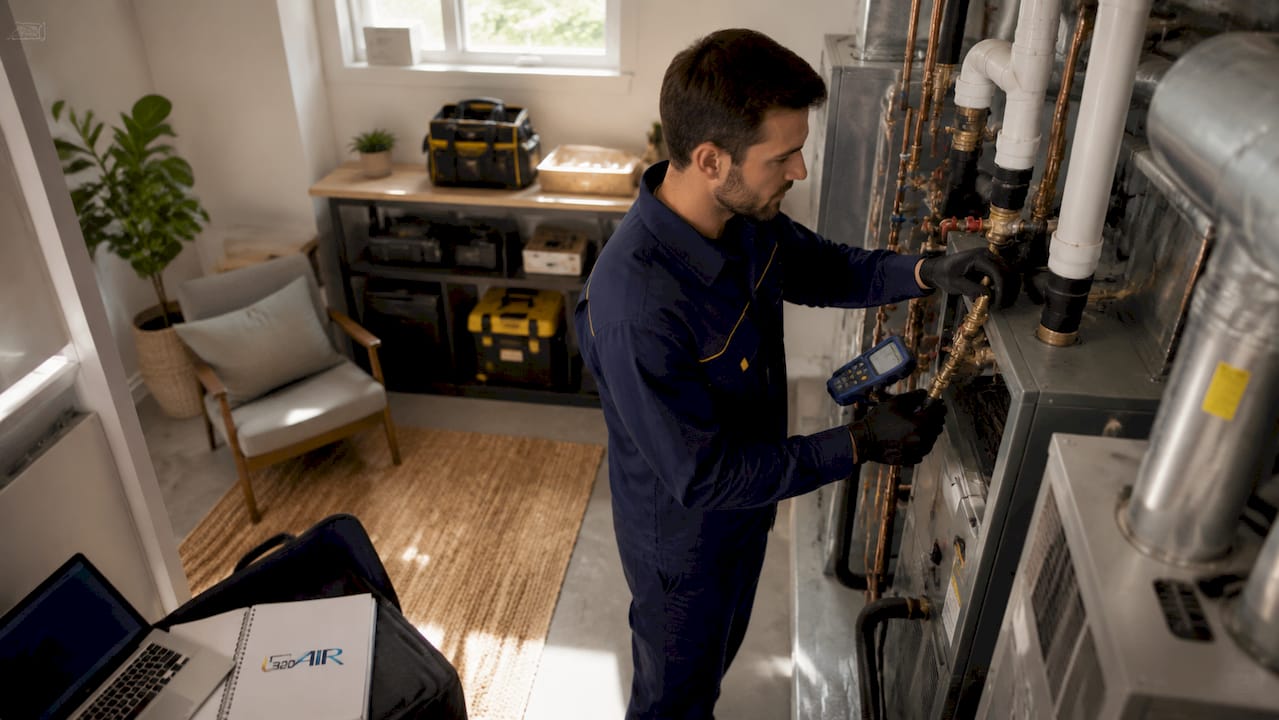
Commissioning starts during design, not after installation. That distinction matters because catching a design flaw on paper costs almost nothing. Catching it after the equipment is installed and running costs significantly more. A well-commissioned system is one where every phase, from blueprint review to final occupancy testing, has been documented and signed off.
For property managers overseeing commercial spaces, commissioning also satisfies lease obligations and building code requirements. For homeowners, it provides confidence that the system you paid for is actually delivering what the contractor promised.
What are the phases of the HVAC commissioning process?
The formal commissioning process follows five phases defined by ASHRAE Guideline 0-2019. Each phase builds on the last, creating a chain of accountability from design intent through daily operations.
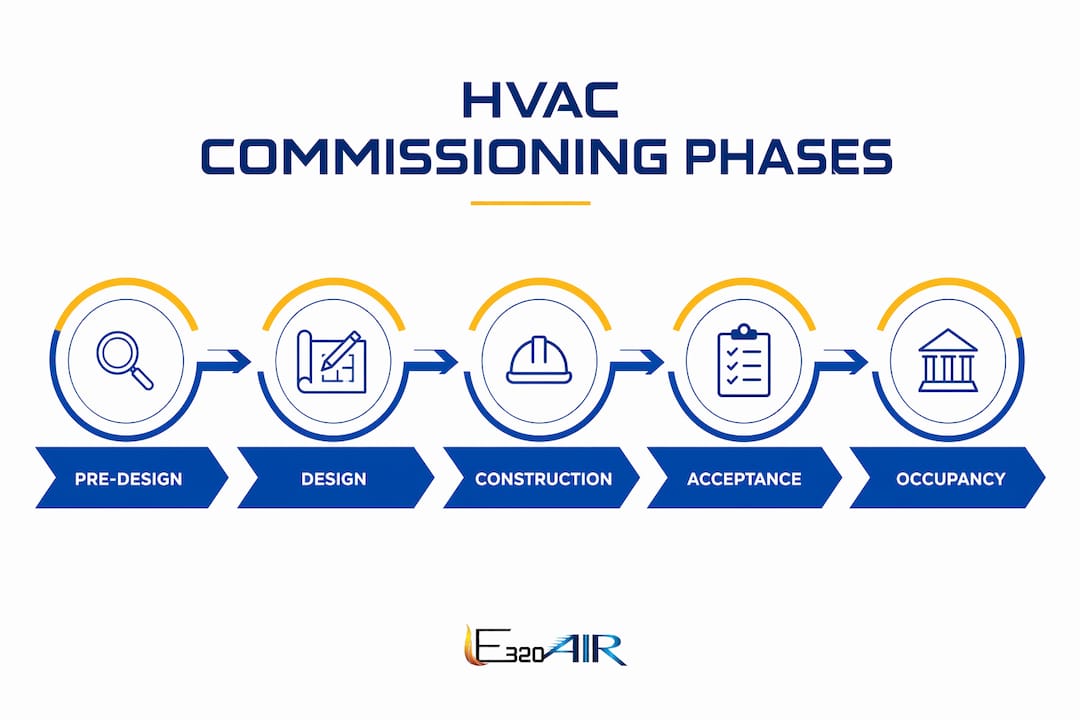
Phase 1: Pre-design
The commissioning authority (CxA) develops the Owner's Project Requirements (OPR) document. This document captures what the owner needs the system to do, including temperature ranges, humidity targets, and energy goals. Every decision made in later phases gets measured against the OPR.
Phase 2: Design
The CxA reviews mechanical drawings and specifications to confirm the design matches the OPR. Errors caught here, such as undersized ductwork or mismatched equipment capacities, are corrected before any equipment is ordered or installed.
Phase 3: Construction
Installation verification happens on-site. The CxA checks that equipment is installed per manufacturer specs and design drawings. This phase also includes TAB (Testing, Adjusting, and Balancing), which confirms airflow and hydronic flow rates match design parameters before functional testing begins.
Phase 4: Acceptance (functional performance testing)
This is the most intensive phase. The CxA runs the system through real and simulated conditions to verify every control sequence, safety interlock, and performance target. More detail on this phase appears in a dedicated section below.
Phase 5: Occupancy and operations
After the building is occupied, the CxA monitors system performance and confirms the equipment operates correctly under actual load conditions. A systems manual and owner training are delivered at this stage. Commissioning reports and system manuals give your maintenance team the documentation needed to sustain efficiency for years.
Pro Tip: Ask your HVAC contractor for the OPR document and the commissioning report before final payment. If they cannot produce both, the commissioning process was incomplete.
What types of HVAC commissioning exist?
Commissioning falls into three categories, each designed for a different situation. Knowing which type applies to your property helps you ask the right questions and budget accurately.
| Type | When to use it | Primary goal |
|---|---|---|
| Initial commissioning | New construction or new installation | Verify system meets design intent from day one |
| Retro-commissioning | Existing building never formally commissioned | Identify and fix inefficiencies in an aging system |
| Re-commissioning | Previously commissioned building with changed use | Restore performance after occupancy changes or renovations |
Initial commissioning applies to new HVAC installations. It runs through all five ASHRAE phases and produces the full documentation package. This is the most thorough type and sets the performance baseline for the life of the system.
Retro-commissioning targets existing buildings that were never formally commissioned. Many older homes and commercial properties fall into this category. A retro-commissioning study often uncovers control sequences that were never programmed correctly, dampers that were never adjusted, and equipment running at the wrong speed. The energy savings from fixing these issues can be significant.
Re-commissioning applies when a building's use has changed. If you converted a retail space into offices, or added a server room to a building, the original commissioning baseline no longer reflects actual load demands. Re-commissioning recalibrates the system to match the new reality.
Pro Tip: If your energy bills have crept up over the past two or three years without a clear cause, retro-commissioning is the most cost-effective diagnostic tool available. It often pays for itself within the first year through energy savings alone.
How does HVAC commissioning deliver energy savings and better comfort?
Proper commissioning reduces annual energy consumption by 13–15 percent compared to buildings where systems were simply installed and started up without formal verification. That gap exists because unverified systems routinely run with miscalibrated controls, unbalanced airflow, and equipment operating outside its design range.
The comfort benefits are equally concrete. A commissioned system delivers consistent temperatures across all zones, maintains proper humidity levels, and provides adequate fresh air exchange. Occupants in well-commissioned buildings report fewer hot and cold spots, less stuffiness, and better air quality overall.
Commissioning also extends equipment life. When a compressor runs at the correct refrigerant charge, when a fan motor operates at the right speed, and when controls cycle equipment correctly, wear rates drop. That means fewer breakdowns and a longer service life before replacement is needed.
- Balanced airflow eliminates hot and cold zones that force occupants to adjust thermostats constantly.
- Correct refrigerant charge prevents compressor overwork and premature failure.
- Properly calibrated controls stop equipment from short-cycling, which is one of the leading causes of early wear.
- Verified ventilation rates maintain indoor air quality and reduce the buildup of CO2 and humidity.
Commissioning also ensures Building Automation Systems respond correctly to changing load demands. A BAS that was never verified may be running equipment at full capacity on a mild day, wasting energy and accelerating wear. Commissioning catches and corrects that behavior. For more on how ductwork affects system efficiency, the relationship between physical installation quality and commissioning outcomes is direct.
What is functional performance testing and why is it critical?
Functional Performance Testing (FPT) is the stress test phase of HVAC commissioning. It verifies that every control sequence, safety interlock, and performance target works correctly under real and simulated conditions.
FPT simulates worst-case scenarios, including power outages, extreme outdoor temperatures, and simultaneous equipment failures. The goal is to expose hidden problems before occupants move in, when fixes are far less disruptive and expensive.
A typical FPT sequence includes the following steps:
- Verify normal startup and shutdown sequences for all equipment.
- Test each control sequence at part-load, full-load, and no-load conditions.
- Simulate failure modes such as sensor faults, power interruptions, and equipment lockouts.
- Confirm safety interlocks shut down equipment correctly when limits are exceeded.
- Document all results and issue a deficiency list for any items that fail.
"The commissioning authority coordinates progressively more detailed testing from design reviews through functional testing and final verification, ensuring no performance gap goes undetected before occupancy."
The systems manual delivered after FPT is often underappreciated. It contains every control sequence, set point, and test procedure used during commissioning. Future maintenance technicians can use it to replicate tests, diagnose faults, and restore settings after repairs. Without it, institutional knowledge about how your system was designed to operate disappears the moment the original commissioning team leaves.
For projects over 50,000 square feet, ASHRAE Guideline 0 requires an independent CxA who has no financial relationship with the design team or contractor. That independence is what makes the quality assurance credible. For residential and smaller commercial projects, a trusted HVAC professional with commissioning experience can fill this role effectively.
How can you apply commissioning insights to maintain your system?
Understanding the commissioning process gives you a clear framework for maintaining your system's performance over time. The knowledge does not expire when the commissioning team leaves.
Start by requesting the full documentation package from your HVAC contractor. This includes the OPR, the commissioning report, the TAB report, and the systems manual. If your system was installed without formal commissioning, ask E320air about a retro-commissioning assessment to establish a current performance baseline.
Here is what to look for in a quality commissioning engagement:
- A written scope of work that references ASHRAE Guideline 0-2019 or Standard 202.
- A TAB report signed by a certified technician confirming airflow and water flow measurements.
- A functional testing log showing pass/fail results for every tested sequence.
- Owner training that covers thermostat operation, filter schedules, and seasonal changeover procedures.
- A systems manual delivered in a format your maintenance team can actually use.
Schedule routine inspections at least twice a year to verify that set points have not drifted and that equipment is operating within the parameters established during commissioning. HVAC inspections for California homeowners follow a similar verification framework and can catch performance drift before it becomes a costly problem.
Re-commissioning every five to seven years is a sound investment for any property. Building use changes, equipment ages, and control systems drift. Periodic re-commissioning catches those changes before they compound into major inefficiencies. For homeowners looking to reduce HVAC operating costs, combining re-commissioning with routine maintenance produces the most consistent long-term savings.
Pro Tip: Keep your systems manual in a binder near the mechanical room or air handler. Every technician who services your system should review it before making adjustments. That single habit prevents a surprising number of accidental set-point changes.
Key takeaways
HVAC commissioning is the most effective way to confirm your system delivers the energy savings, comfort, and reliability you paid for, starting from design and continuing through occupancy.
| Point | Details |
|---|---|
| Commissioning starts at design | The process begins during design review, not after installation, catching errors when they are cheapest to fix. |
| Five ASHRAE phases structure the process | Pre-Design, Design, Construction, Acceptance, and Occupancy each produce specific deliverables and verifications. |
| Energy savings are measurable | Commissioned buildings use 13–15 percent less energy annually than non-commissioned buildings. |
| Three types cover every situation | Initial, retro, and re-commissioning address new systems, aging systems, and systems in changed buildings. |
| Documentation sustains performance | The systems manual and commissioning report are the tools that keep your system performing correctly for years. |
What I've learned from commissioning real homes and commercial buildings
The biggest misconception I run into is that commissioning is just a fancy word for startup. Homeowners assume that once the technician flips the system on and it blows cold air, the job is done. That assumption costs money every month on the utility bill.
What commissioning actually reveals is how the system behaves under stress. I have seen brand-new systems with perfectly installed equipment that failed functional performance testing because the control sequences were programmed incorrectly. The compressor would short-cycle on a hot afternoon, exactly when you need it most. Without FPT, that flaw would have gone undetected until the compressor failed, usually out of warranty.
The other thing I stress to every property manager is the systems manual. Most of them end up in a drawer and are never opened. Then a technician comes out two years later, makes a "small adjustment" to a set point, and the system never quite works right again. The manual exists precisely to prevent that. Treat it like the owner's manual for your car.
If your system is more than five years old and was never formally commissioned, a retro-commissioning assessment is the single highest-return investment you can make in your HVAC system. The HVAC system startup process is a good starting point for understanding what proper verification looks like at the residential level.
— Edward
E320air's HVAC commissioning and installation services
E320air works with homeowners and property managers across the region to deliver properly commissioned HVAC systems from the first design review through final occupancy verification.
Whether you need a new HVAC installation with full commissioning documentation or a retro-commissioning assessment on an existing system, E320air brings the technical depth and field experience to get it done right. Every installation includes TAB verification, functional testing, and a systems manual your maintenance team can actually use. Contact E320air to schedule an assessment and find out exactly where your system stands.
FAQ
What is HVAC commissioning in simple terms?
HVAC commissioning is a quality assurance process that verifies your heating and cooling system is installed correctly and operating as designed. It covers everything from design review to functional testing before and after occupancy.
How long does the HVAC commissioning process take?
The timeline depends on system size and complexity. A residential commissioning process typically takes one to three days for functional testing, while large commercial projects can span several weeks across multiple phases.
Who performs HVAC commissioning?
A commissioning authority (CxA) performs the process. For projects over 50,000 square feet, ASHRAE Guideline 0 requires the CxA to be independent of the design and construction team. For residential projects, a qualified HVAC professional with commissioning experience fills this role.
What is the difference between retro-commissioning and re-commissioning?
Retro-commissioning applies to existing buildings that were never formally commissioned. Re-commissioning applies to buildings that were previously commissioned but have since changed in use or occupancy, requiring a new performance baseline.
Does HVAC commissioning actually save energy?
Yes. Commissioned buildings use 13–15 percent less energy annually than non-commissioned buildings, according to ASHRAE industry estimates. The savings come from corrected control sequences, balanced airflow, and equipment operating within its design parameters.