
TL;DR:
- HVAC seasonal energy efficiency measures total output versus electricity use over a season using SEER2 and HSPF2 ratings. Proper installation, duct sealing, and smart controls are essential for the rated efficiency to translate into real energy savings. California's 2026 standards require a minimum 14.3 SEER2 for new systems, and high-efficiency heat pumps exceed 9.0 HSPF2, ensuring better performance and lower costs.
HVAC seasonal energy efficiency is defined as the ratio of total heating or cooling output delivered over an entire season to the total electrical energy consumed during that same period. The two standard metrics governing this measurement are SEER2 (Seasonal Energy Efficiency Ratio 2) for cooling and HSPF2 (Heating Seasonal Performance Factor 2) for heating. California homeowners and property managers who understand these ratings make better equipment decisions, stay compliant with 2026 federal standards, and cut utility bills in a climate that pushes air conditioners hard from may through october.
What is HVAC seasonal energy efficiency and how is it measured?
SEER2 and HSPF2 are the official industry ratings for seasonal energy performance, and both are calculated the same way: total output in BTUs divided by total watt-hours consumed across a full season. A higher number means the system delivers more cooling or heating for every unit of electricity it uses. The Department of Energy updated these metrics in 2023 by introducing the M1 test procedure, which replaced the older SEER and HSPF standards.
The M1 method changed one critical variable. SEER2 testing applies five times more external static pressure than the legacy SEER test, simulating the real resistance that residential ductwork creates. That change produces more realistic numbers. A unit that scored 18 SEER under the old test scores approximately 17 SEER2 under the new one. This means older SEER ratings and current SEER2 ratings are not directly comparable without adjustment.
SEER2 covers the full cooling season by averaging efficiency across outdoor temperatures from 65°F to 104°F. That range matters because most days are not peak heat days. EER2, a separate metric, measures performance at a fixed 95°F peak condition. EER2 gives a sharper picture of how a system performs on the hottest days, which is exactly when California electricity rates and demand charges are highest.
Key distinctions between the ratings:
- SEER2 measures average cooling efficiency across a full season at varying temperatures
- HSPF2 measures average heating efficiency for heat pumps across a full heating season
- EER2 measures cooling efficiency at a single peak temperature (95°F), not a seasonal average
- Higher ratings always indicate greater efficiency, but actual savings depend on climate, home size, and how the system is controlled
Pro Tip: When comparing equipment quotes, always confirm that ratings are listed as SEER2 and HSPF2, not the older SEER and HSPF. A contractor quoting legacy numbers may be presenting an inflated efficiency picture.
What are the 2026 federal and California minimum efficiency standards?
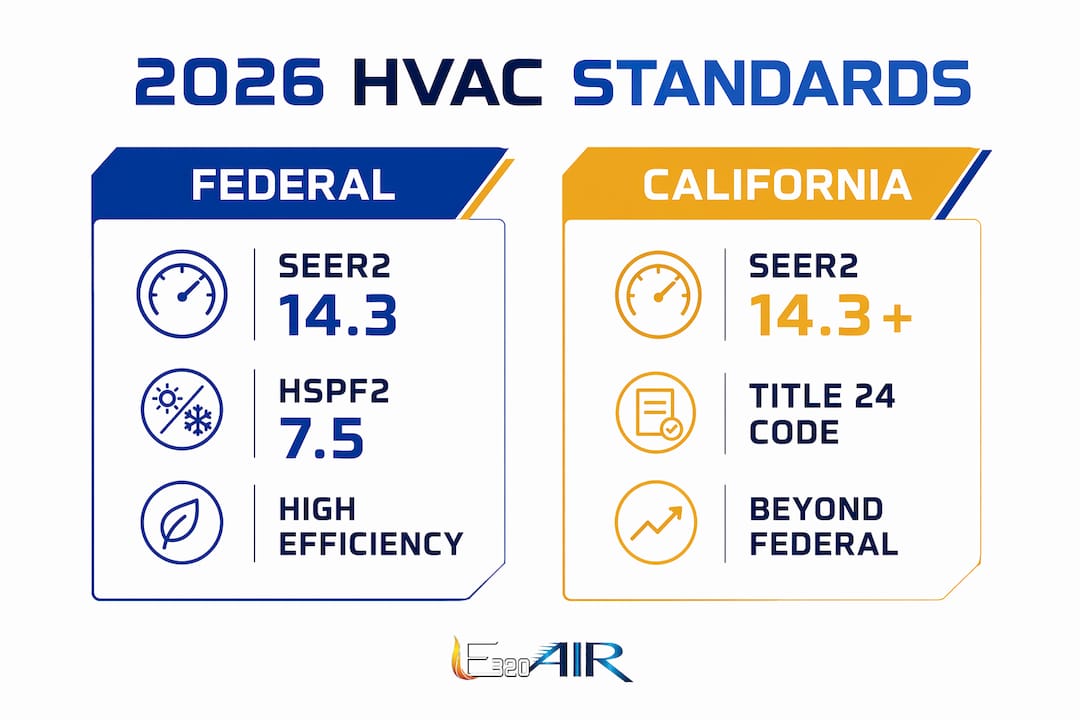
The Department of Energy set new minimum SEER2 standards effective July 2026: 14.3 SEER2 for the South and Southwest regions, which includes California, and 13.4 SEER2 for the North. The national minimum for heat pumps is 14.3 SEER2. No contractor can legally install a new central air conditioner in California that falls below the 14.3 SEER2 threshold.
For heating, the federal minimum HSPF2 standard sits at 7.5. High-efficiency heat pumps exceed 9.0 HSPF2. The cost difference is real: minimum-standard heat pump units run $4,800–$8,500, while high-efficiency units above 9.0 HSPF2 cost $8,000–$13,000. The payback period depends on how many heating hours your property logs each year.
| Rating | Minimum Standard | High-Efficiency Threshold | Typical Installed Cost |
|---|---|---|---|
| SEER2 (cooling) | 14.3 (CA/South) | 18+ | $4,200–$12,000 |
| HSPF2 (heating) | 7.5 | 9.0+ | $4,800–$13,000 |
Every new unit sold in the U.S. must carry an EnergyGuide label showing its SEER2 and HSPF2 ratings. When verifying installed equipment, locate the yellow EnergyGuide label on the outdoor unit or check the model number against the AHRI (Air-Conditioning, Heating, and Refrigeration Institute) directory. That directory is the authoritative public record for certified efficiency ratings.
Pro Tip: California's Title 24 building code adds requirements beyond federal minimums for new construction and major renovations. Confirm that any new installation meets both federal DOE standards and Title 24 before signing off on the work.
How do seasonal efficiency ratings affect real energy savings?
Seasonal ratings are averages, not guarantees. Efficiency ratings represent an average across a range of conditions, so actual savings depend on your specific climate zone, home thermal load, and how you operate the system. A 20 SEER2 unit in a poorly insulated home with leaky ducts will underperform a 16 SEER2 unit in a well-sealed, properly sized installation.
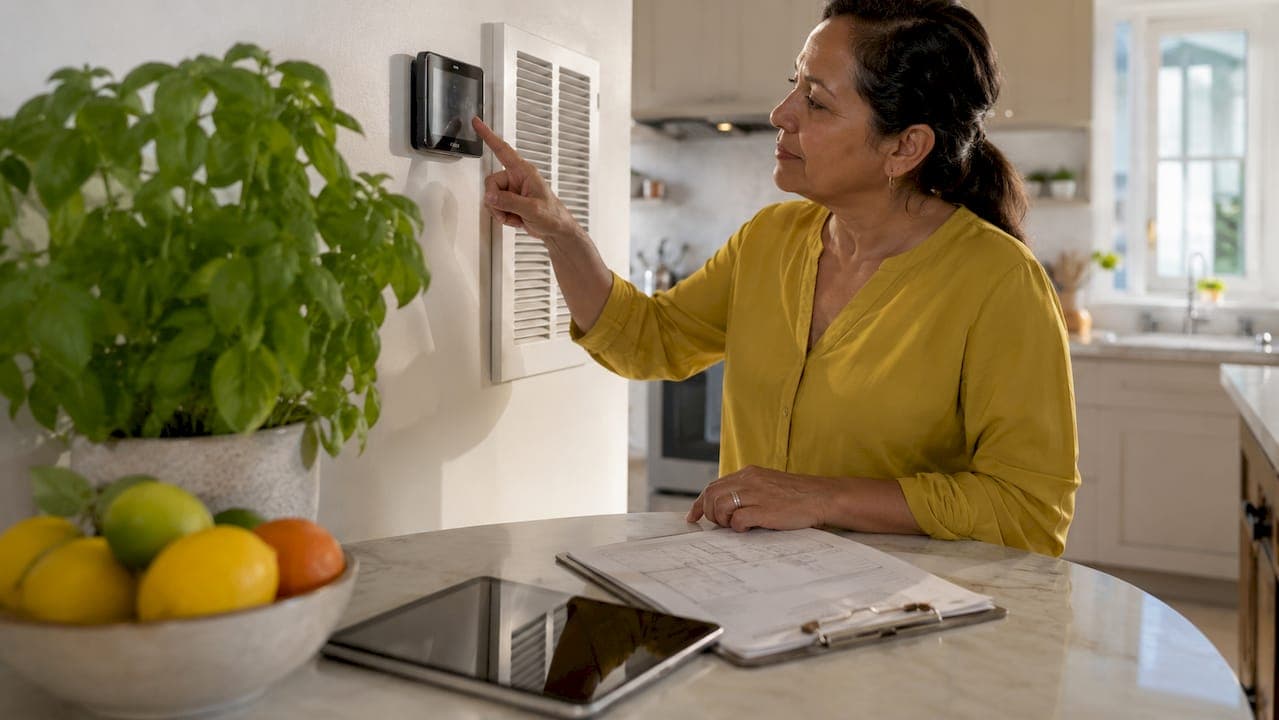
HVAC systems consume 40–50% of a building's total energy. That share makes equipment efficiency the single largest lever for reducing utility costs. Smart controls compound that advantage. Integrating smart controls can reduce HVAC energy usage by 17–26% regardless of the unit's base efficiency rating. That means controls and equipment efficiency work together, not independently.
For California property managers, EER2 deserves specific attention. On peak summer days when temperatures exceed 100°F in inland valleys and the Central Valley, EER2 is the metric that predicts real performance. A system with a strong SEER2 but a weak EER2 may struggle precisely when it matters most for both comfort and cost.
Factors that determine whether rated efficiency translates into actual savings:
- Climate zone match: Equipment rated for Southern climates performs as rated in California's hot zones; Northern-rated equipment may not
- Duct condition: Leaky or undersized ducts reduce delivered efficiency regardless of the unit's SEER2 rating
- Load matching: An oversized unit short-cycles, reducing both efficiency and humidity control
- Control strategy: Programmable and smart thermostat controls prevent unnecessary runtime and reduce peak demand charges
- Maintenance frequency: Dirty coils, clogged filters, and low refrigerant charge all degrade real-world efficiency
Best practices to maximize your HVAC system's seasonal efficiency
Proper equipment sizing is the first and most consequential decision. Manual J load calculation determines the exact heating and cooling capacity a home requires based on square footage, insulation levels, window area, orientation, and local climate data. Skipping this step and sizing by rule of thumb produces either an oversized or undersized system. Both outcomes reduce efficiency and increase operating costs.
- Commission a Manual J calculation before selecting any equipment. Require your contractor to provide the calculation in writing, not just a verbal estimate based on square footage.
- Seal and test ductwork before installation. Duct leakage rates above 10% of system airflow eliminate much of the efficiency advantage of a high-SEER2 unit.
- Specify variable-speed compressors when budget allows. Variable-speed systems modulate output to match actual load, running longer at lower capacity rather than cycling on and off at full power. This improves both SEER2 performance and humidity control.
- Install a smart thermostat with adaptive scheduling. Smart thermostat controls and ventilation management reduce runtime during off-peak hours and respond to occupancy patterns automatically.
- Schedule annual maintenance that includes coil cleaning, refrigerant charge verification, and filter replacement. Retro-commissioning and controls upgrades deliver 20–27% annual energy savings in documented case studies. That result requires consistent maintenance, not just good equipment.
- Consider economizer controls for commercial and larger residential properties. Economizers use outdoor air for free cooling when conditions allow, reducing compressor runtime during mild weather.
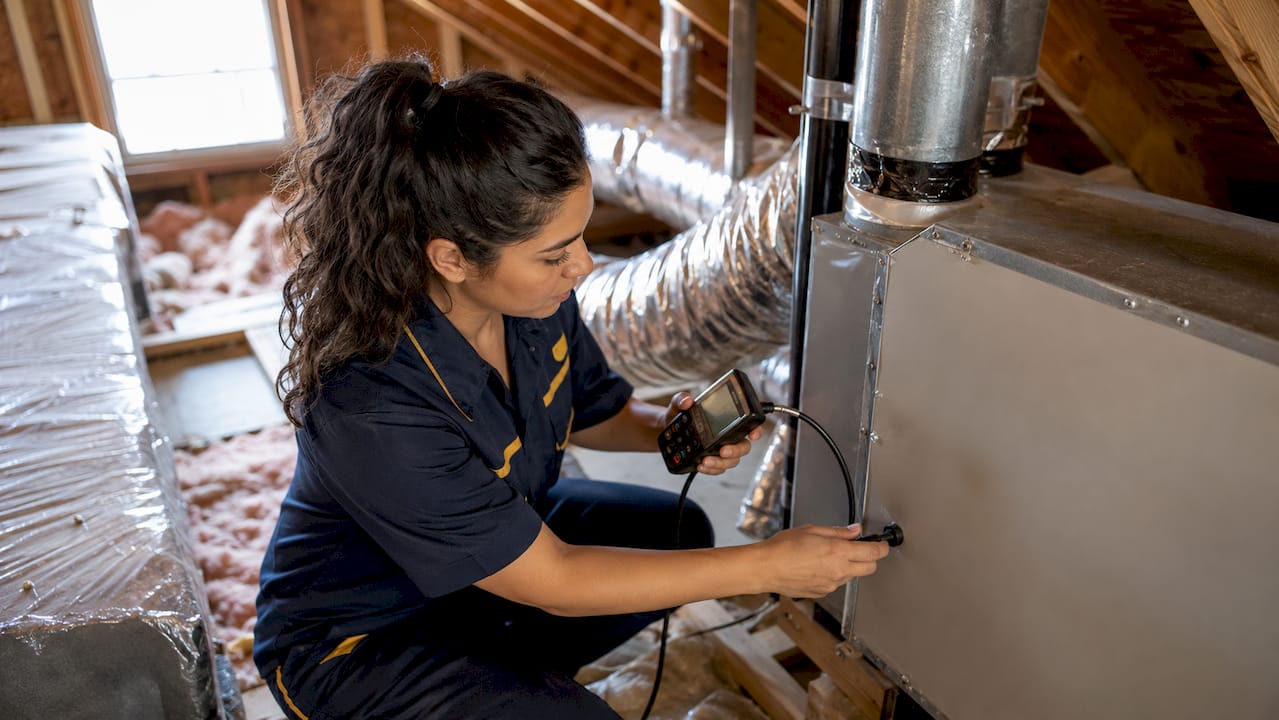
Pro Tip: Ask your contractor for a post-installation commissioning report that confirms measured airflow, refrigerant charge, and static pressure match the design specifications. A unit installed incorrectly will never reach its rated SEER2 in the field.
For properties with both cooling and heating needs, HVAC system design choices made at installation determine efficiency outcomes for the next 15–20 years. Decisions made at the design stage are far cheaper to get right than corrections made after installation.
Key Takeaways
SEER2 and HSPF2 ratings define seasonal efficiency potential, but installation quality, duct condition, and smart controls determine the efficiency a California homeowner actually achieves.
| Point | Details |
|---|---|
| SEER2 is the current cooling standard | California requires a minimum 14.3 SEER2 for all new central AC installations as of July 2026. |
| HSPF2 governs heat pump heating | The federal minimum is 7.5 HSPF2; high-efficiency units exceed 9.0 and cost more upfront. |
| Ratings are seasonal averages | EER2, not SEER2, predicts performance on California's hottest peak-demand days. |
| Controls multiply equipment efficiency | Smart controls reduce HVAC energy use by 17–26% on top of any equipment rating gains. |
| Installation quality is non-negotiable | Manual J sizing and duct sealing are required to realize rated SEER2 efficiency in the field. |
What I've learned after years of California HVAC installations
The rating on the spec sheet is a ceiling, not a floor. Every installation I've seen where a homeowner was disappointed with energy savings had one thing in common: the system was rated correctly but installed or maintained incorrectly. A 20 SEER2 unit with leaky ducts and an oversized capacity will cost more to run than a 16 SEER2 unit that was properly sized and commissioned.
The second misconception I encounter constantly is treating SEER2 as the only number that matters. For California properties in the Central Valley or Inland Empire, EER2 is the number that predicts your July and august electricity bills. Those are the days when grid demand peaks, time-of-use rates spike, and your system runs at full load for hours. A unit with a mediocre EER2 but a high SEER2 is optimized for mild days, not the days that actually hurt your wallet.
My honest recommendation: spend as much attention on the contractor's installation process as on the equipment's efficiency rating. Require a Manual J calculation. Require duct testing. Require a commissioning report. The equipment rating gets you in the door; the installation quality determines whether you walk through it.
— Edward
E320air's approach to high-efficiency HVAC in California
California's 2026 efficiency standards leave no room for guesswork on equipment selection or installation quality. E320air works with homeowners and property managers across California to select, install, and maintain HVAC systems that meet current DOE minimums and exceed them where the investment makes sense.

Every E320air installation starts with a Manual J load calculation and includes duct testing to confirm that rated efficiency reaches the living space. The team handles HVAC installation for both residential and commercial properties, with full compliance documentation for Title 24 and 2026 federal standards. For property managers overseeing multiple units, E320air also provides maintenance programs that protect efficiency ratings over the system's full service life. Visit E320air to schedule a consultation or review past projects in the problem-solving gallery.
FAQ
What does SEER2 mean for a California homeowner?
SEER2 measures how efficiently a central air conditioner cools your home across an entire season. California requires a minimum of 14.3 SEER2 for all new installations as of July 2026.
How is SEER2 different from the old SEER rating?
SEER2 uses the M1 test with five times higher duct pressure than legacy SEER tests, producing more realistic efficiency numbers. A unit rated 18 SEER under the old standard scores approximately 17 SEER2 under the new one.
What is HSPF2 and why does it matter?
HSPF2 rates heat pump heating efficiency across a full heating season. The federal minimum is 7.5 HSPF2, and units above 9.0 qualify as high efficiency.
Does a higher SEER2 always mean lower electricity bills?
Not automatically. Seasonal ratings are averages across a range of temperatures, and actual savings depend on duct condition, equipment sizing, and control strategy. A high-SEER2 unit installed incorrectly will not deliver rated savings.
What is EER2 and when should I pay attention to it?
EER2 measures cooling efficiency at a fixed 95°F peak condition, making it the most relevant metric for California's hottest days. Check EER2 alongside SEER2 when selecting equipment for hot inland climates.