
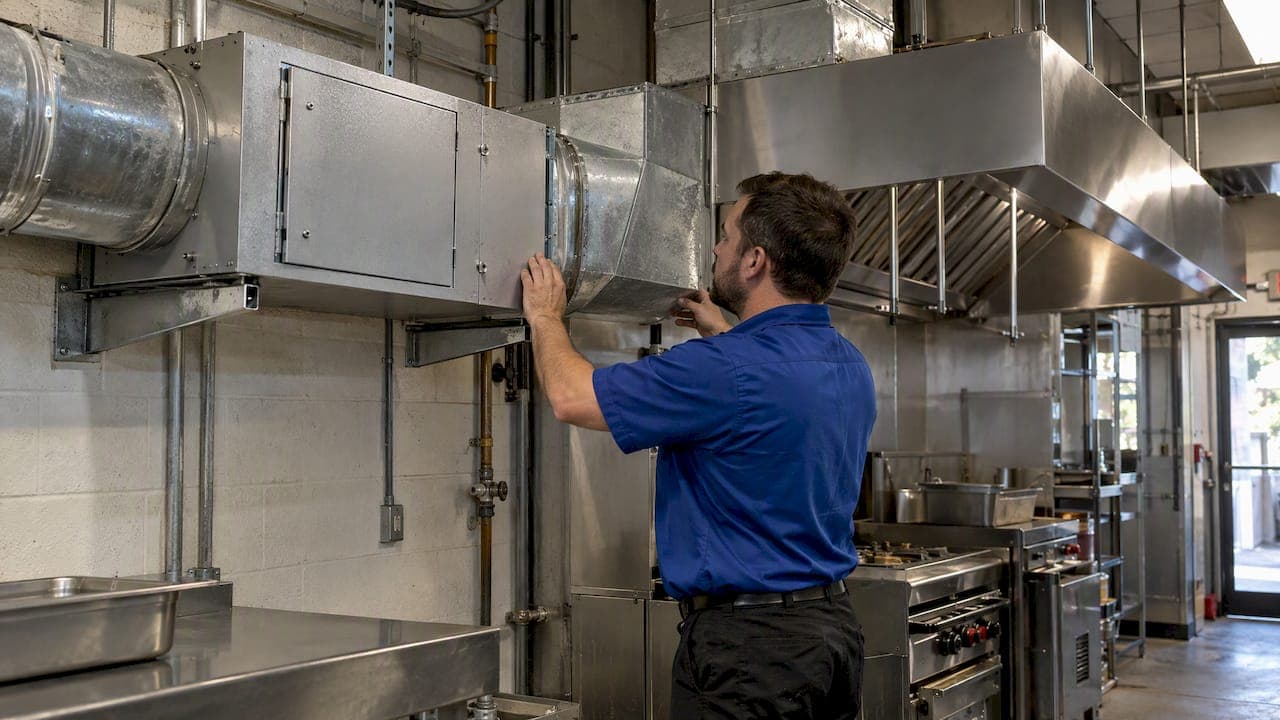
Sizing and installation call for a licensed HVAC contractor, since getting the balance wrong creates real safety risks.
TL;DR:
- Powered tempered units offer consistent comfort but can significantly increase energy costs compared to untempered or passive systems.
- Codes typically require makeup air for exhausts exceeding about 400 CFM to prevent backdrafting of combustion gases and negative pressure issues.
- Costs mainly depend on unit size, CFM capacity, tempering method, duct routing, and labor, often making retrofit projects more expensive than equipment alone.
- Only licensed HVAC contractors should handle systems involving tempering, wiring, or combustion to ensure safety and code compliance.
- Regular maintenance of filters, dampers, and coils is essential for system safety, efficiency, and long-term performance.
Table of Contents
- Types of makeup air units and how each work
- Where makeup air units show up in homes, restaurants, and plants
- Key components that affect performance and cost
- Sizing, code triggers, and safety considerations
- Typical costs and what drives the price
- Maintenance and seasonal operation checklist
- Contractor checklist: how a licensed HVAC pro specifies a MAU
- Author perspective: safe DIY limits and why many installs need a pro
- E320Air services: inspection, permitted installation, and maintenance plans
- FAQ
- Sources
Types of makeup air units and how each work
The right MAU depends on climate, budget, and how much outside air needs tempering before it enters the building. Powered tempered units use an electric coil or a hydronic coil to warm incoming air before it reaches occupied space, which keeps comfort steady but adds to operating cost. Direct-fired and indirect-fired rooftop units handle larger loads, the kind found in commercial kitchens or industrial plants, with direct-fired models burning gas right in the airstream for efficiency and indirect-fired models using a heat exchanger when combustion byproducts can't mix with supply air.
Untempered units and passive wall dampers cost far less upfront but only work where incoming cold or hot air won't create comfort or freezing problems. Energy recovery ventilators and heat recovery ventilators (ERV/HRV) capture energy from outgoing air to precondition incoming air, which suits tight, well-insulated homes or projects where indoor air quality is a priority.
- Powered tempered units: steady comfort, higher energy use.
- Direct-fired and indirect-fired rooftop units: built for high-CFM commercial and industrial loads.
- Untempered units and passive dampers: lowest cost, limited to mild climates or light-duty use.
- ERV/HRV systems: balanced ventilation with lower energy penalty in airtight buildings.
Where makeup air units show up in homes, restaurants, and plants
Matching your situation to a common use case helps you figure out what kind of system you're dealing with.
- Residential kitchens: A powerful range hood in a tightly sealed home can trigger the need for a MAU, and retrofitting one into existing ductwork is often the hardest part of the job.
- Commercial kitchens: Continuous-use or high-CFM hoods generally require a MAU wired to an automatic interlock so makeup air turns on and off with the exhaust fan.
- Industrial, lab, and paint booth settings: Many of these applications prohibit recirculating air entirely, so a dedicated 100% outside air unit is a requirement.
- Red-flag symptoms: Doors that slam shut, a sulfur or exhaust odor near appliances, or a hood label stating a CFM rating above 400 CFM all suggest you need makeup air now, not later.
Key components that affect performance and cost
The parts inside a MAU determine how much comfort and energy efficiency you get for your money. Fan selection matters more than most buyers expect: an ECM variable-speed motor adjusts output to match real-time exhaust demand, while a fixed-speed fan runs at one setting regardless of need. Damper quality and control type affect how tightly the unit seals when idle and how reliably it responds to the exhaust interlock.
Filtration level, measured in MERV rating, trades airflow resistance against how much dust and particulate the system catches before air reaches your space. Tempering choice, whether electric, hydronic, or gas, along with proper insulation and drainage, prevents freezing coils and condensation damage in cold climates.
- Fans: ECM variable-speed units cost more but cut energy use versus fixed-speed motors.
- Dampers and controls: motorized dampers tied to an interlock respond faster than manual types.
- Filtration: higher MERV ratings improve indoor air quality but increase static pressure on the fan.
- Tempering: electric coils are simpler to install, while hydronic and gas options suit larger loads.
Pro Tip: Ask your contractor to specify the fan's static pressure rating against your actual duct run, not just the unit's rated CFM.
Sizing, code triggers, and safety considerations
Mechanical codes commonly require makeup air once an exhaust hood pulls more than about 400 CFM, and that makeup air generally must be interlocked to operate alongside the exhaust fan.
Under guidance like the 2024 International Mechanical Code, exhaust systems exceeding roughly 400 CFM typically require makeup air delivered at a comparable rate. That threshold is the single most common trigger contractors check first.
Skipping this step risks negative pressure, which can pull combustion gases back into the building through water heaters, furnaces, or other combustion appliances instead of venting them outside.
- Measure total exhaust CFM across all hoods and fans.
- Target 80 to 100% makeup air relative to total exhaust.
- Verify the location of gas appliances before finalizing duct routing.
ASHRAE Standards 62.1 and 62.2 set the ventilation rate criteria most contractors reference, but your local code authority has final say on compliance.
Typical costs and what drives the price
Installed MAU costs vary widely depending on unit size and how much ductwork the job requires. Pricing for a makeup air unit depends mainly on CFM capacity, tempering type, and installation complexity, with ductwork and labor often matching or exceeding the equipment cost itself in retrofit projects.
The biggest cost drivers are the unit's CFM rating, how much existing ductwork can be reused versus rerouted, whether tempering is electric, hydronic, or gas, control complexity, and local permit and labor rates. In older buildings, duct routing and mounting access frequently become the deciding factor in total project cost, since cutting new chases or rerouting around structural members adds labor hours fast.
- Reuse existing duct runs where code and airflow allow.
- Match tempering type to climate instead of over-specifying capacity.
- Bundle MAU work with other HVAC upgrades to share labor and permit costs.
Maintenance and seasonal operation checklist
A MAU needs regular attention to keep performing safely and efficiently.
- Replace or clean intake filters on a set schedule, and inspect the outside air intake for debris or blockage.
- Check coils and drain lines before winter for freezing risk and before humid months for condensation buildup.
- Test damper operation and confirm the exhaust interlock still triggers the MAU correctly.
- Schedule professional service at least once a year, and ask the technician to document airflow readings, not just a visual check.
Contractor checklist: how a licensed HVAC pro specifies a MAU
A qualified contractor starts by measuring hood or exhaust CFM, mapping duct layout, locating combustion appliances, and checking access points for the new unit and ductwork. Permits, electrical connections, and any structural modification need licensed trades, not a DIY approach. A professional estimate should include a sizing sheet, a control schematic showing how the interlock works, and a permit plan for your jurisdiction. Before requesting a quote, gather photos of your current hood, its nameplate CFM rating, and any access restrictions around the install location.

Author perspective: safe DIY limits and why many installs need a pro
A passive damper might be fine for a light-duty residential range hood in a mild climate, but anything involving tempering, gas combustion, or an automatic interlock crosses into licensed-trade territory. I've seen more problems caused by undersized passive intakes than by any other shortcut in this category, mostly because people size for comfort and forget the exhaust fan still needs air from somewhere. Electrical work and penetrations through a building envelope carry real risk when done without proper permits. If your project touches tempering, wiring, or combustion safety, hire a licensed HVAC contractor rather than guessing.
— Edward
E320Air services: inspection, permitted installation, and maintenance plans
A properly sized and installed makeup air unit protects your building's pressure balance and keeps combustion appliances venting the way they should, and getting that right the first time saves you from a costly retrofit later. A licensed HVAC contractor typically handles the inspection, measurement, and permitted installation work that a MAU project requires, along with tempering options suited to your climate and maintenance plans to keep the system running once it's in.

To get an accurate estimate, have your current hood's nameplate CFM rating, a few photos of the install location, and any access constraints ready before your appointment. Hiring a licensed contractor for this work reduces both safety risk and code exposure compared to a DIY install.
- Inspection and exhaust measurement before any quote is finalized.
- Permitted installation handled by licensed technicians.
- Tempering options matched to the climate and building type.
- Maintenance plans to keep filters, dampers, and controls working correctly.
Check out E320Air's HVAC installation services or visit E320air to request an estimate.
FAQ
What is the makeup air unit in HVAC?
A makeup air unit is equipment that supplies 100% outside air to replace air removed by an exhaust system, rather than recirculating indoor air the way many air handlers do. It typically filters incoming air and may heat or cool it before delivering it to the space.
How much does a makeup air unit cost?
Installed cost depends mainly on CFM capacity, tempering type, and how complex the ductwork is, and pricing can vary widely project to project. Retrofit jobs with difficult duct routing often cost more in labor than the unit itself.
What is the difference between an air handler and a makeup air unit?
A standard air handler often recirculates conditioned indoor air, while a makeup air unit supplies only outside air to replace what an exhaust system removes. MAUs are chosen specifically when recirculation isn't allowed, such as in commercial kitchens or paint booths.
What are the different types of makeup air units?
Common types include powered tempered units with electric or hydronic coils, direct-fired and indirect-fired rooftop units for larger loads, untempered units with passive dampers for light duty, and energy recovery units like ERVs or HRVs for tight, efficiency-focused buildings. Each fits a different combination of climate, budget, and exhaust volume.
When does a building require a makeup air unit?
Exhaust systems removing more than roughly 400 CFM typically trigger a makeup air requirement under common mechanical codes, with the makeup air generally required to run alongside the exhaust fan. Your local code authority makes the final determination for your specific building and use.
Sources
- The Makeup Air Unit Defined | ACHR News
- Makeup Air handouts (code and safety guidance) | PHRC / PSU
- Exhaust systems and makeup air — achieving balance under the 2024 IMC | ICC
- Makeup Air Unit Cost Guide 2026 – Design Transition Studio
- ASHRAE Standards 62.1 and 62.2 — ventilation and IAQ standards | ASHRAE