
TL;DR:
- An air handler unit circulates conditioned air inside a home by pulling in return air, filtering, and passing it over a coil to heat or cool it. Proper maintenance and correct sizing of the AHU are essential for HVAC efficiency, comfort, and indoor air quality. When repairs become costly, replacing the unit following the $5,000 rule can save homeowners money and improve system performance.
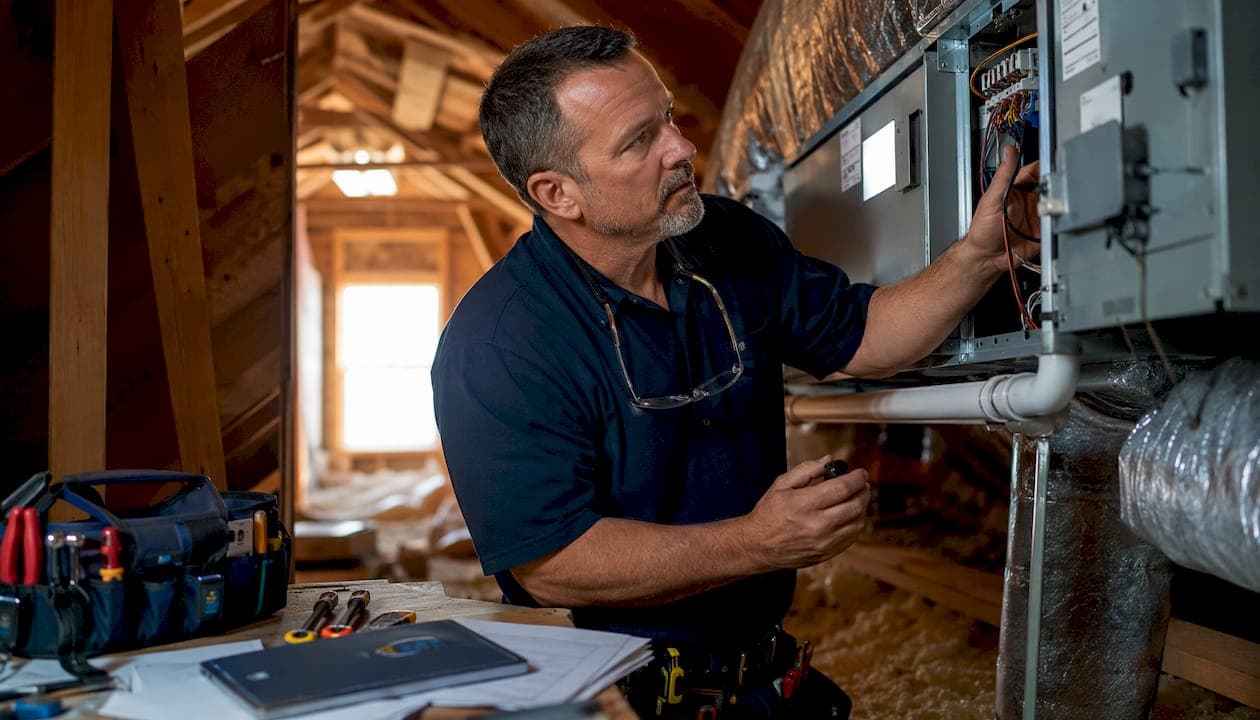
An air handler unit (AHU) is the indoor cabinet at the heart of a central HVAC system. Its job is straightforward: pull return air from your home, filter it, pass it over a coil to heat or cool it, and push it back through your ductwork. That's it. Everything else, the outdoor condenser, the heat pump, the furnace, exists to support or complement what the air handler does inside.
- Carrier defines the AHU as the indoor component responsible for circulating conditioned air through a split system.
- Trane notes that a well-maintained AHU directly affects indoor air quality by forcing air through filters and keeping pollutants in check.
- Typical installed replacement cost runs within a range for a residential unit, depending on capacity and blower type.
- E320air handles AHU inspections, repairs, and full replacements across the Inland Empire.
Table of Contents
- How does an air handler unit work?
- Key components inside your air handler
- Types of air handlers and how they compare to other HVAC equipment
- Routine maintenance and troubleshooting your air handler
- Air handler replacement: costs and the repair-vs-replace decision
- How to choose a contractor for AHU service or replacement
- Why sizing, coil matching, and blower selection actually matter
- Key Takeaways
- The part most homeowners skip until it's too late
- E320air can inspect, repair, or replace your air handler
- Useful sources for further reading
How does an air handler unit work?
The airflow path through an AHU is a short loop, but each step matters. Here's what happens every time your thermostat calls for conditioned air:
- Return air enters. Warm or stale air from your living spaces gets pulled through return grilles and travels to the air handler cabinet.
- The filter catches particles. Before anything else happens, air passes through the filter rack. A clogged filter here starves the whole system.
- Air crosses the evaporator coil. In cooling mode, refrigerant inside the coil absorbs heat from the air, dropping its temperature. In heating mode with a heat pump, the refrigerant cycle reverses and the coil releases heat instead.
- Auxiliary heat strips kick in (if present). On cold days when the heat pump alone can't keep up, electric resistance strips inside the AHU add a boost.
- The blower fan pushes conditioned air out. The blower motor drives air through the supply ducts and into every room.
- The cycle repeats. Air returns through the grilles, and the loop starts again.
The evaporator coil inside the AHU and the condenser coil outside work as a matched pair. Refrigerant shuttles heat between them. The outdoor unit handles the thermodynamic heavy lifting; the AHU handles distribution. A high-efficiency outdoor condenser cannot overcome a poorly sized or poorly maintained air handler.
Pro Tip: Blower motor type changes everything about day-to-day comfort. A standard single-speed PSC motor runs at full blast or not at all. An ECM (variable-speed) motor ramps up and down to match demand, which means quieter operation, more even temperatures, and meaningfully lower energy bills. The U.S. Department of Energy has flagged variable-speed motors as one of the highest-impact efficiency upgrades available for residential HVAC.
Key components inside your air handler
Knowing what's inside the cabinet helps you follow along when a technician explains a problem or when you're reading a quote.
- Blower fan and motor. The engine of the AHU. It draws return air in and pushes supply air out. Motor type (PSC vs. ECM) affects energy use and comfort.
- Evaporator coil. A refrigerant-filled coil that absorbs or releases heat depending on the operating mode. Dirty coils lose efficiency fast and can freeze up.
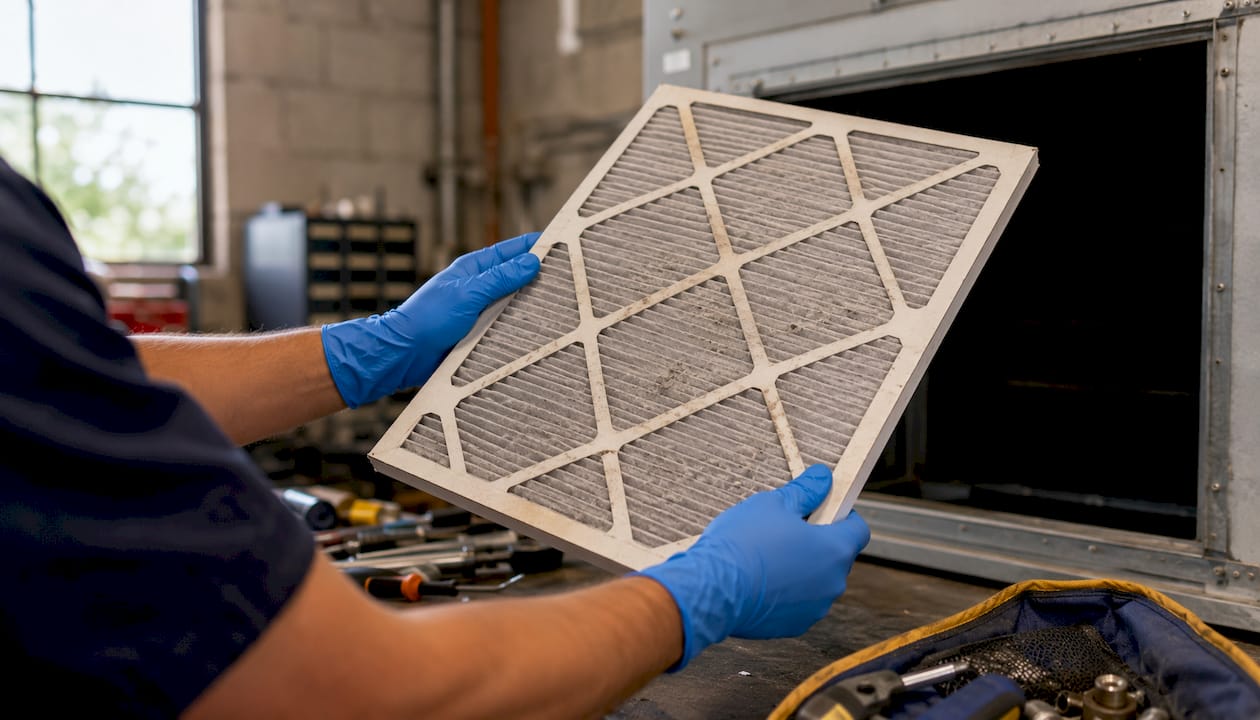
- Filter rack. The slot where your air filter sits. Most residential AHUs use 1-inch or 4-inch filters; change them every 1–3 months depending on household conditions.
- Drain pan and condensate drain. Moisture pulled from the air during cooling collects here. A clogged drain line causes water to back up and overflow, which can damage ceilings and walls.
- Auxiliary heat strips. Electric resistance elements used in heat pump systems for supplemental heat. They draw significant power, so a stuck relay that leaves them on in summer is a real problem.
- Control board and electrical connections. The brain that coordinates the blower, heat strips, and communication with the thermostat. A failed board often mimics symptoms of other failures.
- Access panels. Removable covers that let technicians (and careful homeowners) inspect the coil, blower, and drain pan.
Trane's guidance is direct on this: frequent filter changes and coil maintenance are the highest-impact actions a homeowner can take, because the AHU conditions every cubic foot of circulated air in the house. Neglect those two items and the AHU becomes a source of mold and particles rather than a filter against them.
Pro Tip: When a contractor quotes a coil replacement, ask whether the new coil is a factory-matched unit for your outdoor equipment. A mismatched coil can drop system efficiency by 10–15% and may void the manufacturer warranty on both components.
Types of air handlers and how they compare to other HVAC equipment
Common AHU configurations
- Single-speed (PSC motor) AHUs. The most common and least expensive. They run at one speed, which works but wastes energy and creates temperature swings.
- Variable-speed (ECM motor) AHUs. More expensive upfront, but they modulate airflow to match the load. Better humidity control, quieter, and lower operating costs over time.
- Vertical vs. horizontal cabinets. Vertical units stand upright in a closet or utility room. Horizontal units lie on their side, typically in an attic or crawlspace. The cabinet orientation affects labor cost at installation.
- Residential vs. commercial AHUs. Residential units handle 1.5–5 tons of capacity. Commercial AHUs are larger, often rooftop-mounted, and include more sophisticated controls.
AHU vs. furnace vs. condenser
| Feature | Air Handler | Furnace | Outdoor Condenser |
|---|---|---|---|
| Location | Indoors | Indoors | Outdoors |
| Primary function | Moves and distributes air; houses evaporator coil | Generates heat via gas or electric combustion | Rejects or absorbs heat via refrigeration cycle |
| Typical components | Blower, evaporator coil, filter, heat strips | Heat exchanger, burner, blower | Compressor, condenser coil, fan |
| Used with | Heat pumps, central AC | Central AC, heat pumps (some) | Air handlers, furnaces |
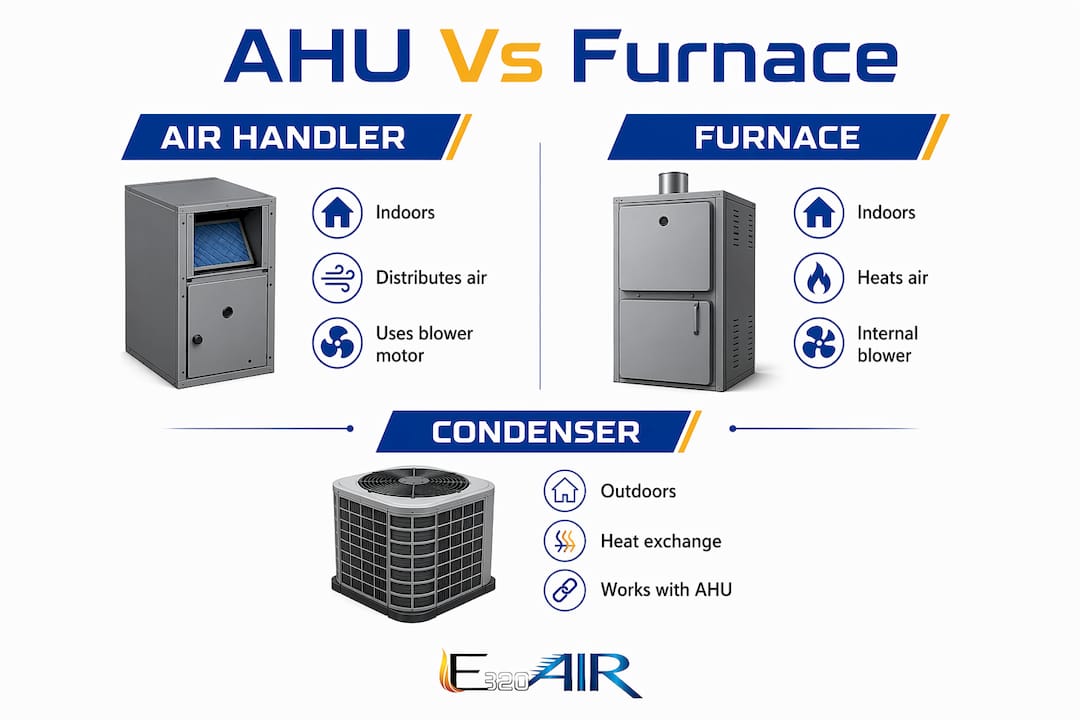
The HVAC.com breakdown puts it plainly: the AHU is the indoor distribution side, the condenser is the outdoor heat-exchange side, and they function as a matched split system.
Does every house have an air handler?
No. Homes with a gas furnace use the furnace's internal blower to move air through the ducts. The furnace performs the same airflow job as a dedicated AHU, so a separate air handler isn't needed. Homes with a heat pump or electric-only system are the ones most likely to have a standalone AHU. If you have a heat pump and no furnace, you almost certainly have an air handler.
Routine maintenance and troubleshooting your air handler
Maintenance checklist with intervals
- Change the air filter every 1–3 months. Thicker 4-inch media filters can go longer; 1-inch filters in dusty homes need monthly checks. See E320air's filter replacement guide for filter type recommendations.
- Inspect the evaporator coil annually. A technician should clean the coil during every annual tune-up. Dirty coils reduce cooling capacity and cause freeze-ups.
- Clear the condensate drain line every 6 months. Pour a cup of diluted bleach or white vinegar into the drain access port to prevent algae buildup.
- Check the blower motor and belt annually. Belt-driven blowers (older systems) need belt tension checks and occasional replacement. Direct-drive ECM motors need less attention but should still be inspected.
- Schedule a full AHU inspection once a year. A professional HVAC maintenance visit covers electrical connections, refrigerant levels, coil condition, and controls.
Common problems and likely causes
- Weak airflow: Clogged filter, dirty blower wheel, or failing blower motor.
- Water leaking from the unit: Blocked condensate drain or cracked drain pan.
- Ice forming on the coil: Restricted airflow (dirty filter or coil) or low refrigerant charge.
- Unusual noises: Squealing often points to a worn belt or blower bearing; banging suggests a loose blower wheel.
- Reduced cooling or heating: Dirty evaporator coil, refrigerant leak, or failed heat strips.
When to call a pro
Call a licensed HVAC technician if you see ice on the coil, smell burning from the cabinet, notice water damage around the unit, or suspect a refrigerant leak (hissing sound, oily residue on line connections). Electrical and refrigerant issues are not DIY territory.
Air handler replacement: costs and the repair-vs-replace decision
Typical lifespan and cost ranges
Residential air handlers generally last for a couple of decades with proper maintenance. When repair costs start climbing, the math shifts toward replacement.
Most U.S. homeowners pay roughly $1,200–$4,500 for a fully installed air handler replacement. Unit-only prices can start around $400 for a basic 1.5–2.0 ton residential model. Premium variable-speed systems push the installed price higher. The main cost drivers:
- Capacity (tonnage). Larger homes need larger units.
- Blower motor type. Upgrading from a PSC to an ECM variable-speed motor typically adds several hundred to over a thousand dollars in equipment and labor.
- Access difficulty. Attic or crawlspace installations cost more in labor than closet installs.
- Coil compatibility. A matched coil replacement adds cost but protects efficiency and warranty coverage.
When the total project includes both the indoor AHU and outdoor condenser, plus labor, ductwork, and permits, the combined replacement budget runs considerably higher. Plan for that possibility before you get quotes.
The $5,000 rule
The $5,000 rule is a simple homeowner heuristic: multiply your system's age (in years) by the estimated repair cost. If the result exceeds $5,000, replacement usually makes more financial sense than repair. A 12-year-old AHU facing an $800 repair scores 9,600, which points toward replacement. A 5-year-old unit with the same repair scores 4,000, which favors fixing it.
JA Bertsch's worked example walks through the calculation in plain terms if you want to run the numbers for your own system. Use the rule as a starting point, not a final verdict. Factor in energy efficiency gains from a newer unit and whether the rest of the system is in good shape.
How to choose a contractor for AHU service or replacement
Getting the right contractor matters as much as getting the right equipment. A poor installation of a great air handler still delivers poor results.
Questions to ask on the first call
- What brand and model are you recommending, and why does it match my outdoor unit?
- Is the evaporator coil factory-matched to my condenser?
- What blower motor type does the unit include?
- Does the quote include permits, line-set inspection, and thermostat compatibility?
- What's the labor warranty, and how long is the equipment warranty?
Credentials to verify
- State HVAC contractor license (required in California and most states)
- General liability insurance and workers' compensation
- EPA Section 608 certification for refrigerant handling
- Manufacturer training or authorization (Carrier, Goodman, and Trane all offer dealer programs)
- References or reviews from local customers
Red flags on quotes
- Vague scope with no model numbers or tonnage specified
- No mention of coil compatibility or line-set condition check
- "We'll figure it out when we get there" on access or ductwork
- Unusually low price with no explanation of what's excluded
- No permit pulled for a full system replacement
Comparing at least two or three written estimates is worth the time. The AHRI publishes replacement guidance that contractors should follow; asking whether a contractor references AHRI standards is a quick credibility check.
Why sizing, coil matching, and blower selection actually matter
This is where most homeowner mistakes happen, and where a good contractor earns their fee.
An undersized AHU runs constantly and never quite reaches setpoint. An oversized one short-cycles, which means it shuts off before it's had time to dehumidify the air. Both scenarios lead to discomfort and higher bills. The right size comes from a Manual J load calculation, which accounts for your home's square footage, insulation, window area, and local climate. Ask any contractor replacing your AHU whether they're running Manual J. If they size by square footage alone, that's a problem.
Pro Tip: Ask for a Manual S equipment selection report alongside the Manual J. Manual S confirms the chosen unit's performance data matches the calculated load. Together, these two documents are the industry standard for proper equipment selection and are referenced in the AHRI replacement guidance.
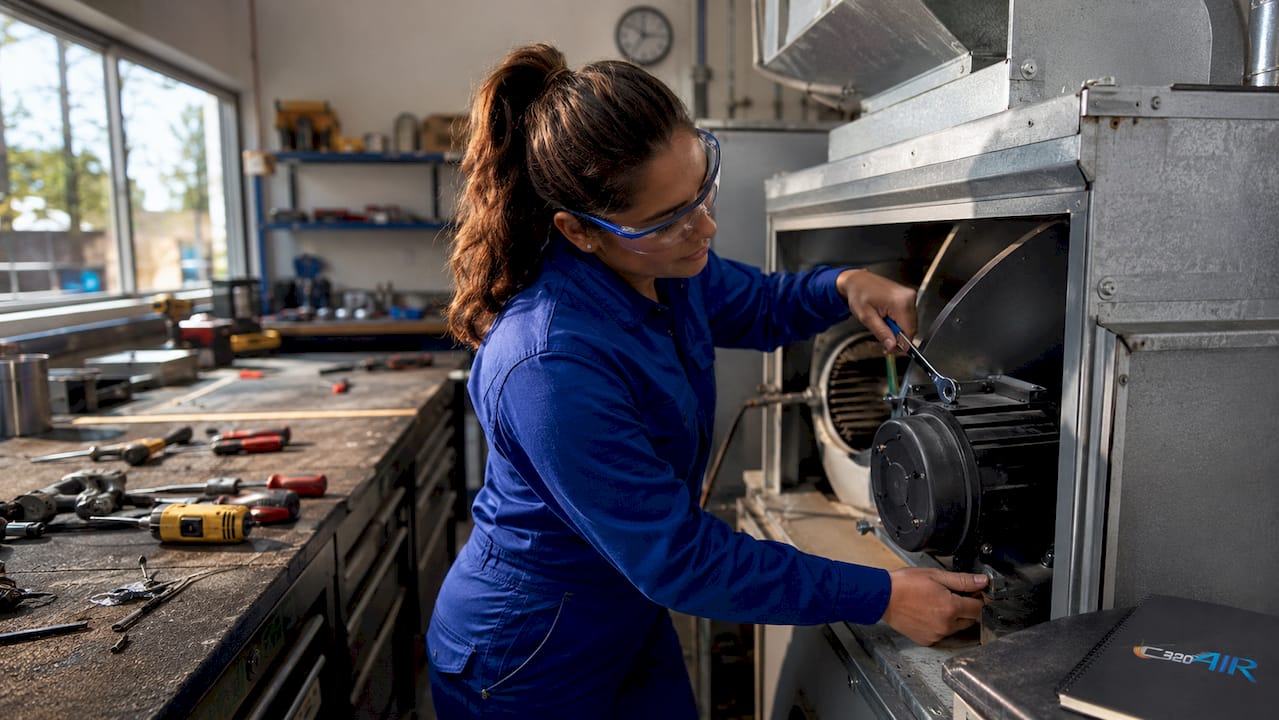
Coil compatibility is the other common failure point. Contractors sometimes install an available coil rather than the factory-matched one, which can reduce system efficiency and void warranties. Insist on a matched coil, and ask to see the AHRI certificate that confirms the matched pair's rated efficiency.
Variable-speed blower selection also affects more than comfort. Proper HVAC sizing and blower matching directly influence how well the system handles humidity, which is one of the biggest comfort factors in Southern California summers. If you're upgrading from a PSC to an ECM motor, the contractor should also quote thermostat and control board updates, since older thermostats often can't communicate with variable-speed equipment.
A short installer checklist at replacement: verify duct static pressure, confirm line-set length and condition, test all controls and thermostat compatibility, and run the system through both heating and cooling modes before signing off.
Key Takeaways
An air handler unit is the indoor component that moves and conditions all the air in your home, making its maintenance and correct sizing the single highest-impact factor in HVAC performance.
| Point | Details |
|---|---|
| What an AHU does | Pulls return air, filters it, passes it over the evaporator coil, and pushes conditioned air through your ducts. |
| Maintenance priorities | Change filters every 1–3 months, clear the condensate drain every 6 months, and schedule an annual professional inspection. |
| Repair vs. replace | Use the $5,000 rule: multiply system age by repair cost; results above $5,000 favor replacement. |
| Installed cost range | Most homeowners pay $1,200–$4,500 for a fully installed residential AHU replacement. |
| E320air | E320air provides AHU inspections, repairs, and full installations across the Inland Empire. |
The part most homeowners skip until it's too late
The air handler is the most overlooked piece of the HVAC puzzle. Homeowners spend time researching outdoor units, comparing SEER ratings, and debating brands, but the AHU sitting in the closet or attic gets ignored until something goes wrong. That's backwards.
Every cubic foot of air your family breathes passes through that cabinet. A neglected coil grows mold. A clogged drain pan warps your ceiling. A failing blower motor runs up your electric bill for months before it finally quits. The homeowners who get the most out of their HVAC systems are the ones who treat the air handler as the priority, not an afterthought.
The single highest-return action most homeowners can take right now costs almost nothing: check the filter. If it's gray and dense, change it today. Then schedule an annual inspection before the next cooling season. Those two habits prevent the majority of AHU failures I see in the field.
E320air can inspect, repair, or replace your air handler
If your air handler is underperforming, leaking, or simply overdue for a professional look, E320air handles the full range of AHU services across the Inland Empire. From a quick filter and coil inspection to a complete system replacement with a factory-matched coil and variable-speed blower, the work gets done right the first time.

E320air technicians carry out Manual J sizing, verify coil compatibility, and confirm thermostat and control board compatibility before any replacement job is signed off. No vague quotes, no surprise scope changes. Whether you need a same-week repair or want to plan a full system upgrade, request a service estimate or visit E320air to book an inspection today.
Useful sources for further reading
- Carrier: What Is an Air Handler? — Manufacturer definition and overview of AHU components and functions; a solid starting point for homeowners.
- Trane: Air Handler Glossary — Concise manufacturer definition with IAQ context; useful for understanding how AHU maintenance connects to air quality.
- HVAC.com: Air Handler vs. Condenser — Clear explanation of how the indoor AHU and outdoor condenser work together; answers the most common split-system confusion.
- PickComfort: AC Air Handler Cost Guide — Detailed breakdown of installed cost ranges and the main drivers (blower type, coil, access); useful before getting quotes.
- CBS News: The $5,000 HVAC Rule — Plain-language explanation of the repair-vs-replace heuristic with worked examples.
- E320air HVAC Installation Services — Local AHU installation and replacement services for Inland Empire homeowners and building managers.