

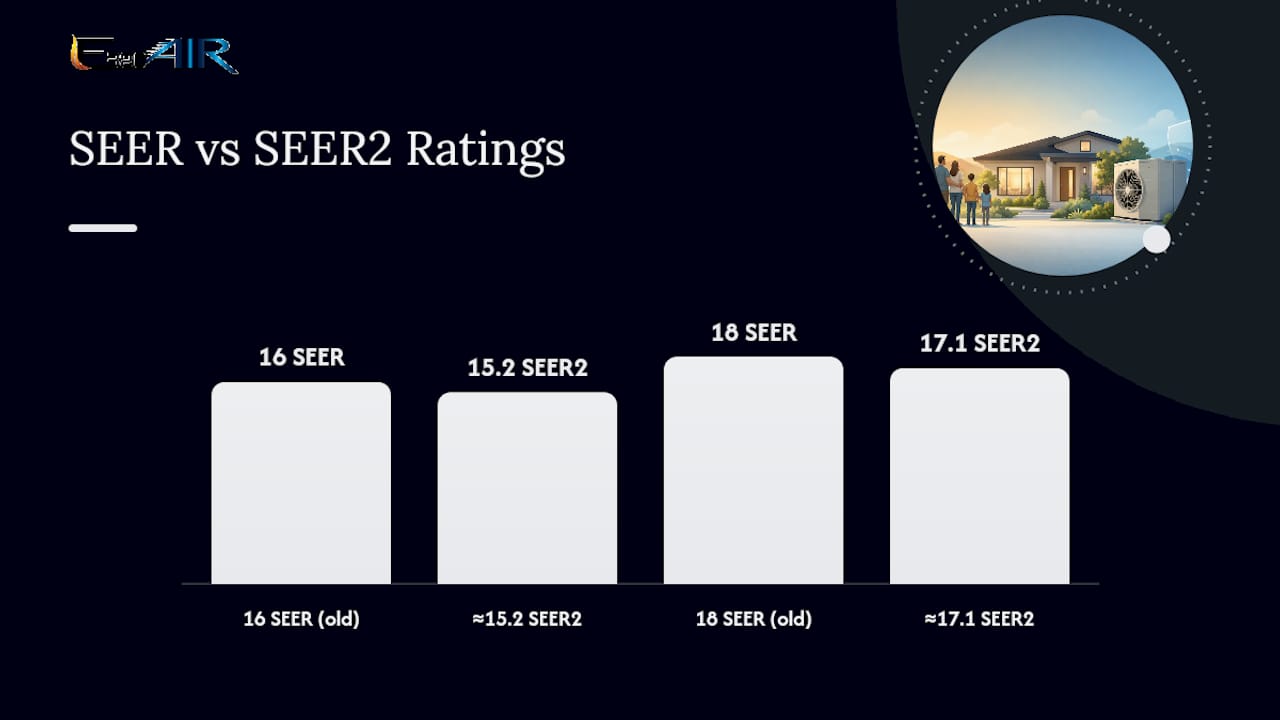
Use SEER2 when comparing any new air conditioner or heat pump. It's the current, more realistic efficiency score, and it replaced SEER for good starting in 2023. A lower SEER2 number on the same equipment isn't worse hardware. It reflects a tougher lab test. As a rough rule, a 16 SEER unit rates close to 15.2 SEER2, and most homeowners land in a comfortable, cost-effective range between 16 and 18 SEER2.
TL;DR:
- SEER2 ratings are roughly 4 to 5% lower than SEER ratings for the same equipment due to tougher testing conditions that better mimic home ductwork.
- Always verify SEER2 and EER2 ratings with official AHRI certification to ensure accurate performance data, especially for variable-speed models.
- The new testing standard measures at higher static pressure levels, making SEER2 a more realistic indicator of real-world energy efficiency.
- Choosing high-SEER2 equipment makes sense only if the system is properly installed with sealed ducts and accurate load calculations to reach its rated efficiency.
- For most homeowners, efficiency benefits outweigh costs when selecting systems rated between 16 and 18 SEER2, particularly in hot, humid climates with longer cooling seasons.
Table of Contents
- SEER2 vs SEER: What Actually Changed in the Test
- Comparing SEER and SEER2: Conversion Rules That Actually Hold Up
- How SEER2 Should Shape Your Buying Decision
- Why Installation Quality Beats a Higher SEER2 Number
- Reading the Label: SEER2, EER2, HSPF2, and EnergyGuide
- What a Contractor Actually Sees on the Job
- Get Your SEER2 Numbers Verified Before You Buy
- Where to Verify the Rules Yourself
- Sources
- FAQ
SEER2 vs SEER: What Actually Changed in the Test
The letters look almost identical, but the test behind them isn't. The U.S. Department of Energy updated the testing procedure for central air conditioners and heat pumps, and the new SEER2, EER2, and HSPF2 ratings became mandatory on January 1, 2023, according to the Federal Register rulemaking. That's not a marketing refresh. It's a legal change to how every manufacturer must measure and label equipment sold in the United States.
The core difference sits in something called external static pressure, essentially the resistance a blower has to push air against inside real ductwork.
- The old SEER test (M1 predecessor) measured performance at just 0.1 inches of water column, barely any resistance at all.
- The new M1 test method measures at 0.5 inches of water column, roughly five times higher, which mimics the tighter, twistier ducts found in actual homes.
- That single change is why SEER2 numbers run roughly 4 to 5% lower than SEER for otherwise identical equipment, according to testing data from HVACDatabase.
Manufacturers didn't quietly make weaker air conditioners. They started testing under conditions that actually resemble your attic and your ducts, and the blower motor and coil design underneath a high-SEER2 unit still has to work harder to hit that number, which is precisely why it's a better predictor of your real energy bill.
Comparing SEER and SEER2: Conversion Rules That Actually Hold Up
You'll still see plenty of older SEER-rated equipment and spec sheets floating around, so you need a way to translate one into the other without getting fooled.
The rough conversion works both directions:
- To estimate old SEER from SEER2, multiply by about 1.047.
- To estimate SEER2 from an older SEER number, multiply by roughly 0.95, per HVAC Base's conversion guidance.
- A 16 SEER unit lands around 15.2 SEER2. An 18 SEER unit lands close to 17.1 SEER2.
Statistic Callout: SEER2 ratings typically sit 4 to 5% lower than the old SEER number for the same physical equipment. That gap is the testing method, not a performance drop.
That math gets shakier with variable-speed and multi-stage systems, since their output changes with conditions in ways a flat multiplier can't capture cleanly. When you're comparing a specific model, skip the mental math and pull the SEER Rating Explained equipment's AHRI certificate directly, which lists the verified, tested SEER2 number rather than an estimate.
How SEER2 Should Shape Your Buying Decision
Efficiency ratings only matter in the context of how much your system actually runs. A house in Phoenix and a house in Seattle have completely different math, even with an identical unit sitting in the backyard.
- Figure out your cooling hours first. Homes running fewer than roughly 1,000 cooling hours a year see paybacks on anything above 16 SEER2 stretch past a decade according to HVACDatabase's analysis. In that situation, sealing ducts or upgrading insulation often pays back faster than chasing a higher tier, making envelope improvements that can change HVAC sizing a smart first step.
- Match the tier to your climate. Most homeowners in moderate climates find their sweet spot between 16 and 18 SEER2. Homes in very hot, humid regions running the AC most of the year get more mileage out of 18 SEER2 and above, since every efficiency point compounds across thousands of run hours.
- Price the premium honestly. High-SEER2 equipment often carries a significantly higher upfront cost compared to baseline units, per HVACDatabase's cost breakdown. That premium needs to be weighed against your actual annual cooling load, not just the sticker on the box.
- Check regional minimums before you shop. DOE ties minimum SEER2 levels to region: the North sits around 13.4 SEER2, while the Southeast and Southwest require roughly 14.3 SEER2 for many split systems, according to Service Nation's regional breakdown. Contractors have to match equipment to your zip code, which affects what they can legally install for you in the first place.
- Factor in rebates before comparing payback windows. Utility and manufacturer rebates shift the breakeven point considerably, sometimes cutting years off a premium unit's payback timeline.
Pro Tip: Before you fixate on the SEER2 number, look at duct sealing and thermostat upgrades. A lot of homeowners get a faster return from efficiency upgrades than from jumping one full SEER2 tier.
Why Installation Quality Beats a Higher SEER2 Number
A high-SEER2 unit installed badly performs like a mediocre one. That's not an exaggeration. It's how airflow physics works.
Undersized or leaky ductwork forces the blower to fight static pressure well beyond what the equipment was designed for, which chips away at real-world efficiency no matter what the EnergyGuide label says. Oversized equipment short-cycles, meaning it never runs long enough to properly dehumidify or reach steady, efficient operation. Both problems quietly erase the advantage you paid extra for.
A properly sized and correctly installed mid-range SEER2 system can outperform a poorly installed premium unit, according to ACCalculator's field analysis. That single point should reorder your priorities before you ever compare brand names.
Before signing any installation contract, require these checks:
- A Manual J load calculation specific to your home, not a rough estimate based on square footage alone.
- Duct sealing and static pressure testing, especially in homes with older or undersized ductwork.
- Matched indoor and outdoor components, since mismatched coils and condensers rarely hit their rated SEER2 in practice.
Pro Tip: Ask your contractor to show you the measured static pressure reading after installation, not just before. That single number tells you whether your ducts can actually deliver the efficiency you paid for.
Reading the Label: SEER2, EER2, HSPF2, and EnergyGuide
The yellow EnergyGuide sticker is your fastest gut check, but only if you know what to look for on it.
- Confirm the sticker lists a SEER2 number, not a leftover SEER figure from old inventory still sitting on a shelf.
- Check EER2, which measures efficiency at peak, high-heat conditions rather than a seasonal average. Homes in hot climates should weigh this number heavily, since it reflects performance on the exact days your system works hardest, as noted in ACCalculator's efficiency breakdown. Read more in our EER rating explainer.
- For heat pumps, check HSPF2 for heating-season performance, since a unit can be strong on cooling and mediocre on heating.
- Always ask for the AHRI certificate, the verified third-party test result tied to your exact matched system, not just the outdoor unit alone.
Treat a missing SEER2 figure, no AHRI certificate on request, or an unusually low EER2 relative to the SEER2 number as red flags worth walking away from.
What a Contractor Actually Sees on the Job
Homeowners tend to fixate on the number on the box. In the field, the number on the box is only half the story. A system rated at 17 SEER2 that's connected to leaky, undersized ductwork will underperform a well matched 16 SEER2 system with sealed ducts and correct airflow, every time. Before anyone recommends a tier, we verify SEER2 and EER2 against the AHRI certificate, run a proper Manual J load calculation, and inspect the ductwork for leaks and static pressure problems. That order matters more than brand loyalty or chasing the highest number on the shelf. If a quote skips the load calculation and jumps straight to a model number, that's the moment to ask more questions.
— Edward
Get Your SEER2 Numbers Verified Before You Buy
When choosing a contractor for SEER2 tier recommendations, look for a licensed and insured team offering flexible payment options, including financing, that backs recommendations with real diagnostics instead of guesswork.

Before recommending equipment, our technicians run a proper load calculation, check your existing ductwork for leaks and static pressure issues, and confirm the AHRI-certified SEER2 and EER2 numbers on any unit under consideration. That's the difference between a system that hits its rated efficiency and one that quietly underperforms for the next fifteen years. Whether you need a full HVAC installation or want to start with a residential HVAC inspection to see what your current setup is actually costing you, request a quote today and get numbers you can verify, not just a sticker you have to trust.
Where to Verify the Rules Yourself
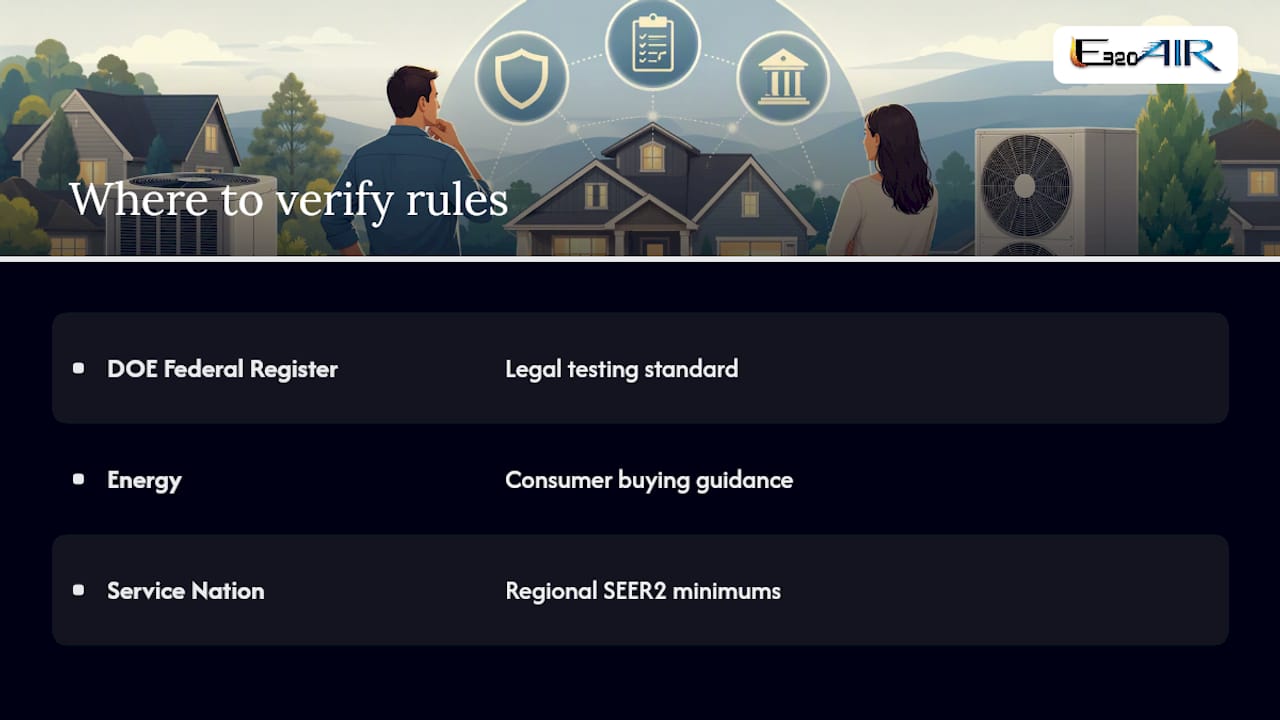
For the legal testing standard, check the DOE's Federal Register rulemaking. For consumer buying guidance, see Energy. For regional minimums, see Service Nation's SEER2 standards breakdown.
Sources
- Energy Conservation Program: Test Procedure for Central Air Conditioners and Heat Pumps (Federal Register)
- SEER vs SEER2: Ratings explained — HVACDatabase
- SEER2 explained — ACCalculator
- Energy
FAQ
Is 15 SEER2 the Same as 16 SEER?
Not exactly, but they're close. A 16 SEER unit converts to roughly 15.2 SEER2 using the standard 0.95 conversion factor, so a 15 SEER2 rating sits just slightly below that older 16 SEER equivalent in real terms.
Can You Convert SEER2 to SEER?
Yes, as a rough estimate: multiply the SEER2 number by about 1.047 to get an approximate old-style SEER figure, based on HVAC Base's conversion guidance. This works fine for straightforward single-stage systems, but variable-speed equipment needs the AHRI certificate for an exact number.
Which Is Better, SEER or SEER2?
SEER2 is the better metric to use, simply because it's the current, legally required standard and it's tested under conditions much closer to a real home's ductwork. SEER isn't "worse" as a concept, it's just an outdated test that used unrealistically low static pressure.
Is a 14.3 SEER2 Rating Good?
A 14.3 SEER2 rating typically meets the minimum regional requirement in areas like the Southeast and Southwest, according to Service Nation's regional standards, rather than representing a high-efficiency choice. Most homeowners looking for a meaningful upgrade over minimum-compliant equipment should look toward the 16 to 18 SEER2 range instead.