
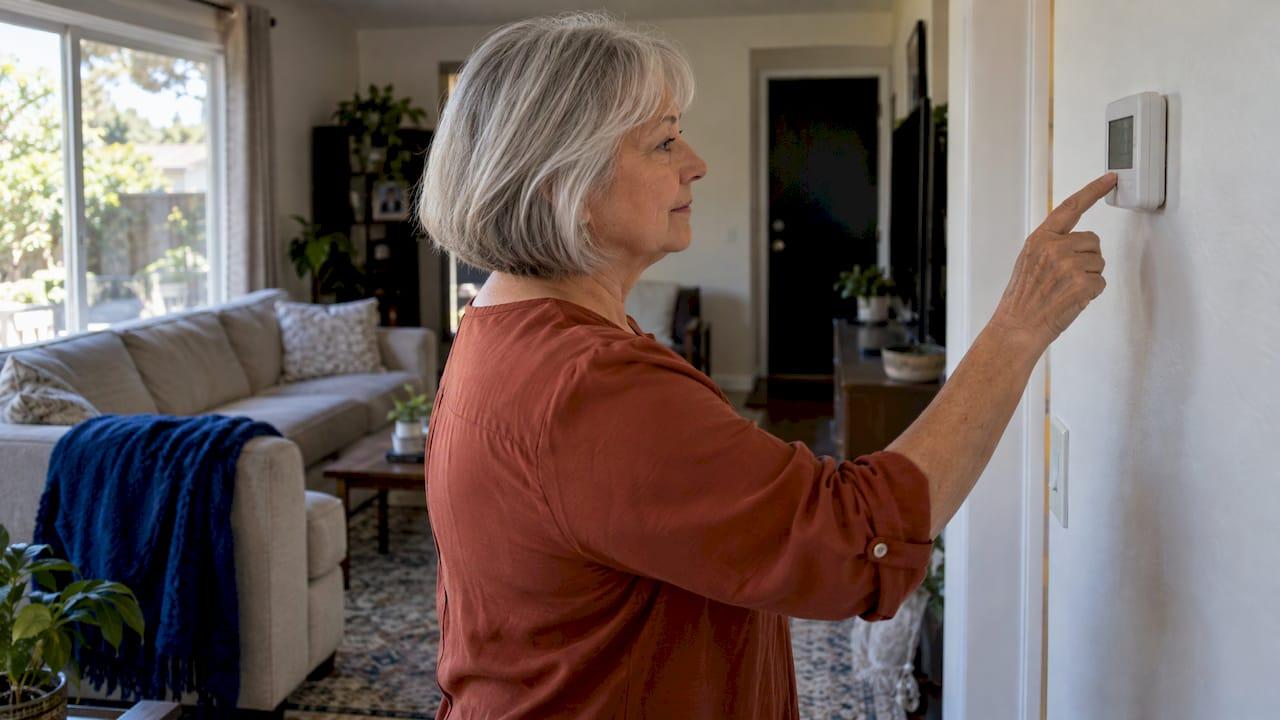
For most Riverside-area homes, a good starting point is 78°F while you are home and awake, a few degrees warmer while you sleep, and a deeper setback when the house is empty. That is a starting point, not a rule. Inland Empire afternoons regularly run past 100°F, and the right number depends on your home's insulation, your humidity, who lives there and how well your system keeps up. If 78°F will not hold on a hot afternoon, the thermostat is usually not the problem, and our technicians at E320air can look at the system itself.
TL;DR
- Start at 75 to 78°F when you are home and need cooling, then nudge the setting up until it stops feeling comfortable.
- Raise it about 4°F at night and about 7°F when nobody is home for a good part of the day.
- California's housing agency recommends 82°F as a general maximum safe indoor temperature, and a lower one when indoor humidity is high.
- A ceiling fan lets you set the thermostat about 4°F higher at the same comfort, as long as someone is in the room.
- Older adults, young children and people with heart, lung or kidney conditions need a cooler ceiling than the general number.
Table of Contents
- What to set when you are home
- Is 78°F too hot for an Inland Empire house?
- Settings for sleeping and for when you are away
- Constant temperature or a schedule?
- Use fans to raise the number, not to cool the room
- How much a higher setting saves
- Settings for older adults, children and heat-sensitive people
- When the thermostat cannot hold your number
- Get your system ready to hold the setting
- FAQ
- Sources
What to set when you are home
The number you see most often is 78°F, and it has a real source. As reported by the Desert Sun, the Department of Energy and ENERGY STAR suggest starting at 75 to 78°F during the day, and PG&E recommends 78°F or higher when you are home, health permitting.
Treat that as a range to test, not a mandate. ABC10 notes that the Department of Energy does not name a magic number. Its advice is to set the thermostat as high as is comfortable while you are home and need cooling. The familiar 78, 82 and 85 figures come from a 2009 ENERGY STAR schedule that the EPA later said was never a mandate.
A practical way to find your number:
- Set the thermostat to 76°F for a few days and live with it.
- Move it up one degree every couple of days.
- Stop at the warmest setting where you do not notice the heat, do not sleep worse and do not feel sticky.
- Write that number down as your daytime baseline. Everything else in this guide is an offset from it.
In a dry inland afternoon, many households land at 78°F. In a house with west-facing windows, a hot attic or ductwork running through unconditioned space, 76°F may be the real comfortable number. That gap often comes from the building, not from your preferences. Our guide to attic ventilation and HVAC in Inland Empire homes explains why some rooms never seem to cool down.
Is 78°F too hot for an Inland Empire house?
For most healthy adults, 78°F is within a comfortable and defensible range. The more useful question is where the upper limit sits, and California has now put a number on it.
The state's Department of Housing and Community Development, in its AB 209 policy recommendations, recommends that California consider a general maximum safe indoor air temperature of 82°F for homes. That is a ceiling for safety, not a comfort target. You would not choose to live at 82°F all summer, but it tells you that a setting in the high 70s sits well inside the safe zone for most people.
Why humidity moves the limit
The same report explains that humidity reduces sweat evaporation and raises the body's heat load. So the safe maximum drops as indoor relative humidity (the share of moisture the air is holding) rises above 60%. Per the report's tables, built on the ASHRAE 55-2023 comfort standard, the limit is 81°F at 60 to 69% humidity and 78°F at 90% or more without air movement. With fans moving air, the limit is 4°F higher.

Inland Empire summers are mostly dry, but humid spells and monsoon-pattern days happen, and a closed-up house with cooking, showers and many people inside can feel muggy. If your 78°F feels clammy, humidity is the likely reason, and a longer, steadier cooling cycle helps because it removes more moisture from the air.
How hot it actually gets
The same HCD report lists Riverside's 99th percentile outdoor temperatures, meaning the level exceeded only on the hottest 1% of hours: 93°F in May, 100°F in June, 98°F in July and August, and 101°F in both September and October. Note that last part. Cooling season here does not end after Labor Day, and your thermostat plan should not either.
Settings for sleeping and for when you are away
Once you have a daytime baseline, the other settings are offsets from it. Per the Desert Sun's summary, ENERGY STAR recommends raising the temperature about 4°F while you sleep, and DOE and ENERGY STAR say to raise the baseline by 7°F when no one is home.
From a 78°F baseline, that works out like this:
| Situation | Offset from baseline | Example setting |
|---|---|---|
| Home and awake | None | 78°F |
| Asleep | About +4°F | 82°F |
| Away from home | About +7°F | 85°F |
Those are the published guideline figures, and you should adjust them to your own house. Some people sleep poorly above the mid-70s, and a bedroom that holds heat from the afternoon may need a lower setting than the table suggests. If you keep your daytime baseline at 76°F, the offsets give 80°F asleep and 83°F away, which is still a sensible schedule.
How long you are gone matters too. The Department of Energy's rule of thumb, as relayed by The HVAC Brief, is that adjusting the temperature makes sense when the house is empty for about four hours or more during the day. For a quick errand, leave it alone.
A programmable or smart thermostat handles this automatically, so you are not relying on remembering to change it on the way out the door. Set the away period to begin a little after you leave and the return setting to start before you get home.
Constant temperature or a schedule?
This is the question people argue about most, and the research gives a more careful answer than either camp.
The physics is simple. As the Department of Energy explains, a warmer house while you are gone slows the heat sneaking in, so the system has less to fight. The smaller the gap between indoor and outdoor temperature, the lower the cooling bill. Letting the house warm up while you are out therefore saves energy, and you do not pay for the system to hold a low temperature for an empty home.
The tricky part is pre-cooling, which means cooling the house extra before the hottest hours, then letting it drift up. A Department of Energy Building America study, Residential Mechanical Precooling, found that precooling alone rarely saved energy. A 2°F thermostat setup during peak hours produced estimated annual cooling savings of 2% to 10%. An ACEEE study on residential pre-cooling found that a setup to 78°F during peak hours was needed to save energy in every modeled case. It estimated cooling savings of 15% in a benchmark house and 9% in a high-performance house, with deeper and longer setbacks doing better on hotter days.
What this means in practice: a schedule with a real, sustained setback beats a constant setting, and tiny tweaks do little. If you are on a time-of-use electric rate, where afternoon and evening power costs more, shifting your warmest setting into those hours is where the savings concentrate. We cover that in more detail in our post on California thermostat settings and time-of-use bills.

Use fans to raise the number, not to cool the room
A fan cools you, not the air. The Department of Energy's guidance, as summarized by The HVAC Standard, is that a ceiling fan lets you raise the thermostat about 4°F with no loss of comfort. The HCD humidity tables apply the same 4°F allowance with air movement.
Two habits make this work:
- Turn fans off when you leave the room. They only help people who are in the airflow.
- Do not lean on fans in extreme heat. A UCLA Luskin report on keeping children safe in hot homes notes that when indoor air is hotter than 95°F, fans may cause the body to gain heat rather than lose it, especially in humid conditions.
So a fan is a way to run 82°F feeling like 78°F on a normal hot day. It is not a substitute for working air conditioning during a heat wave.
How much a higher setting saves
Expect modest, real savings, not a miracle. According to the Desert Sun's report, the Department of Energy says turning the thermostat back 7 to 10°F for eight hours a day saves as much as 10% a year on heating and cooling, with savings greater in milder climates. PG&E puts it at roughly 2% on cooling costs for every degree above 78°F. Kiplinger gives the same 7 to 10°F, eight-hour figure.
Read those as ceilings. The 10% figure is an upper bound that assumes a deep setback held for a full eight hours. Inland Empire summers are severe, and the Department of Energy notes savings are smaller in harsher climates, so your percentage will likely be lower than a coastal neighbor's. Your actual result depends on insulation, window shading, duct condition, your electric rate and how efficient the equipment is.
To see your own result, compare your summer kilowatt-hour use month to month on your utility bill rather than relying on a national percentage.
Settings for older adults, children and heat-sensitive people
The general numbers above assume a healthy adult. They do not apply cleanly to everyone in the house.
The HCD report says cardiovascular, respiratory or kidney disease and poor thermoregulation (the body's ability to manage its own temperature) are associated with higher heat susceptibility. It adds that people who need lower temperatures should not be stopped from making accommodations. It also cites a study of elderly people, average age 80.9, in which walking speed, rising from a chair and balance were negatively affected above 82.2°F. Limited mobility also makes it harder for older adults to move to a cooler place during extreme heat.
In practice:
- If an older adult, an infant or someone with a heart, lung or kidney condition lives in the home, keep the occupied rooms cooler than the general guidance, and do not use the 82°F nighttime or 85°F away settings for them.
- A UCLA Luskin report on adapting to extreme heat in California recommends encouraging older adults to stay indoors and hydrated in high heat, and having caretakers who can recognize heat illness check on them more often.
- Ask your doctor what indoor temperature is safe for a specific condition or medication. A thermostat guide cannot answer that for you.
When the thermostat cannot hold your number
If the house will not reach 78°F on a 100°F afternoon, or the system runs nonstop, no setting will fix it. Common causes are low refrigerant, a clogged filter or coil, leaky ducts, an undersized or aging unit, or a hot attic. Our guides on preparing your HVAC for an Inland Empire heat wave and on how desert climate affects HVAC systems walk through what to check before the hottest weeks. For a broader look at the year, see seasonal HVAC needs for Riverside County homeowners.
If the unit is old, an upgrade changes what your thermostat can do. Our post on home AC upgrade options for Moreno Valley homeowners explains what is worth considering.
Our view from the Inland Empire
A thermostat setting is only as good as the system behind it. We hear the same thing from homeowners across Riverside, Moreno Valley, Corona and Redlands: they followed the 78°F advice and the house still would not cool. The number is rarely the issue. Ducts, airflow, refrigerant charge and equipment age decide whether your system can reach it on a 100°F day.
Our approach is to start from comfort and safety, then work back to the setting. Our technicians are licensed and insured, we work on all major brands, and we aim for tailored, energy-efficient solutions with minimal disruption to your day. A well-maintained system holds a higher setting comfortably, which is exactly what saves you money.
Heat does not keep office hours. We are available around the clock, including weekends and holidays, because a system that fails on a holiday afternoon is the one that matters most.
Edward
Get your system ready to hold the setting
E320air handles residential and commercial HVAC across the Inland Empire: repairs, routine maintenance, new equipment, system upgrades and installations, including air conditioning, heating and air quality systems. If your home needs help holding a comfortable temperature, start with our residential HVAC services. If your unit is at the end of its life, see HVAC installation. Flexible payment options, including financing, are available.
For a business with customers or staff to keep cool, our commercial HVAC page covers maintenance and emergency repairs.
FAQ
What is the best thermostat setting for summer in Riverside?
Start at 75 to 78°F while you are home, then raise it a degree at a time until it stops feeling comfortable. Federal and utility guidance points to this range, and the Department of Energy says to set it as high as is comfortable. Your own house, humidity and health decide the final number.
Is 78°F too hot for a house?
For most healthy adults it is a comfortable, safe setting. California's housing agency recommends 82°F as a general maximum safe indoor temperature, and a lower limit when indoor humidity is above 60%. Older adults, young children and people with heart, lung or kidney conditions should stay cooler.
Is it better to keep a house at a constant temperature?
Not in summer. A warmer house while you are away slows heat gain, so the system works less. Studies show the best savings come from a meaningful, sustained setback, such as a setup to 78°F during peak hours, rather than small adjustments.
What should I set the thermostat to at night?
About 4°F above your daytime setting is the ENERGY STAR guideline, so roughly 82°F from a 78°F baseline. If you sleep poorly when it is warm, or an older adult or child sleeps in the house, keep it lower.
Should I use a fan with the AC?
Yes, while you are in the room. A ceiling fan lets you set the thermostat about 4°F higher at the same comfort. Turn it off when you leave, and do not rely on fans when indoor air is above 95°F.
Sources
- Optimal AC settings as California heads into a predicted hot summer, Desert Sun
- Here's how to set your thermostat to save money, ABC10
- Policy Recommendations: Recommended Maximum Safe Indoor Air Temperature, California HCD
- Thermostat Settings: Winter, Summer and Setback Savings, The HVAC Brief
- Residential Mechanical Precooling, DOE Building America
- Maximizing the Benefits of Residential Pre-Cooling, ACEEE
- Thermostat settings that save energy, The HVAC Standard
- Keeping Children Safe by Cooling Homes and Schools in California, UCLA Luskin
- Adapting to Extreme Heat in California, UCLA Luskin
- The Right Temperatures to Set Your Thermostat, Kiplinger