
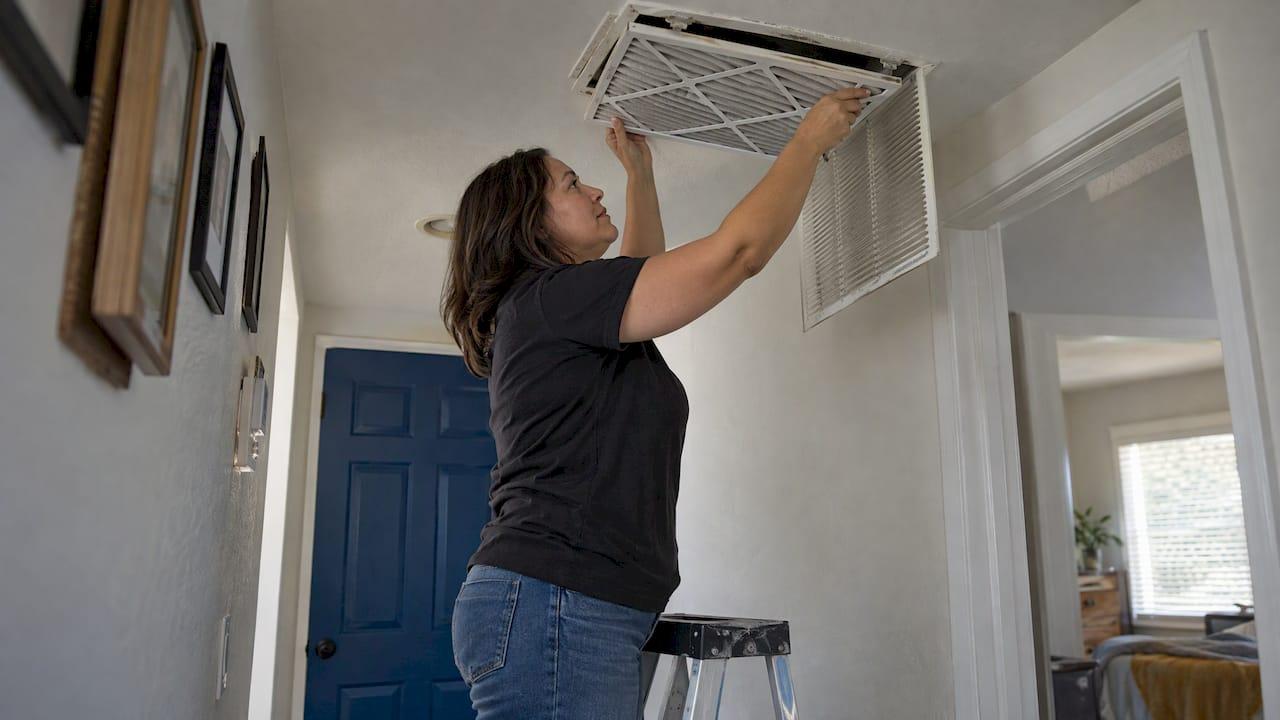
To prepare your HVAC system for a heatwave, do five things before the heat arrives. Have the system serviced, change the air filter, clear space around the outdoor unit, set a sensible thermostat plan, and cut the heat entering the house. Then make a backup plan in case the power or the AC fails. Most of it takes an afternoon. The tune-up is the one job for a licensed technician.
This guide is for homeowners, landlords, and business owners in Riverside, San Bernardino, and Los Angeles counties, where triple-digit days stress equipment every summer and into fall.
TL;DR
- Book a professional pre-season check-up before the heat, not during it. Federal guidance recommends annual service by a contractor.
- Check the air filter monthly in hot weather. A dirty filter cuts airflow and raises energy costs.
- Keep the outdoor unit clear of debris and plants so air moves freely.
- Pre-cool the house early, then hold the thermostat near 78°F in the late afternoon and evening peak.
- Shade windows, and plan for a power outage or AC failure before it happens.
Table of Contents
- Why a heatwave is the hardest test your AC faces
- Get a professional tune-up before the heat arrives
- Change the air filter, and keep checking it
- Clear and protect the outdoor unit
- Set a smart thermostat plan
- Keep the heat out of the house
- Plan for an outage or an AC failure
- Signs your AC needs a technician now
- Our perspective: heatwave readiness is a maintenance habit
- Get your system ready with E320air
- A quick pre-heatwave checklist
- FAQ
- Sources
Why a heatwave is the hardest test your AC faces
An air conditioner on a 75°F day works a little. On a 108°F day in Fontana or Hemet, it runs for hours with almost no break. Every weak point shows up: a clogged filter, dirty coils, a low refrigerant charge, or a worn capacitor.
The stakes go beyond comfort. The EPA notes that during extreme heat, indoor temperatures can rise quickly when HVAC systems stop operating, and that heat exposure can cause serious illnesses such as heat exhaustion and heat stroke. That is why preparation matters more than a quick fix on the hottest day, when repair crews are busiest.
The good news is that most heatwave failures start as small problems you can catch weeks earlier.
Get a professional tune-up before the heat arrives
The EPA advises having air conditioning units cleaned and serviced before heat arrives. ENERGY STAR splits the work clearly: homeowners can handle filters, while a contractor should perform annual pre-season check-ups.
A good pre-season visit typically covers:
- Checking refrigerant pressures and looking for leaks
- Cleaning the condenser and evaporator coils
- Testing capacitors, contactors, and electrical connections
- Clearing the condensate drain
- Checking thermostat operation and airflow at the vents
- Looking at ductwork for obvious leaks or disconnections
Do not wait for the first 100°F forecast. Once a heatwave is on the way, service calendars fill quickly. If you have not had a tune-up this year, schedule one in the cooler months so a weak part is replaced before it fails. Heat pump owners can use our heat pump maintenance checklist to see what a visit should include.
Also run a short test. Set the thermostat to cool and drop it a few degrees below room temperature. Within a few minutes you should feel cold air at the vents and hear the outdoor unit start. If you do not, our air conditioner troubleshooting guide walks through the common causes before you call.
Change the air filter, and keep checking it
The filter is the cheapest and fastest upgrade you can make. ENERGY STAR says a dirty filter can increase energy costs and damage equipment, and that airflow problems can reduce a system's efficiency by up to 15 percent. It recommends inspecting, cleaning, or changing filters once a month. The Department of Energy gives the same monthly interval, or as recommended by your HVAC contractor.
In the Inland Empire, dust, pollen, and seasonal smoke clog filters faster than in milder places. Check yours monthly through summer and fall, and hold it up to a light. If you cannot see light through it, replace it.
Choosing a filter
Check your filter's size on its frame, and use a filter your system is rated for. During smoky periods, the EPA recommends a MERV 13 or higher filter to capture fine particles. It adds that most furnaces and HVAC systems can handle MERV 13 if the filter is replaced frequently. Ask your technician which rating suits your equipment. Our HVAC filter replacement guide for California homes covers sizes, ratings, and schedules. If you are stocking up, comparing air conditioners on sale this week also helps you see what replacement units and related supplies cost per unit.
Keep a spare filter on hand before the heat starts. You do not want to run to the store on a 110°F afternoon.
Clear and protect the outdoor unit

The condenser outside your home rejects the heat pulled from inside. If air cannot move through it, the system works harder and cools less.
The EPA recommends cleaning and trimming around outdoor HVAC units so air can flow freely, and washing dust and dirt from cooling coils. In practice:
- Turn off power to the unit at the disconnect or breaker before you touch it.
- Remove leaves, trash bags, and cottonwood fluff from around the cabinet.
- Trim shrubs and grass so nothing crowds the unit. Leave generous clearance on every side and above.
- Gently rinse the outside of the fins with a garden hose from the outside in. Never use a pressure washer, which bends the fins.
- Do not stack storage, planters, or covers against the unit.
If the fins are bent, matted with grime, or the coil is heavily fouled, leave the deeper cleaning to a technician. A professional coil cleaning reaches parts a hose cannot.
Set a smart thermostat plan
The goal in a heatwave is steady cooling, not a desperate drop to 68°F. The Department of Energy and ENERGY STAR recommend setting the thermostat to 75 to 78°F during the day and raising it by 7°F when no one is home. The DOE says running at 78°F instead of 72°F can save between 6 and 18 percent on your cooling bill.

Pre-cool, then ease off at peak hours
Utilities across Southern California ask customers to shift cooling away from the evening peak. San Diego Gas & Electric advises pre-cooling your home earlier in the day, then, health permitting, setting the thermostat to 78°F or higher between 4 p.m. and 9 p.m. Southern California Edison suggests 78 degrees when home and 85 degrees or off when away. If you are on a time-of-use plan, see our guide to California thermostat settings that beat TOU bills.
A workable heatwave schedule looks like this:
| Time of day | Thermostat approach |
|---|---|
| Morning | Pre-cool the house while outdoor air is still cooler |
| Midday | Hold 75 to 78°F, with blinds closed |
| 4 p.m. to 9 p.m. | Raise to 78°F or higher if health allows |
| Away from home | Raise about 7°F, do not shut the system off |
| Overnight | Cool to a comfortable level if the house still holds heat |
The schedule above combines the DOE and utility guidance cited here. Your own comfort and health come first. Infants, older adults, and people with medical conditions may need cooler settings, so ask your doctor what temperature is safe for you.
One more point: the DOE's consumer guide says that when you are away in summer, keep the system running to avoid moisture build-up that could produce mold. Restarting a unit makes it work harder and longer. A higher setback is better than turning it off.
Be careful with fans
Fans help at moderate temperatures. The Culver City Fire Department notes that fans used with AC can make you feel cooler at higher thermostat settings. But they have limits. The EPA states that electric fans should not be used for cooling when room temperature reaches the mid-90s or higher, because they will not prevent heat-related illness. The Los Angeles Regional Collaborative adds that above 95°F indoors, fans become ineffective and can dehydrate you faster.
The EPA also suggests cleaning fan blades so the motor runs efficiently. Use ceiling fans in occupied rooms only, and turn them off when you leave.
Keep the heat out of the house
Every degree of sun you block is a degree your AC does not have to remove.
- Close window coverings during the day. The DOE advises keeping window coverings closed during the day in summer to block heat from the sun.
- Use exterior shade where you can. The EPA says outdoor awnings and louvers can reduce the heat entering a home more than indoor shades. It recommends shading windows that get morning and afternoon sun.
- Seal air leaks. The Culver City Fire Department suggests weather-stripping to seal leaks. Check door bottoms, window frames, and attic hatches.
- Shift heat-producing chores. Run the oven, dryer, and dishwasher early in the morning or late at night. Culver City's guidance also suggests unplugging devices you are not using.
Open or closed windows?
The EPA's rule of thumb: in general, if the air outside is hotter than inside, keep windows closed. If it is cooler, open the shades and windows. That means opening up at night or early morning in the Inland Empire's dry climate, then sealing up by mid-morning.
Two cautions. The EPA says you may need to open windows slightly for ventilation during activities that reduce indoor air quality, and to consider outdoor air quality first. It also notes that hot weather can worsen ozone, so check your local air quality before airing out the house. For more ideas on a hot climate, see our home cooling solutions list for hot climates in 2026.
Plan for an outage or an AC failure
Heatwaves strain the grid. Rolling outages and equipment failures tend to arrive on the same afternoon. Decide ahead of time what you will do.
- Know where to go. The Culver City Fire Department advises knowing where you will go if your AC fails, such as a cooling center or a friend or relative with working AC. Look up your city's cooling centers now.
- Generators go outside. The EPA warns that if you use a generator during an outage, use it only outdoors and away from doors, windows, and vents. Carbon monoxide is deadly, builds up quickly, and can linger for hours.
- Limit outdoor activity. The EPA suggests keeping it to morning and evening, and never leaving a person or animal alone in a parked car.
- Protect equipment. If power flickers, give the AC a few minutes before restarting so the compressor is not strained. Ask a technician about surge protection for your system.
For anyone with heat illness symptoms such as confusion, fainting, or a very high body temperature, call 911.
Signs your AC needs a technician now
Some problems are not DIY. Turn the system off and call a licensed HVAC contractor if you notice:
- Warm air from the vents while the outdoor unit runs
- Ice on the refrigerant lines or indoor coil (see why an HVAC system freezes in summer)
- A unit that short-cycles, turning on and off every few minutes
- Burning smells, buzzing, or a breaker that keeps tripping
- Water pooling near the indoor unit
- A sharp rise in your electric bill without a change in usage
If your system is old and failing repeatedly, replacement may beat another repair. Our guide to extending HVAC lifespan shows how to get the most out of what you have.
Our perspective: heatwave readiness is a maintenance habit
We see the same pattern every summer in the Inland Empire. The calls that come in during a heatwave are rarely about a sudden failure. They are about a filter that went unchanged for months, a coil caked with dust, or a unit that was already struggling in June.
That is why we treat maintenance as the real heatwave preparation. A pre-season visit lets a technician find the weak part while the weather is mild and the schedule is open. You get a calm repair instead of an emergency.
We also think comfort and efficiency should go together. Our approach is built around tailored, energy-efficient solutions with minimal disruption to your day. We service all major brands, and we offer flexible payment options, including financing, so a needed repair or upgrade is not postponed until the hottest week.
If your system is aging, an upgrade or new installation sized for your home can cool more evenly and run with less strain. Our licensed and insured technicians can look at your equipment and tell you plainly what it needs.
Edward
Get your system ready with E320air
E320air handles residential and commercial HVAC repair, routine maintenance, system upgrades, and new equipment installation across the Inland Empire, from Riverside and Corona to Redlands, Rancho Cucamonga, and Hemet. Our licensed and insured technicians work on all major brands, and we say our service is available around the clock, including weekends and holidays.
If you want a pre-heatwave check, start with our residential HVAC services. If your system is at the end of its life, see our HVAC installation page. Business owners can look at our commercial HVAC and maintenance services. Contact us to discuss your system and your payment options.
A quick pre-heatwave checklist
Print this or save it on your phone.
- Schedule a professional tune-up (refrigerant, coils, electrical, drain).
- Replace the air filter and buy a spare.
- Clear the outdoor unit, with the power off, and trim plants back.
- Test cooling and confirm cold air at the vents.
- Program the thermostat: pre-cool in the morning, 78°F or higher at the evening peak.
- Install or check exterior shade, and close blinds on sunny windows.
- Seal leaks around doors and windows.
- Locate the nearest cooling center and keep phone numbers handy.
- Confirm that any generator will be used only outdoors.
- Save your HVAC contractor's number where everyone in the house can find it.
FAQ
How do I keep my house cool in 100-degree weather?
Pre-cool the house in the morning, keep blinds closed on sunny windows, and hold the thermostat near 78°F during the day. Raise it a little during the 4 p.m. to 9 p.m. peak if your health allows. Avoid running ovens and dryers during the hottest hours. Seal air leaks and add exterior shade where possible.
Should I open or close my windows during a heatwave?
Close them when it is hotter outside than inside, and open them when the outdoor air is cooler, such as overnight. The EPA also advises checking outdoor air quality first, since hot weather can worsen ozone. If air quality is poor, keep windows shut and rely on your filtered HVAC system.
Is it bad to turn my AC off when I leave the house?
It is better to raise the setting than to switch the system off. The DOE advises raising the thermostat about 7°F when no one is home. It also says to keep the system running in summer to avoid moisture build-up that could cause mold, and that restarting makes the unit work harder.
How often should I change my AC filter during a heatwave?
Check it at least monthly, and change it when it looks dirty. ENERGY STAR recommends inspecting, cleaning, or changing filters once a month. Homes with pets, dust, or smoky air may need changes more often. Your technician can recommend the right schedule for your system.
Can I service my AC myself?
You can handle filters and clear debris around the outdoor unit with the power off. Refrigerant, electrical parts, and coil cleaning should be left to a licensed technician. ENERGY STAR says a contractor should perform annual pre-season check-ups.
Sources
- Extreme Heat | US EPA
- Extreme Heat and Indoor Air Quality | US EPA
- Emergencies and Indoor Air Quality | US EPA
- Preparing for Smoke and Heat | US EPA
- Maintenance Checklist | ENERGY STAR
- Home Cooling Systems | Department of Energy
- Top 11 Things You Didn't Know About Saving Energy at Home: Summer Edition | Department of Energy
- Consumer Guide to Home Heating and Cooling | Department of Energy
- Heat Wave | San Diego Gas & Electric
- Crews Ready for Another Round of High Temps | Southern California Edison
- Extreme Heat | Culver City Fire Department
- Cool Down Your Home | Los Angeles Regional Collaborative