
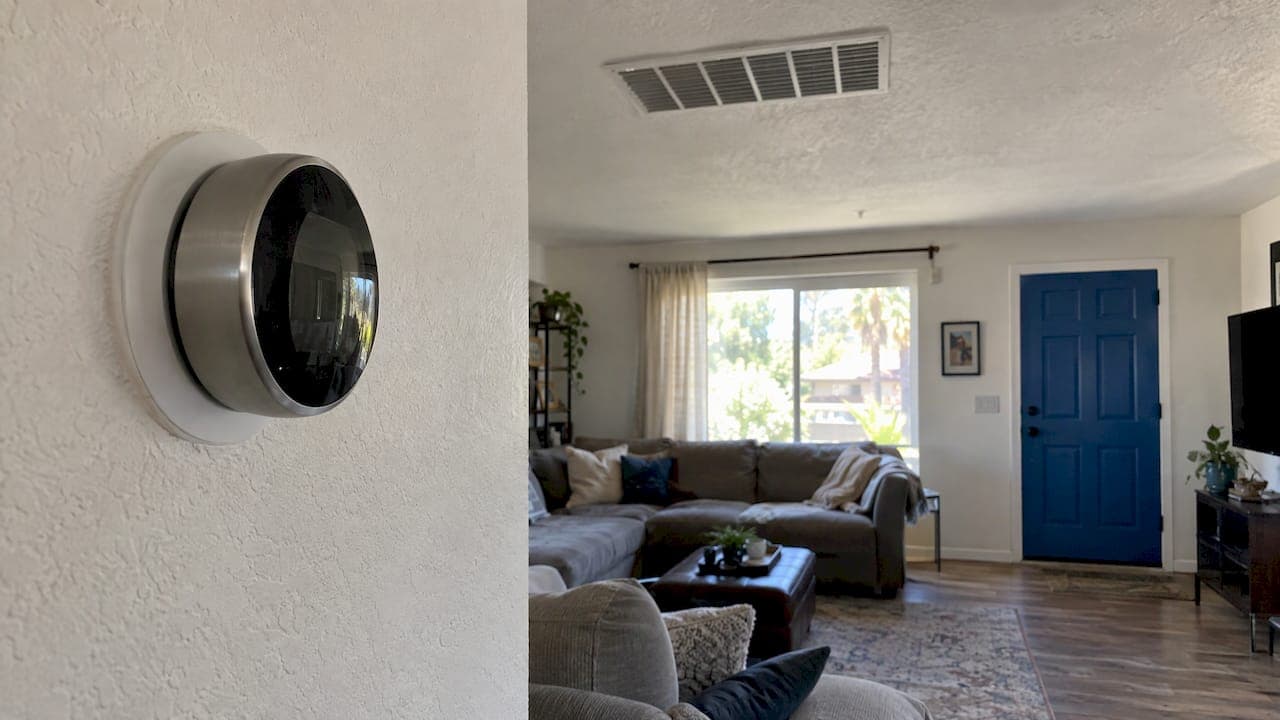
Demand response for HVAC means your utility, or an authorized aggregator, asks your air conditioning or heating system to use less power for a few hours when the grid is strained. It usually happens through a smart thermostat, not through the equipment itself. In return, you typically earn bill credits or rewards, and you can usually override an event if you get uncomfortable. If you live in the Inland Empire, where summer afternoons push cooling demand hard, it is one of the few programs that pays you for something your system already does.
Below we explain what happens during an event, what the settings look like, how California's rules differ from voluntary programs, and how to check what your own utility offers.
TL;DR
- Demand response temporarily reduces or shifts your HVAC power use during peak grid demand, mostly by nudging the thermostat setpoint a few degrees.
- The connection point is the control layer (a qualifying smart thermostat), so the right thermostat and a properly working system matter more than new equipment.
- Voluntary programs pay credits and usually let you opt out of events. California code separately requires demand-responsive controls in certain new and altered nonresidential and multifamily systems.
- Southern California Edison (SCE) lists several residential options with published credits. Terms change, so confirm on the utility's page before enrolling.
- A tuned, well-sealed system rides through events more comfortably than a struggling one.
Table of Contents
- What demand response means for your HVAC system
- What actually happens during an event
- Can you override an event?
- Inland Empire programs: what SCE lists
- Comfort, bills and the physics of your house
- Demand response in larger systems and commercial buildings
- California's code: when demand response is required
- Perspective
- Get your system ready for the next peak season
- Before you enroll: a short checklist
- FAQ
- Sources
What demand response means for your HVAC system
Demand response refers to programs that temporarily reduce or shift electricity use during periods of high demand, so the grid avoids instability, brownouts or outages. For a home, the practical point of contact is the smart thermostat or control system rather than the HVAC equipment. Your furnace, heat pump or air conditioner does not need to be "demand response equipment." The thermostat receives the signal and changes how the system runs.
ENERGY STAR describes it plainly: some local utilities let homeowners help manage the electricity load by accepting a signal that lets a device such as a thermostat or smart room air conditioner reduce load remotely during critical times.
HVAC is the target because of scale. The U.S. Department of Energy notes that residential air conditioning is one of the largest loads in the home and generally coincides with the highest peak on the grid. Airzone Control reports that cooling can represent more than 70 percent of electricity demand at the summer peak. That is why a few degrees on millions of thermostats matter to a utility.
What actually happens during an event
A demand response event is not a blackout for your AC. In a thermostat program, the air conditioner keeps running. The setpoint moves.
The Department of Energy explains that enrolled smart thermostats allow setpoint control that keeps the AC running during events, can pre-cool before them, and makes it easier for homeowners to override if they are uncomfortable.
Programs across the country follow a similar pattern, though the details differ:
- Pre-conditioning. Before the event, the home may be pre-cooled. Greater Grid's Power Savers program says the thermostat may be adjusted down 3 degrees before an event in some cases to pre-cool the home.
- The event itself. The setpoint rises. In Power Savers, the adjustment is up to 4 degrees above the current temperature, typically lasts no more than 4 hours, and occurs between 12 and 9 p.m.
- Recovery. When the event ends, the thermostat returns to your schedule. The NEEA research names this stage snapback: an increase in load right after an event as the system recovers.
For comparison, National Grid's program in the Northeast says most events last about three to four hours, with typically 10 to 15 electric events each summer. Those numbers describe that program, not yours, but they give a realistic picture of the commitment.
Setup you need
Sensi's FAQ explains that demand response programs require a smart thermostat connected to Wi-Fi, and that customers can opt out of an event that arrives at an inconvenient time. If your thermostat loses its connection, it cannot receive the signal. Check the thermostat model against your utility's eligible device list before you buy.
If you are not sure what a smart control does beyond the thermostat face, our homeowner's guide to smart HVAC controls explains the pieces.
Can you override an event?
Usually yes, and this is where today's programs differ from older ones. The Department of Energy describes the original approach, Direct Load Control, as a relay on the outdoor unit that the utility could switch off during extreme grid congestion, with no way for homeowners to override and no explanation for why the house was warm. Customers typically received an annual bill credit.
Modern thermostat programs are gentler. Power Savers states that you can opt out of an event at any time from your mobile device, web browser or thermostat. Other programs build limits into the terms. SCE's Summer Discount Plan automatically cycles the A/C off and on during events, and an override option lets you skip up to 5 events per year.
Read the terms for what opting out costs. SDG&E's thermostat program, for example, lets customers opt out of an adjustment or the whole program, but they stop receiving rebates or incentives if they do. That is San Diego, not the Inland Empire, but it shows why the fine print matters.
Inland Empire programs: what SCE lists
Most Inland Empire homes buy electricity from SCE, though some cities have municipal utilities, so start by checking your bill to see who serves your address. SCE's demand response page lists several residential options with published figures:
| Program | What SCE lists | What it needs |
|---|---|---|
| Smart Energy Program | One-time $75 sign-up credit and up to $50 in annual bill credits for staying enrolled June 1 through September 30 | Qualifying smart thermostat and central A/C. SCE adjusts the thermostat by up to four degrees during events |
| Summer Discount Plan | Up to $160 in summer bill credits | Central A/C. SCE cycles the A/C off and on during events |
| Critical Peak Pricing | Average savings of $50 per year | A rate that charges more on critical peak days |
| SmartShift Rewards | Average savings of $60 per year | See SCE's page for device requirements |
All figures come from SCE's demand response programs page, and programs, credits and enrollment windows change. Treat the table as a guide to what to look for, and confirm current terms with SCE before you enroll.
If your home is served by another California utility, the structure is similar. PG&E's programs, for example, require an eligible rate schedule and an interval meter. Ask your utility which programs your meter and rate qualify for.
Do the math with your own habits in mind. Credits of $50 to $160 are real, but the better question is whether you can live with a 4-degree setpoint rise on a 100-degree Fontana or Hemet afternoon. If someone works from home or you have a baby or elderly relative, a program with override options fits better than one that cycles the compressor.
Comfort, bills and the physics of your house
The NEEA report on residential HVAC is candid about the central tradeoff. Heating and cooling are needed most during the hottest and coldest periods, which are often the times of greatest grid need. It also says the home's "thermal storage" is tied to customer satisfaction: any setpoint change is felt within hours if the home is occupied.
So your house determines how an event feels. Airzone Control makes the same point: if the home is already comfortable, you may not notice a setpoint change for an hour or two. Several things decide whether your home holds temperature through an event:
- Envelope. NEEA lists weatherization as a key aspect: a more effective envelope reduces losses and increases thermal storage. Attic insulation, sealed ducts, shaded west windows and good glazing all buy you time. For commercial buildings, the roof is a large part of this, and energy-efficient commercial roofing is one way owners reduce the cooling load before demand response even starts.
- Duct condition. Leaky ducts in a hot attic undo pre-cooling. Cool air you made at 1 p.m. should end up in the rooms.
- System sizing and staging. An oversized or struggling system cycles hard during recovery. Our explainer on HVAC equipment staging shows why multi-stage equipment handles gentle setpoint changes smoothly.
- Thermostat settings. Pre-cooling, schedules and time-of-use rates all interact. Our piece on California thermostat settings that work with TOU bills covers the practical side, and the thermostat efficiency guide explains how the control affects the system.
For a deeper look at how design drives comfort, see how HVAC design affects comfort and efficiency.
Demand response in larger systems and commercial buildings
Commercial controls can do more than a single thermostat. PG&E's Automated Demand Response manual lists common project types: global temperature adjustment that raises setpoints by two to eight degrees, HVAC equipment cycling, and other adjustments such as lowering duct static pressure, shutting off auxiliary fans and pre-cooling. The same manual says ADR programs provide incentives and technical assistance to offset the cost of purchasing and installing controllable devices and ADR controls. That is a PG&E program, so Inland Empire property owners should ask their own utility whether a comparable one exists.

If you manage a retail unit, office or small warehouse, the practical step is the same: find out what your controls can do before you look at programs. A building with a modern control platform and a well-maintained rooftop unit can respond to an event without tenants noticing.
California's code: when demand response is required
Voluntary programs are one thing. California building rules are another. They apply to new construction and certain alterations, not to a homeowner deciding whether to enroll.
The California Energy Commission's 2022 compliance manual says that in nonresidential and multifamily buildings without DDC to the zone level, thermostatic controls for single-zone air conditioners and heat pumps must be demand response thermostats, also called Occupant Controlled Smart Thermostats, with listed exceptions such as zones that need constant temperatures and room air conditioners.
The technical details are specific:
- Appendix JA5 says the thermostat defaults to an event response of +4°F for cooling and -4°F for heating, and occupants can change event responses and settings at any time, including during events.
- Section 110.12 requires demand responsive controls to be a certified OpenADR 2.0a or 2.0b VEN, a certified Baseline Profile OpenADR 3.0 VEN, or certified to respond to such a VEN.
- The same section requires the ability to remotely raise cooling setpoints by 4 degrees or more in noncritical zones, lower heating setpoints by 4 degrees or more, reset to original levels, and adjust the rate of change.
For a contractor, that means choosing and commissioning the right thermostat at installation. For a property owner, it means a replacement or new system on a commercial or multifamily building may need compliant controls, which is worth settling at the quote stage. For efficiency and code more generally, our guide to HVAC economizer benefits and code is a good companion.
Perspective
We see demand response as a controls question first and an equipment question second. The program only works well in a home where the system, the ducts and the thermostat are doing their jobs.
In the Inland Empire, most of the complaints we hear about comfort in July are not about the thermostat. They come from systems that can barely keep up on a hot afternoon, from leaky ductwork or from controls that were never set up properly. If your system is already struggling at 3 p.m., adding a four-degree setpoint rise makes it worse. If it is tuned and maintained, you can take the credits and barely notice the event.
That is why we pair this topic with maintenance and thoughtful upgrades. A checked system with clean coils and correct airflow, plus a thermostat your utility supports, gives you control. You decide when to override. When a system is at the end of its life, a replacement with staged or variable capacity and a compatible control makes participation comfortable instead of a gamble.
Our technicians are licensed and insured, work on all major brands, and tailor recommendations to the home or building in front of them, whether that is an upgrade, a new installation or a repair.
Edward
Get your system ready for the next peak season
If you want to take part in a program, or simply want your home to hold up on the hottest days, E320air can help. We handle residential HVAC service, system enhancements and thermostat upgrades, and we install new equipment across the Inland Empire through our HVAC installation service. Our team is available around the clock, including weekends and holidays, and we offer flexible payment options including financing.
For commercial buildings, our commercial HVAC, maintenance and emergency repair services cover rooftop units and controls. If you are planning a replacement, our guide to top HVAC replacement options for California homes is a good place to start. We do not publish prices, so contact us for a quote based on your property.
Before you enroll: a short checklist
- Find your utility on your electric bill, and open its demand response page.
- Check your thermostat against the eligible device list and confirm it has a stable Wi-Fi connection.
- Read the event terms: maximum setpoint change, typical duration, hours, number of events, and how overrides are handled.
- Know the opt-out consequences. Some programs withhold credits if you leave.
- Have your system serviced before the cooling season so it can handle pre-cooling and recovery.
- Set your own rules. Decide in advance who in the household may override, and when.
FAQ
What is demand response in HVAC?
It is a program or control feature that reduces or shifts your heating or cooling electricity use when grid demand is high. In homes it is usually done by adjusting a smart thermostat's setpoint for a few hours. A utility or authorized aggregator sends the signal, and you typically receive a credit or reward.
Will my air conditioner shut off during an event?
In most thermostat programs, no. The setpoint rises by a few degrees and the system keeps running, often after pre-cooling. Some programs, such as SCE's Summer Discount Plan, cycle the A/C off and on instead. Check which method your program uses before enrolling.
Can I opt out if it gets too hot?
Generally yes. Many programs let you override from the thermostat or an app, and some cap the number of skipped events per year. Read your program's terms, because opting out of the whole program can end your credits.
Do I need a new HVAC system to participate?
Usually not. Residential programs typically need a qualifying smart thermostat controlling a central A/C or heating system, plus Wi-Fi. A system in good working order makes events more comfortable, and an installer can confirm your thermostat's compatibility.
Is demand response required by California law?
Not for a homeowner choosing whether to enroll in a utility program. California's Energy Code does require demand-responsive controls in certain nonresidential and multifamily systems, so owners of those buildings should confirm requirements when replacing or installing equipment.
Sources
- Demand Response and HVAC: How Smart Control Supports a More Resilient Grid (Airzone Control)
- Features to Consider (ENERGY STAR)
- Demand Response Programs and Their Impact on Peak Load (U.S. Department of Energy)
- Power Savers FAQ (Greater Grid)
- Demand Response of Residential HVAC (NEEA)
- Thermostat Program (National Grid ConnectedSolutions)
- Demand Response FAQs (Sensi)
- Demand Response Programs for Homes (SCE)
- Demand Response Smart Thermostat program terms (SDG&E)
- Demand Response Programs (PG&E)
- Automated Demand Response Program Manual 2024-2027 (PG&E)
- 2022 Nonresidential and Multifamily Compliance Manual (California Energy Commission)
- Appendix JA5 Technical Specifications for Occupant Controlled Smart Thermostats (California Energy Commission)
- Section 110.12 Mandatory Requirements for Demand Management (Energy Code Ace)
- Energy efficient commercial roofing