
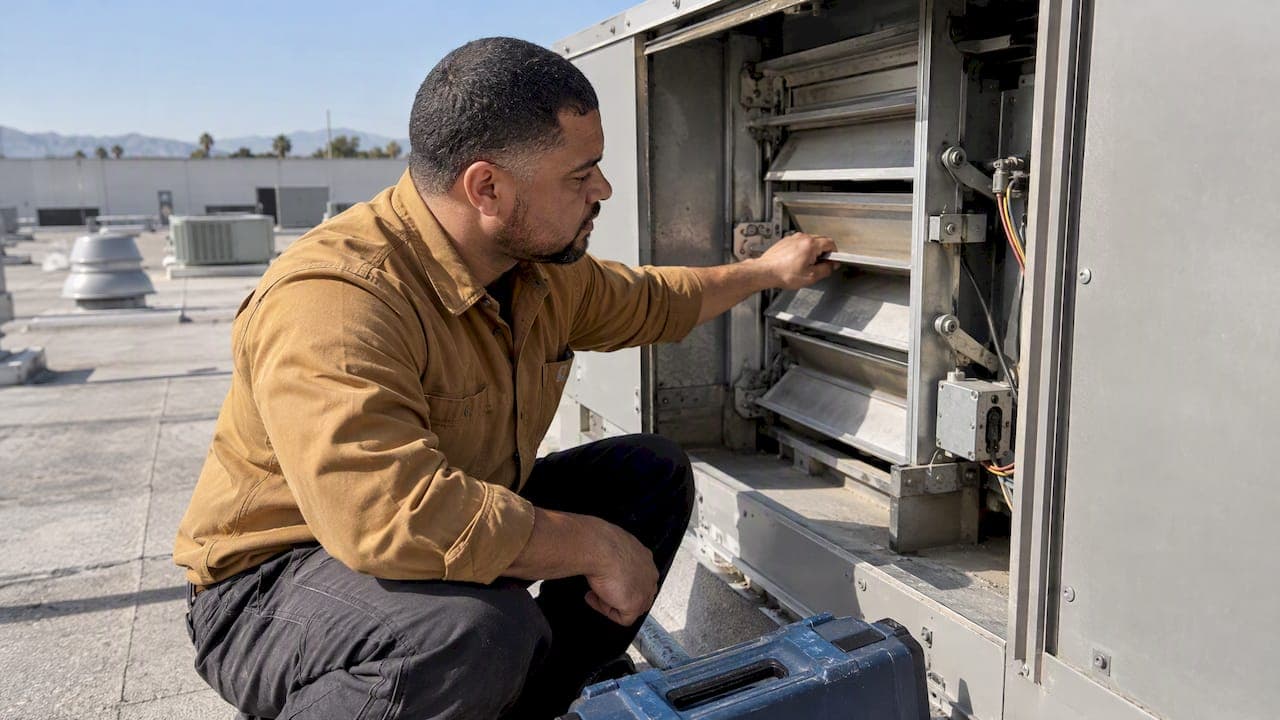
An HVAC economizer lets a cooling system use cool outdoor air instead of running the compressor when outside conditions allow. The main benefits are lower cooling costs, better ventilation and, in California, compliance with Title 24 on many commercial rooftop units. Those benefits only show up when the damper and sensors work. A broken economizer can cost you more than having none.
We are an HVAC contractor serving the Inland Empire, so this guide is written for commercial building owners, landlords and property managers in places like Riverside, Fontana, Ontario and Corona. We also cover homeowners, because the honest answer for a typical house is different.
TL;DR
- An economizer is a set of dampers, sensors and controls that brings in outdoor air for free cooling when it is cool and dry enough.
- Research reviews report cooling energy savings of roughly 6 to 27% in variable air volume systems, depending on climate and setup.
- California's 2025 Energy Code generally requires an economizer on cooling air handlers over 33,000 Btu/hr, so replacing a commercial rooftop unit usually means getting one.
- A stuck damper or drifting sensor turns savings into waste, so seasonal checks matter more than the hardware.
- Standard residential systems generally do not use economizers.
Table of Contents
- What an HVAC economizer actually does
- The energy savings: what is realistic
- Better ventilation and indoor air quality
- Title 24: when California requires an economizer
- The catch: economizers fail quietly
- Do homes need an economizer?
- Economizer or no economizer: how to decide
- Our perspective
- Need a rooftop unit installed or checked?
- FAQ
- Sources
What an HVAC economizer actually does
A conventional air conditioner recirculates indoor air and cools it again and again with refrigerant. An air-side economizer adds a shortcut. When the outside air is cooler than the return air, the unit opens an outdoor air damper, closes the return damper partly or fully, and pulls outside air in. Stale air leaves through an exhaust or relief path. The compressor rests, and the fans do most of the work.
The parts are simple to name:
- Outdoor air, return air and relief dampers that modulate airflow.
- Actuators that move the dampers.
- Temperature and sometimes humidity sensors that decide when outside air is useful.
- A controller that runs the logic and, on newer units, reports faults.
The Pacific Northwest National Laboratory notes that the word "economizer" covers several different devices in HVAC and refrigeration. This article is about the air-side type found on rooftop units and air handlers. Water-side economizers, common in large chilled-water plants, are a separate topic.
The energy savings: what is realistic
Cooling is one of the largest costs for a commercial building, and in the Inland Empire the cooling season is long. An economizer only helps in hours when outside air is cooler than the building needs. That is why climate matters so much.
A 2025 peer-reviewed review of air-side economizers in commercial buildings reports annual cooling energy reductions of 6 to 27% in variable air volume systems, depending on climate and configuration. The same review cites field work in the dry climate of Mojave, California, where optimizations that included economizer controls cut energy use by up to 40% per cooling degree day. That is a specific test, not a promise for your roof.
Trade coverage is consistent on the business case. ACHR News reports that payback is generally under five years. The Business Energy Advisor side of the story is similar: the U.S. Department of Energy lists air economizers among high-impact retrofits for saving energy and improving indoor air quality.
Why Inland Empire weather helps and limits the payoff
Inland Empire summers are hot, so midday free cooling is often unavailable from June through September. The gains come from the shoulder seasons and from cool evenings and mornings, plus a good number of mild winter days when a store, office or warehouse still has internal heat from lighting, equipment and people. Commercial spaces tend to need cooling even when it is cool outside, which is the reason economizers are standard practice on rooftop units. Your actual savings depend on your building's load, schedule and how well the controls are set, so ask for an estimate based on your own building rather than a headline percentage.
Better ventilation and indoor air quality
The second benefit is easy to overlook. Because an economizer moves more outdoor air, it can raise ventilation rates well above the minimum. The same 2025 review reports that in the studies it analyzed, properly functioning systems raised outdoor air supply from 2.5 L/s to 10 L/s per person. That was associated with CO2 reductions of up to 180 ppm and formaldehyde reductions of about 38% in commercial spaces.

Paired with CO2 sensors, an economizer can support demand-controlled ventilation, which supplies fresh air based on occupancy instead of a fixed schedule. The ENERGY STAR guidance on air-side economizers also points to the benefit of combining approaches rather than relying on one device.
Outdoor air is not automatically clean, though. On smoky wildfire days or high-pollen days, bringing in more of it can hurt. Good filtration and sensible lockouts matter. If indoor air is your main concern, our guide on how HVAC improves indoor air quality and our list of top HVAC air quality improvements cover filtration and ventilation options in more detail.
Title 24: when California requires an economizer
For commercial owners in California, an economizer is often not optional. Section 140.4(e) of the 2025 Energy Code prescriptively requires each cooling air handler with a design total mechanical cooling capacity over 33,000 Btu/hr to include an air economizer, unless an exception applies. The California Energy Commission lists exceptions, such as certain systems that meet higher cooling efficiency requirements and fan systems serving computer rooms. Computer rooms have their own economizer rules in the Energy Commission's computer room and data center guidance.
What this means in practice:
- Replacing a rooftop unit. A new unit above the threshold generally comes with an economizer, and the economizer needs fault detection and diagnostics (FDD) so failures are flagged.
- Planning a budget. The economizer, curb adapters, controls and permit work belong in the replacement quote, not as a surprise change order.
- Checking exceptions. Whether your unit qualifies for an exemption is a code question for your contractor and building department, not something to assume.
For a wider look at code, see our explainers on California Title 24 HVAC requirements and 2026 HVAC efficiency standards. Requirements are updated by the state, so confirm current rules for your project before you sign anything.
The catch: economizers fail quietly
This is the part sales brochures skip. An economizer is a mechanical assembly of dampers, linkages, actuators and sensors. It sits on a roof, out of sight, and the building still feels cool when it fails, so nobody complains.
The PNNL operations and maintenance guidance flags stuck dampers and sensor drift as common failures. A damper stuck open lets hot outdoor air into the building all afternoon, and the compressor works harder to compensate. A damper stuck closed means you pay for mechanical cooling when free cooling was available. One engineering course reproduced from industry research estimates that only about one in four economizers works properly, and that a damper stuck fully open in a humid climate such as Tampa could make a building use 52% more energy than one with no economizer at all. Tampa is not Riverside, but the mechanism is the same.
The ACHR News coverage makes the same point from the contractor side: the benefits depend on correct application, controls and upkeep.

A seasonal economizer check
A good maintenance visit on a rooftop unit with an economizer should include:
- Running the actuator through its full range and confirming the damper actually moves, not just the actuator arm.
- Checking damper blades, seals and linkages for wear, binding or gaps.
- Verifying outdoor and return air sensors against a calibrated reference.
- Confirming the changeover setpoint and control logic match your climate and building.
- Testing minimum outdoor air position so ventilation requirements are met.
- Reviewing any FDD alerts and fixing the cause, not clearing the code.
Owners of rental and multi-tenant properties will recognize the pattern: equipment that no tenant complains about gets skipped. A guide to ongoing rental property maintenance makes the case for scheduled inspections over waiting for problems, and rooftop economizers are a clear example.
Do homes need an economizer?
Usually not. Economizers are standard on commercial rooftop units because those buildings carry heavy internal loads from lighting, equipment and people, even in mild weather. A typical house has a split system, furnace and ductwork without a large outdoor air intake, and adding one runs into practical limits: space for intakes, filtration and contamination concerns, and humidity control. The ENERGY STAR guidance discusses these cautions for air-side economizers.
If you are a homeowner chasing lower bills, other upgrades are usually better value: a properly sized high-efficiency system, duct sealing, a smart thermostat and regular maintenance. Our guides to HVAC upgrades that pay back fastest, seasonal energy efficiency in California and HVAC replacement options for California homes walk through those choices.
Economizer or no economizer: how to decide
| Situation | Economizer likely? | Why |
|---|---|---|
| New or replacement commercial RTU over 33,000 Btu/hr | Yes, usually required | Title 24 prescriptive requirement, with exceptions |
| Small commercial unit under the threshold | Optional | Weigh payback against upkeep |
| Computer room or server closet | Special rules | Separate Title 24 provisions |
| Typical single-family home | Generally no | Design and humidity limits |
| Older RTU with an economizer already | Verify it works | Faults are common and hidden |
Our perspective
We see economizers as a good idea that is only as good as the person maintaining it. On the Inland Empire's commercial roofs, the question we ask is not whether a unit has one. It is whether the damper moves, the sensor reads true and someone would notice if it stopped.
Our approach is to treat the economizer as part of the whole system. That means sizing the equipment to the building, matching controls to how the space is used, and scheduling seasonal checks so a failure does not run through a whole summer. We work on all major brands, and for owners who want a new unit, we can talk through code requirements, tailored energy-efficient options and financing so the project does not stall on the first quote. Our technicians are licensed and insured, and we offer service around the clock, including weekends and holidays, because a failed rooftop unit in July does not wait for Monday.
If you remember one thing: an economizer does not save money by existing. It saves money by working.
— Edward
Need a rooftop unit installed or checked?
If you manage a commercial property in the Inland Empire, our commercial HVAC service covers routine maintenance, emergency repairs and equipment replacement. For a new system, see our HVAC installation page. Tell us the make, age and location of your unit and we will advise whether an economizer applies and how to keep it working.
FAQ
What is an economizer in HVAC?
It is a set of dampers, sensors and controls on an air conditioning system that brings in cool outdoor air for free cooling when conditions allow. It reduces how often the compressor runs and increases fresh air ventilation. It is most common on commercial rooftop units and air handlers.
Does a rooftop unit need an economizer in California?
Often yes. Under the 2025 Energy Code, cooling air handlers over 33,000 Btu/hr generally must include one, unless an exception applies. Your contractor and local building department can confirm how it applies to your unit.
How much can an economizer save?
It depends on climate, building load and condition. A 2025 review reports 6 to 27% annual cooling energy savings in variable air volume systems. A faulty economizer can erase those savings, so maintenance is part of the calculation.
How do I know if my economizer is working?
Comfort alone will not tell you. Have a technician verify damper movement, sensor accuracy and control settings at least seasonally, and ask whether the unit has fault detection. Mild-weather compressor runtime that seems too high is also a sign to check.
Can I add an economizer to my house?
It is generally not a fit for standard residential systems because of intake, filtration and humidity limits. Better options for most homes include efficient equipment, duct sealing and maintenance.
Sources
- A review of air-side economizers in human-centered commercial buildings (Energy and Buildings, 2025)
- 2025 Economizers FAQs, California Energy Commission
- Computer Rooms and Data Centers, California Energy Commission
- Best Practices for Air-Side Economizers Operation and Maintenance, PNNL
- Economizers Offer Many Benefits for Rooftop Units, Air Handlers, ACHR News
- HVAC Retrofit, U.S. Department of Energy
- Use an Air-Side Economizer, ENERGY STAR
- Economizers in Air Handling Systems, CED Engineering