
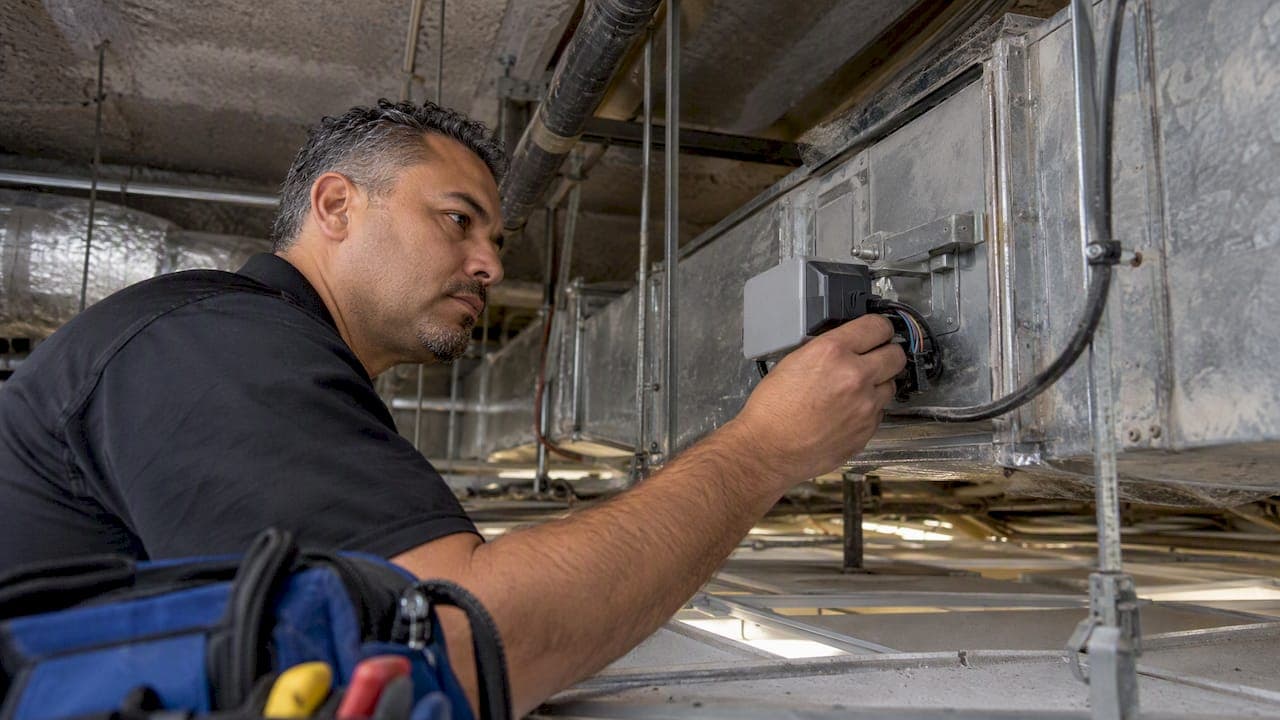
If a zoning damper will not open, one part of your building gets little or no air while the rest of the system runs normally. The cause is usually one of five things: the zone is not actually asking for air, the thermostat or control panel is wired wrong, the actuator has no 24-volt signal, the damper blade is mechanically stuck, or a duct problem is mimicking a closed damper. You can rule out the first and the last yourself in about 20 minutes. The rest needs a technician with a meter, and the repair should protect the whole system, not just push one blade open.
TL;DR
- A zone that stays closed is not always broken. Smart zoning controls close a damper once the room reaches its setpoint, so test with a clear demand before blaming hardware.
- Check the basics first: thermostat mode and setpoint, a clean filter, open registers and unobstructed return grilles.
- Do not force a damper open, close other registers to push air toward the weak zone, or open sealed electrical panels. Zoned systems depend on balanced airflow across the air handler.
- Persistent faults come from miswiring, a dead actuator, a seized shaft, a failed control board or a bypass problem. Each has a different fix, so ask for a zoning diagnostic, not an automatic replacement.
- Write down what you see before you call. It shortens the visit and the bill.
Table of Contents
- First, confirm the damper is supposed to open
- How a zoning system decides to open a damper
- Common causes and what each looks like
- What you can safely check yourself
- Why forcing it open can make things worse
- What a proper zoning diagnostic includes
- Duct problems that look like a stuck damper
- One zone not cooling: a quick decision guide
- When zoning itself is the issue
- Our perspective
- Get a zoning diagnostic from E320air
- FAQ
- Sources
First, confirm the damper is supposed to open
Before touching hardware, make sure the zone is calling for air. Manufacturer support pages for zoned systems say the same thing: a zone that stays closed is not automatically a failure. AirTouch support guidance explains that control logic may close a zone on purpose once its target is reached. Airzone's troubleshooting page starts with the system operating mode for the same reason.
Here is a simple demand test:
- Set the system to cool (or heat) at the main thermostat or panel.
- Make sure the other zones are satisfied, or set them a few degrees away from the call you want.
- At the affected zone's thermostat, drop the cooling setpoint several degrees below the room temperature (or raise the heating setpoint above it).
- Wait a few minutes. Listen at the panel or damper for a small motor sound, and feel the register for airflow.
If air arrives, your zone was simply satisfied, or the setpoint was too close to room temperature. If it does not, you have a real fault and the details you just gathered are useful to a technician.
How a zoning system decides to open a damper
Knowing the chain makes each failure easier to place. A zone thermostat reads its space and calls for heating or cooling. That call goes to the zone control panel, not straight to the equipment. The panel opens the dampers of the calling zones, then signals the furnace or air conditioner to run. Each damper has a small motor, called an actuator, that turns the blade in the duct.
So a zone can fail at any link:
- Thermostat: wrong mode, dead batteries, bad wiring, or a thermostat assigned to the wrong zone number.
- Control panel: no 24-volt power, a blown low-voltage fuse, or a failed output for that zone.
- Actuator: the motor is burned out, or it spins without moving the blade because the set screw is loose.
- Damper: the blade or shaft is rusted, bent or jammed.
- Duct: a branch is crushed, disconnected or closed by hand, so the damper is open but no air arrives.
One field problem that is easy to miss is crossed wiring. As Journal of Light Construction describes, a thermostat can command Zone 1 while the Zone 2 actuator responds, or the open and close commands can be reversed. The central equipment still runs, so everything seems fine until someone tests each zone one at a time.
Common causes and what each looks like
| Cause | What you notice | Who fixes it |
|---|---|---|
| Zone satisfied or wrong mode | Damper closes after setpoint; works when you create demand | You |
| Thermostat fault or wrong zone assignment | Wrong zone responds, or nothing responds | Technician |
| No 24-volt power or failed panel output | No actuator movement or sound in any zone, or in one zone only | Technician |
| Failed actuator motor | Panel sends a signal, but the motor is silent and the blade does not move | Technician |
| Stripped or loose set screw | Motor hums or turns, but the blade stays put | Technician |
| Seized shaft or rusted blade | Blade stiff by hand, intermittent opening | Technician |
| Duct restriction or closed manual damper | Damper moves, but airflow is weak | Technician, sometimes you |
| Bypass or airflow design problem | Noise, temperature swings, other zones overcooled | Technician |
The split between motor and mechanism matters for cost. A mechanical problem in the damper body can mean opening the duct, while an actuator is often a smaller swap. We do not publish a price for either, because the answer depends on the brand, the accessibility and the duct layout. A fair contractor tests first and quotes after.
What you can safely check yourself
Keep this to things that cannot hurt you or your equipment. Write down what you find as you go:
- Which zone is affected, and whether other zones have normal airflow.
- Thermostat mode and setpoint at that zone, and whether the display is blank or the batteries are low.
- Whether it happens in cooling, heating or both. A fault in both points to the damper or wiring. A fault in one points to equipment staging or settings.
- When it began. After a storm, a remodel, an attic job or a thermostat swap are all useful clues.
- Any sound from the damper or panel: clicking, humming, grinding or nothing at all.
- Supply registers and return grilles. Move furniture, rugs and boxes away from them, and make sure no register has been closed by hand.
- The filter. Replace an accessible dirty one. A clogged filter lowers airflow across the whole system and makes a weak zone feel worse.
If the damper is visible and you can see the actuator, you can note whether it moves when you create a demand. Stop there. Do not open sealed electrical panels, do not jumper terminals and do not bypass any safety device. Low-voltage work on a control board is still work on equipment that also carries line voltage nearby.
Why forcing it open can make things worse
The usual internet advice is to pull the actuator off and spin the blade by hand, or lock the damper open with locking pliers. You will see both on the forums that rank for this search. A technician can use a manual check as a diagnostic, for example to learn whether the blade moves freely once the motor is removed. One home-repair thread on a Honeywell M847D actuator describes that approach: loosen the set screw, remove the motor and turn the shaft by hand to see whether the damper itself is free.
As a permanent fix, though, it is a bad idea. The California Energy Commission's field-verification guidance for zonally controlled systems notes that these systems may use supply dampers, multiple thermostats, bypass ducts or dump zones, and that poor handling of excess air can hurt comfort and equipment performance. When other dampers close, fan pressure and coil airflow change. A damper locked open in one zone leaves the other zones uncontrolled, and a system sized around zoning may not move air the way it was designed to.
The same logic applies to closing registers elsewhere to push more air toward the weak room. It adds static pressure. In a zoned system with a bypass, it can also send conditioned air straight back to the return without cooling a single room.

What a proper zoning diagnostic includes
ACCA's Manual Zr covers equipment airflow, zone damper system design and bypass path design for residential zoning. That is a useful picture of the scope: the damper is one part of a system. When you call a contractor, ask for the following:
- Reproduce the fault under a clear heating or cooling demand, zone by zone.
- Check the thermostat for the right zone number, mode and wiring.
- Measure low-voltage power at the panel and at the actuator while the zone calls.
- Test the actuator response. Does it get a command, and does it move?
- Move the blade by hand with the motor off to find a mechanical bind.
- Inspect the branch duct for crushing, disconnection, leaks or a closed manual damper.
- Check the bypass and equipment airflow, including what happens with only one small zone calling.
The last step is the one most quick repairs skip. Journal of Light Construction points out that a system can look functional while every damper is assigned backward, or while a small active zone creates unacceptable airflow. Testing zones one at a time exposes both problems. This is the same idea behind commissioning a new system, which we cover in our guide to HVAC commissioning for homeowners.
Duct problems that look like a stuck damper
Sometimes the damper is fine. A branch duct that has been crushed by someone working in the attic, a flex duct that has pulled off its collar, or a manual balancing damper left closed can all starve a room while the zone damper opens on command. The reverse also happens: an oversized or uncontrolled bypass can make the equipment seem healthy while conditioned air short-circuits back to the return, as the California Energy Commission material above describes.
This matters in the Inland Empire, where many ducts run through hot attics. A leaky or disconnected run there can lose a lot of cooling before it reaches the room. If the weak zone is the one farthest from the air handler, or the one over a garage or addition, ask the technician to check the duct before replacing parts.
One zone not cooling: a quick decision guide
- Air is weak but present: suspect a filter, register, duct or bypass issue before the damper.
- No air at all, and no sound at the damper: suspect power, the panel output or a dead actuator.
- Motor hums but nothing moves: suspect the set screw or the blade.
- Wrong zone responds: suspect wiring or thermostat assignment.
- The problem comes and goes: suspect a marginal actuator, a loose wire or a rusted shaft. Intermittent faults are hard to catch, so note the time and conditions when it happens.
- Only a new or recently modified system fails: ask for a commissioning check.
If the whole house is hot, not just one zone, that is a different call. Compressor, refrigerant or airflow problems can look like a zoning fault. Our guide to seasonal HVAC needs in Riverside County explains what to expect in peak summer and winter.
When zoning itself is the issue
Some zoning problems are design problems. Too many small zones on one undersized system, a poorly sized bypass, or zones that were added to an existing system without rebalancing can cause repeated faults that no actuator swap will cure. In these cases the right fix may be a redesign or an upgrade to a better-matched system. If you want the basics of how zoning helps comfort, read what HVAC zoning is and why it matters. If you are weighing an upgrade, energy efficient HVAC systems for Inland Empire homes covers the trade-offs.
Still, we would not recommend full replacement as a first response. The right service request is a zoning-damper diagnostic. A qualified contractor should identify whether the fault is control demand, miswiring, 24-volt power, actuator, mechanical damper, branch duct or excess-air design before proposing a repair or an upgrade.
Our perspective
Most calls about a zone that will not open arrive with the same assumption: the damper is broken. Often it is not the damper. In our experience the first useful question is what the zone was asked to do, and by which thermostat. A system that runs but sends air to the wrong place is a wiring or commissioning problem, and swapping parts will not fix it.
We also want owners to know that a fast patch is not always a good repair. Locking a damper open gets a room cool today and leaves you with an uncontrolled system and a harder-working blower. We would rather test each zone, show you what failed, and explain the options, whether that is a small repair, a rebalancing or a system enhancement. Our technicians are licensed and insured, work on all major brands, and are available around the clock, including weekends and holidays, because a room that will not cool in an Inland Empire summer is not a problem that can wait. If you want to see how we approach unusual jobs, our problem solving gallery shows examples.
— Edward
Get a zoning diagnostic from E320air
If your checks did not solve it, we can test the zone from thermostat to duct and tell you what is failing before you approve any work. We serve homeowners, landlords, property managers and business owners across the Inland Empire, from Riverside and Moreno Valley to Fontana, Corona and Hemet. We handle residential and commercial systems, repairs, maintenance, upgrades and installation, with flexible payment options including financing. For a house, start with our residential HVAC services. For an office, retail space or multi-unit property, see commercial HVAC, maintenance and emergency repairs. If zoning keeps failing because the system was never designed or commissioned well, ask about HVAC installation.
FAQ
Why is my zone damper not opening?
The most common reasons are no call for air from the thermostat, wrong mode, miswiring, no 24-volt power, a failed actuator, a loose set screw or a seized blade. First create a clear demand by moving that zone's setpoint several degrees. If nothing happens, a technician should test the panel output and actuator.
Can you manually open a zone damper?
A technician can, to diagnose whether the blade is free, and some dampers have a manual lever. It is not a good permanent fix, because a damper locked open removes zone control and can disturb airflow across the equipment. Leave it to a professional to decide whether a temporary lock is safe.
Are zone dampers normally open or closed?
It depends on the model and the control design. Many are driven by a motor and use a spring to return to a default position when power is lost, so the default differs between products. A technician can confirm the default for your brand, and it also helps to know it when diagnosing a power failure.
How do I get a damper unstuck?
Safe steps for an owner are limited: confirm demand, check filters and registers, and note any sounds. Freeing a rusted shaft means removing the actuator and sometimes cutting into ductwork, and that is where fixes can go wrong. Call a licensed technician, especially if the damper is in an attic.
Is a zone not cooling always a damper problem?
No. A closed register, a crushed branch duct, a dirty filter, a thermostat fault or a bypass issue can look the same. This is why we test the whole airflow path rather than replacing the actuator first.
Sources
- California Energy Commission: Residential Manual Appendix F, field verification of zonally controlled systems
- ACCA: Manual Zr, Residential Zoning Systems
- Journal of Light Construction: Troubleshooting Zone Damper Systems
- Airzone: A zone's damper does not open
- AirTouch: Why is a zone not opening or closing?
- Home Improvement Stack Exchange: Honeywell M847D zone damper randomly stops working