
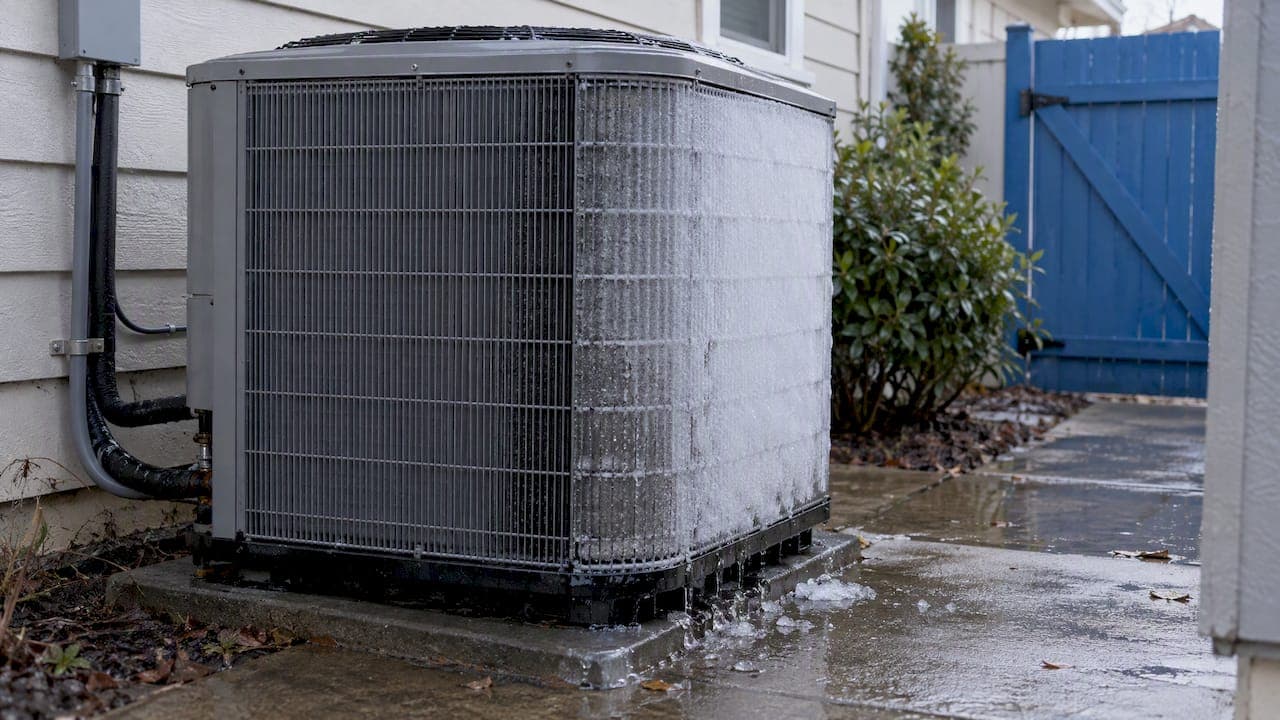
Some frost on a heat pump's outdoor unit is normal. Ice that keeps growing, covers the whole coil, or is still there hours after the sun comes up is not. That means the defrost system is failing, usually because of a bad sensor, a faulty control board, low refrigerant or blocked airflow. Switch the system off if the unit is turning into a block of ice, and have a licensed technician find the fault.
Below, we explain how defrost is supposed to work, how to tell a healthy cycle from a failing one, what causes the failures, and what you can check yourself without opening a panel.
TL;DR
- Light frost and a short cloud of steam during defrost are normal. Ice that persists or keeps growing points to a real fault.
- The usual suspects are a faulty defrost sensor or control board, low refrigerant from a leak, a failing reversing valve, or a dirty coil and weak outdoor fan.
- Safe homeowner checks are limited to clearing debris and plants, confirming drainage and waiting a few hours to see if the ice melts. Never chip ice off the coil.
- If the unit is encased in ice or the problem returns, shut it off and call a technician, because running it can cause damage.
Table of Contents
- What a normal defrost cycle looks like
- Signs your heat pump is not defrosting properly
- What causes a heat pump defrost problem
- What you can safely check yourself
- When to shut it off and call a technician
- Why defrost problems cost more than comfort
- Our perspective: defrost problems in the Inland Empire
- Get a defrost problem diagnosed
- FAQ
- Sources
What a normal defrost cycle looks like
In heating mode, the outdoor coil pulls heat out of the air. To do that, it has to run colder than the air around it. Trane notes the coil is typically 10 to 20°F colder than the outdoor air. When the coil falls below the dew point, moisture condenses on it, and below freezing that moisture turns to ice, as a U.S. Department of Energy Building America report describes.
So frost is expected. The defrost cycle exists to clear it. Here is what happens:
- Sensors read outdoor air and coil temperature, and a control board decides when to start defrost.
- The reversing valve briefly switches the system into cooling mode, sending warm refrigerant to the outdoor coil.
- The outdoor fan stops while the coil warms, and electric backup heat may come on indoors.
- When the coil sensor is satisfied, or a maximum time is reached, the system returns to heating.
You may see a puff of steam from the unit. That is melted ice evaporating, not smoke.
How long should defrost take?
It depends on the equipment. Trane reports demand-defrost systems commonly run about 3 to 5 minutes, while Vaillant says a cycle typically lasts 5 to 15 minutes depending on how much frost has built up. There is also no single universal schedule. NREL testing found strategies differ by manufacturer, using outdoor temperature, run time or refrigerant pressure, and colder conditions can need longer defrost. Your owner's manual is the best guide to what is normal for your model.
We have a separate walkthrough on what to do when a defrost cycle runs over 10 minutes.
Signs your heat pump is not defrosting properly
The defrost system fails in two directions: it never starts, or it starts and never finishes the job. Watch for these:
- Ice that stays or grows. Trane says ice that does not go away or keeps growing may signal a bigger issue.
- A solid sheet or block of ice over the coil and fan guard, instead of a light white frost.
- Ice on the base pan or cabinet. DOE research shows meltwater can refreeze on the cabinet or base and build up over repeated cycles, restricting airflow even while the coil itself is being defrosted.
- Cool or weak air indoors for long stretches, often with the backup heat strips running far more than usual.
- A defrost cycle that starts again and again, or one that never seems to end.
- An outdoor fan that runs strangely or not at all.
A caution on the cool air: during defrost the system is running in cooling mode, so brief cooler air is part of normal operation. It becomes a concern when it lasts well beyond the cycle times above or happens repeatedly. If your problem is simply weak warmth with no ice, our guide to what contractors check first when a heat pump isn't heating covers that path.
What causes a heat pump defrost problem
Trane lists low refrigerant, faulty defrost controls or a faulty sensor as the main reasons ice does not clear. InterNACHI adds a bad reversing valve, wiring problems, a bad thermostat, refrigerant leaks, a dirty coil, a fan that is not running or rotating correctly, and a replacement motor with too low an RPM.
| Cause | What it does | What you may notice |
|---|---|---|
| Faulty defrost sensor | Sends wrong temperature readings, so the board starts defrost late or never | Heavy ice on the coil, fan may keep running |
| Bad defrost control board | Fails to start or end the cycle | Ice that never clears, or cycles that never end |
| Low refrigerant or leak | Coil runs too cold and frost builds faster than defrost can clear | Ice growing, weak heat, possible lockout |
| Failing reversing valve | Defrost can't send hot refrigerant to the coil | No heat, ice persists |
| Dirty coil or blocked airflow | Restricts air across the coil | Frost patterns that build unevenly |
| Fan or motor problem | Poor airflow, or wrong fan behavior during defrost | Fan not spinning, or spinning when it should stop |
| Wiring or thermostat fault | Control signals never arrive | Erratic cycling |
Sensors and control boards
The control reads two temperatures, outdoor air and coil, and a microprocessor decides when to defrost. This is why a cheap sensor can cause an expensive-looking problem. If the sensor misreads, the board is working from bad information. A technician can test the sensor and the board separately, which avoids replacing the more costly part by guesswork.

Demand defrost versus timed defrost
Trane explains that demand defrost uses sensors to defrost only when needed and to stop when the ice is cleared. Timed defrost runs after a set amount of runtime whether or not frost is present. Older timed systems can waste energy by defrosting a clean coil, or can fall behind in damp, near-freezing weather. Knowing which type you have helps a technician interpret what you are seeing.

Refrigerant problems
Refrigerant is sealed in the system and should not "run low" on its own. If it is low, there is a leak. Topping it off without finding the leak only delays the next failure. Low refrigerant also changes coil temperature, so ice shows up in conditions where a healthy system would stay clear.
Drainage and meltwater
Meltwater needs somewhere to go. DOE's installation guide for cold climates warns that defrost water should be routed so it does not refreeze into a slip hazard, and recommends avoiding roof drip lines or concentrated runoff over the outdoor unit. If the pad is poorly placed, water can freeze in the base and choke airflow even when the defrost controls are fine.
What you can safely check yourself
Keep this short and cautious. Defrost faults involve refrigerant, high-voltage controls and moving parts. InterNACHI notes diagnosing them goes beyond a normal home inspection for exactly that reason.
- Wait a few hours. Trane advises waiting to see whether the ice melts and the unit defrosts before calling. If it clears and stays clear, note the date and weather and mention it at your next service.
- Look for obvious blockage. Trane recommends keeping foliage and plants at least 2 feet from the outdoor unit, keeping vents clear, and maintaining drainage and elevation.
- Check the area around the unit for leaves, debris, snow or standing water against the cabinet.
- Clean a dirty coil carefully. Trane says to clean outdoor coils whenever they look dirty. Use the method in your owner's manual, with the power off at the disconnect.
- Confirm the thermostat is set to heat, with the right mode and a sensible setpoint.
What not to do: do not chip, scrape or pry ice off the coil, since the fins and refrigerant tubing are easy to damage. Do not pour boiling water on the unit. Do not remove panels to poke at the board.
When to shut it off and call a technician
Turn the system off at the thermostat, and then at the outdoor disconnect if you can reach it safely, in these situations:
- The unit is covered in ice or looks like a block rather than a coil.
- Ice returns within a day or two of melting.
- The outdoor fan is not turning, or you hear grinding or buzzing.
- You see oily residue near refrigerant lines, which can suggest a leak.
- Water is freezing on the pad or walkway near the unit.
InterNACHI states that a nonfunctioning defrost system can leave the coil as a large block of ice, make the unit nonfunctional and cause damage if operation continues. Waiting it out with the system running is a bad bet once ice is heavy.
What a proper service visit covers
Trane's maintenance checklist says professional service should verify airflow, refrigerant charge and leaks, the reversing valve, the defrost control, electrical terminals, base-pan drainage and sensor operation. That is a useful list to hold a contractor to. A good diagnosis names which of those failed and why, rather than swapping parts until the ice stops.
Why defrost problems cost more than comfort
Even a healthy defrost cycle has a price. DOE's 2024 defrost research describes defrost as necessary but carrying an efficiency penalty, and cites an example seasonal coefficient-of-performance reduction of 1.5% to 12.7% from frost growth and defrosting. A system that defrosts too often, or struggles with heavy ice, pushes that penalty higher and leans harder on electric backup heat.
Ice also strains hardware. A fan fighting a frozen coil and a compressor running with poor airflow wear out sooner. If you want the long view, see how to make a heat pump last 20 years and our heat pump maintenance checklist. For performance in colder conditions, our piece on heat pump cold weather performance below 0°F gives more context.
Our perspective: defrost problems in the Inland Empire
Most heat pump owners in our service area don't think about defrost until the first cold, damp night of the season. Then they see ice and assume the unit is dying. Usually it isn't, but the ice is a symptom worth reading carefully.
Here is how we think about it. First, we separate "ice that comes and goes" from "ice that stays." The first is the system doing its job. The second is a fault, and it has a cause we can find: a sensor reading, a board output, a pressure, an airflow check. Second, we don't like guessing. A defrost problem can look identical whether the culprit is a sensor that costs little or a refrigerant leak that costs a lot, so we test before we recommend.
Third, we tell homeowners to stop running a heavily iced unit. People wait for a convenient appointment while the system keeps running, and that is how a small repair becomes a large one. Our technicians are licensed and insured, work on all major brands, and are available around the clock including weekends and holidays, so there is rarely a reason to wait.
Last, we are honest about when repair makes sense. If a unit has repeated failures across several parts, we will talk through upgrade options and financing rather than keep billing you for patches.
— Edward
Get a defrost problem diagnosed
If your heat pump is icing up in Riverside, Moreno Valley, Fontana, Hemet or anywhere else we serve across the Inland Empire, our team can test the sensor, control board, refrigerant charge and airflow and tell you what is failing. See our heater repair service to book a visit. If the diagnosis points to replacement, we also handle HVAC installation with flexible payment options, including financing. For a no-heat emergency, our guide on signs to call a pro for an HVAC outage explains when not to wait.
FAQ
Is it normal for a heat pump to get frost on it?
Yes. In heating mode the outdoor coil runs colder than the air, so frost forms in cold, humid conditions and the defrost cycle clears it. Trouble starts when ice stays, thickens or covers the whole unit for hours.
What causes a heat pump to stop defrosting?
The most common causes are a faulty defrost sensor, a bad control board, low refrigerant from a leak, or a reversing valve problem. Dirty coils, a failing outdoor fan, wiring faults and a bad thermostat can also contribute. A technician can separate these with testing.
What controls the defrost cycle on a heat pump?
A defrost control board reads outdoor and coil temperature sensors, and a microprocessor decides when to start and stop. Some older systems use a timer instead. Manufacturers use different strategies, so check your manual for your model.
Can I pour hot water on my heat pump to melt the ice?
We advise against it. Hot water can refreeze on the pad, creating a slip hazard, and it doesn't fix the reason the ice formed. Switch the system off and have a technician look at it, especially if the ice is heavy or keeps returning.
How long can I run a heat pump with ice on it?
Light frost that clears within a normal cycle is fine. Heavy ice is different: continued operation can damage the unit, so turn it off and call a licensed HVAC contractor.
Sources
- Heat Pump Troubleshooting: Diagnosing Common Issues, Trane
- Measured Performance of a Low Temperature Air Source Heat Pump, U.S. DOE Building America
- Quantifying and Reducing Defrost Energy Use, U.S. DOE
- Homeowner's Guide to Heat Pump Repair, Trane
- What Is the Heat Pump Defrost Cycle?, Trane
- Defrost cycle of a heat pump explained, Vaillant
- Defrost Cycle of a Heat Pump, InterNACHI
- Laboratory Test Report for Fujitsu 12RLS and Mitsubishi mini-splits, U.S. DOE/NREL
- Home Heat Pump Maintenance, Trane
- Guide To Installing Air-Source Heat Pumps in Cold Climates, U.S. DOE