
TL;DR:
- Regular maintenance, including filter changes and airflow checks, keeps Southern California heaters working efficiently throughout the year. Professional inspections are essential seasonally to ensure system components like controls and defrost systems are functioning properly. Developing simple habits and scheduling annual professional visits can extend equipment lifespan and prevent costly breakdowns.
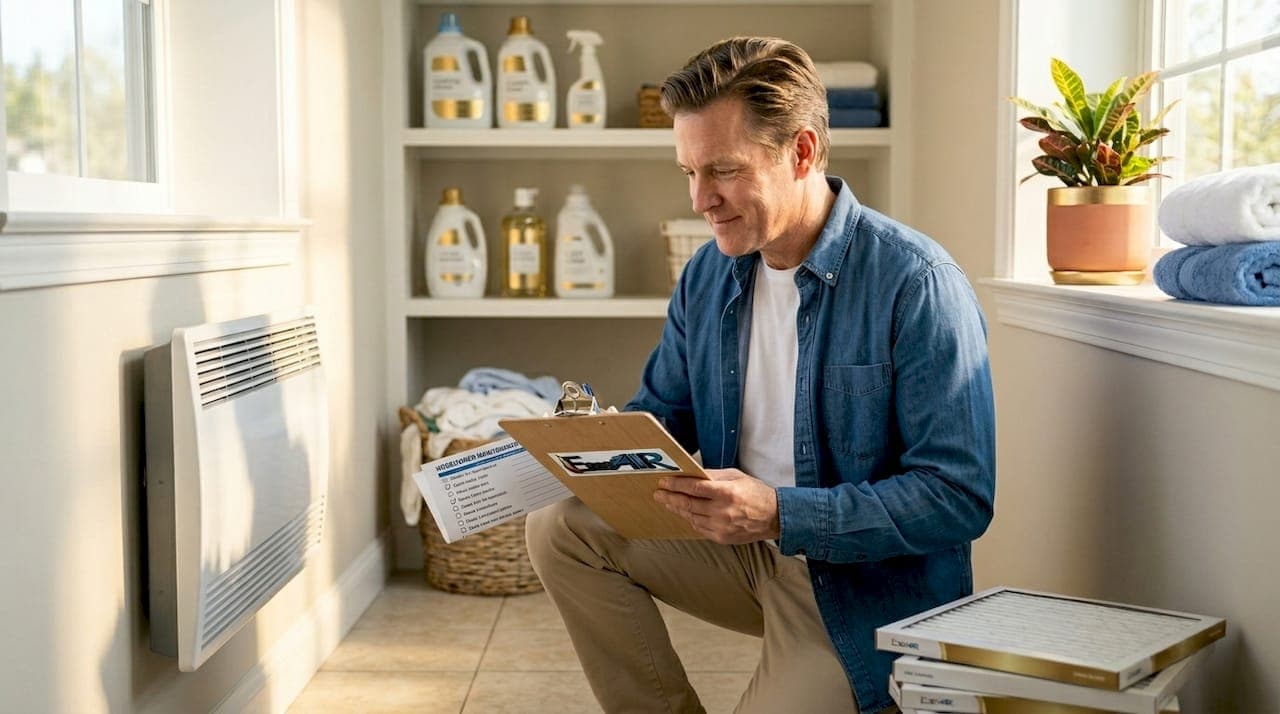
Picture this: it's one of those rare January nights in Southern California when the temperature drops fast and your family reaches for the thermostat. The heater kicks on, but the airflow feels weak, the room barely warms up, and your energy bill the next month is a nasty surprise. That scenario plays out in homes across the Inland Empire and the Los Angeles basin every winter, almost always because the heating system sat dormant for months without any attention. This guide walks you through every practical step for keeping your heater running strong, from the tools you'll need to the tasks best left to a licensed technician.
Table of Contents
- What you need for safe and effective heater maintenance
- Step-by-step home heater maintenance tasks you can do
- When to call a professional: what pros check and why it matters
- Common mistakes and how to avoid them
- Our take: practicality and priorities in Southern California heater care
- Get expert help for stress-free heating season
- Frequently asked questions
Key Takeaways
| Point | Details |
|---|---|
| Routine filter changes | Changing your HVAC filter every 30–90 days is the simplest way to keep your system running smoothly. |
| Airflow matters | Clear vents and unobstructed registers are key for safe, efficient heating throughout the season. |
| Professional checks vital | A pro’s annual inspection ensures controls, refrigerant, and electrical systems are ready for winter. |
| Avoid common mistakes | Neglecting maintenance can lead to costly repairs and unexpected breakdowns. |
| Seasonal timing counts | Fall is the best time for professional heat pump defrost checks and overall system service. |
What you need for safe and effective heater maintenance
Now that you know why maintenance matters, let's see what you'll need to get started. Walking into a maintenance task without the right supplies is a great way to cut corners, skip steps, and end up back where you started.
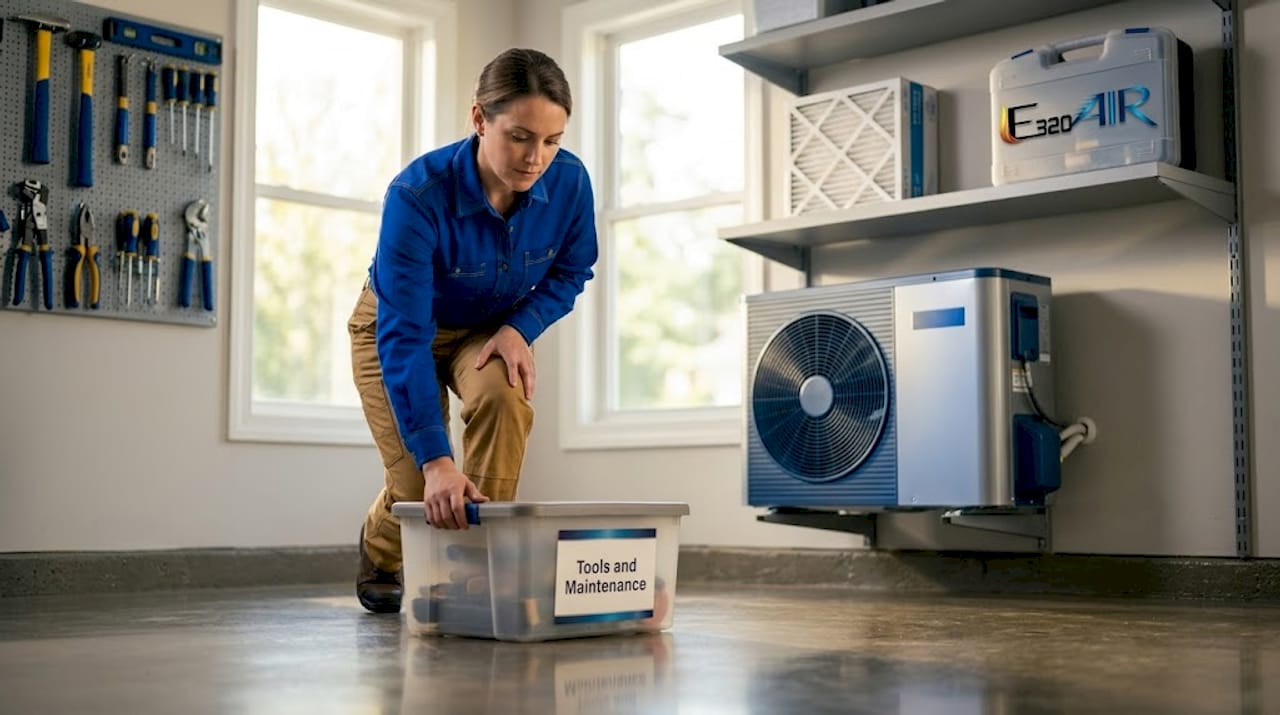
Essential tools and safety equipment
Before you touch anything, gather the basics:
- A screwdriver set (flathead and Phillips)
- A flashlight or headlamp for inspecting dark cabinets and crawl spaces
- Work gloves to protect your hands from sharp sheet metal edges
- Safety glasses when working near ductwork or outdoor units
- A vacuum with a brush attachment for cleaning registers and return vents
- A measuring tape to confirm filter dimensions before purchasing replacements
- A mild spray cleaner and soft brush for outdoor unit fins (heat pumps only)
Choosing the right filter
Filter selection makes a bigger difference than most homeowners realize. MERV ratings (Minimum Efficiency Reporting Value) measure how well a filter traps particles. A MERV 8 to MERV 11 filter balances air quality and airflow for most Southern California homes. Go too high, like a MERV 16, and you can actually restrict airflow and put strain on your blower motor. You can find replacement filters at hardware stores, HVAC supply houses, or online. Understanding HVAC filter essentials helps you pick the right rating for your specific system without guessing.
Preparing your workspace
Clear the area around your air handler, furnace, or heat pump before you begin. Remove any stored boxes, clutter, or flammable materials from a two-foot radius around the unit. Turn the system off at the thermostat first, then at the disconnect switch or breaker before opening any panels.
Supplies by heater type: quick comparison
| Supply needed | Central gas furnace | Central heat pump | Ductless mini-split |
|---|---|---|---|
| Replacement air filter | Yes (standard 1" or 4" media) | Yes | Yes (washable filter) |
| Outdoor unit cleaner | No | Yes | Yes |
| Fin comb | No | Recommended | Recommended |
| Vacuum with brush | Yes | Yes | Yes |
| CO detector test | Yes | No | No |
For heat pumps, routine homeowner tasks typically focus on airflow and outdoor unit cleanliness, and manufacturers also recommend a recurring filter change schedule that matches your specific model's guidance.
Step-by-step home heater maintenance tasks you can do
With your tools and prep list ready, here's exactly how to care for your heater between professional visits. These steps apply to most central systems and ductless units found in Southern California homes.
- Turn off power to the system at the thermostat and the breaker or disconnect switch. Never work on a live system.
- Locate your air filter. In most central systems, it's either in the return air grille on a wall or ceiling, or in a slot on the air handler cabinet itself. Ductless mini-splits have washable filters inside the indoor head unit.
- Remove the old filter carefully and slide it into a plastic bag before carrying it through your home to avoid spreading dust.
- Check the filter's condition. A gray, clogged filter means your system has been working harder than necessary. Note how dirty it is so you can adjust your replacement schedule.
- Insert the new filter in the correct airflow direction. The arrow on the filter frame must point toward the air handler, not away from it. This is one of the most common installation errors.
- Clean all supply and return registers with your vacuum brush attachment. Dust buildup on register blades restricts airflow and recirculates particles into your living space.
- Check that no registers are blocked by furniture, rugs, or curtains. Even one blocked return vent can force your system to work harder and reduce heating capacity throughout the house.
- Inspect the outdoor heat pump unit. Rinse the coil fins gently with a garden hose set to low pressure. Never use a pressure washer because it bends the delicate aluminum fins and reduces efficiency.
- Clear debris from around the outdoor unit. Keep a two-foot clearance of leaves, mulch, and shrubbery on all sides so the system can draw in and exhaust air freely.
- Restore power and test by setting the thermostat five degrees above the current room temperature and confirming warm air flows within a few minutes.
"Change the HVAC air filter every 30 to 90 days year-round and keep registers and return vents clean and unobstructed to protect system performance."
Following a consistent HVAC maintenance schedule for your Upland or surrounding area home makes these steps feel automatic rather than reactive. You can also browse routine maintenance tips for additional context on keeping systems in top shape.
Pro Tip: Set a recurring phone reminder for the first of every other month to check your filter. In homes with pets or dusty environments, move to a monthly schedule because animal dander and construction dust clog filters faster than average.
When to call a professional: what pros check and why it matters
After you've finished your homeowner tasks, it's important to know when expert help is essential. Some maintenance steps require tools, certifications, and knowledge that go far beyond what a screwdriver and a garden hose can cover.
What licensed technicians inspect during a professional visit
- Electrical connections and wiring integrity throughout the system
- Refrigerant levels and the absence of leaks
- Coil condition, including cleaning if there is buildup that garden hose rinsing cannot remove
- Controls, contactors, and capacitors for wear or failure
- The reversing valve on heat pumps (the component that switches between heating and cooling mode)
- Defrost control operation, which is checked specifically in fall before cold nights become regular
Professional heat pump maintenance commonly includes checking controls and operational components, coil inspection and cleaning, electrical connections, refrigerant levels, and system-specific items like the reversing valve and defrost control operation. These are not tasks you can safely or legally perform yourself because refrigerant handling requires EPA Section 608 certification and electrical diagnostics require specialized meters and expertise.
You can also review heat pump professional services to better understand the scope of what a technician covers.
DIY vs. pro tasks: side by side
| Task | Homeowner | Licensed technician |
|---|---|---|
| Filter replacement | Yes | No |
| Register cleaning | Yes | No |
| Outdoor unit rinse | Yes | No |
| Coil deep cleaning | No | Yes |
| Refrigerant check | No | Yes (EPA certified) |
| Electrical inspection | No | Yes |
| Defrost control check | No | Yes |
| Reversing valve test | No | Yes |
| Carbon monoxide test (furnaces) | Basic detector test only | Full combustion analysis |
Understanding these distinctions also helps you evaluate whether your system needs HVAC repair services or just a simple DIY tune-up before you call anyone. There are also clear seasonal HVAC maintenance benefits to scheduling a professional visit before the coldest stretch of the year arrives.
Pro Tip: Book your professional fall checkup in October or early November. HVAC companies in Southern California fill up quickly as homeowners scramble when the first cold week hits, so scheduling ahead saves you from waiting in line and possibly going without heat.
Common mistakes and how to avoid them
Even with good intentions, many homeowners make avoidable mistakes. Here's what to watch for so you don't undo all your hard work.
Skipping filter changes because "the heater barely runs"
This is one of the most common beliefs in Southern California. Homeowners assume that because the heater only runs a few months per year, the filter stays clean. In reality, your system circulates air year-round if the fan runs for cooling or air circulation purposes. Dust accumulates regardless of whether the heat is on. A neglected filter strains the blower motor, reduces airflow, and sets the stage for a breakdown exactly when you need heat most.
Not checking airflow across all vents
It only takes one blocked register to create pressure imbalances in the duct system. When a duct is pressurized beyond its design limit, small leaks open at joints and connections, and conditioned air bleeds into wall cavities instead of your living space. Walk through every room and confirm nothing is blocking supply or return registers.
Ignoring the defrost cycle on heat pumps
Southern California homeowners sometimes assume heat pumps never need defrost-related checks because winters are mild. That logic breaks down on nights when temperatures dip to the low 40s or high 30s, which does happen in the Inland Empire, the foothills, and the San Gabriel Valley. Ice can form on the outdoor coil, and if the defrost control is not working correctly, the system will struggle to heat your home at exactly the moment you need it. Manufacturer guidance strongly implies at least one professional maintenance visit around seasonal transitions, particularly to check defrost-related items in fall.
Treating all systems as identical
Gas furnaces, heat pumps, and ductless mini-splits each have unique maintenance requirements. Using a one-size-fits-all checklist leads to missed steps. For example, gas furnace owners need to test their carbon monoxide detector and inspect the flue, while heat pump owners need to keep outdoor coils clear year-round.
Delaying repairs because the system still turns on
A heater that turns on is not necessarily a heater that runs efficiently. Strange noises, short cycling (turning on and off rapidly), or rooms that never quite reach the set temperature are early warning signs. Ignoring them leads to more expensive failures. Adjusting thermostat efficiency practices can also reveal whether a controls issue is masking a deeper mechanical problem.
The cost of ignored maintenance (stat callout)
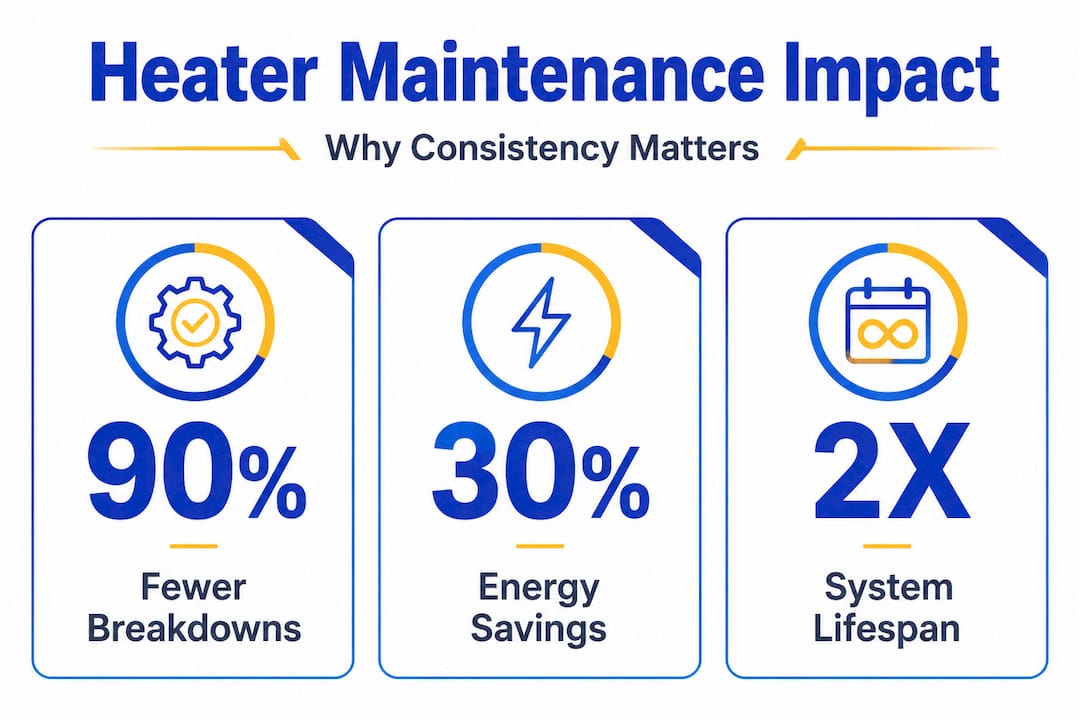
Studies consistently show that most major HVAC system failures trace back to deferred maintenance. Equipment that receives regular professional service lasts significantly longer, typically 15 to 20 years for well-maintained heat pumps versus 10 to 12 years for neglected ones. The upfront cost of one professional visit per year is a fraction of an emergency repair bill or premature replacement.
Our take: practicality and priorities in Southern California heater care
Most maintenance guides present a universal checklist and call it a day. Our perspective, built from years of servicing systems across Southern California, is a little different.
The mild climate here creates a false sense of security. Homeowners in colder states have no choice but to service their systems religiously because a breakdown in Minnesota in February is a genuine emergency. In Southern California, people survive a cold snap with an extra blanket and assume everything is fine. That attitude is exactly what turns a $150 maintenance visit into a $1,200 repair call.
The defrost control issue is a perfect example. A key edge case for heat pump systems is seasonal timing and the need to include defrost-system awareness in colder months. Trane specifically notes that defrost control operation checks are fall-only tasks for technicians, not something you check in spring and forget about. Many Southern California homeowners have never heard the words "defrost control" in connection with their heat pump, and that is a gap we see cause real problems every winter.
Our actual recommendation is to think in habits, not events. One filter check every two months takes three minutes. One quick walkthrough to verify all registers are clear takes five minutes. These micro-habits prevent 80% of the problems we see on service calls. Pair those habits with one professional visit each fall and your system will likely outlast the typical equipment lifespan.
Southern California also experiences rapid temperature swings, especially in the foothills and desert-edge communities. A week in the 70s followed by a night in the 38-degree range is not unusual. Systems that were dormant all summer and fall are suddenly asked to perform at full capacity overnight. That is the worst possible time to discover a dirty coil, a failing capacitor, or a stuck reversing valve. Choosing the right HVAC service partner means you have someone ready to respond when that temperature drop hits.
Get expert help for stress-free heating season
Ready to safeguard your comfort for the season? Here's how to get personalized, professional help before the next cold snap catches your heater off guard.
Keeping up with DIY steps is a great start, but nothing replaces the peace of mind that comes from a licensed technician confirming your system is fully ready. E320 Air serves Southern California homeowners with expert maintenance, repairs, and full system replacements.

Whether you need a pre-season tune-up, a new professional HVAC installation, or fast expert heater repair when something goes wrong, our team brings the experience and tools to get your home comfortable quickly. You can also see real results from our work in our problem solving success stories to understand what a difference proper maintenance and timely repairs make for Southern California homeowners. Reach out today to book your fall or winter maintenance visit before our schedule fills up.
Frequently asked questions
How often should I change my heater filter?
Most HVAC filters should be changed every 30 to 90 days year-round, though homes with pets or heavy dust may need monthly changes.
Do I need professional heater maintenance every year in Southern California?
Yes. Manufacturer guidance recommends at least one professional visit around seasonal transitions, ideally in the fall, to catch issues before cold weather arrives, even in mild climates.
What's the difference between homeowner and pro maintenance?
Homeowners handle filter changes and airflow checks, while technicians inspect controls, electrical connections, refrigerant levels, and defrost systems per licensed technical standards.
Why is defrost control important for heat pumps?
Defrost control prevents ice buildup on the outdoor coil and ensures efficient heating on cold nights. Trane specifies that defrost control checks are a fall-only task for licensed technicians.
What are the signs my heater needs a professional checkup?
Strange noises, reduced heating output, unusually high energy bills, or uneven warmth across rooms all signal that your system needs expert attention before a minor issue becomes a major repair.