
TL;DR:
- The duration of AC installation in Southern California varies from about one hour for window units to several days for complex central systems. Factors influencing time include home size, system type, existing infrastructure, accessibility, and scope of work, with thorough preparation and clear communication helping avoid delays. Most residential installations typically take four to eight hours, but additional related work or site complications can extend the timeline, emphasizing the importance of realistic expectations.
If you're planning an AC installation in Southern California, one of the first things you want to know is: how long does it take to install a air conditioner? The answer isn't a single number. It ranges from about one hour for a basic window unit to two full days for a complex central air system in a larger home. Understanding what drives those differences helps you plan your schedule, set up childcare or pet care, and avoid being caught off guard when your technician says the job will run into the next morning.
Table of Contents
- Understanding factors that impact installation time
- Typical installation timelines for different air conditioner types
- Preparing your home for air conditioner installation
- What to expect on air conditioner installation day
- Common installation delays and how to avoid them
- Why realistic expectations and good communication save you time on AC installs
- Make your air conditioner installation easy with E320 Air
- Frequently asked questions
Key Takeaways
| Point | Details |
|---|---|
| Installation time varies | AC installation duration depends on type of unit, home size, and setup complexity. |
| Typical central AC install | Replacing a central air system usually takes four to eight hours in Southern California homes. |
| Prepare your home | Clearing access and discussing with your contractor can help ensure a smoother installation day. |
| Installation day stages | Removal, setup, and testing/calibration are the core phases of installation. |
| Good communication matters | Being realistic with your contractor about your home setup helps avoid delays and surprises. |
Understanding factors that impact installation time
The biggest reason AC replacement times vary is site- and home-specific factors like home size and whether the setup is straightforward. Before you can get a reliable estimate, you need to understand what actually controls the clock.
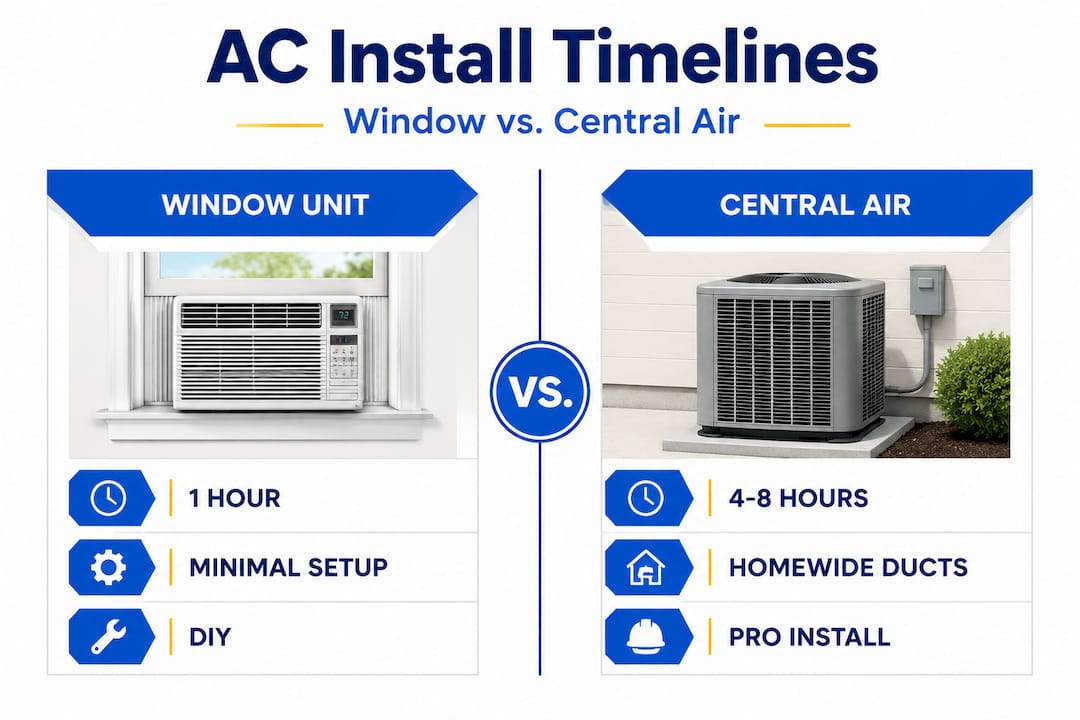
Type of system. A window unit takes an hour. A full central air system in a two-story home can take all day. The system type sets the floor and ceiling for your air conditioner installation time.
Home size. More square footage means more ductwork, more refrigerant line runs, and more time testing each zone. A 1,200-square-foot condo and a 3,500-square-foot house are completely different jobs, even if they're both getting the same brand of unit.
Existing infrastructure. If your home already has properly sized ducts, a working electrical panel with capacity to spare, and a clean installation site, things move fast. If ducts need repair, the panel needs an upgrade, or wiring needs to be run through walls, the time needed for AC installation grows significantly.
Site accessibility. Rooftop packaged units in Southern California are common, and they add time. Technicians need roof access, appropriate equipment to lift units, and extra safety steps. A rooftop installation can add one to two hours compared to a ground-level setup.
There are also less obvious factors worth knowing about:
- Number of indoor air handlers being installed (each adds time)
- Age and condition of the home's existing HVAC infrastructure
- Whether permits are required and inspections must be scheduled
- Distance between outdoor condenser and indoor air handler locations
Pro Tip: Before your technician arrives, ask specifically about your home's ductwork condition. Dirty, collapsed, or undersized ducts are among the most common hidden time-adders that contractors discover on-site. Knowing in advance lets you schedule the right amount of time.
If you're comparing HVAC replacement options in California, the system type you choose will have the biggest single impact on how long your installation day runs.
Typical installation timelines for different air conditioner types
Most single-family home AC replacements take four to eight hours, while window units can be installed in about one hour. Here's how the average AC install time breaks down by system type:
| AC system type | Typical installation time | Professional required? |
|---|---|---|
| Window unit | 30 minutes to 1 hour | Usually not |
| Mini-split (single zone) | 4 to 6 hours | Yes |
| Mini-split (multi-zone) | 6 to 10 hours | Yes |
| Central air (existing ducts) | 4 to 8 hours | Yes |
| Central air (new ductwork) | 1 to 3 days | Yes |
| Packaged rooftop unit | 4 to 8 hours | Yes |
A few things that extend the installing air conditioner duration beyond these ranges:
- Installing multiple mini-split zones in different rooms on the same day
- Upgrading electrical service at the same time as the AC installation
- Homes built before 1980 where ductwork may contain materials requiring special handling
- Unusual architectural features like vaulted ceilings or crawl spaces
Pro Tip: If you're installing a central air system in a Southern California home for the first time (no existing ducts), budget for two to three days. First-time duct installation is a substantial project and trying to rush it leads to airflow problems down the line.
For a closer look at what the stages of HVAC replacement look like from start to finish, that breakdown helps you match each phase to the overall timeline. You can also review what streamlining HVAC installation looks like for California homes to see how experienced contractors keep projects on schedule.
Preparing your home for air conditioner installation
Good preparation is the fastest way to shave unnecessary time off your installation. Asking your contractor what surfaces or systems may need rework is the best way to get a realistic installation time estimate before the crew shows up.
Here's a practical preparation checklist:
- Clear the installation areas. Move furniture, boxes, and valuables away from where the air handler will go and where the outdoor condenser will be placed. Technicians need at least three feet of clear working space in all directions.
- Check your electrical panel. Know whether your panel has available breaker slots and adequate amperage. If you're not sure, your contractor can assess this during a pre-installation walkthrough.
- Discuss ductwork condition beforehand. If your home is older or you've noticed uneven cooling in the past, mention it. Your contractor can inspect ducts ahead of time rather than discovering problems mid-job.
- Plan for pets and children. Technicians will be moving between indoor and outdoor spaces all day, leaving doors open repeatedly. It's worth arranging for pets to stay elsewhere on installation day.
- Confirm the full scope in writing. Before the day starts, you should have a written work order that specifies what's being installed, what existing equipment is being removed, and what, if any, electrical or duct work is included.
Additional prep steps that help on installation day:
- Mark any underground utilities or irrigation lines near where the outdoor unit will be placed
- Ensure the outdoor installation area has a clear path from the street or driveway for equipment delivery
- Identify and label your electrical panel's breakers so technicians can quickly find the right circuits
Pro Tip: Ask your contractor for a pre-installation walkthrough a day or two before the job. This is especially useful for AC installation in Hemet and surrounding areas where older homes sometimes have surprises inside the walls. A 30-minute walkthrough prevents a four-hour delay.
If you're dealing with an older system that's been showing problems, reviewing an air conditioner troubleshooting guide before your appointment helps you communicate those issues clearly to your technician.
What to expect on air conditioner installation day
Understanding the workflow helps you see why the air conditioning setup time ranges as much as it does. Most residential HVAC installations are a one- to two-day process, with removal followed by new system setup and then testing.
Here's what a typical full day of central air installation looks like:
- Old equipment removal (1 to 2 hours). Technicians disconnect and remove the existing system, recover refrigerant according to EPA regulations, and prepare the site for new equipment. This step takes longer when the old unit is in a tight space or when it's a rooftop installation.
- New unit placement and mounting (1 to 2 hours). The outdoor condenser and indoor air handler are positioned and secured. For rooftop units, this phase includes crane or lift equipment setup.
- Refrigerant line and electrical connections (1 to 2 hours). Copper lines are run between units, electrical wiring is connected, and the condensate drain is routed properly. This is precision work and cannot be rushed.
- System testing and calibration (1 to 2 hours). The system is charged with refrigerant, powered on, and run through a full test cycle. Technicians check airflow at every vent, verify thermostat communication, and confirm the system reaches target temperatures.
"Rushing the testing phase is the single most common reason homeowners call us back within 30 days of installation. If a contractor skips thorough calibration to finish faster, the system runs inefficiently or fails early. The testing phase is not optional."
Factors that push the timeline into a second day include needing related work like water heater or plumbing adjustments that affect the mechanical room layout, or discovering mid-job that ductwork needs repair before the new system can be commissioned properly.
Review the full HVAC installation process to see how each phase connects.
Common installation delays and how to avoid them
Accessibility issues like rooftop installations or hard-to-reach sites increase installation time significantly. But most delays are preventable.
Common causes of installation delays:
- Cluttered or blocked installation areas. Technicians can't install equipment they can't reach. Clearing space before day one is free and takes 20 minutes.
- Surprise duct or electrical repairs. These are the biggest culprits behind single-day jobs becoming two-day jobs. A pre-installation walkthrough catches most of these before the crew arrives.
- Permit delays. In many Southern California cities, HVAC installations require a permit. If your contractor pulls the permit and the city schedules an inspection before work can continue, your timeline shifts. Ask your contractor to pull permits well in advance.
- Wrong unit sizing. An improperly sized system may require a different electrical circuit than planned or fit differently than expected. Always confirm unit sizing through a Manual J load calculation before ordering equipment.
- Poor communication about scope. If the homeowner and contractor aren't aligned on what's included in the job, work stops while details get sorted out. Get it in writing first.
Pro Tip: Check with your city's building department website before scheduling installation. Some Southern California cities have longer permit processing times than others, particularly for larger system replacements. Knowing this ahead of time helps your contractor plan the job correctly.
For homeowners working through air conditioner repair considerations alongside a new installation, coordination between both scopes of work is worth discussing with your contractor before either job begins.
Why realistic expectations and good communication save you time on AC installs
Here's something most AC installation articles won't tell you: the timeline your contractor gives you on the phone is always optimistic. Not because contractors are careless, but because no contractor has seen the inside of your walls yet.
Asking specifically about what needs rework helps get the most accurate installation time forecast. But the homeowners who actually get that accurate forecast are the ones who walk the contractor through their home before the installation date, not on the morning of.
Every experienced HVAC technician has a story about showing up for what looked like a four-hour job and leaving 14 hours later because the attic access panel turned out to be in a closet behind built-in shelving, or because the panel had been upgraded incorrectly by a previous handyman. These things happen. The question is whether you find out the week before or the hour of.
The best thing you can do as a homeowner isn't to research installation timelines obsessively. It's to build a relationship with your contractor where honest communication goes both ways. You tell them about your home's quirks. They tell you what they actually expect to encounter, not just what you want to hear. Understanding what an HVAC contractor does and what information they need from you makes that conversation far more productive.
Being flexible with your schedule by a half day almost always results in a better installation than one rushed to hit an arbitrary end time.
Make your air conditioner installation easy with E320 Air
Planning an AC installation in Southern California doesn't have to feel like guesswork. E320 Air specializes in residential HVAC installations across the region, and we give every homeowner a clear, honest timeline before we schedule a crew.

Our technicians handle every phase from initial assessment through final system calibration, so you're never left wondering what's happening or how much longer the job will take. We pull permits, communicate scope in writing, and flag potential delays before they become your problem. If you're ready to move forward or just want an accurate estimate for your specific home, visit E320 Air to get started. You can also explore our professional HVAC installation services or browse our problem-solving project gallery to see how we've handled installs like yours.
Frequently asked questions
How long does it take to install a central air conditioner in a typical Southern California home?
Central air installation typically takes between 4 and 8 hours in a home with existing ductwork and adequate electrical connections already in place.
Why can installing an air conditioner take longer than a day sometimes?
If your home needs ductwork or electrical upgrades, or if the unit is in a difficult location like a rooftop, installation can stretch to two or even three days.
Can I install a window air conditioner myself quickly?
Yes. Window AC units typically take about one hour to install and don't require a licensed professional unless the unit is particularly heavy or the window configuration is unusual.
What can I do to help speed up the air conditioner installation process?
Clear the work areas before your technician arrives, discuss any known electrical or ductwork issues with your contractor ahead of time, and have a written scope of work confirmed so there are no on-the-spot decisions slowing things down.