
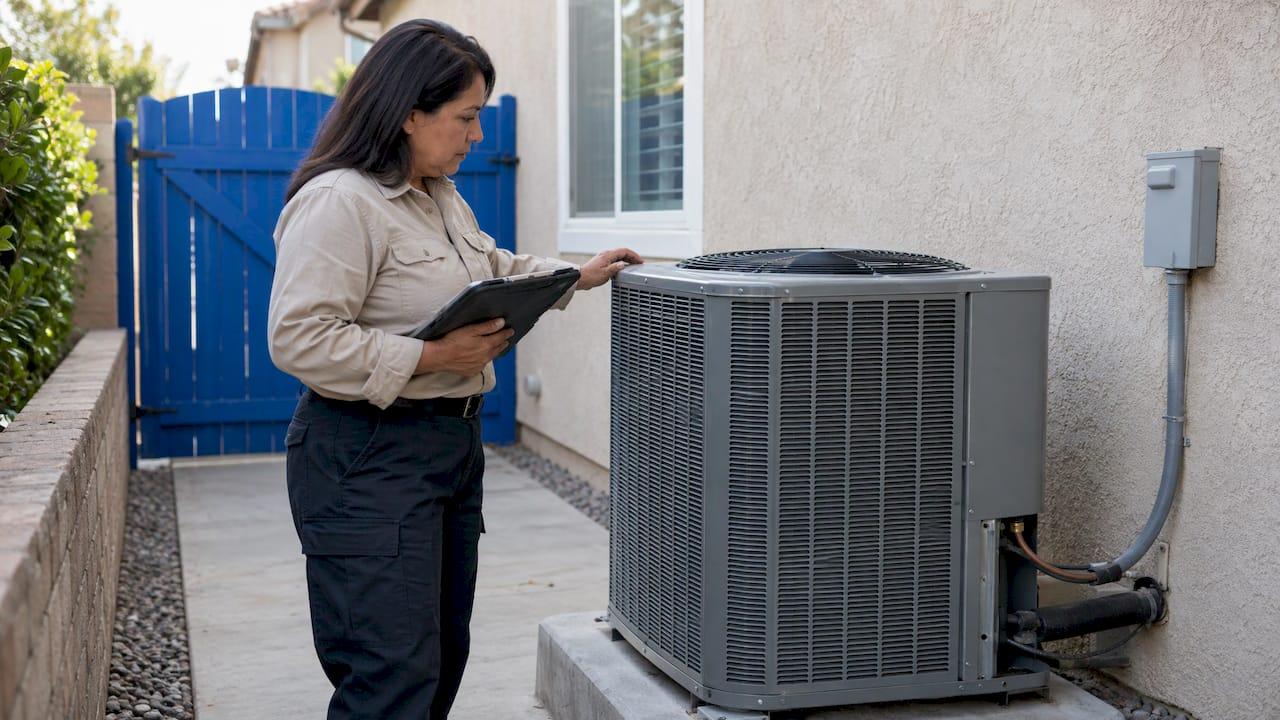
If you are replacing, adding or altering an air conditioner, furnace, heat pump or ductwork in Rancho Cucamonga, you need a mechanical permit from the city's Building & Safety division. The permit is applied for online, the work is inspected, and the city's fee schedule effective January 1, 2026 lists $249 for a residential package unit or split system. A licensed contractor who knows the local process makes this routine instead of a source of delays, and that is how we approach every installation.
This guide covers what work needs a permit, what is exempt, what it costs, how to apply, what inspectors look at, and what changes if your home is in a neighboring Inland Empire city.
TL;DR
- Installing, altering, repairing, replacing or remodeling a mechanical system needs a permit in Rancho Cucamonga, apart from a short list of exemptions such as portable units.
- The city's fee schedule effective January 1, 2026 lists $249 for a residential package or split system and $332 for a residential HVAC system. Fees are adjusted each July 1, so check the current schedule.
- Applications go through the Rancho Cucamonga Online Permit Center. Paper plans are not accepted, and plan review takes roughly 10 to 15 working days.
- Plans filed on or after January 1, 2026 are reviewed under the 2025 California codes and Energy Code.
- Every city has its own building department. Rules in Ontario, Fontana or Moreno Valley are not Rancho Cucamonga's rules.
Table of Contents
- When an HVAC job needs a permit in Rancho Cucamonga
- What the permit costs
- How to apply: the Online Permit Center
- Inspections: what happens after the permit is issued
- Which codes apply to your project in 2026
- Who is allowed to do the work
- What happens when work is done without a permit
- If you live outside Rancho Cucamonga
- A practical checklist before you sign
- Our perspective
- Plan your replacement with E320air
- FAQ
- Sources
When an HVAC job needs a permit in Rancho Cucamonga
The short answer: almost any real equipment work does. The California Mechanical Code requires a separate mechanical permit before you install, alter, repair, replace or remodel a mechanical system, except for the work listed in its exemption section.
Rancho Cucamonga backs that up locally. Chapter 15.12 of the city's Municipal Code makes it unlawful to alter, repair or replace regulated equipment in violation of the code. It also prohibits owning or maintaining an unpermitted system, which it defines to include any mechanical system altered, repaired or replaced without a required permit.
In practice, these jobs are permit jobs:
- Replacing a furnace, air handler, evaporator coil or outdoor condenser
- Installing a new central air conditioner, heat pump or ductless mini-split
- Adding, relocating or removing ductwork
- Moving equipment to a new location on the property
SoCalGas's HVAC guide lists the same kinds of work as ones that may need a building permit: new installation, change-out or replacement of the air handler, coil, furnace or condenser, relocation, removal, and adding ducting.
What is exempt
The Mechanical Code's exemptions are narrow. They include portable heating, ventilating or cooling appliances, portable evaporative coolers, closed piping inside equipment, and component replacement that does not alter the equipment's original approval. Refrigerating equipment that is part of equipment already permitted is also exempt.
Two points matter for homeowners. First, the exemptions do not permit work that violates other code provisions. Second, the code analysis notes that a component swap stops being exempt once it changes capacity, fuel type, controls or safety devices. A like-for-like part swap during a repair is one thing. A different-size condenser is another. If you are not sure which side your job falls on, ask your contractor to confirm with the city before work starts.
What the permit costs
Rancho Cucamonga's Master Fee Schedule, effective January 1, 2026, lists these mechanical permit fees:
| Item | Fee |
|---|---|
| Residential package unit or split system | $249 |
| Each additional package or split system | $166 |
| Residential HVAC system | $332 |
| Each additional system | $50 |
| Heating unit, compressor, evaporative cooler, ventilation system, vent fan or exhaust hood | $395 each |
| Ductwork only | $166 |
The same schedule sets an hourly rate of $166 for plan check, inspection and re-inspection. The city adjusts fees annually on July 1, and the code itself now says that permit fees are set by City Council resolution rather than listed in a fixed table. So treat these numbers as the figures published for fiscal year 2025-26 and confirm the current schedule on the city's website before you budget.
A permit fee is only one line of a replacement quote. Equipment, labor, duct work and any code-driven upgrades make up the rest. Our HVAC service price guide for California explains how those pieces add up.

How to apply: the Online Permit Center
Rancho Cucamonga has moved permitting online. The city's Building & Safety page states that all permits are applied for through the Rancho Cucamonga Online Permit Center, and that permits are issued only by email and through that center.
The city's electronic document review instructions lay out the sequence:
- Open the Online Permit Center, choose Building & Safety, then Create an Application.
- Upload plans as a single scaled, black-and-white PDF under 100 MB. Paper plans are not accepted.
- Staff contact the applicant within two business days about the intake fee.
- Plan review takes approximately 10 to 15 working days.
- Once the plans are approved, the permit is pulled and issued by email and through the portal.
For a straight equipment replacement, the plan set is usually modest: the application, the equipment details and the site information. Expect the application to ask for equipment manufacturer, model and efficiency ratings. Larger projects, such as a new system with new ductwork, take more paperwork.
The most common delay is not the city. It is an incomplete application, a PDF that does not meet the format rules, or an equipment spec that does not match what gets installed. Ask any contractor you hire who submits the application, who answers the city's questions, and who is present at the inspection.
Inspections: what happens after the permit is issued
A permit is not the finish line. All permitted work is inspected. The same SoCalGas guide notes that cities and counties inspect a sample of projects, checking code compliance, the performance of the permitted work and the submitted compliance documents.
In Rancho Cucamonga, the city offers next-day inspections for all permits, Monday through Thursday, 8 a.m. to 5 p.m., scheduled through your Online Permit Center account. For inspection questions, you can text (909) 303-1786 or call (909) 477-2710.
A standard replacement typically involves a final mechanical inspection. Jobs with new ductwork can add a rough-in inspection before the ducts are covered, and new gas piping may need a pressure test. Inspectors generally look for:
- Equipment installed as shown on the permit
- Gas connections, venting and flue termination done properly
- Required clearances around the outdoor unit and the air handler
- Electrical disconnects and safety devices in place
- Energy-compliance paperwork available
Plan for someone to be home, or for your contractor to be on site, when the inspector arrives. Keep your inspection sign-off and the final permit record. You will want them if you ever sell the home or file a warranty claim.
Which codes apply to your project in 2026
For plans filed on or after January 1, 2026, Rancho Cucamonga reviews them under the 2025 California codes: Building, Residential, Mechanical, Electrical and Plumbing, plus CalGreen and the 2025 California Energy Code.
The Energy Code is the one homeowners feel most. The California Energy Commission states that buildings with permit applications submitted on or after January 1, 2026 must comply with the 2025 Energy Code, which expands heat pump use in new homes and strengthens ventilation standards.
For an existing home, the practical effect is that a changeout usually triggers Title 24 energy-compliance paperwork, and sometimes a third-party verification of the installation. That is part of the permit process, not an extra. We explain the details in our guide to California Title 24 HVAC requirements, and our 2026 HVAC efficiency standards guide covers how the new ratings affect which equipment you can choose.
Who is allowed to do the work
HVAC installation in California is trade work regulated by the state. SoCalGas notes that licensed contractors have at least four years of trade experience, have passed law and trade exams, carry a contractor's bond, and are regulated by the Contractors State License Board. The same guide says that hiring a licensed contractor who obtains the required permit and follows local codes and Title 24 increases the likelihood that the system is installed properly and runs efficiently.
For a homeowner, landlord or property manager, the working rule is simple. Hire a licensed, insured contractor, and get it in writing who is responsible for the permit, the inspection and the compliance paperwork. Our technicians are licensed and insured, and we install and repair all major brands. You can read more about how a typical job flows in our HVAC installation workflow for California homes.
What happens when work is done without a permit
Skipping the permit does not make the requirement disappear. Under the city's code, an unpermitted mechanical system is itself a violation, and that status stays with the property. It tends to surface at the worst moment: a home sale, a refinance or an insurance claim. Buyers' inspectors and lenders ask for permit records, and unpermitted work can complicate a closing, as this overview of selling a house with unpermitted work shows.
There is also a performance side. A system that never had its installation checked may have gas, venting or duct problems nobody has seen. A permitted and inspected job gives you a record that the work met code on the day it was finished.
If you live outside Rancho Cucamonga
Incorporated cities run their own building departments. The Rancho Cucamonga process above applies to homes inside the city. Properties in unincorporated county areas follow county rules, and a home in a neighboring city follows that city's rules.
Ontario is a good example of how details differ. Its Building Permit FAQs say portable cooling equipment needs no permit, gas piping beyond a very short connection needs a plumbing permit, and all permitted work goes through successive inspections with a final at completion. Its fee page lists a $47.50 minimum for any permit and plan check fees at 80% of permit fees. Those are Ontario numbers, not Rancho Cucamonga numbers.
If your home is in Moreno Valley, see our Moreno Valley HVAC permit checklist. For a general overview that applies across California, read what an HVAC permit requirement means for homeowners. We serve homeowners, landlords, property managers and business owners across the Inland Empire, so ask us about your city before you plan the project.
A practical checklist before you sign
- Confirm your contractor is licensed and insured.
- Ask who submits the Online Permit Center application and who handles the city's questions.
- Ask which inspections your job will need, and who will be on site for each.
- Make sure the quote lists the equipment make, model and efficiency rating, since the application asks for them.
- Ask how Title 24 paperwork is handled.
- Keep the final inspection record with your home files.
Our perspective
We install and repair systems across the Inland Empire, and the permit is part of the job, not an obstacle to it. A homeowner whose AC fails in July wants cool air fast, and that is the moment shortcuts look tempting. They are not worth it. An inspected installation protects your warranty position, your resale file and your safety.
Our approach is to treat code compliance as part of delivering a system that works well. We are licensed and insured, we work with all major brands, and we aim for transparent service with as little disruption to your household or business as possible. If you need equipment sized and chosen for California's efficiency rules, we can walk you through the options. Our equipment buying guide is a good place to start.
Because we are available around the clock, including weekends and holidays, an emergency does not have to mean a rushed decision. We can get you comfortable first and then plan the replacement properly.
Edward
Plan your replacement with E320air
If your system is failing or you are planning an upgrade, we handle residential and commercial HVAC repairs, maintenance, equipment sales, upgrades and installations. Our technicians are licensed and insured, we cover all major brands, and flexible payment options, including financing, are available.

To plan a replacement, start with our HVAC installation service. If the heat is out, see our heater repair page. Business owners can go to our commercial HVAC page.
FAQ
Do I need a permit to replace a furnace in Rancho Cucamonga?
Yes. Replacing a furnace is mechanical work, and the California Mechanical Code requires a permit for installing or replacing a mechanical system. Rancho Cucamonga's code also treats a system replaced without a required permit as an unpermitted system. The work is then inspected before it is signed off.
How much does an HVAC permit cost in Rancho Cucamonga?
The city's fee schedule effective January 1, 2026 lists $249 for a residential package unit or split system and $332 for a residential HVAC system. Ductwork alone is $166. Fees are adjusted each July 1, so confirm the current schedule with the city.
How long does it take to get a permit?
The city says plan review takes approximately 10 to 15 working days after you submit through the Online Permit Center. Staff contact the applicant within two business days about the intake fee. Once work is complete, inspections can be scheduled for the next day on Monday through Thursday.
Can I use the same rules in Fontana, Ontario or Riverside?
No. Each incorporated city sets its own permit process and fees. Ontario, for example, publishes its own minimum permit fee and plan check percentage. Check with your city's building department, or ask your contractor, before the project begins.
Sources
- California Mechanical Code: permit requirements and exemptions
- Rancho Cucamonga Municipal Code Chapter 15.12: Building Code
- SoCalGas guide for HVAC systems
- Rancho Cucamonga Master Fee Schedule, effective January 1, 2026
- Rancho Cucamonga Municipal Code Chapter 15.16: Mechanical Code
- Rancho Cucamonga EDR submittal process
- City of Rancho Cucamonga Building & Safety
- Rancho Cucamonga applicable codes
- California Energy Commission: 2025 Building Energy Efficiency Standards
- Selling a house with unpermitted work
- City of Ontario Building Permit FAQs
- City of Ontario Building Department Fees